
Why Are Budget Backpackers And Luxury Seekers In Cape Verde Transforming Global Travel Trends And Redefining Island Tourism Economics?
Why Are Budget Backpackers And Luxury Seekers In Cape Verde Transforming Global Travel Trends And Redefining Island Tourism Economics?

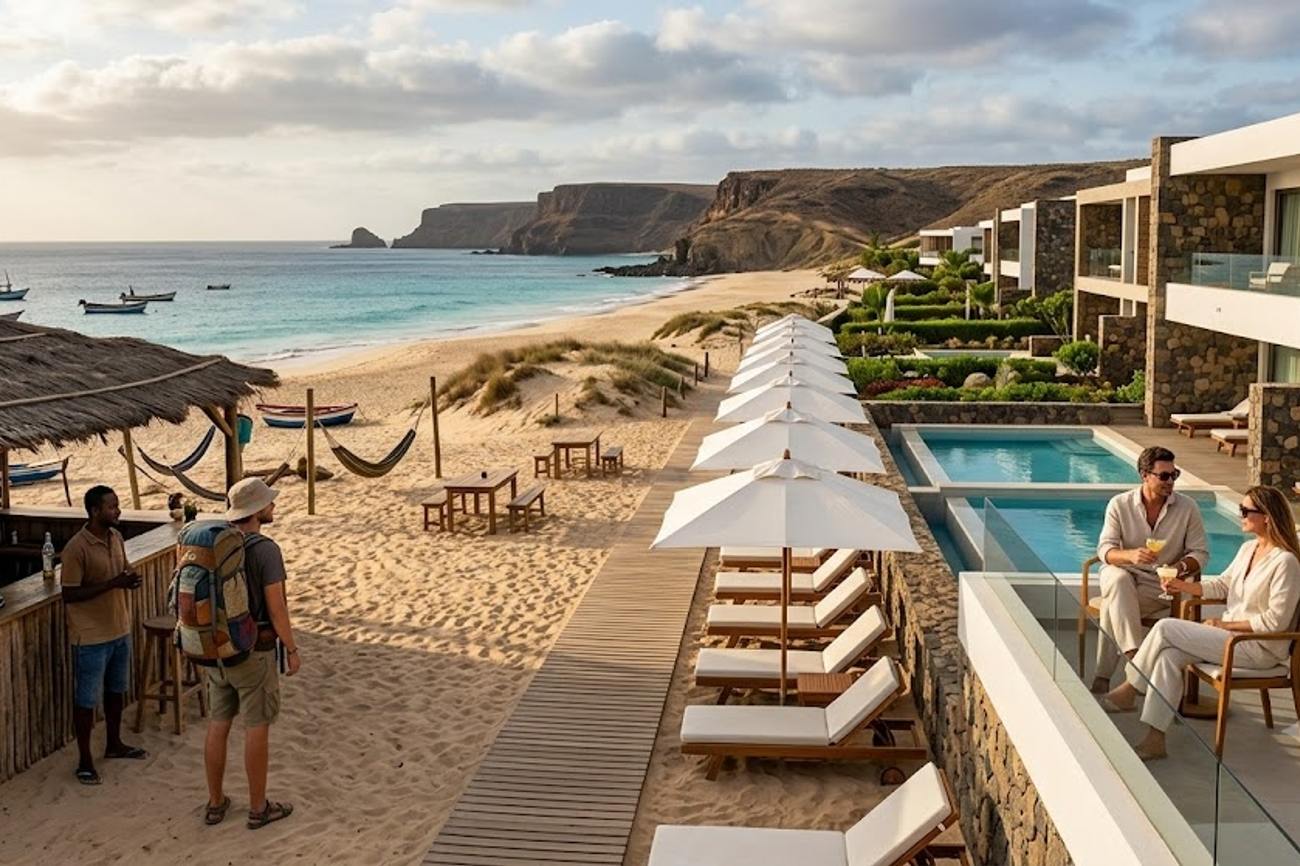
Image generated by AI
[Praia, October 2023] — Cape Verde is facing a critical economic divergence as a surge in international tourism drives nearly 44.9% of the nation's GDP while simultaneously deepening internal wealth inequality. The West African archipelago is currently navigating a transition toward aggressive growth targets, aiming for 3.15 million annual arrivals by 2030, but officials warn that the current "all-inclusive" model is siphoning profits away from local communities.
The crisis centers on a systemic "economic leakage" where foreign-owned corporate entities control the vast majority of the tourism pipeline. Current data reveals that 87.1% of foreign visits are managed via external package providers, creating a gated ecosystem that isolates travelers from the domestic economy. While the Government of Cape Verde seeks to leverage this growth to create 30,000 new jobs and generate CVE 4.4 billion (approximately $47 million) in tax revenue, the actual financial benefit to resident islanders remains constrained.
The All-Inclusive Leakage Trigger
The primary driver of this economic imbalance is the dominance of the "arm's length" economy. High-volume tourism strategies, particularly on the islands of Sal and Boa Vista, rely on self-contained resort complexes. These entities operate as closed loops; guests arrive via package deals, stay within gated perimeters, and consume imported goods and services.
Because these external corporations manage the bookings, logistics, and hospitality, a substantial portion of traveler spending never enters the local circulation. This creates a paradox where macroeconomic indicators show rapid expansion, but municipal districts and local artisans see negligible monetary gains. To combat this, policy advisors are now pushing for statutory directives that would make operating permits contingent upon:
- Mandatory procurement of food from domestic agricultural suppliers.
- Strict quotas for the employment of local residents.
- Rigorous protocols for freshwater management to protect island resources.
Markets and Regions Impacted
The impact of this dual-track tourism economy varies wildly depending on the island and the traveler profile. The following table breaks down the current operational divide:
| Region/Island | Primary Traveler Profile | Economic Model | Local Impact |
|---|---|---|---|
| Sal & Boa Vista | High-end resort seekers / Package tourists | Corporate Gated / All-Inclusive | Low direct income for local merchants |
| Santo Antão | Independent backpackers / Explorers | Decentralized / Budget-driven | High direct support for family businesses |
| São Vicente | Cultural tourists / Independent travelers | Community-based / Localized | Direct funding for indigenous eateries |
| Santiago | Heritage seekers / Independent travelers | Decentralized / Localized | Direct support for family-run guesthouses |
Data shows that the average length of stay for visitors is 8.7 days, with daily expenditures averaging 9,014 escudos (roughly €82). However, in the resort-heavy islands, this spending is largely captured by international firms, whereas in the mountainous and cultural hubs, it flows directly to the residents.
What This Means for Travelers
For the modern traveler, the current state of Cape Verde represents a choice between two entirely different experiences with vastly different ethical footprints.
If you book an all-inclusive package: You will likely remain within a controlled environment. While this offers convenience and luxury, your financial contribution to the actual people of Cape Verde is minimal. You are participating in a system that contributes to national GDP figures but may exacerbate local inequality.
If you travel independently: By opting for family-run guesthouses, utilizing local minibuses, and taking public island ferries, you are engaging in "positive impact tourism." Your spending directly empowers neighborhood families and supports the survival of indigenous businesses. This route offers a more authentic cultural immersion but requires more logistical planning.
Travelers are encouraged to verify the sustainability practices of their chosen providers. The World Tourism Organization (UNWTO) emphasizes that shifting toward regional business ecosystems is the most effective way for tourists to reduce their negative environmental and social footprints.
The Path to 2030
As Cape Verde pushes toward its 2030 goal of 3.15 million arrivals, the government and regional tourism boards are under pressure to restructure the industry. The goal is to move away from a volume-only strategy and toward a value-based model that prioritizes equitable labor standards and ecological conservation.
The next phase of development, projected through 2024 and 2025, will likely see a tightening of regulations for global resort chains. If the proposed policy transformations are enacted, international hotel brands will be forced to integrate municipal artisans and domestic farmers into their supply chains. This shift would transform the tourism sector from a source of leakage into a genuine engine for self-sustaining financial stability for the archipelago's residents.
FAQ: Cape Verde Tourism 2024
How does my choice of accommodation affect the local economy? Staying in gated resorts often means your money goes to foreign corporations. Choosing family-run guesthouses in regions like Santo Antão or Santiago ensures your funds stay within the community, directly supporting local families and small businesses.
What is the average cost of a trip to Cape Verde? Current data indicates an average daily expenditure of 9,014 escudos (approximately €82) per visitor. This varies significantly between luxury all-inclusive packages and budget-conscious independent travel.
Which islands are best for authentic cultural experiences? While Sal and Boa Vista are geared toward beach luxury, Santo Antão, São Vicente, and Santiago offer deeper cultural immersion and more opportunities to interact with the local population and economy.
Are there government efforts to make tourism more equitable? Yes. Policy advisors are proposing new laws that would require resorts to hire local staff and buy food from domestic farmers as a condition of their operating permits.
The archipelago stands at a crossroads between corporate isolation and community empowerment.
#CapeVerde2030 #SalIsland #BoaVista #SantoAntao #TourismLeakage #WestAfricaTravel
Related Travel Guides
- How is South Korea Using K-Culture to Revitalize Tourism Beyond Seoul
- Minneapolis-Saint Paul Stands Alongside Detroit Metropolitan and Others as North America’s Top Airports Enter a New Era of Excellence
- How Are Smart International Travel Brands Completely Rethinking Their Growth Plans To Welcome Africa, All You Need To Know
Disclaimer
This article is for informational and educational purposes only. It does not constitute legal, financial, or professional advice. While we strive to provide accurate and up-to-date information, travel policies, regulations, and conditions change rapidly. Always verify information with official sources before making travel decisions. Nomad Lawyer makes no representations about the accuracy, reliability, completeness, or suitability of the information provided. Readers should consult qualified professionals for advice specific to their circumstances. The views expressed in this article are those of the author and do not necessarily reflect the views of Nomad Lawyer.
Naina Thakur
Contributor & Travel Specialist
Travel enthusiast and legal writer covering visa regulations, responsible tourism, and cultural journeys across global destinations.
Learn more about our team →