
Minneapolis-Saint Paul Stands Alongside Detroit Metropolitan and Others as North America’s Top Airports Enter a New Era of Excellence
Minneapolis-Saint Paul Stands Alongside Detroit Metropolitan and Others as North America’s Top Airports Enter a New Era of Excellence

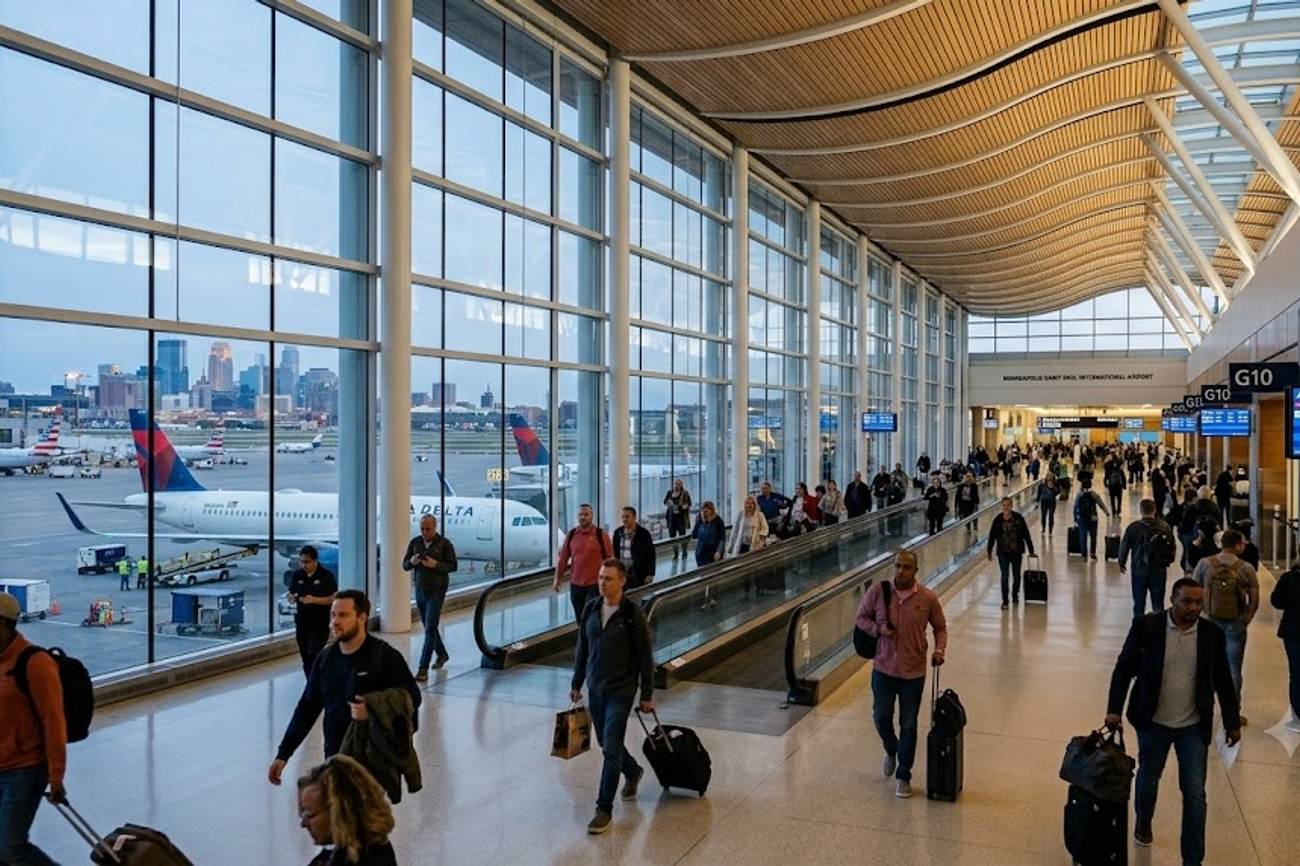
Image generated by AI
Analysis by: Travel Industry Trend Analyst | nomadlawyer.org Date: October 2023 Focus: North American Aviation Infrastructure & Passenger Sentiment
Passenger satisfaction scores across North American medium-sized airports have surged by 16 points on a 1,000-point scale, outstripping the gains seen in mega airports (14 points) and large airports (13 points). This divergence indicates that while massive capital expenditures are being deployed across the continent, smaller-scale hubs are currently more effective at converting infrastructure spend into tangible passenger approval. This shift comes at a time when global air travel demand is hitting record peaks, putting unprecedented pressure on terminal capacity and ground operations.
The Infrastructure ROI in Numbers
The correlation between capital expenditure and passenger sentiment is becoming clearer, though the data suggests a diminishing return on "budget size" alone. Between mid-2025 and mid-2026, a study of 24,000 passengers across the United States and Canada revealed that strategic modernization—rather than sheer spending—is the primary driver of satisfaction.
The current leaders in the "Mega Airport" category demonstrate the impact of targeted terminal upgrades. Minneapolis-Saint Paul International Airport leads this segment with a score of 684, followed by Detroit Metropolitan Wayne County Airport at 663 and Phoenix Sky Harbor International Airport at 642. The success at Minneapolis-Saint Paul is directly attributed to a modernization program focusing on high-utility passenger needs: upgraded seating, expanded charging infrastructure, and enhanced lighting.
In the "Large" and "Medium" categories, the scores are notably higher, suggesting that smaller footprints are easier to optimize for the passenger journey. Tampa International Airport leads the Large category with 715 points, while Charleston International Airport tops the Medium category with 712 points.
Comparative Satisfaction Benchmarks
When analyzing the data, a pattern emerges: the smaller the airport category, the higher the absolute satisfaction score. This suggests that "Mega" hubs struggle with the sheer volume of passengers, which can negate the benefits of new construction. According to data from the International Air Transport Association (IATA), managing passenger flow in high-density hubs remains the industry's primary bottleneck.
The following table breaks down the current satisfaction leaders by airport classification:
| Airport Category | Top Performer | Score (1,000 pt scale) | Second Place | Score | Third Place | Score |
|---|---|---|---|---|---|---|
| Mega | Minneapolis-St. Paul | 684 | Detroit Metropolitan | 663 | Phoenix Sky Harbor | 642 |
| Large | Tampa International | 715 | Portland International | 708 | Dallas Love Field | 698 |
| Medium | Charleston Intl. | 712 | Ontario International | 705 | Indianapolis Intl. | 695 |
This distribution shows a 31-point gap between the top Mega airport and the top Large airport, highlighting a systemic struggle in the largest hubs to maintain a "human-centric" experience despite billions in investment.
What This Means for Travelers
For the individual traveler, these data points signal a shift in how you should plan your transit and layovers. The industry is moving away from "monolithic" terminal design toward "experience-based" hubs.
- Prioritize "Large" and "Medium" Hubs for Connections: If you have a choice between a Mega hub (like MSP or DTW) and a Large hub (like Tampa or Portland) for a connection, the data suggests you will encounter significantly higher levels of comfort and efficiency in the smaller facilities.
- Expect "Construction Friction" in Q4: As airports rush to complete these multi-billion dollar projects to meet record demand, temporary walkways and closed retail zones remain common. If you are flying through a hub currently undergoing "modernization," add 20-30 minutes to your terminal transit time.
- Leverage Digital Wayfinding: The airports scoring highest are those integrating real-time updates and digital displays. Travelers should rely on airport-specific apps over generic maps, as the highest-rated airports are currently prioritizing "connected" passenger journeys.
- Budget for Higher Terminal Spend: With the rise of "local identity" dining and retail, airport spending is no longer just about convenience. The trend toward regional businesses means higher-quality options are available, but often at a premium price point compared to standard airport fast food.
The Shift Toward "Sense of Place" and Revenue
The data indicates a strategic pivot in airport management: the transition from being a "transportation utility" to a "destination gateway." This is not merely an aesthetic choice but a commercial strategy. There is a direct linear correlation between passenger satisfaction and non-aeronautical revenue.
Travelers who rate their experience as "excellent" demonstrate a significantly higher propensity to spend on food, beverage, and retail than those who rate their experience as "average." By integrating local architecture and regional brands, airports are reducing "travel stress," which in turn opens the passenger's wallet.
This mirrors broader trends reported by Statista regarding the growth of the global airport retail market. When a passenger feels relaxed due to efficient wayfinding and comfortable seating, their dwell time increases, and their willingness to engage with retail offerings rises. The current focus on "local identity" is a calculated move to increase the average transaction value per passenger.
Forward Projection: The 2027 Outlook
Based on the current trajectory of satisfaction gains (13-16 points), we can project that the "experience gap" between Mega and Medium airports will persist unless Mega hubs shift their focus from "capacity expansion" to "flow optimization."
The next phase of investment will likely move beyond physical structures into AI-driven passenger management. We expect to see a surge in biometric integration to solve the "volume problem" mentioned in the research. If the industry cannot manage the record-setting travel demand through better flow, the current gains in satisfaction will be erased by the frustration of longer security queues and boarding delays.
Furthermore, the integration of regional businesses will likely expand. We will see airports competing not just on flight schedules, but on the quality of their "curated" retail environments, effectively turning terminals into high-end shopping malls that happen to have runways.
FAQ: North American Airport Trends 2026
Will airport ticket prices increase due to these multi-billion dollar upgrades? While airports generate revenue from landing fees and retail, most modernization is funded through airport improvement bonds and private investment. However, increased "passenger facility charges" (PFCs) are often embedded in ticket prices to recoup these costs.
Is now a good time to book flights through major hubs? Yes, but with caution. While satisfaction is rising, the "construction friction" mentioned in the data is still prevalent. If you are using a hub like Minneapolis-St. Paul, check current terminal maps for temporary closures before arriving.
Which airport categories are currently providing the best experience? Medium-sized airports are the current leaders in satisfaction growth (16 points) and overall scores (Charleston leading at 712), offering a better balance of efficiency and comfort than Mega hubs.
Why are airports adding more local restaurants instead of global chains? Data shows that "sense of place" increases passenger satisfaction. Satisfied, relaxed passengers spend more money, making local, high-quality offerings a more profitable long-term strategy than generic food courts.
The era of the sterile terminal is ending; the era of the curated gateway has arrived.
Tags: North American Aviation 2026, Airport Passenger Satisfaction Metrics, MSP Airport Modernization, Infrastructure ROI Aviation, Terminal Experience Data, Hub Capacity Trends
Related Travel Guides
- How Are Smart International Travel Brands Completely Rethinking Their Growth Plans To Welcome Africa, All You Need To Know
- Sangster International Airport and Jamaica Gateways Expand Lounges and Terminal Facilities for Autumn Travel 2026
- Italy Builds New Tourism Opportunities Around Lazio Borghi Walking Routes and Local Experiences With 16.3% Online Booking Growth
Disclaimer
This article is for informational and educational purposes only. It does not constitute legal, financial, or professional advice. While we strive to provide accurate and up-to-date information, travel policies, regulations, and conditions change rapidly. Always verify information with official sources before making travel decisions. Nomad Lawyer makes no representations about the accuracy, reliability, completeness, or suitability of the information provided. Readers should consult qualified professionals for advice specific to their circumstances. The views expressed in this article are those of the author and do not necessarily reflect the views of Nomad Lawyer.
Kunal K Choudhary
Co-Founder & Contributor
A passionate traveller and tech enthusiast. Kunal contributes to the vision and growth of Nomad Lawyer, bringing fresh perspectives and driving the community forward.
Learn more about our team →