Texas Cruise Market Shift: Why 76 Percent of Travellers Choose Human Advisors Over Digital Booking Engines

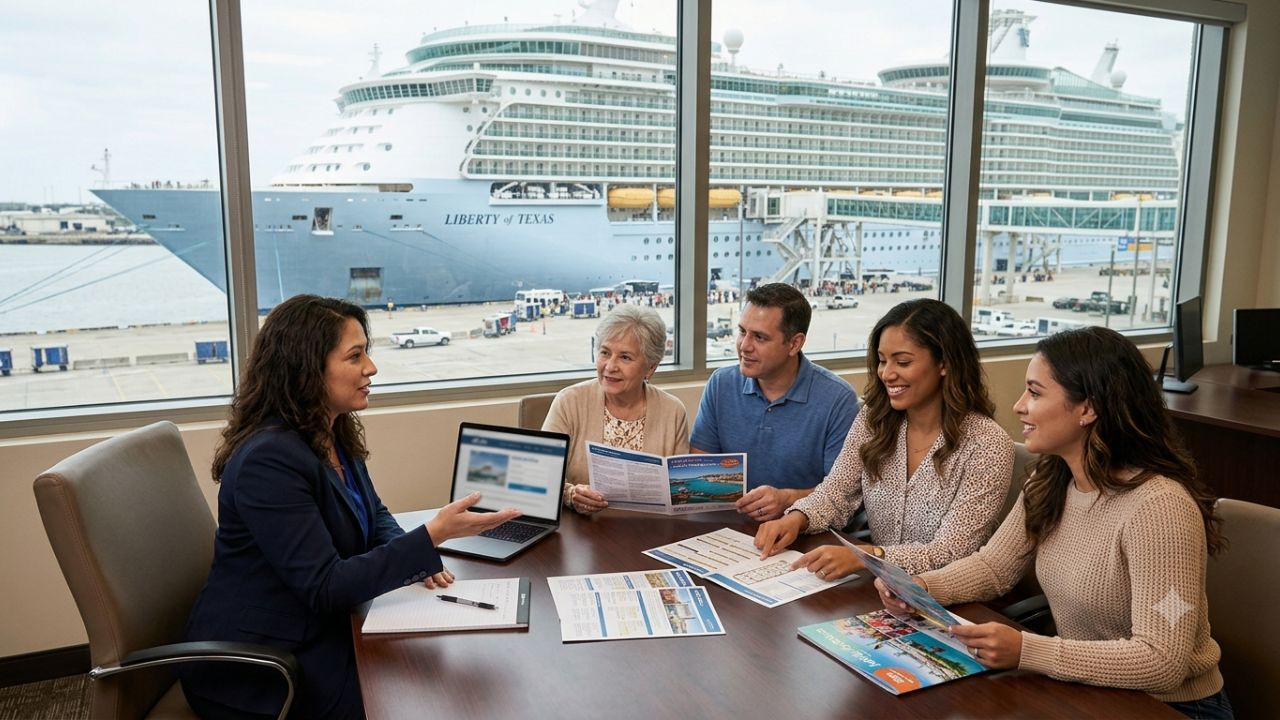
GALVESTON / HOUSTON — In an era dominated by automated digital checkout funnels and self-service mobile applications, the maritime cruise industry across Texas stands as a remarkable distribution anomaly, with human travel advisors commanding 76 percent of total booking revenue compared to just 24 percent for digital platforms. As passenger volumes surge through the Port of Galveston—the fourth busiest cruise gateway in the United States—travellers throughout metropolitan hubs including Houston, Dallas-Fort Worth, Austin, and San Antonio are systematically bypassing algorithm-driven online travel agencies (OTAs). Instead, they are turning to professional travel advisors, specialized brokerage firms, and consortium-affiliated agencies to manage their maritime holidays.
This consumer preference highlights a fundamental economic reality: cruising is not a standardized commodity. Unlike point-to-point domestic airline flights or single-night hotel stays, a modern cruise represents a multi-variable financial commitment that routinely ranges from $3,000 for a modest family voyage to well over $15,000 for high-tier suites and extended itineraries. The architectural complexity of floating mega-resorts, combined with dynamic pricing structures, complex cancellation penalty schedules, and multi-generational family logistics, creates a high-stakes environment where the cold efficiency of a digital checkout button fails to provide peace of mind. As Texas maritime tourism delivers more than $2.4 billion in annual economic output and sustains 9,500 regional jobs, the enduring supremacy of human advisors demonstrates that complexity breeds an essential demand for human advocacy.
          TEXAS CRUISE BOOKING DISTRIBUTION ARCHITECTURE (2026)
          ======================================================

          TOTAL REGIONAL CRUISE BOOKING REVENUE
          [==================================================] 100%
                                   |
         +-------------------------+-------------------------+
         |                                                   |
         v                                                   v
  [ HUMAN ADVISORS & OFFLINE ]                       [ DIGITAL SELF-SERVICE ]
  Market Share: 76%                                  Market Share: 24%
  * Brick-and-Mortar Agencies                        * Direct Cruise Line Websites
  * Host Agency Independent Advisors                 * Online Travel Agencies (OTAs)
  * Specialized Phone Brokerages                     * Mobile Booking Applications
  * Consortia Buying Power (Virtuoso, Signature)     * Generic Automated Checkouts
  * Fiduciary Advocacy & Disruption Defense          * Automated Call-Center Queues
         |                                                   |
         +-------------------------+-------------------------+
                                   |
                     [ PORT OF GALVESTON HOMEPORT ]
                     * 4th Busiest US Cruise Port
                     * $2.4 Billion Regional Economic Impact
                     * 38% Multi-Generational Family Sailings
                     * 2.6 Nights Average Pre-Cruise Hotel Stay
The 76/24 Distribution Divide: Why Cruise Sales Resist Pure Automation
Across the broader global travel and tourism landscape, digital transformation has steadily eroded traditional retail distribution channels. Modern consumers routinely purchase transcontinental airline seats, reserve rental cars, and book boutique city hotels directly through smartphone applications without speaking to a human representative. Yet within the maritime cruise sector, this digital transition has hit a structural ceiling.
Industry performance metrics across the Gulf Coast maritime corridor confirm that approximately 76 percent of all cruise vacations originating from Texas homeports are booked through traditional, offline, or human-assisted channels. These encompass established brick-and-mortar storefront agencies, home-based independent contractors affiliated with major host agencies, and high-touch telephone brokerages. Pure self-service digital web engines and mobile booking applications capture only 24 percent of gross booking volume, functioning primarily as research and price-checking portals rather than final transaction funnels.
The underlying cause of this market resistance lies in the sheer architectural density of modern passenger ships. A commercial airliner presents a relatively simple seating configuration divided into basic economy, premium economy, business, and first class. A downtown commercial hotel generally categorizes inventory by bed type, square footage, and exterior view. In sharp contrast, a contemporary mega-ship—such as Carnival Cruise Line's Excel-class vessels or Royal Caribbean International’s Oasis- and Icon-class ships operating out of Galveston—functions as a floating vertical city containing dozens of distinct stateroom categories spread across fifteen to twenty passenger decks.
TEXAS CRUISE MARKET DISTRIBUTION MATRIX 2026
| Entity / Facility | Delays | Cancellations | Details |
|---|---|---|---|
| Distribution Channel | Market Share | Core Demographic | Primary Value Driver |
| Human Travel Advisor | 76% of Revenue | Families, Affluent, | Total-cost clarity, |
| (Offline / Assisted) | Groups, Boomers | cabin curation, defense | |
| Digital Self-Service | 24% of Revenue | Solo, Young Pairs, | Simple short hops, |
| (OTAs / Apps) | Budget Bargains | perceived speed | |
| Consortia Affiliation | ~62% of Agents | Virtuoso, Signature | Exclusive OBC, group |
| Ensemble Networks | blocks, dining perks | ||
| Multi-Generational | 38% of Departures | 3-Generation Texas | Complex multi-cabin |
| Family Sailings | Extended Families | seating synchronization |
Micro-location variables aboard a 6,000-passenger vessel introduce significant financial and experiential risk for unassisted consumers. Staterooms within the exact same brochure category can feature radically divergent living conditions depending on their physical position relative to shipboard infrastructure:
- Cabins situated directly beneath the lido deck buffet or late-night nightclub suffer from overhead mechanical cleaning noise, moving deck chairs, and bass vibration.
- Staterooms positioned directly above the ship's forward anchor winches or aft mooring machinery experience severe acoustic disruption during early morning docking maneuvers.
- Obstructed-view balconies partially blocked by fiberglass lifeboats, structural steel maintenance davits, or exterior window-washing rigs can diminish the value of a high-ticket veranda booking.
- Midship cabins close to central elevator elevator lobbies provide stability for travelers prone to motion sickness, whereas extreme forward or aft cabins experience heightened pitch and heave during rough sea states in the Gulf of Mexico.
Human travel advisors maintain proprietary cabin inventory charts, deck plan schematics, and personal inspection histories. By steering clients toward optimal stateroom placements and away from noisy mechanical bulkheads, professional advisors eliminate the costly trial-and-error risks inherent in automated digital checkout grids.
The Total-Cost Equation: Unmasking Hidden Fees and Dynamic Pricing Traps
The advertised lead-in fare of a contemporary cruise represents one of the most deceptive marketing constructs in the travel industry. Online travel agencies and search engine algorithms intentionally highlight stripped-down base rates to capture consumer click-through traffic. However, these promotional prices exclude mandatory government charges, operational fees, and essential onboard amenities, creating a financial trap for unsuspecting digital shoppers.
A family from Dallas or Austin viewing an online promotion for a seven-night Western Caribbean cruise might see an enticing advertised rate of $699 per person. Yet when the transaction advances through the digital checkout funnel, mandatory port expenses, terminal handling fees, and government taxes routinely add $180 to $260 per guest. In addition, standard mass-market cruise lines enforce daily hotel service charges (onboard gratuities) ranging from $16.00 to $20.50 per person per day depending on stateroom classification, adding another $224 to $287 for a couple over a one-week sailing.
HIDDEN EXPENSE AUDIT: 7-NIGHT CARIBBEAN CRUISE FROM GALVESTON
| Entity / Facility | Delays | Cancellations | Details |
|---|---|---|---|
| Cost Component | Advertised Online | True Realized Cost | Budget Distortion |
| Lead-in Cabin Fare | $699.00 / person | $1,398.00 (Couple) | Baseline advertised |
| Port Taxes & Levies | Omitted initially | $380.00 to $520.00 | Mandatory government |
| Daily Service Grats | Excluded at check | $224.00 to $287.00 | Automatic room debit |
| Beverage Package | Excluded ($0 shown) | $950.00 to $1,250 | ~$65–$85/day + 18% tip |
| Satellite Wi-Fi (2) | Excluded ($0 shown) | $280.00 to $390.00 | Essential connectivity |
| Specialty Dining (2) | Excluded ($0 shown) | $180.00 to $240.00 | Premium dining covers |
| Real Couple Outlay | $1,398.00 (Apparent | $3,412.00 to $4,085 | +144% above headline |
When discretionary but practically unavoidable onboard amenities—such as high-speed Starlink satellite Wi-Fi packages, beverage packages, and specialty restaurant reservations—are factored in, the true out-of-pocket expenditure routinely swells to more than 140 percent of the original online estimate.
Professional travel advisors deliver immediate total-cost transparency. Rather than allowing clients to experience onboard bill shock, experienced advisors conduct comprehensive financial comparative audits. By evaluating mass-market cruise options against premium and upscale brands—such as Celebrity Cruises, Princess Cruises, or Holland America Line—advisors frequently demonstrate that premium lines featuring bundled pricing (where Wi-Fi, beverage packages, and gratuities are incorporated into the base contract) deliver superior net financial value compared to stripped-down mass-market alternatives.
Consortia Clout: Group Blocks, Onboard Credits, and Loyalty Stacking
A major economic engine driving the dominance of human advisors across Texas is that booking through a professional agent is often measurably cheaper and more rewarding than booking directly through a cruise line's proprietary website. This pricing advantage stems from the corporate architecture of global travel consortia.
The majority of high-producing travel agencies in Texas maintain affiliations with elite international travel networks, including Virtuoso, Signature Travel Network, and Ensemble Travel Group. These consortia function as collective bargaining syndicates, pooling billions of dollars in annual leisure travel purchasing power to negotiate preferred commercial agreements with global cruise operators.
       CONSORTIA PURCHASING ARCHITECTURE AND CONSUMER VALUE-ADD
       ========================================================

       [ GLOBAL TRAVEL CONSORTIA ]
       (Virtuoso, Signature Travel Network, Ensemble)
       Multi-Billion-Dollar Collective Purchasing Clout
                                |
                                v
       [ ADVANCE SPECULATIVE GROUP BLOCKS ]
       Secured 18 to 24 Months Prior to Departure
       * Group Tier Rates Locked Below Future Public Inflation
       * Guaranteed Stateroom Allocations on Peak Holiday Sailings
                                |
                                v
       [ EXCLUSIVE VALUE-ADD PACKAGES ]
       * $100 to $600 Complimentary Onboard Spending Credit (OBC)
       * Prepaid Shipboard Gratuities Covered by Consortium
       * Complimentary Specialty Dining Experiences & Wine Amenities
       * Private Hosted Cocktail Receptions & Bespoke Shore Excursions
                                |
                                v
       [ LOYALTY STACKING SOFTWARE ]
       Advisors Combine Cruise Line Loyalty Tiers (Crown & Anchor, VIFP)
       with Consortium Amenities ===> Superior Double-Dip Financial Return
Through these consortium agreements, agencies secure advance speculative group blocks on popular sailing dates twelve to twenty-four months before departure. When public retail fares escalate due to algorithmic revenue management systems as ships fill up, consortium advisors can access protected group inventory, offering Texas clients lower rates than those published on direct consumer websites.
In addition to direct rate savings, consortium-backed bookings include tangible value-add amenities that direct online checkout portals cannot provide. These perks frequently include:
- Direct shipboard spending credits (Onboard Credit - OBC) ranging from $100 to $600 per stateroom, which passengers can apply toward shore tours, spa treatments, or retail purchases.
- Complimentary dinners for two in premium specialty steakhouses or culinary venues.
- Prepaid shipboard gratuities absorbed by the agency or consortium marketing funds.
- Exclusive access to private cocktail receptions hosted by onboard agency representatives.
- Dedicated, small-group shore excursions accompanied by private local guides, offering an intimate alternative to 50-passenger shipboard motorcoaches.
Additionally, skilled advisors leverage proprietary booking software to achieve loyalty stacking. Affluent cruisers from Houston and San Antonio frequently hold elite status in cruise loyalty programs, such as Royal Caribbean’s Crown & Anchor Society or Carnival’s VIFP Club. Independent web portals frequently fail to integrate corporate loyalty benefits with third-party promotions. Human advisors expertly stack earned corporate loyalty perks (such as balcony discounts and priority boarding) with external consortium amenities, delivering a double-dip financial return that direct digital booking engines cannot replicate.
The Multi-Generational Family Travel Boom: Complex Kinship Coordination
Demographic shifts across Texas homeports underline why human consultative services remain indispensable. According to regional tourism statistics, multi-generational family vacations represent approximately 38 percent of all cruise departures originating from the Port of Galveston.
Cruising is uniquely favored for multi-generational milestones—such as golden wedding anniversaries, milestone birthdays, and extended family reunions—because it eliminates the daily friction of group restaurant budgeting and cooking. However, coordinating a multi-generational group comprising grandparents, adult siblings, teenagers, and toddlers introduces extraordinary operational complexity that completely overwhelms standard digital checkout funnels.
MULTI-GENERATIONAL CRUISE LOGISTICAL COMPLEXITY AUDIT
| Entity / Route | Metrics | Operational Status |
|---|---|---|
| Operational Variable | Digital Booking Engine Failure | Human Advisor Solution |
| Stateroom Proximity | Arbitrary cabin assignment across decks | Guaranteed adjoining or |
| Separates parents from small children | directly adjacent rooms | |
| Accessible Cabins | Opaque inventory; fails to confirm ADA | Direct coordination with |
| turning radiuses or roll-in showers | Access Desk specialists | |
| Dining Table Seating | Assigns fragmented tables across dining | Synchronizes linked cross |
| rooms and incompatible time seatings | booking dining tables | |
| Split Payment Splits | Requires single payer; cannot divide | Manages distinct credit |
| billing across distinct family units | cards, deposits & plans | |
| Mixed Excursion Needs | Generic group tours unsuitable for mixed | Curates private vans for |
| ages, physical mobility, or toddlers | customized family pace |
Consider a family faction from San Antonio and Austin organizing a twelve-person holiday voyage. The grandparents require a midship accessible balcony stateroom close to an elevator to accommodate limited mobility. The parents require a pair of connecting staterooms to monitor young children, while adult cousins seek budget-friendly interior cabins on an upper deck near the sports complex.
When an unassisted consumer attempts to book this arrangement online, digital booking engines require separate browser sessions, fail to guarantee connecting door configurations, assign arbitrary dining times that scatter family members across separate tables, and mandate payment on a single credit card. If one family member cancels or alters their dates, the entire digital group reservation can unravel.
Human travel advisors function as master project managers for complex family groups. Advisors link individual booking confirmation numbers into synchronized dining manifests, ensuring that twelve family members sit together every evening in the main dining room. They manually secure adjoining cabin assignments, register special dietary restrictions with shipboard food and beverage directors, arrange private shore transportation with wheelchair-accessible lift vans, and manage individualized payment schedules across multiple household accounts. By transferring administrative stress away from family organizers, advisors ensure that the vacation experience begins long before embarkation day.
Disruption Management, Fiduciary Defense, and Travel Insurance Realities
The contemporary post-pandemic travel environment has permanently elevated consumer awareness of operational disruption risks. Cruising represents a high-ticket, advance-purchase vacation that remains vulnerable to external operational shocks: Gulf hurricanes, tropical storms, industrial port strikes, mechanical diversions, medical evacuations, and missed airline connections.
Cruise contracts are defined by strict passenger ticket terms that heavily favor operating carriers. Major cruise lines enforce rigid cancellation penalty schedules:
- Cancellations made 90 to 60 days prior to departure forfeit the initial deposit (frequently $500 to $1,000 per cabin).
- Cancellations between 59 and 30 days prior forfeit 50 percent of the total gross fare.
- Cancellations between 29 and 15 days prior forfeit 75 percent of the fare.
- Cancellations within 14 days of sailing forfeit 100 percent of all monies paid.
When a sudden medical crisis, family bereavement, or transit disruption forces an unassisted consumer to cancel a digital booking, they are thrust into automated call-center phone trees or faceless chat interfaces. Online platforms adhere strictly to electronic contract terms, offering zero discretionary relief and leaving consumers with catastrophic financial losses.
       DISRUPTION MITIGATION: SELF-SERVICE VS. HUMAN ADVISOR DEFENSE
       ==============================================================

       [ UNASSISTED DIGITAL OTA BOOKING DISRUPTION ]
       Flight Cancelled / Severe Weather Shuts Galveston Port
       ===> Automated Chatbots & 3-Hour Call Center Hold Times
       ===> Rigid Enforcement of 100% Cancellation Penalty Schedules
       ===> 45% Misunderstand Generic Insurance Checkbox Exclusions
       ===> Total Financial Forfeiture & Stranded at Departure Port

                                    vs.

       [ HUMAN TRAVEL ADVISOR FIDUCIARY DEFENSE ]
       Flight Cancelled / Severe Weather Shuts Galveston Port
       ===> Dedicated Advisor Directly Contacts Cruise Operations
       ===> Immediate Rerouting of Air Legs & Extension of Pre-Cruise Hotels
       ===> Independent Third-Party Insurance Policy Activated (Pre-Existing Covered)
       ===> Intercedes to Secure Future Cruise Credits or Full Insurance Cash Recovery
In contrast, human travel advisors function as licensed financial shields and consumer fiduciaries. Statistical surveys indicate that nearly 45 percent of unassisted digital bookers completely misunderstand the coverage terms and exclusions embedded within generic travel insurance checkboxes presented during online checkout. These generic add-ons frequently exclude pre-existing medical conditions, fail to cover carrier financial default, and impose low reimbursement caps on baggage loss and trip delays.
Professional travel advisors analyze a client’s specific health, financial, and logistical exposure, recommending independent, comprehensive travel insurance policies that include pre-existing medical waiver riders, cancel-for-any-reason (CFAR) protections, and robust emergency medical evacuation coverage running up to $500,000. When adverse weather or airline cancellations threaten a sailing, the advisor actively intervenes: rerouting flights, modifying pre-cruise hotel accommodations in Houston or Galveston, coordinating directly with cruise line port agents, and filing comprehensive insurance reimbursement claims. This high standard of personalized advocacy transforms an advisor into an indispensable risk manager for high-value family travel.
The Hybrid Agency Evolution: AI Acceleration Without Disintermediation
A central development within the 2026 Texas cruise market is the emergence of the hybrid travel agency. Rather than replacing human professionals, the rapid proliferation of artificial intelligence and advanced customer relationship management (CRM) software has significantly enhanced agency productivity and responsiveness.
Boutique travel agencies located in Dallas, Houston, Austin, and San Antonio are integrating machine-learning tools into their daily operational workflows. Modern agency software platforms utilize predictive algorithms to scan real-time cruise inventory across dozens of operators simultaneously, tracking cabin availability, price drops, and promotional upgrades across thousands of staterooms. Industry performance data verifies that travel agencies adopting these hybrid technological workflows achieve a 29 percent higher booking conversion rate, while reducing operational administrative time by nearly half.
THE HYBRID TRAVEL AGENCY OPERATIONAL ADVANTAGE 2026
| Entity / Route | Metrics | Operational Status |
|---|---|---|
| Technology Dimension | Automated Digital Platform | Hybrid Human Agency |
| Inventory Search | User manually clicks through basic tabs | AI-driven multi-brand |
| Slow, isolated, single-brand view | live inventory scan | |
| Fare Monitoring | None; user must re-check manually | Automated price-drop |
| Misses promotional re-fare windows | alerts trigger re-fares | |
| Client Data Profiling | Generic browser cookies and ads | Rich CRM preference |
| Impersonal, spam promotional emails | tracking across decades | |
| Disruption Response | Automated generic cancellation notice | Real-time re-routing & |
| Long call-center queue; zero empathy | human advocacy desk | |
| Human Empathy | Completely absent | Uncompromising, trusted |
| Algorithm prioritizes company margin | personal relationship |
These technological efficiencies allow advisors to spend less time manually keying passenger passport details and more time delivering consultative value: analyzing shore tour options, providing personal dining recommendations, and reviewing insurance coverage. When unexpected software glitches or automated schedule adjustments occur, human agents step in to resolve the problem instantly, ensuring that passengers never feel abandoned in a faceless digital maze.
The absolute necessity of human brokerage is most apparent within corporate incentive travel and full-ship charters. Corporations headquartered in Dallas and Houston regularly execute high-performing employee retreats and executive conferences aboard cruise ships, with transactions frequently exceeding $500,000 per voyage. Self-service online booking engines are structurally incapable of handling the complex multi-contract negotiations, corporate liability indemnifications, and bespoke event production required for full-ship charters. Specialized corporate travel brokers negotiate directly with cruise line maritime vice presidents, securing private shipboard buyouts, customized branding, and dedicated convention facilities. Consequently, the corporate charter sector remains 100 percent anchored in traditional, offline brokerage channels.
In the corporate corridors of Houston's Energy Corridor and the financial districts of Dallas and Plano, enterprises in oil and gas, healthcare technology, and commercial banking view cruise ships as floating conference centers offering high security and captive attendance. Corporate meeting planners require custom audiovisual staging in the main theater, private dining salon buyouts, branded room keycards, and synchronized group flight transfers from Houston airports. Negotiating these multifaceted corporate agreements requires specialized commercial lawyers and seasoned cruise brokers who understand maritime liability covenants, force majeure cancellation clauses, and complex billing manifests that no automated checkout portal can process.
Port of Galveston Expansion and Regional Economic Multipliers
The persistent dominance of human travel advisors is inextricably linked to the rapid expansion of maritime port infrastructure along the Texas Gulf Coast. The Port of Galveston has evolved into one of the most commercially dynamic turnaround hubs in the global cruise industry, serving as the primary maritime gateway for the central United States. As cruise lines deploy larger tonnage and diversify itinerary portfolios beyond traditional seven-night Western Caribbean rotations, the demand for consultative advisory services expands in tandem. Princess Cruises and MSC Cruises are introducing longer 10- to 14-night itineraries transiting the Panama Canal and reaching the Southern Caribbean, attracting affluent retirees and seasonal travellers who demand high-touch planning for multi-port journeys.
       PORT OF GALVESTON MARITIME INFRASTRUCTURE & ECONOMIC IMPACT
       ===========================================================

       [ TERMINAL 25 ]           [ TERMINAL 10 ]           [ TERMINAL 16 ]
       Carnival Cruise Line      Royal Caribbean           MSC Cruises / Princess
       Excel-Class Hub           Allure / Harmony Hub      $150M Modernization
       (Carnival Jubilee)        Oasis-Class Berths        State-of-the-Art OPS
               |                         |                         |
               +-------------------------+-------------------------+
                                         |
                                         v
                     [ REGIONAL ECONOMIC IMPACT: $2.4 BILLION ]
                     * 9,500+ Direct & Indirect Regional Jobs
                     * 3.5M+ Annual Passenger Movements Target
                     * 2.6 Nights Average Pre-Cruise Hotel Stay
                     * High-Yield Spend across Houston & Galveston
Major capital investments across Galveston's waterfront have substantially increased vessel capacity:
- Terminal 25: Underwent a multi-million-dollar modernization to serve as the year-round homeport for Carnival Cruise Line's 182,800-gross-ton, LNG-powered flagship, Carnival Jubilee.
- Terminal 10: Developed through a state-of-the-art public-private partnership with Royal Caribbean Group, the $125 million zero-energy terminal accommodates Oasis-class mega-ships such as Allure of the Seas and Harmony of the Seas.
- Terminal 16: A new $150 million cruise complex engineered to welcome MSC Cruises and Princess Cruises, introducing state-of-the-art passenger handling infrastructure and Onshore Power Supply (OPS) capabilities.
Economic assessments confirm that cruise tourism generates more than $2.4 billion in annual economic activity across Texas, sustaining over 9,500 jobs across maritime logistics, hospitality, passenger ground transport, and commercial supply chains.
A central driver of this localized economic prosperity is the pre-cruise dwell time generated by drive-market and fly-market passengers. Travelers originating from inland urban centers such as Dallas, Austin, and San Antonio routinely travel to the coast early, spending an average of 2.6 nights in local hotels in Houston, Clear Lake, or historic Galveston Island prior to boarding their ship.
Travel advisors play an essential role in maximizing this economic yield. Rather than booking standalone cruise tickets, professional advisors package holistic vacation itineraries: pairing cruise reservations with pre-cruise boutique hotel stays, secured terminal parking reservations, private airport transfers from Houston George Bush Intercontinental Airport (IAH) or William P. Hobby Airport (HOU), and reservations at local seafood restaurants. By curating comprehensive regional packages, travel advisors ensure that visitor spending is captured by local small businesses, cementing the symbiotic partnership between human travel professionals and the Texas coastal economy.
Strategic Consumer Blueprint: Maximizing Value Through Professional Guidance
For consumers across Texas and the wider Gulf Coast region planning a cruise vacation, adhering to a disciplined booking strategy ensures maximum financial return and peace of mind:
- Partner with a Consortium-Affiliated Specialist: Verify that your travel advisor is affiliated with an established host agency or a global travel consortium such as Virtuoso, Signature, or Ensemble. Consortium affiliation guarantees access to speculative group pricing blocks, complimentary onboard spending credits, and exclusive shipboard amenities that direct websites cannot match.
- Execute Stateroom Selection with Deck Plan Scrutiny: Never permit an automated booking algorithm to assign a "guarantee" cabin status unless you are entirely indifferent to room location. Consult with an experienced advisor to examine deck plans, verifying that your stateroom is insulated from lido deck noise, galley dishwashing stations, anchor winches, and lifeboat visual obstructions.
- Conduct Bottom-Line Total Cost Accounting: Disregard promotional lead-in fares published on social media or search engines. Request a fully itemized, bottom-line cost proposal that accounts for port taxes, mandatory prepaid service gratuities, beverage upgrades, Wi-Fi connectivity, and specialty dining, allowing you to accurately benchmark mass-market lines against inclusive premium alternatives.
- Secure Comprehensive Independent Travel Insurance: Avoid automated, one-size-fits-all insurance checkboxes on digital checkout pages. Request an independent third-party travel insurance policy that includes pre-existing medical condition waivers, hurricane interruption coverage, and at least $250,000 in emergency medical evacuation protection.
- Plan Multi-Generational Family Bookings Twelve Months in Advance: For extended family reunions or milestone anniversary groups, initiate booking coordination nine to twelve months prior to departure. Early planning enables your advisor to lock in adjacent connecting cabins, secure coveted midship staterooms, and link dining reservation numbers before dining room seatings reach maximum capacity.
In an increasingly complex maritime travel environment, the enduring supremacy of human travel advisors across Texas proves that personal expertise, professional advocacy, and genuine human connection remain the ultimate luxury.
Related Travel Guides
- Dominican Republic Opens Port Samaná as Caribbean Nations Invest Billions in Ports
- Ocean Living Realities: How Ageing Hulls, Bunker Spikes, and Insolvency Challenge Residential Cruising
- Carnival Freedom Expands Western Mediterranean Itinerary with Malta as Barcelona Redevelops Terminals
- Amtrak Expands Thanksgiving Train Services Nationwide as Record Holiday Rail Demand Surges
- France Rail Strike Grips Paris Terminals and Shuts Regional Train Networks Ahead of Peak Autumn Travel
This article is for informational purposes. Flight routes, passenger regulations, visa rules, and transit advisories are subject to change by airlines and aviation authorities. Readers are advised to verify schedules and travel documentation with relevant carriers and border agencies before departure.
Related Stories

Margaritaville at Sea Launches 2027 Unlimited Cruise Membership Across Florida and Texas Ports
Dominican Republic Opens Port Samaná as Caribbean Nations Invest Billions in Cruise Ports and Homeports