
Cosmic Frontier at 4,500 Metres: How Women Stargazers Are Transforming Ladakh’s Hanle Dark Sky Reserve

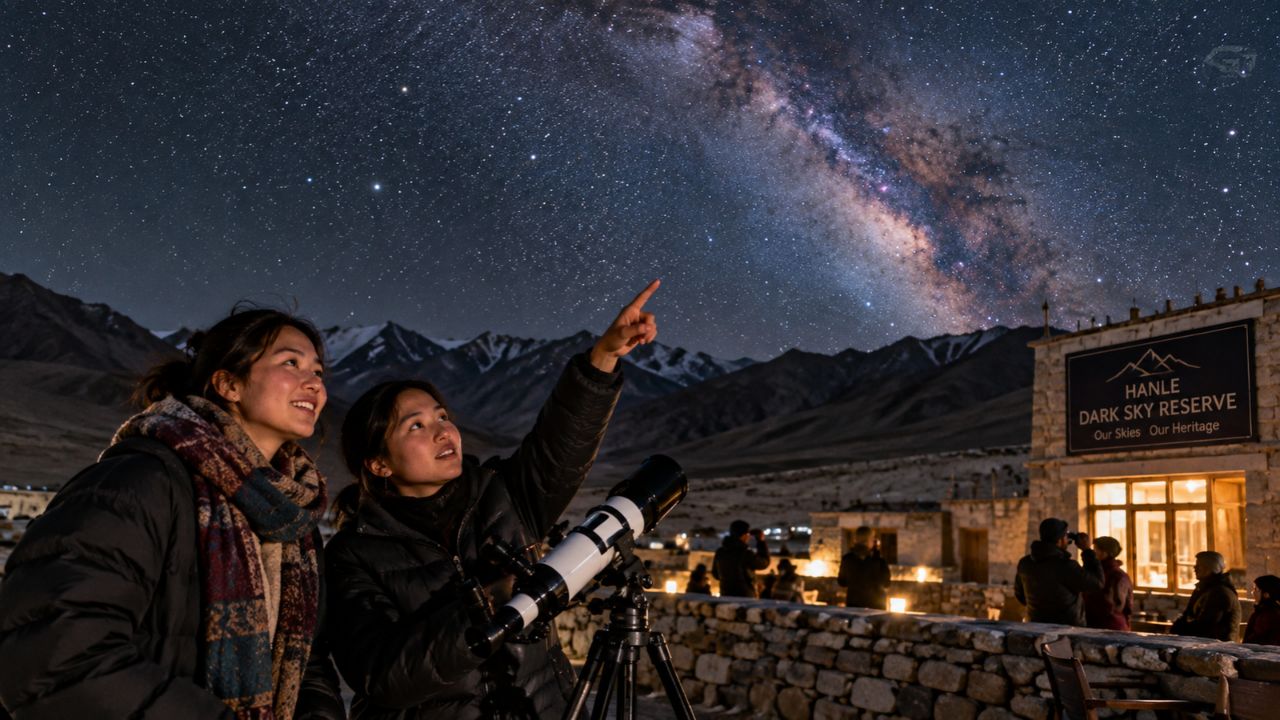
Perched at an oxygen-thin elevation of 4,500 metres above sea level across the windswept Changthang Wildlife Sanctuary, the remote eastern Ladakh settlement of Hanle was long known only to nomadic pashmina herders and cloistered astrophysicists. Today, local village women trained as grassroots astronomy ambassadors are spearheading India’s first designated Dark Sky Reserve, operating precision telescopes beneath near-zero moisture skies where the Milky Way blazes with such luminescence that it casts distinct human shadows across the cold desert floor.
Established in December 2022, the Hanle Dark Sky Reserve represents a radical reimagining of high-altitude Himalayan tourism. Rather than funneling visitors through fleeting sightseeing drives that leave mountain hamlets burdened with plastic waste and vehicular emissions, Hanle invites travelers into a slow, contemplative nocturnal sanctuary. Here, scientific research and indigenous empowerment merge, turning the ancient high-altitude village into one of the world's most compelling destinations for authentic cosmological discovery.
The Hanle Revolution: Where Cutting-Edge Astrophysics Meets Village Stewardship
The foundation for Hanle’s celestial prominence began in the year 2000 when the Indian Institute of Astrophysics (IIA) installed the 2-metre optical-infrared Himalayan Chandra Telescope atop the barren summit of Dig-pa-ratsa Ri. Operating at extreme altitude where atmospheric interference and water vapor are virtually non-existent, the installation quickly expanded into the Indian Astronomical Observatory, establishing an array of international monitoring instruments across the peak and its surrounding foothills.
Yet for more than two decades, the observatory operated in splendid isolation from the community below. Herders grazed sheep and yaks in the surrounding valleys while scientists monitored deep space from climate-controlled control rooms. That dynamic shifted fundamentally with the official notification of the Dark Sky Reserve in December 2022, driven by a pioneering alliance between the Union Territory administration, the Ladakh Autonomous Hill Development Council (LAHDC) Leh, and the Indian Institute of Astrophysics.
Recognizing that preserving nocturnal darkness required active community leadership rather than passive decrees, authorities launched an intensive grass-roots training program. Local youth and village women were selected to become certified astronomy ambassadors. Through rigorous week-long instructional courses conducted by professional astronomers, these women mastered celestial mechanics, optical telescope alignment, and constellation interpretation.
Equipped with portable field telescopes funded through institutional partnerships, these ambassadors now host small-group observational sessions for travelers. Instead of treating high-altitude tourism as a seasonal race, Hanle has nurtured an economy anchored in home-cooked meals, cultural exchange, and deep-space observation. Women who previously had few independent income sources now manage successful homestay enterprises, leading guests through views of the cloud bands of Jupiter, the spiral arms of the Andromeda galaxy, the faint blue disc of Neptune, and interstellar gas nebulae visible only in the world's darkest skies.
Underpinning this operational success is the Hanle Dark Sky Reserve Local Area Committee. This governance body unites village elders, local leaders, and scientific observers to enforce strict light-management regulations across the settlement. Street lamps are shielded and deflected downward, motor vehicle headlights are restricted during observational hours, and homestays are outfitted with heavy blackout curtains, ensuring that human settlements protect the night sky as a shared economic and scientific treasure.
What Makes Hanle and the Changthang Plateau Unique
Hanle occupies a high-altitude desert plain unlike any other region in northern India. Located near the disputed frontiers of eastern Ladakh, the village sits in a broad, dried lake basin surrounded by rounded barren mountains that glow in shades of rust, slate, and ochre under intense ultraviolet sunlight.
The nocturnal atmosphere at 4,500 metres possesses extraordinary clarity. Because the Himalayas block the Indian monsoon, Hanle experiences over 250 completely cloudless nights per year, paired with exceptionally low relative humidity that minimizes atmospheric scattering. When twilight fades, the sky does not simply turn dark; it reveals an overwhelming canopy of countless stars, the pale zodiacal light, and airglow phenomena that are completely invisible near urbanized environments.
By day, Hanle reveals deep historic and spiritual roots. Dominating the valley from a rocky ridge stands the 17th-century Hanle Monastery (Hanle Gompa), established under the patronage of King Sengge Namgyal of Ladakh and the Tibetan Drukpa Kagyu master Stagtsang Raspa. One of the few historic monasteries in Ladakh that was never ransacked during regional invasions, the whitewashed gompa houses priceless centuries-old murals, ancient Tibetan scriptures, and meditation chambers offering panoramic views across the braided river plains of the Hanle River.
The surrounding wilderness of the Changthang Wildlife Sanctuary is equally captivating. This high-altitude biosphere is the natural habitat of rare Tibetan wildlife, including herds of grazing Kiang (Tibetan wild ass), high-altitude black-necked cranes that nest along marshy riverbanks, Tibetan gazelles, Himalayan marmots, and the elusive snow leopard and Pallas’s cat.
Visitor Insider Tips: Navigating Hanle, High Passes, and Dark Sky Protocols
A journey to Hanle requires meticulous logistical planning, bodily respect for extreme altitude, and rigorous adherence to light-conservation protocols. As detailed through Incredible India and the official portal of Leh District Administration, responsible preparation is essential.
- Mandatory Three-Day Acclimatization in Leh: Never attempt to travel directly from Leh to Hanle in a single push. Hanle sits at 4,500 metres—higher than most Himalayan trekking passes. Spend a minimum of 48 to 72 hours resting in Leh (3,500 metres), followed by an intermediate acclimatization night in Chumathang, Nyoma, or Tangtse before ascending into the Hanle basin. Carry a portable pulse oximeter, drink plenty of warm fluids, and consult a travel physician regarding preventive altitude medication.
- Red-Light Etiquette is Strictly Enforced: Traditional white flashlights, smartphone torches, and car headlights are strictly banned outside after nightfall. White light destroys night-adjusted vision for up to thirty minutes and ruins ongoing astronomical exposures at the observatory. Bring a dedicated headlamp with a red-LED setting, cover device screens with red cellophane, and ensure all homestay room curtains are drawn tightly before turning on interior lighting.
- Dress for Sub-Zero Thermal Extremes: Even during mid-summer months of July and August, nocturnal temperatures in Hanle plunge close to or below freezing, accompanied by fierce winds across the plateau. Pack heavy down jackets, thermal merino wool base layers, windproof trousers, insulated boots, fleece-lined gloves, and balaclavas. Stargazing involves hours of standing stationary in open fields, making layered insulation indispensable.
- Secure Valid Inner Line Permits (ILP): Hanle lies within a sensitive border zone near the Line of Actual Control. All travelers—both domestic and international—must secure valid online Inner Line Permits / protected area permits via the official Ladakh portal before departing Leh. Carry multiple physical copies of your permit and identification to present at military checkpoints along the route via Loma Bridge.
- Savor High-Altitude Changpa Flavors: Support local hosts by dining on regional homestay cuisine. Sip steaming mugs of gur-gur cha (salted yak-butter tea), which provides essential hydration and fats against the desiccating cold. Savor skyu, a traditional Ladakhi stew made of hand-pinched wheat dumplings simmered with garden root vegetables, alongside paba (steamed roasted barley and pea flour dough) and wild garlic pickle (tso mik).
Cultural and Environmental Context: Changpa Nomads and Ecological Fragility
The rise of astro-tourism in Hanle marks an essential economic alternative for the Changpa people, the semi-nomadic pastoralists who have traversed the Changthang Plateau for centuries. Historically dependent on grazing pashmina goats (Capra hircus) and yaks across harsh alpine steppes, nomadic families face mounting pressures from erratic winter snowfall patterns, shifting international wool prices, and the younger generation’s desire for modern education and livelihoods.
By centering women as the intellectual and economic leaders of the Dark Sky Reserve, the program creates high-value, low-footprint employment that keeps families anchored in their ancestral homeland. Rather than leaving the village for wage labor in distant cities, young women gain prestige, technical skills, and reliable household income that funds healthcare, heating provisions, and educational opportunities.
At the same time, the Changthang environment is delicate. The arid alpine tundra has a short growing season and cannot absorb mass tourism infrastructure. Reckless off-road driving damages fragile permafrost cushions, and careless littering threatens endangered black-necked cranes.
The Hanle model proves that tourism does not have to be an extractive industry. By strictly capping guest capacity in village homestays, banning commercial light pollution, and educating visitors to view the cosmos through the eyes of the women who live beneath it, Hanle offers an inspiring blueprint for sustainable, community-led wilderness conservation.
FAQ: Visiting the Hanle Dark Sky Reserve 2026
What makes the Hanle Dark Sky Reserve globally significant? Established in December 2022 at an elevation of 4,500 metres in eastern Ladakh, Hanle is India’s first Dark Sky Reserve, combining world-class astronomical research with community-led stargazing guided by locally trained women ambassadors.
How do travelers reach Hanle from Leh? Visitors travel overland from Leh via the Indus Valley highway through Karu, Chumathang, Nyoma, and Loma Bridge, a dramatic 260-kilometer journey requiring high-clearance vehicles and proper acclimatization stops.
Are permits required to visit Hanle? Yes. All visitors must obtain Ladakh Inner Line Permits (Protected Area Permits) processed through the official Leh district administration portal, with verified physical copies presented at military transit checkpoints.
What is the best time of year for stargazing in Hanle? April through October provides clear skies, accessible mountain roads, and active community homestays, with the new moon periods offering the most spectacular views of the Milky Way and deep-sky objects.
Beneath the eternal silence of the Changthang skies, the women of Hanle are turning starlight into a lasting legacy of independence, science, and hope.
Related Travel Guides
- Sacred Rhythms of the High Himalaya: The 11th Ladakh Zanskar Festival Celebrates Districthood in Padum
- Stargazing Nevada: Dark Sky Rhythms, Historic Mining Towns, and Desert Solitude 2026
- Beyond the Boardwalk: How Santa Monica, Pensacola, and America’s Coastal Resorts Are Reinventing Year-Round Travel
Disclaimer
This article is for informational and educational purposes only. It does not constitute legal, financial, or professional advice. While we strive to provide accurate and up-to-date information, travel policies, regulations, and conditions change rapidly. Always verify information with official sources before making travel decisions. Nomad Lawyer makes no representations about the accuracy, reliability, completeness, or suitability of the information provided. Readers should consult qualified professionals for advice specific to their circumstances. The views expressed in this article are those of the author and do not necessarily reflect the views of Nomad Lawyer.
Raushan Kumar
Founder & Lead Developer
Full-stack developer with 11+ years of experience and a passionate traveller. Raushan built Nomad Lawyer from the ground up with a vision to create the best travel and law experience on the web.
Learn more about our team →