Guyana Invests Billions in Port Infrastructure to Transform Georgetown and Parika into 2026 Cruise Hubs

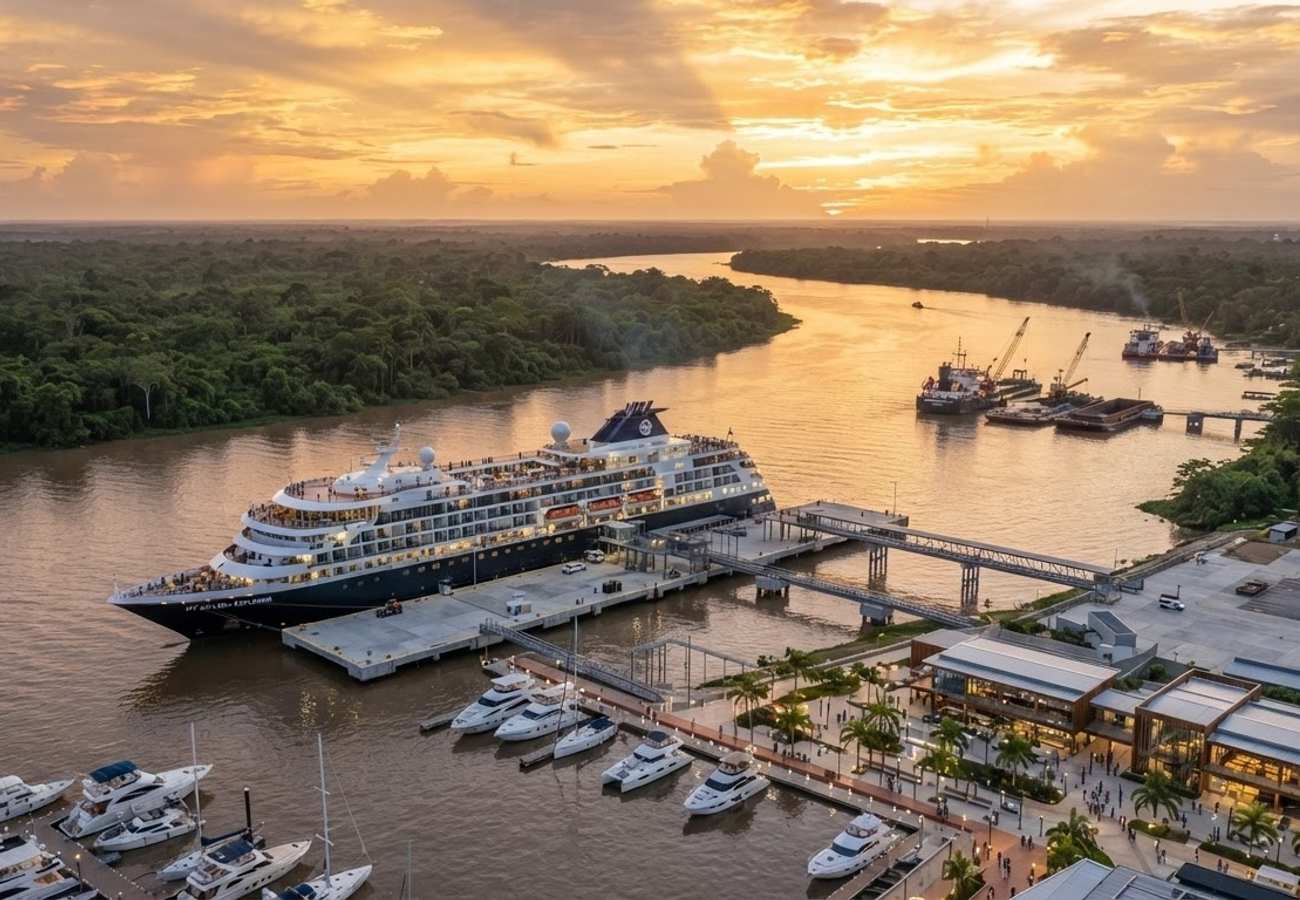
Image generated by AI
Guyana is executing a sweeping overhaul of its maritime infrastructure in 2026, allocating billions in funding to transform Georgetown, Parika, and the Berbice corridor into high-capacity gateways for international cruise liners and luxury yachts. These strategic upgrades aim to remove longstanding navigational barriers and position the nation as a premier South American destination for expedition and luxury marine travel.
The initiative represents a shift in Guyana's tourism strategy, moving from passive reception of small expedition vessels to the active creation of a sophisticated cruise network. By targeting specific bottlenecks—primarily river depth and wharf capacity—the government is attempting to integrate its rainforests, river systems, and cultural landmarks into a seamless itinerary for global travelers.
Strategic Maritime Enhancements in Georgetown
Georgetown remains the primary nerve center for the country's international maritime arrivals. However, the capital has historically struggled with shallow river depths that preclude the entry of "mega" cruise ships. To rectify this, the government has prioritized aggressive dredging and modernization efforts.
Under the 2026 Budget, G$6.3 billion has been earmarked specifically for dredging the mouth of the Demerara River. Further augmenting this is a US$11.2 million contract signed in May 2026, which focuses on a 9km channel dredging project extending from Houston to Golden Grove. This project is engineered to create a navigational channel 100 meters wide and 5 meters deep, providing the necessary clearance for larger vessels to navigate safely.
Beyond the dredging, the city is modernizing its wharves and port efficiency. Because Georgetown serves as the primary launch point for excursions to Kaieteur Falls and the Mahaica River, these upgrades are expected to increase the volume of shore excursions and boost the local economy for guides and hospitality providers.
Parika's Evolution into a Luxury Marine Gateway
While Georgetown handles the bulk of current traffic, Parika in Region Three is being developed as the most ambitious, tourism-centric port in the country. Rather than focusing solely on utility, the Parika project is designed as a comprehensive waterfront destination.
The overall project valuation stands at approximately G$4.5 billion. The 2026 Budget has allocated G$2.2 billion to accelerate the development of the stelling and waterfront, with over G$700 million specifically dedicated to Parika-based works during the current budget cycle. Construction reached a milestone in June 2026 with the first pouring of concrete.
The vision for Parika includes:
- A reconstructed stelling and modernized waterfront.
- Dedicated cruise-liner and yacht berths.
- Integrated customs and immigration infrastructure to streamline international arrivals.
- A new marina complemented by restaurants, recreation zones, and visitor parking.
Once completed—with the wider waterfront project slated for 2028—Parika will serve as the primary departure point for the Essequibo River tourism circuit, allowing luxury travelers to bypass the congestion of the capital and enter the interior more directly.
Regional Connectivity and Support Hubs
The maritime strategy extends beyond the two primary hubs, creating a "spoke-and-hub" system where smaller ports facilitate the distribution of tourists into the hinterlands.
In the Berbice corridor, the government has announced preliminary plans for port expansion. Budget 2026 includes provisions for capital dredging at the mouth of the Berbice River to accommodate larger vessels, though a specific standalone investment figure for a cruise terminal has not yet been publicized.
Further inland, Bartica in Region Seven acts as a critical link. Following the commissioning of a G$553 million roll-on/roll-off stelling in 2025, 2026 efforts are focused on increasing vessel capacity between Parika and Bartica. This ensures that cruise passengers arriving at the coast can efficiently transition to river-based tourism in the Essequibo, Cuyuni, and Mazaruni landscapes.
In Region Two, Supenaam is receiving approximately G$500 million in 2026 for the extension of its northern ferry terminal and the modernization of its aging stelling. A May tender estimated the engineering costs for the northern extension at G$489.52 million. Meanwhile, Charity and Port Kaituma are slated for future upgrades under a five-year river-transport strategy, focusing primarily on agricultural exports and river commuting, though these will eventually support nature-based tourism.
Guyana Maritime Development Data 2026
| Destination / Gateway | 2026 Status | Infrastructure Focus | Investment / Budget | Significance | Timeline |
|---|---|---|---|---|---|
| Georgetown | Primary Gateway | Demerara River dredging; wharf modernization | G$6.3B (Budget 2026); US$11.2M (Contract) | Essential for mega-ship access | US$11.2M contract signed May 2026 |
| Parika (Reg 3) | Emerging Hub | International port, marina, customs, waterfront | G$4.5B total; G$2.2B in Budget 2026 | Luxury yacht & cruise liner focus | Concrete poured June 2026; completion 2028 |
| Berbice Corridor | Planning Stage | Mouth of Berbice River capital dredging | Not specified | Increased capacity for larger vessels | Development stage 2026 |
| Bartica (Reg 7) | Support Gateway | Ro-Ro stelling; Parika-Bartica fleet expansion | G$553M (2025 stelling) | Interior river-tourism access | Operational / Expanding 2026 |
| Supenaam (Reg 2) | Transport Hub | Northern ferry terminal extension; stelling repair | ~G$500M (2026 allocation) | Essequibo Coast distribution | Works progressing 2026 |
| Charity (Reg 2) | Future Port | New port facility | Part of 5-year strategy | Pomeroon region access | Medium-term |
| Port Kaituma (Reg 1) | Future Gateway | New port facility; basin dredging | Part of 5-year strategy | North-west tourism connectivity | Medium-term |
Why This Matters: The Impact on Travel and Logistics
For the international traveler and the cruise industry, these developments signal that Guyana is transitioning from a "niche" expedition destination to a scalable tourism market.
From a logistical standpoint, the dredging of the Demerara and Berbice rivers removes the primary deterrent for major cruise lines: the risk of grounding and the limitation of ship size. For the first time, Guyana will be able to compete for the "luxury" segment of the market rather than just the "adventure" segment.
For the traveler, this means a significant reduction in friction. The development of customs and immigration facilities in Parika suggests a move toward decentralized arrivals, allowing tourists to land closer to the rainforests and river systems they intend to visit, rather than spending hours in transit from the capital. This "direct-to-destination" model is likely to increase the average length of stay and spend per visitor.
Furthermore, the integration of the Parika-Bartica-Supenaam corridor creates a reliable maritime "highway." This reduces the reliance on expensive air charters for interior travel, making the deep interior of Guyana accessible to a broader range of international visitors.
Guyana is effectively building the physical foundation required to turn its natural biodiversity into a sustainable economic engine through maritime excellence.
Related Travel Guides
This article is for informational purposes. Flight routes, passenger regulations, visa rules, and transit advisories are subject to change by airlines and aviation authorities. Readers are advised to verify schedules and travel documentation with relevant carriers and border agencies before departure.
Related Stories

European Mass Protests Disrupt Travel Across France, Italy, Belgium, and Turkey in 2026

Prague Emerges as Europe's Top Solo Travel Hub as Kraków and Istanbul Expand Budget Transit and Winter Rail Links