
Greenland Takes Center Stage As US And Denmark Security Partnership Creates New Momentum For Arctic Travel
A landmark US-Denmark defense agreement elevates Greenland's global profile, accelerating airport modernizations and opening a new era for Arctic expedition travel.

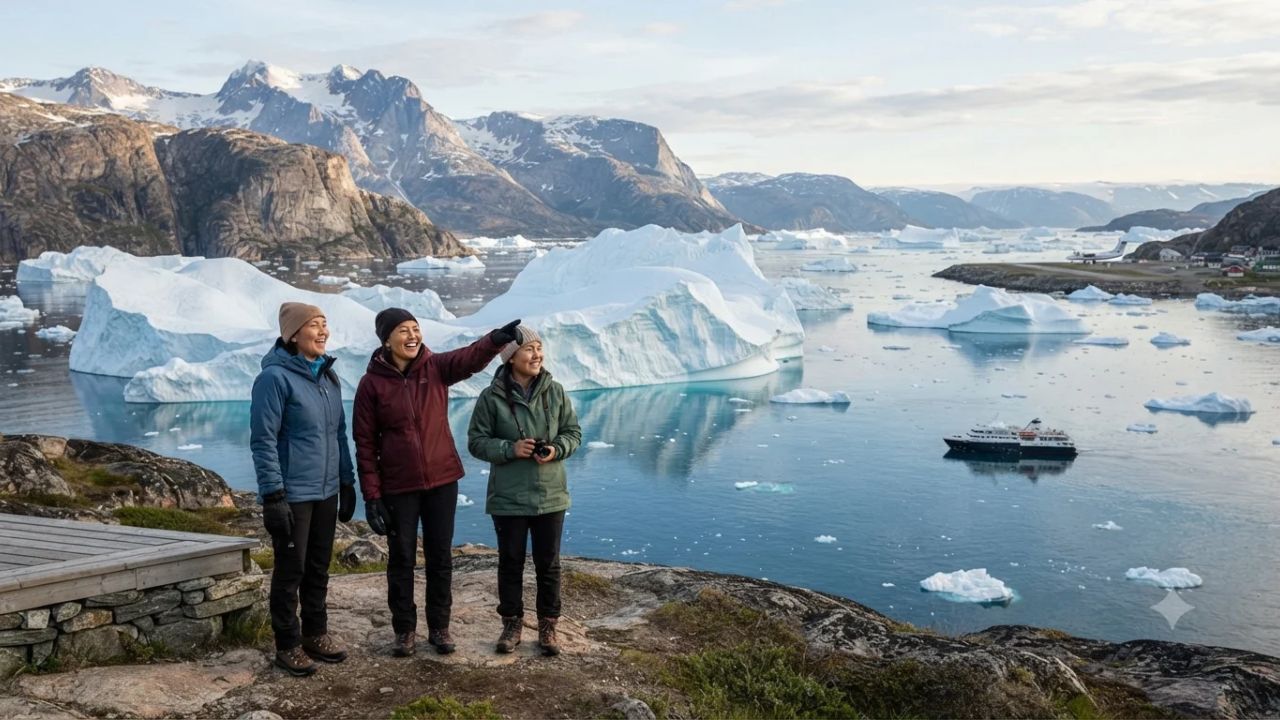
Image generated by AI
A landmark trilateral security pact granting the United States an expanded permanent defense role across Greenland's 836,000 square miles of Arctic territory is triggering an unexpected commercial renaissance for high-latitude expedition tourism. Formulated between Washington, Copenhagen, and Nuuk, the defense arrangement restricts strategic activities by rival nations while reinforcing Greenland’s sovereign self-determination within the Kingdom of Denmark. While framed primarily around geopolitical deterrence and Arctic radar surveillance, the pact coincides with transformative civil aviation developments, most notably the commissioning of Nuuk's new international airport capable of handling widebody aircraft. As global attention pivots to Greenland's dramatic icefjords, mineral reserves, and Inuit cultural heritage, the island is positioned to dismantle decades of physical isolation. For international travelers, the resulting dual-use infrastructure investments and heightened global visibility are transforming the world's largest island from a prohibitively expensive, multi-leg expedition into an accessible frontier for luxury adventure and scientific travel.
Geopolitical Alignment: The Trilateral Accord and Sovereign Self-Determination
The trilateral agreement between the United States, Denmark, and Greenland cements a strategic framework across one of the most sensitive maritime chokepoints in the Northern Hemisphere. Characterized by President Donald Trump as securing a permanent US role in Greenland’s security and defense architecture, the arrangement deepens bilateral military coordination while restricting commercial or scientific overtures from strategic competitors. However, both Danish officials and the Government of Greenland (Naalakkersuisut) were firm in emphasizing that the agreement alters neither Greenland's legal borders nor its domestic governance. Greenland remains an autonomous territory exercising full control over its territorial development, mineral resources, and domestic visitor economy.
The timing of this defense accord has thrust Greenland into the global media spotlight, generating intense consumer curiosity about its geography, climate science, and settlement culture. Historically, Arctic travel has remained a niche pursuits reserved for intrepid adventurers and specialized polar researchers. High ticket prices, scarce commercial lodging, and extreme weather historically suppressed mass tourism.
Yet as defense analysts focus on northern sea routes and early-warning radar arrays, private capital and institutional investors are recognizing that Greenland’s tourism sector can expand far more rapidly than capital-intensive mining projects. Tourism officials in Nuuk are leveraging this international attention to position Greenland not merely as a geopolitical frontier, but as the premier sustainable wilderness destination for high-yield travelers seeking rare natural encounters.
Aviation Modernization and Expedition Corridors: The Infrastructure Overhaul
The primary structural bottleneck that historically constrained Greenlandic tourism was aviation logistics. For over half a century, international flights from Europe could land only at Kangerlussuaq—a remote inland World War II air base—forcing arriving passengers to transfer onto small turboprops operated by Air Greenland to reach coastal settlements. The construction and opening of Nuuk’s expanded international airport fundamentally reorganizes this network by allowing direct long-haul jet service from North American and European hubs directly into the capital.
Complementing aviation upgrades, maritime operators are expanding polar cruise itineraries across the North Atlantic. Expedition ships are charting combined routes linking Iceland, Greenland, the Canadian Arctic archipelago, and northern Scandinavia. These voyages provide coastal settlements with substantial seasonal revenue, supporting local guides, community craft markets, traditional hunting culture demonstrations, and regional culinary venues.
According to marketing strategies published by Visit Greenland, the island’s core visitor assets center on pristine natural scale and indigenous heritage. Marquee attractions include the UNESCO-protected Ilulissat Icefjord, where massive glaciers calve into Disko Bay, alongside winter Aurora Borealis viewing, dogsled expeditions, and humpback whale watching. By expanding digital communications, renewable energy grids, and regional airport terminals in tandem with defense-related improvements, Greenland is establishing an operational foundation capable of supporting international tourism without compromising environmental integrity.
| Infrastructure Domain | Traditional Operating Status | Modernized 2026 Facility | Practical Traveler Consequence |
|---|---|---|---|
| Capital Aviation Hub | Short runway at Nuuk; turboprop feeder flights only | Extended international runway handling widebody jets | Direct non-stop flights from North America and Europe |
| Secondary Transit Base | Heavy reliance on remote Kangerlussuaq base | Decentralized direct coastal airport connections | Bypasses domestic turboprop transfers and cuts travel days |
| Polar Cruise Connectivity | Limited tender operations and sparse fueling berths | Expanded deepwater expedition docks across coastal ports | Facilitates seamless shore excursions and resupply |
| Digital Communications | Intermittent high-latitude satellite connections | High-bandwidth low-Earth-orbit broadband networks | Reliable connectivity for mobile bookings and safety alerts |
| Tourism Adventure Segment | Primary Geographical Corridors | Key Visitor Attractions | Sustainable Policy Challenge |
|---|---|---|---|
| Expedition Cruising | Disko Bay, Prince Christian Sound, Scoresby Sund | Iceberg navigation, zodiac excursions, wildlife spotting | Regulating heavy fuel oil emissions and shore landing sizes |
| Indigenous Heritage | Nuuk, Ilulissat, East Greenland settlements | Traditional Inuit drum dancing, artisan crafts, seal gastronomy | Ensuring tourism revenue flows directly to native residents |
| Glaciology & Climate Expeditions | Greenland Ice Sheet, Russell Glacier | Ice walking, crevasse scientific tours, research visits | Minimizing human environmental footprints on fragile ice caps |
| Polar Dark-Sky Excursions | Kangerlussuaq, Nuuk hinterlands | Northern Lights photography, dog sledding expeditions | Managing unpaved trail erosion during winter seasons |
Expert Analysis: Dual-Use Infrastructure Economics and Overtourism Containment
For travelers booking itineraries to Greenland, the direct consequence of this trilateral pact is the rapid de-risking of Arctic travel logistics. Operating in polar latitudes requires immense logistical support: reliable search-and-rescue (SAR) coverage, advanced weather-forecasting satellites, ice-strengthened maritime tenders, and certified all-weather aviation approaches. When national governments invest billions into polar security assets, the secondary benefit to civilian aviation and expedition cruising is profound. Commercial operators can negotiate lower maritime insurance premiums and offer more reliable schedules knowing that emergency response frameworks and upgraded satellite navigation are permanently established in the region.
The pricing pressure this creates means Greenland will experience a surge in high-net-worth American travelers who previously avoided the destination due to convoluted air routings. With direct flights into Nuuk, an American traveler can reach the edge of the Arctic ice cap in less time than it takes to fly to Hawaii. However, because Greenland lacks the physical infrastructure to accommodate mass tourism, hotel capacity in Nuuk and Ilulissat will face immediate supply crunches, driving room rates and guided excursion costs to premium international levels.
To preserve its pristine environment, Greenlandic authorities are deliberately rejecting the high-volume, low-cost tourism model that created overcrowding in neighboring Iceland. Instead, destination managers are imposing strict carrying-capacity caps on cruise vessel passenger counts and requiring international tour companies to employ certified local Inuit guides. By focusing strictly on high-yield, low-impact adventure travelers, Greenland ensures that its sudden geopolitical prominence translates into sustainable community wealth rather than environmental degradation.
Key Takeaways
- Landmark Trilateral Security Accord: The United States, Denmark, and Greenland finalized a defense arrangement expanding American security cooperation and Arctic access while preserving Greenlandic sovereign self-determination.
- Heightened Global Visibility: Geopolitical attention is driving a wave of interest from high-net-worth adventure travelers, science tourists, and luxury cruise operators.
- Aviation Infrastructure Transformation: Nuuk's new international airport terminal enables direct widebody transatlantic flights, eliminating decades of complex turboprop transfers through remote military hubs.
- Polar Cruise Expansion: Expedition cruise operators are integrating Greenland into North Atlantic itineraries linking Iceland, Northern Europe, and the Canadian Arctic.
- Controlled High-Yield Tourism Model: Tourism authorities prioritize high-spend, low-impact travel to protect fragile polar ecosystems and direct economic benefits to local Inuit communities.
FAQ: Greenland Arctic Tourism and Geopolitics 2026
Does the US-Denmark security agreement affect travel entry rules for Greenland?
No. Greenland remains an autonomous territory within the Kingdom of Denmark with its own immigration regulations. Standard passport and visa rules for visiting Greenland remain unchanged.
How does the new Nuuk airport improve access for international travelers?
Nuuk’s expanded international runway accommodates direct long-haul flights from North America and Europe, eliminating the traditional requirement to transfer through Kangerlussuaq on regional turboprops.
What are the top activities for visitors traveling to Greenland?
Key experiences include exploring the UNESCO-listed Ilulissat Icefjord, watching humpback whales in Disko Bay, dog sledding, viewing the Northern Lights, and experiencing authentic Inuit cultural traditions.
How is Greenland preventing overtourism in its fragile Arctic environment?
Authorities enforce strict landing caps for expedition cruise vessels, mandate local guide employment, and focus on high-yield, low-volume tourism to protect Arctic wildlife and small coastal settlements.
[As great powers redraw the geopolitical map of the high north, the ultimate victor may well be the curious traveler who finally gains a direct flight to the edge of the ice sheet.]
Related Travel Guides
The 10 Best Airline Lounges at New York JFK Airport, According to Reddit (2026 Guide)
The 10 Best Hotels in Las Vegas, According to Reddit (2026 Guide)
The 10 Best Arctic Expedition Cruises in Greenland, According to Reddit
Disclaimer
This article is for informational and educational purposes only. It does not constitute legal, financial, or professional advice. While we strive to provide accurate and up-to-date information, travel policies, regulations, and conditions change rapidly. Always verify information with official sources before making travel decisions. Nomad Lawyer makes no representations about the accuracy, reliability, completeness, or suitability of the information provided. Readers should consult qualified professionals for advice specific to their circumstances. The views expressed in this article are those of the author and do not necessarily reflect the views of Nomad Lawyer.
Raushan Kumar
Founder & Lead Developer
Full-stack developer with 11+ years of experience and a passionate traveller. Raushan built Nomad Lawyer from the ground up with a vision to create the best travel and law experience on the web.
Learn more about our team →