Chiang Mai Airport Flight Disruptions for Yi Peng and Loy Krathong: Complete Traveler Guide 2026

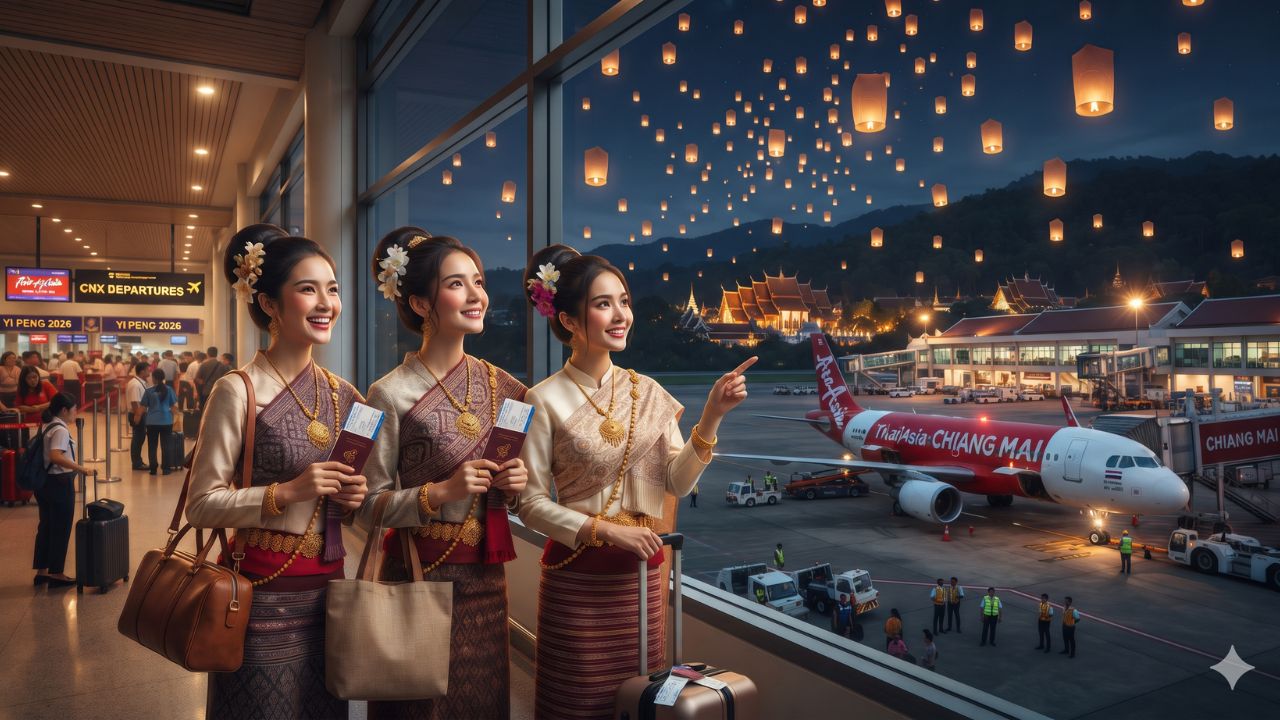
Image generated by AI
For two consecutive evenings each November, Chiang Mai International Airport deliberately slashes its operational runway window from roughly 20 hours down to just 12, surrendering northern Thailand's night skies to tens of thousands of fire-powered paper lanterns. To prevent airborne lanterns (khom loi) from drifting into commercial jet flight paths during the historic Yi Peng and Loy Krathong festivals, civil aviation regulators and airlines have enacted substantial schedule overhauls between 21 and 28 November 2026. Official schedules verified by Chiang Mai's provincial public relations office confirm that carriers have cancelled 108 commercial flights, rescheduled 80 services, and introduced 105 supplementary daytime flights, reconfiguring regional transit across one of Southeast Asia's most celebrated cultural spectacles.
Sky Lanterns and Jet Turbines: Managing Aviation Safety During Yi Peng
The collision of ancient Buddhist merit-making rituals and modern commercial aviation creates an intricate logistical challenge over the Chiang Mai valley. Flying lanterns—constructed from porous rice paper stretched over bamboo frames and heated by wax-soaked fuel coils—can rise thousands of feet into terminal approach corridors. If sucked into high-bypass turbofan engines or wrapped around pitot static tubes, they pose catastrophic flight safety hazards.
To eliminate this threat without suppressing centuries-old Lanna traditions, Airports of Thailand coordinated with domestic and international carriers to enforce strict airspace curfews on 24 and 25 November 2026. On Sunday, 24 November, flights are prohibited during a morning window from 10:00 am until 12:00 pm noon, followed by a complete nighttime ground halt from 7:00 pm until 1:00 am the following morning. On Monday, 25 November, the identical 7:00 pm to 1:00 am evening restriction applies.
Despite the truncated daily flight window, Chiang Mai International Airport expects an average of 210 flights daily throughout the festival week, with peak volumes climbing to 232 daily departures and arrivals. This severe compression means daytime terminals will operate at maximum capacity, concentrating thousands of international holidaymakers from primary feeder hubs across Singapore, Malaysia, India, China, and the United Kingdom into tight midday processing banks.
| Flight Operation & Transit Metric | Official Operational Adjustment | Active Dates & Daily Timing (2026) | Traveler Advisory |
|---|---|---|---|
| Cancelled Commercial Flights | 108 scheduled services withdrawn | 21–28 November 2026 | Rebooking via airline apps; refunds eligible |
| Rescheduled Flights | 80 departures/arrivals shifted | Moved outside 7 pm – 1 am curfew | Check updated boarding passes 48h prior |
| Supplementary Added Flights | 105 additional daytime frequencies | Scheduled across morning/afternoon banks | Extra seats added to absorb stranded traffic |
| Daytime Airspace Restriction | Runway closed to takeoffs/landings | 24 November: 10:00 am to 12:00 pm noon | Early morning transit planning advised |
| Nighttime Airspace Curfew | Total suspension of air traffic | 24 & 25 November: 7:00 pm to 1:00 am | Evening airport access closed; road traffic heavy |
| Airport Operating Window | Reduced from ~20 hours to 12 hours | 24 & 25 November peak festival days | Arrive 2h early (domestic), 3h (international) |
| Daily Airport Traffic Volume | 210 average flights (up to 232 peak) | Across festival week (21–28 Nov) | Extended security lines; check-in delays |
| Dedicated Ground Shuttles | 1,280 daily bus/taxi/limo transfers | Continuous daytime terminal operation | RTC City Bus lines R3 running to Old City |
| Ride-Hailing & Car Rentals | ~2,500 Grab cars & 9 car rental desks | Coordinated with provincial transport | Pre-book rides; terminal pickup congestion |
Under Civil Aviation Authority of Thailand (CAAT) Regulation No. 101, passengers booked on cancelled or significantly retimed flights on Thai-registered carriers or international departures originating in Thailand possess specific consumer rights. These include options for full cash refunds without penalty, no-cost rerouting onto alternative daytime flights, or travel vouchers, alongside complimentary meals during extended ground delays.
What Makes Lanna's Dual Light Festivals Unique
While travelers often use the terms interchangeably, Yi Peng and Loy Krathong represent two distinct historic observances that converge on the twelfth full moon of the Thai lunar calendar.
Loy Krathong is celebrated nationwide across Thailand. Devotees gather at rivers, canals, and ponds to float small candlelit rafts (krathongs) traditionally fashioned from banana tree trunks, folded banana leaves, orchids, and incense. The ritual pays reverence to Phra Mae Khongkha, the Hindu-Buddhist goddess of water, symbolizing an intentional release of anger, misfortune, and spiritual defilement from the preceding year.
Yi Peng, by contrast, is unique to northern Thailand's ancient Lanna Kingdom, which was centered in Chiang Mai. Rooted in astrological calendars and Buddhist lore, Yi Peng honors the sacred hair relic of the Buddha housed in the celestial heaven of Tavatimsa. By releasing glowing paper lanterns into the night air, participants send prayers aloft, believing that the ascending flames carry away personal burdens while illuminating paths toward spiritual wisdom.
Across the historic Old City, temples and teak homes hang multicolored hanging lanterns (khom fwan) and ground oil lamps (phritip), bathing ancient brick stupas like Wat Chedi Luang and Wat Phan Tao in warm golden radiance.
Visitor Insider Tips: Authorized Lantern Zones, Temples, and Transit Hacks
Experiencing the magic of Yi Peng without running afoul of strict municipal laws or missing flight connections requires insider knowledge.
- Strict Red Zone Enforcement: Chiang Mai municipal authorities enforce absolute bans on releasing lanterns within "red zones"—which include the entire airport perimeter, major runway takeoff vectors, and the historic walled Old City. Lighting sky lanterns inside red zones carries severe criminal penalties under the Air Navigation Act. Instead, participate in authorized public releases along the Ping River around the Nawarat Bridge and Iron Bridge, or reserve seats at regulated cultural centers outside the urban aviation zone.
- Terminal Timing and Ground Transport Hacks: With flights squeezed into narrow daytime windows, arriving two hours ahead for domestic flights and three hours ahead for international departures is mandatory. Rather than waiting in sprawling taxi queues outside arrivals, take the RTC Smart Bus (Route R3), which departs directly from Exit 1 for just 30 to 50 Thai Baht, connecting the terminal to Nimman and the Old City. If using Grab, remember that roughly 2,500 vehicles are active, but gridlock around the moat can double transit times between 5:00 pm and 9:00 pm.
- Crowd-Free Temple Sanctuary: Avoid the massive crowds along Tha Phae Gate on the night of 24 November by heading to quieter northern monastic sanctuaries. Visit Wat Lok Moli outside the north moat, where novice monks chant beneath canopies of suspended orange lanterns, or walk through the wooded grounds of Wat Umong at the foot of Doi Suthep, where subterranean tunnels offer contemplative reflection away from firecrackers.
- Authentic Northern Lanna Flavors: Escape tourist-oriented festival buffet tents to sample authentic northern cuisine. Seek out local neighborhood stalls serving khao soi (egg noodles in rich coconut curry broth topped with crispy fried noodles and pickled mustard greens), spicy sai oua (aromatic lemongrass pork sausage grilled over charcoal), and nam prik ong (savory minced pork and tomato chili dip served with raw vegetables and crackling pork skins).
Cultural and Environmental Context: Eco-Krathongs and Airspace Sovereignty
The modern evolution of Yi Peng and Loy Krathong highlights an urgent environmental dialogue across northern Thailand. In past decades, mass-market tourism introduced non-biodegradable materials—including polystyrene foam bases for floating rafts and metal wire frames for sky lanterns. These materials polluted the Mae Ping River, trapped marine life, and littered remote mountain forests, while drifting wires triggered electrical short circuits in rural power grids.
In response, municipal leaders and the Tourism Authority of Thailand have established rigorous ecological standards. Commercial vendors in Chiang Mai are legally mandated to construct floating rafts solely from organic elements like banana stems, manioc starch, and natural flowers that decompose harmlessly or feed river fish. Similarly, approved sky lanterns must use biodegradable mulberry (saa) paper and natural bamboo ribs bound with cotton string rather than wire.
Environmental stewardship also extends to post-festival cleanups. The morning after Loy Krathong, municipal flotillas and hundreds of local student volunteers take to the Ping River, scooping out thousands of rafts before they drift downstream into regional irrigation barrages. By choosing natural materials and honoring designated flight-safety corridors, travelers directly support northern Thailand's commitment to preserving sacred living traditions without compromising environmental health or aviation security.
FAQ: Navigating Chiang Mai Yi Peng & Flight Disruptions 2026
Is Chiang Mai International Airport completely closed during Yi Peng 2026?
No. The airport operates during adjusted daytime hours. Runway closures occur strictly on 24 November from 10:00 am to 12:00 pm, and on both 24 and 25 November between 7:00 pm and 1:00 am.
What should I do if my flight to or from Chiang Mai is cancelled?
Contact your issuing airline immediately to secure a free seat change on one of the 105 added daytime flights. Under CAAT rules, you are entitled to rebooking or a full refund.
Where can tourists legally release sky lanterns in Chiang Mai?
Lanterns can only be released in designated municipal zones outside the flight corridor—primarily along sections of the Ping River—or at licensed cultural event venues outside the city. Releasing lanterns in the Old City is strictly illegal.
What is the best way to get from the airport to the city center during festival week?
Take the affordable RTC Smart Bus directly from the terminal exit, or pre-book a licensed airport limousine. Allow at least 60 to 90 minutes for road transit due to festival traffic jams.
[As thousands of golden lanterns ascend into the quiet night, Chiang Mai demonstrates that sacred heritage and modern skies can find harmony through mutual respect and meticulous care.]
Related Travel Guides
This article is for informational purposes. Flight routes, passenger regulations, visa rules, and transit advisories are subject to change by airlines and aviation authorities. Readers are advised to verify schedules and travel documentation with relevant carriers and border agencies before departure.
Related Stories

Qatar Airways Launches Historic Flights to Colombia and Venezuela: Long-Haul South America Travel Guide 2026

Dominica Celebrates 48 Years of Independence: Creole Heritage, Music Festivals, and Cultural Guide 2026