Brazil Takes Eco-Tourism Global: Mato Grosso do Sul Promotes Bonito at WTM London and ITB Americas 2026

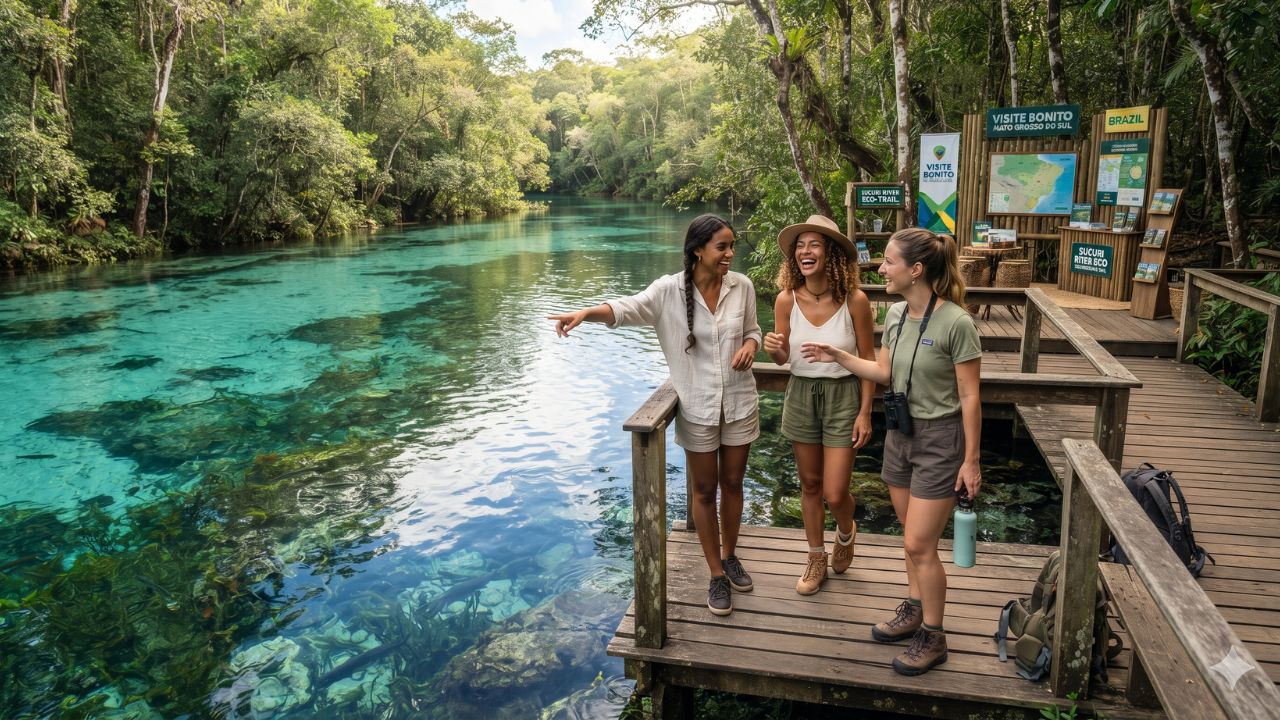
Image generated by AI
In the freshwater springs around Bonito, Brazil, river water is so naturally filtered through subterranean limestone caverns that swimmers can read small book print through five meters of crystalline depths. While mass-market travelers flock predictably to Copacabana or Iguazu Falls, the central-western state of Mato Grosso do Sul is executing a major international campaign to position its pristine river systems and cavern sanctuaries as the global gold standard for responsible travel. Confirmed on 3 November 2026 by the Mato Grosso do Sul Tourism Foundation (Fundtur-MS) alongside national promotion agency Embratur, the state is anchoring a six-day international trade offensive across two continents: presenting at World Travel Market (WTM) London from 3 to 5 November 2026 and headlining the inaugural ITB Americas in Guadalajara, Mexico from 10 to 12 November 2026.
The Global Eco-Tourism Shift: Promoting Conservation-Led Travel Across Two Continents
The synchronized push across London and Guadalajara reflects an intentional evolution in how South America approaches international leisure marketing. Rather than simply selling sun, sea, and carnival spectacles, Brazilian tourism authorities are highlighting regulated carrying capacities, local community ownership, and verified environmental stewardship.
The two-stage campaign bridges distinct international source markets. At ExCeL London, WTM London provides immediate connectivity to overseas European outbound buyers. Organizers advertise representation from more than 180 countries, over 4,000 exhibitors, 5,500 international buyers, and upwards of 46,000 attendees. This follows a strong 2025 edition that drew 46,500 verified attendees across 182 nations, generating £2.2 billion in negotiated commercial contracts while marking a five percent rise in total exhibitors and a 55 percent surge in travel technology firms.
Following the European trade engagement, Fundtur-MS shifts operations directly to Expo Guadalajara for the launch edition of ITB Americas. Organized by Messe Berlin, the trade floor targets the 35 independent nations of the Americas through a structured hosted buyer system. The framework requires 80 percent of hosted buyers to originate from North, Central, and South America and the Caribbean, with the remaining 20 percent drawn from key intercontinental markets. To guarantee commercial output, fully hosted buyers must complete at least 27 individual business appointments, partially hosted buyers a minimum of 15, and trade buyers at least six meetings, setting the stage for the already announced second edition on 9 to 11 November 2027.
| Event & Platform Metric | World Travel Market (WTM) London 2026 | ITB Americas Guadalajara 2026 |
|---|---|---|
| Host City & Nation | London, United Kingdom | Guadalajara, Mexico |
| Exhibition Venue | ExCeL London | Expo Guadalajara |
| Active Event Dates | 3–5 November 2026 | 10–12 November 2026 |
| Exhibition Duration | Three business days | Three business days |
| Institutional Status | Established premier global summit | Inaugural Western Hemisphere edition |
| Geographic Scope | Global (>180 countries advertised) | 35-nation regional market (The Americas) |
| Buyer Quota Structure | >5,500 international buyers advertised | 80% Americas / 20% international |
| Mandatory Meeting Tiers | General scheduled trade meetings | 27 (fully hosted) / 15 (partially hosted) / 6 (trade) |
| Official Brazilian Delegation | Fundtur-MS alongside Embratur | Fundtur-MS alongside Embratur |
| Primary Promotional Focus | Bonito nature tourism & operator contracts | Sustainable tourism & decarbonization models |
| Next Announced Summit | Annual November cycle (London) | 9–11 November 2027 (Guadalajara) |
While state officials note that final country counts, signed commercial deals, and verified arrivals growth will emerge only after post-show audits, the promotional focus centers firmly on Bonito's decarbonization certifications and structured visitor management.
What Makes Bonito Different: Limestone Karst Geology and the Voucher Único
Bonito's pristine aquatic environment is a direct consequence of prehistoric geology. Situated within the Serra da Bodoquena plateau on the southern rim of the UNESCO World Heritage Pantanal Biosphere, the region rests atop deep deposits of calcium carbonate. Rainwater seeping into the ground dissolves the limestone, filtering out organic impurities before resurfacing in artesian springs. High calcium levels cause floating sediment to calcify and sink to river bottoms, creating gin-clear streams like Rio da Prata, Rio Sucuri, and Rio Formoso, where shoals of golden dorado and red-finned piraputanga glide through undulating freshwater meadows.
To prevent overtourism from destroying this fragile ecosystem, municipal authorities established the Voucher Único (Single Voucher System). In Bonito, private landowners cannot sell tickets at farm gates, and travelers cannot simply pay entrance fees upon arrival. Every single attraction, river drift, cavern descent, and boat launch must be reserved through an accredited local travel agency operating on a municipal digital platform.
The system enforces strict daily carrying capacity limits. River snorkeling tours limit groups to a maximum of nine visitors accompanied by a certified naturalist guide, with departures spaced at rigid 20-minute intervals. In addition, activity prices are fixed by municipal decree, eliminating ticket scalping, predatory pricing, and overcrowding.
Beyond crystal rivers, the surrounding plateau houses geological wonders like the Anhumas Abyss (Abismo Anhumas)—a vertical cavern where travelers rappel 72 meters through a narrow rock crevice into an underground lake filled with 20-meter submerged stalagmites—and the Buraco das Araras, one of South America's largest sinkholes, where hundreds of wild red-and-green macaws nest within 100-meter sheer sandstone cliffs.
Visitor Insider Tips: Navigating Regulations, Seasons, and Regional Rhythms
Experiencing Bonito and Mato Grosso do Sul requires meticulous preparation and respect for local conservation rules that generic guides frequently overlook.
- Booking Around Carrying Capacities: Because daily entry quotas for premier river floats like Rio da Prata and Recanto Ecológico Rio da Prata sell out weeks in advance, secure your Voucher Único bookings two to three months ahead for dry season travel, and at least four months ahead for the Christmas, New Year, and Carnival holidays.
- Strict Sunscreen and Repellent Prohibitions: Sunscreens, moisturizers, tanning oils, and chemical insect sprays are strictly forbidden inside springhead rivers. The chemicals react with the calcium carbonate, clouding water clarity and poisoning delicate aquatic mosses. Instead, travelers wear mandatory full-body neoprene wetsuits provided by tour operators, which supply thermal insulation and natural buoyancy, preventing fins from touching the riverbed.
- Navigating the Dry vs. Wet Seasons: The best water transparency occurs during the southern hemisphere winter from May to September, when dry weather prevents agricultural runoff from entering waterways. The rainy summer from December to March swells dramatic waterfalls like Boca da Onça and floods the neighboring Pantanal, but torrential downpours can occasionally cloud river visibility for 24 to 48 hours.
- Transport and Regional Bases: While Bonito Regional Airport (BYO) hosts select domestic flights from São Paulo, most international visitors fly into Campo Grande International Airport (CGR). From Campo Grande, reserve a seat on licensed shared tourist vans for the four-hour highway transfer southwest to Bonito. Pair a four-day stay in Bonito with a three-day wildlife safari in the southern Pantanal near Miranda or Aquidauana.
- Regional Culinary Specialties: Replenish energy with local Pantaneiro dishes. Sample peixe a urucum (native pintado or pacu fillets baked under a sauce of tomatoes, cream, and indigenous annatto seed oil), savor warm manioc-cheese chipas, and beat the afternoon heat with communal tereré poured over fresh crushed herbs.
Cultural and Environmental Context: Karst Protection and Destination Decarbonization
The environmental balance in Mato Grosso do Sul is delicate. Surrounding the protected limestone pockets of Bonito and the Bodoquena range are extensive commercial cattle ranches and expanding soy farms. Agricultural runoff, soil compaction, and deforestation along riverbanks represent persistent ecological pressures that could deposit silt into subterranean springs.
To safeguard its water, the state established mandatory riparian buffer zones (matas ciliares) along river corridors, legally obligating rural private properties to preserve native gallery forests. In parallel, Bonito has achieved international certification as one of the world's first certified carbon-neutral eco-destinations, measuring local emissions across transport, lodging, and tour activities, and offsetting them through regional reforestation initiatives.
By participating in WTM London and ITB Americas, Fundtur-MS and Embratur demonstrate that small-scale, high-value eco-tourism delivers superior long-term economic stability compared to unregulated mass tourism. Tourism revenues flow directly to local naturalist guides, family-run lodges, and conservation biologists, demonstrating that economic prosperity in South America can coexist with untouched freshwater ecosystems.
FAQ: Visiting Bonito and Mato Grosso do Sul 2026
How do I obtain the Voucher Único for attractions in Bonito?
The voucher cannot be purchased at attraction entrances. You must book through a licensed local travel agency in Bonito, either online before arriving or upon arrival in town. Prices are fixed by municipal law.
What is the best time of year to visit Bonito for river snorkeling?
The dry winter months between May and September offer the clearest underwater visibility. Water temperatures in spring rivers remain constant at 22°C to 24°C (72°F to 75°F) year-round due to subterranean geothermal buffering.
Do I need a visa to travel to Brazil in 2026?
Visitors from the European Union, the United Kingdom, and MERCOSUR nations enter visa-free for tourism stays up to 90 days. Citizens of the United States, Canada, and Australia should check current electronic visa (e-Visa) requirements before departure.
Is it safe to drink the tap water in Bonito?
While public municipal water is treated, the high natural concentration of dissolved calcium carbonate and magnesium can cause mild digestive sensitivity. Most travelers prefer filtered or bottled water for drinking.
[Drifting face-down above sunlit riverbeds, surrounded by wild dorado in water as pure as morning air, travelers experience Brazil's greatest living lesson in conservation.]
Related Travel Guides
Paraguay Visa-Free Travel Rules Enter Focus as Key August 2027 Validity Deadline Approaches
This article is for informational purposes. Flight routes, passenger regulations, visa rules, and transit advisories are subject to change by airlines and aviation authorities. Readers are advised to verify schedules and travel documentation with relevant carriers and border agencies before departure.
Related Stories
Qatar Airways Launches Historic Flights to Colombia and Venezuela: Long-Haul South America Travel Guide 2026
Chiang Mai Airport Flight Disruptions for Yi Peng and Loy Krathong: Complete Traveler Guide 2026