UK and European Flight Disruption Breakdown: Airspace Bottlenecks, Delay Chains, and Passenger Guide 2026

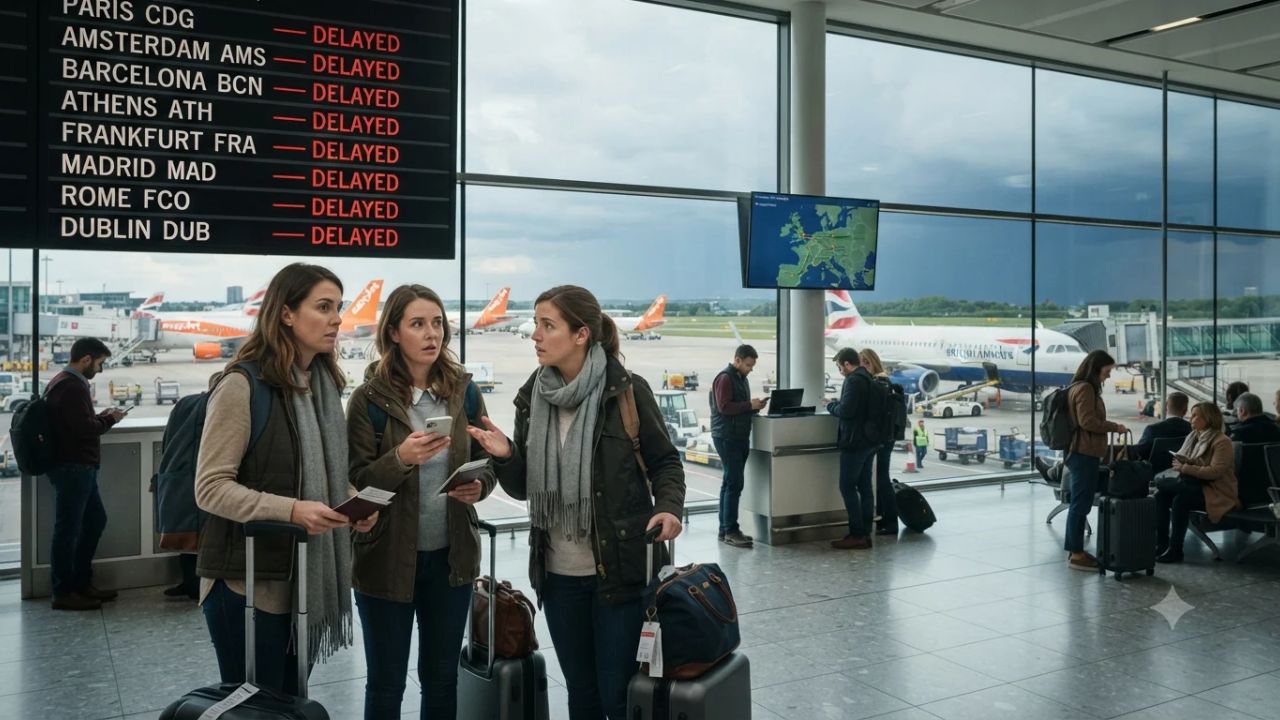
While passengers often look out terminal windows at cloudless blue skies, 60% of all en-route flight delays across Europe stem from air traffic control capacity and staffing constraints rather than stormy weather. When a technical issue surfaced at Scotland's Prestwick control centre on 21 September, operations returned to capacity within hours, yet the resulting ripple effect pushed aircraft rotations and crew schedules off track for days. That incident followed a separate flight-data software fault on 8 September that triggered six hours of airspace restrictions and required more than two full days to clear backlogged passenger schedules.
According to data compiled by EUROCONTROL, European skies managed an average of 35,893 daily flights between 7 and 13 September 2026—a 2.6% increase over the same week in 2025. When airspace reaches peak saturation, ground controllers issue Air Traffic Flow Management (ATFM) departure slots to hold aircraft on tarmac gates rather than sending them into holding patterns overhead, creating cascading schedule delays across hundreds of connecting routes.
The Anatomy of European Airspace Bottlenecks
The concentration of en-route delays across Europe is geographic. During mid-September 2026, four national airspaces accounted for the vast majority of continental bottlenecks: France generated 23% of all en-route delays, Spain contributed 18%, Greece accounted for 12%, and Germany represented 10%.
The operational friction centers around key Area Control Centres (ACCs) managing high-density international transit corridors:
| Area Control Centre (ACC) | Primary Disruption Factors | Network Delay Contribution | Impacted Transit Corridors |
|---|---|---|---|
| Barcelona (Spain) | Persistent daily capacity limits and localized convective storms | Highest individual ACC delay volume | Trans-Iberian and Mediterranean leisure routes |
| Marseille (France) | Sector availability restrictions and controller staffing shortages | Major Western Mediterranean bottleneck | UK/Northern Europe to Spain, Italy, and North Africa |
| Athens & Makedonia (Greece) | Severe staffing constraints amid extended tourist seasons | High concentration across Aegean airspace | Central Europe to Greek Islands and Eastern Mediterranean |
| Belgrade (Serbia) | High traffic volume funnels avoiding closed conflict zones | Southeastern European corridor pinch point | Western Europe to Turkey, Middle East, and Asia |
Summer 2026 recorded 66 all-time daily traffic records across Europe, culminating on 24 July with a historic peak of 37,659 flights. Average daily flights between 1 June and 31 August reached 35,959 (+2.4% vs 2025). Even though ATFM delays dropped by 17% to 3.27 minutes per flight and arrival punctuality rose to 72.6%, approximately 681,000 flights—equaling 21% of all commercial services—still encountered flow management holds.
How Reactionary Delay Multiplies Across Airline Schedules
The core reason an afternoon flight from London to Rome might sit on the tarmac on a sunny day is reactionary delay. In July 2026, European flights departed an average of 18 minutes behind schedule, with reactionary knock-on effects responsible for 8.7 minutes of that total.
When an inbound aircraft receives a 45-minute calculated take-off time (CTOT) slot on its first morning run, that initial hold pushes back baggage handling, aircraft cleaning, passenger boarding, and pilot duty windows on every subsequent sector. Because commercial carriers schedule tight 35-to-50-minute turnarounds at busy hub airports, a single morning restriction in France or Spain inevitably triggers evening cancellations in the United Kingdom or Germany.
To counter unchecked disruption cascades, European aviation authorities expanded the Capacity and Weather-Based Operations program, saving over 3.1 million delay minutes between 1 May and 31 August 2026. A 2026 emergency trigger protocol automatically enforces structured rerouting whenever continental network delays approach 80,000 minutes or an individual control centre nears 20,000 minutes, preventing sudden airspace saturation.
Visitor Insider Tips for Navigating European Air Disruption
- Book Early Morning Departures (Before 08:30 AM): Schedule flights on the first departure wave of the day. Early morning aircraft are already positioned at the gate overnight, meaning they do not suffer from accumulated reactionary delays that plague afternoon and evening services.
- Know Your Immediate Duty of Care Rights: Under UK261 and European passenger rights rules overseen by the UK Civil Aviation Authority and the European Commission, airlines must provide free meals, refreshments, two phone calls or emails, and overnight hotel accommodations with transport if your flight is delayed beyond two to four hours (depending on flight distance), regardless of whether the disruption is caused by weather or extraordinary circumstances.
- Track Inbound Aircraft Registration via Radar Apps: Use live tracking apps like Flightradar24 or FlightAware to check the real-time position of your incoming aircraft (the "Where is my plane coming from?" feature). If the inbound plane is stuck two countries away with an ATFM slot, you can adjust ground plans hours before the gate screen updates.
- Build 3-Hour Connection Windows for Non-Protected Transfers: If booking separate tickets on point-to-point low-cost airlines (like easyJet, Ryanair, or Wizz Air), maintain at least three hours between connections. Unlike codeshare itineraries, self-transfers offer zero protection if your first flight lands late.
- Keep Digital Copies of Boarding Passes and Receipts: Save all meal and hotel receipts if the airline fails to provide vouchers directly during major ground disruptions. You are entitled to reimbursement for reasonable expenses incurred while waiting for re-routed transportation.
Cultural and Environmental Context
Modern European aviation operates under twin imperatives: expanding mobility and aggressive decarbonization. Air traffic inefficiencies do not merely frustrate travelers; en-route holding patterns and detour routings generate millions of tons of excess aviation carbon emissions annually.
Initiatives like the Single European Sky (SES) reform aim to replace fragmented national air corridors with direct trajectory routings, reducing flight times and fuel burn. Concurrently, European governments are investing heavily in high-speed rail corridors, encouraging passengers to switch from short-haul domestic flights to electric rail networks across France, Spain, Germany, and Italy, thereby freeing up congested low-altitude airspace for essential long-haul travel.
FAQ: Visiting Europe Amid Air Delays 2026
Are airlines required to pay compensation for air traffic control delays?
Air traffic control restrictions and technical radar outages are generally classified as extraordinary circumstances, exempting cash compensation, but airlines must always provide meals and accommodation.
What is an ATFM departure slot?
An Air Traffic Flow Management slot is a tactical air traffic control instruction giving an aircraft a specific calculated take-off time to prevent overcrowding in congested airspace.
Can I request a refund if my flight is delayed by over 5 hours?
Yes. Under UK261 and EU261 rules, if a flight delay reaches five hours or more, you have the legal right to abandon the journey and claim a full refund.
How do I check if my delay is eligible for expense reimbursement?
Keep all itemized food, beverage, and accommodation receipts and submit a formal claim directly through the operating carrier's passenger relations portal.
Understanding the invisible web of European airspace gives smart travelers the foresight to navigate flight disruptions with confidence.
Related Travel Guides
- Trinidad and Tobago Declares a Nationwide State of Emergency as Violent Crime Rises, Urging Visitors to Focus on Trinidad Travel Safety and Security: New Travel Alert
- Asia Aviation Disruption: Navigating Flight Delays Across Dubai, Bangkok, and Major Mega-Hubs in 2026
- Australia Issues Urgent Safety Warning as Finke Desert Race Tragedy Sparks Major Investigation, Urging Motorsport Tourists to Exercise Extreme Caution: New Travel Alert
This article is for informational purposes. Flight routes, passenger regulations, visa rules, and transit advisories are subject to change by airlines and aviation authorities. Readers are advised to verify schedules and travel documentation with relevant carriers and border agencies before departure.
Related Stories
Malaysia Enters Northeast Monsoon Season as AirAsia Issues Urgent KLIA Terminal 2 Travel Advisory

Middle East Flight Disruptions: Over 880 Delays and 70 Cancellations Hit Dubai, Doha, and Saudi Airports