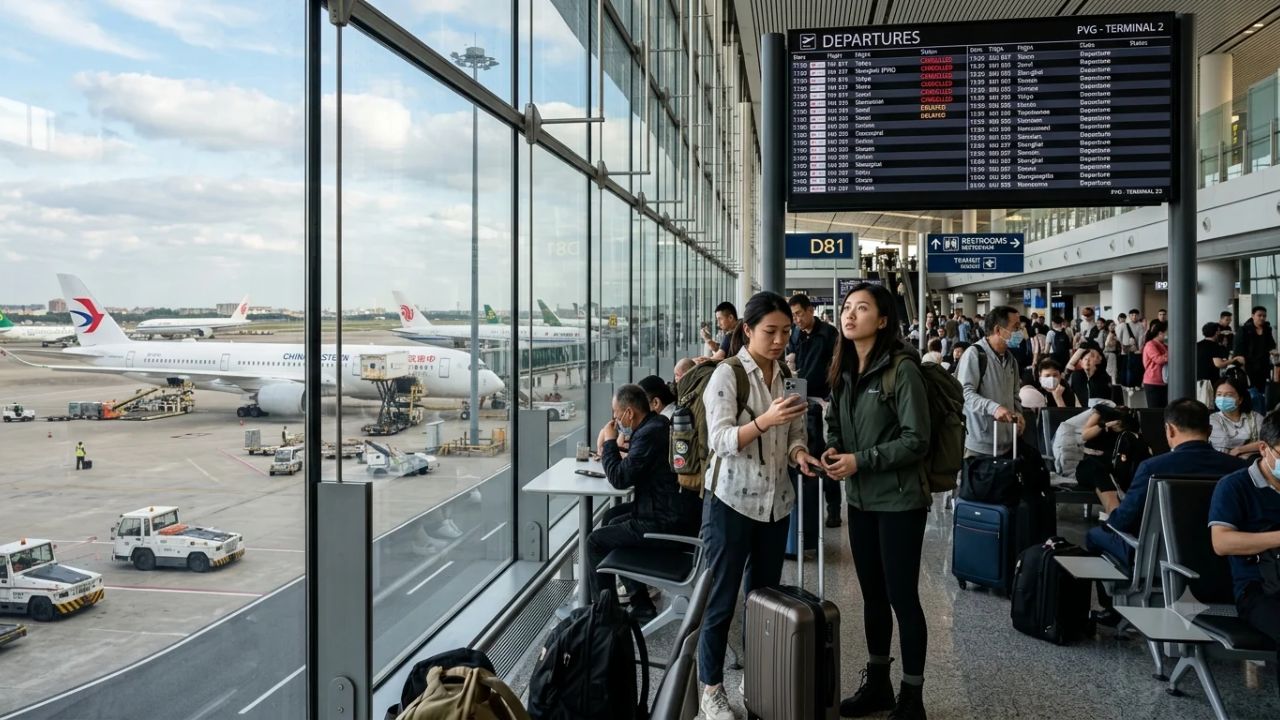
Middle East Flight Disruptions: Over 880 Delays and 70 Cancellations Hit Dubai, Doha, and Saudi Airports


Over 880 flight delays and 70 cancellations were recorded across twelve major Middle Eastern airports as airlines adjust operations to active EASA conflict zone advisories
[DUBAI, Oct 30, 2026] — Commercial aviation corridors across the Arabian Peninsula, the Levant, and neighboring transit gateways have encountered widespread flight schedule disruptions, with official flight-tracking records documenting 883 delays and 70 cancellations across twelve major Middle Eastern airports amid active regional conflict-zone airspace advisories and heightened security alerts.
[!NOTE] Operational Status and Verified Snapshot: Verified aviation tracking data recorded on October 29 at 5:27 pm ET (October 30 at 1:27 am GST) confirms widespread schedule turbulence across the Middle East. Hub operations at Dubai International Airport (DXB) led the region with 206 delays and 9 cancellations, followed by Doha’s Hamad International (DOH) with 141 delays and 3 cancellations, and Istanbul Airport (IST) with 137 delays and 7 cancellations. Saudi Arabian gateways bore the brunt of flight cancellations, led by King Abdulaziz International in Jeddah (116 delays, 18 cancellations) and King Khalid International in Riyadh (18 delays, 17 cancellations). Across seven leading regional carriers, tracking logs registered 513 delays and 32 cancellations, with Air Arabia recording a 27% delay rate, Emirates logging 104 delays (19%), Qatar Airways reporting 117 delays (18%), and Turkish Airlines registering 119 delays (8%). The operational strain coincides with active European Union Aviation Safety Agency (EASA) conflict-zone advisories valid until November 16, 2026, warning of missile, drone, and air-defense activity over the Persian Gulf, the Gulf of Oman, and Saudi Arabia.
MIDDLE EAST AVIATION DISRUPTION ARCHITECTURE (OCTOBER 2026)
| [ REGIONAL DISRUPTION TOTALS: 12 MAJOR AIRPORTS ] |
|---|
| - Peak Delay Epicenters: Dubai (206), Doha (141), Istanbul (137), Jeddah (116) |
| - Peak Cancellation Epicenters: Jeddah (18), Riyadh (17), Dubai (9), Istanbul (7) |
| +----------------------------+-----------------------------+ |
| v v |
| [ UNDERLYING CATALYSTS ] [ AIRLINE NETWORK DISRUPTIONS ] |
| - EASA Conflict Zone Bulletins (CZIB) active to Nov 16 - 7 Major Regional Carriers Tracked |
| - Persian Gulf & Gulf of Oman over-water warnings - Total Airline Delays: 513 Flights |
| - Ballistic missile & drone interceptions in Saudi Arabia - Total Cancellations: 32 Flights |
| - Tactical re-routings & crew duty window expirations - Air Arabia: 27% Delay Rate (Peak) |
| +----------------------------+-----------------------------+ |
| v |
| [ PASSENGER OPERATIONAL MANDATES ] |
| - Verify flight status before terminal departure; do not assume scheduled departure times |
| - Protect separate ticket connections; allow 3- to 4-hour transit buffers at DXB, DOH, and IST |
| - Exercise statutory rebooking and refund options; document all delay notices and extra costs |
The Anatomy of the Regional Aviation Disruption
The modern global air transport system relies on geographic corridors where international flights between Europe, Africa, Asia, and the Americas converge over the Arabian Peninsula and the Eastern Mediterranean. When military activities, air-defense operations, or civil aviation safety warnings restrict these narrow transit channels, the operational impact extends far beyond the immediate airspace, generating flight delays across connecting hubs worldwide.
Geographically, the Middle East serves as the indispensable land-bridge of international civil aviation. Long-haul intercontinental routes connecting Western Europe with Southeast Asia and Australia—frequently referred to in the aviation sector as the Kangaroo Route—rely on predictable transit corridors through the airspace of the Arabian Peninsula. When these airways face disruption, airlines cannot simply alter course without extensive planning. Every detour requires bilateral diplomatic overflight clearances, precise fuel calculations, and coordination with neighboring flight information regions that are often already operating at or near peak air traffic capacity.
A snapshot of verified flight-tracking data compiled on October 29 at 5:27 pm ET (corresponding to October 30 at 1:27 am Gulf Standard Time) revealed that twelve key Middle Eastern airports recorded a combined 883 flight delays and 70 cancellations within a single 24-hour reporting cycle.
Rather than being concentrated at a single airport, the disruption affected airports across the Gulf Cooperation Council (GCC) states, Turkey, and the Levant. Mega-hubs managing large volumes of international connecting traffic—specifically Dubai International (DXB), Hamad International in Doha (DOH), and Istanbul Airport (IST)—recorded the highest total delay figures. Conversely, airport operations across the Kingdom of Saudi Arabia accounted for the largest share of outright flight cancellations, reflecting local security precautions and airspace management directives.
While airline operations teams work to absorb delays through tactical routing adjustments and schedule modifications, the scale of the disruption underscores the continuing vulnerability of commercial aviation corridors in the region. When an intercontinental flight departing London Heathrow or Frankfurt arrives in Dubai or Doha two hours behind schedule, the delay cascades immediately across onward morning departures to Mumbai, Singapore, Bangkok, and Sydney. The complex choreography of hub-and-spoke connectivity breaks down, stranding transit passengers, overloading terminal gate space, and leaving flight crews out of legal duty hours.
AIRPORT-BY-AIRPORT FLIGHT DISRUPTION BREAKDOWN
| Airport Name & IATA Code Delayed Flights Cancelled Flights Operational Profile |
|---|
| -------------------------------------------------------------------------------------------- |
| Dubai International (DXB) 206 9 Regional delay leader |
| Hamad International, Doha (DOH) 141 3 Intercontinental hub |
| Istanbul Airport (IST) 137 7 Connecting gateway |
| King Abdulaziz Intl, Jeddah (JED)116 18 Hajj/Umrah & domestic |
| Ben Gurion Airport, Tel Aviv (TLV)89 1 Eastern Mediterranean |
| King Fahd Intl, Dammam (DMM) 48 4 Eastern Province hub |
| Prince Mohammad, Madinah (MED) 36 2 Religious travel hub |
| Kuwait International (KWI) 33 2 Upper Gulf gateway |
| Muscat International (MCT) 30 2 Oman coastal corridor |
| King Khaled Intl, Riyadh (RUH) 18 17 Capital corporate hub |
| Queen Alia Intl, Amman (AMM) 19 2 Levant transit gateway |
| Abha Regional Airport (AHB) 10 3 Southern domestic hub |
| -------------------------------------------------------------------------------------------- |
| REGIONAL SUMMARY (12 AIRPORTS) 883 DELAYS 70 CANCELLATIONS Widespread impact |
Key Factors Driving Middle East Aviation Disruptions
The widespread flight delays and cancellations across Middle Eastern air corridors stem from two interrelated factors: direct military threats and conservative civil aviation safety warnings issued by international regulators.
1. Missile and Drone Activity Affecting Saudi Arabian Airspace
Saudi Arabian commercial aviation has faced operational pressure resulting from drone and missile activity attributed to Yemen’s Houthi movement.
Official news agency reporting highlighted the scale of the challenge confronting the Kingdom's aviation infrastructure. A Reuters investigation published on October 26, 2026, documented that 4,071 of 4,736 scheduled flights at Riyadh’s King Khalid International Airport (RUH) were cancelled between October 8 and October 25—representing an unprecedented cancellation rate of approximately 86% during that eighteen-day window. Across all Saudi airports combined, more than 7,800 scheduled flights—amounting to 45% of total commercial departures nationwide—were grounded over the same period.
While King Khalid International Airport subsequently resumed partial operations, international carriers have continued to adjust or temporarily suspend schedules based on security assessments. On October 26, Houthi military representatives claimed another targeted drone attack, while the Associated Press reported that Royal Saudi Air Defense forces successfully intercepted ballistic missiles over Riyadh and the Kingdom's Eastern Province.
To safeguard civilian airliners, Saudi civil aviation authorities (GACA) and military air traffic managers periodically institute temporary ground stops, hold incoming aircraft in designated holding patterns, or close specific airway corridors. When an airport as busy as Riyadh or Jeddah experiences a temporary ground stop, aircraft burn holding fuel, flight crews approach maximum legal duty limits, and downstream return flights face delays or cancellations.
2. EASA Conflict-Zone Airspace Advisories (CZIB)
Compounding local security conditions, international airlines operating across the region must comply with conflict-zone information bulletins (CZIBs) issued by the European Union Aviation Safety Agency (EASA) and other civil aviation authorities.
EASA’s official conflict-zone register maintains active safety advisories covering the sovereign airspace of Saudi Arabia, Jordan, Lebanon, Iraq, and Iran, alongside the maritime airspace of the Persian Gulf and the Gulf of Oman. Several of these advisories remain in effect through at least November 16, 2026, subject to periodic security reviews.
The EASA advisory for the Persian Gulf and Gulf of Oman is particularly significant for commercial airlines, as it encompasses the over-water flight paths connecting Bahrain, Kuwait, Qatar, and the United Arab Emirates, along with parts of Oman’s maritime airspace.
EASA recommends that commercial operators avoid designated over-water routes and exercise heightened caution when operating over adjacent landmasses. The safety agency cites specific operational risks:
- The presence of advanced air-defense systems operating in high-readiness states, creating potential risks of misidentification.
- Low-altitude and medium-altitude military drone flights and ballistic missile trajectories that can cross commercial airway tracks without prior notice.
- Falling military debris resulting from mid-air missile interceptions.
- Rapidly changing airspace restrictions that require aircraft in flight to make sudden, unplanned diversions.
To comply with these safety bulletins, international airlines must reroute flights around restricted flight information regions (FIRs). Flying around closed airspace extends flight times by 45 to 90 minutes, consumes additional jet fuel, and strains airport departure and arrival slot sequences across Europe and Asia.
Airport Disruptions: Hub Delays and Saudi Cancellations
Analyzing flight-tracking data reveals distinct regional patterns in how airports were affected.
REGIONAL HUBS VS. SAUDI DOMESTIC CANCELLATION RATIOS
| - Dubai International (DXB): 206 Delays (23% of regional total) | 9 Cancellations (0% rate) |
|---|---|
| - Hamad International (DOH): 141 Delays (16% of regional total) | 3 Cancellations (0% rate) |
| - Istanbul Airport (IST): 137 Delays (15% of regional total) | 7 Cancellations (0% rate) |
| - 5 Saudi Airports (JED, RUH, DMM, MED, AHB): 228 Delays | 44 Cancellations (63% of regional) |
| - King Abdulaziz, Jeddah: 116 Delays | 18 Cancellations (1% origin / 2% destination cancel rate) |
| - King Khaled, Riyadh: 18 Delays | 17 Cancellations (4% origin / 2% destination cancel rate) |
| - King Fahd, Dammam: 48 Delays | 4 Cancellations (1% origin / 1% destination cancel rate) |
| - Prince Mohammad, Madinah:36 Delays | 2 Cancellations |
| - Abha Regional Airport: 10 Delays | 3 Cancellations (5% origin cancellation rate) |
The Hub Delay Leaders: Dubai, Doha, and Istanbul
The three largest connecting hubs in the broader region—Dubai, Doha, and Istanbul—accounted for 484 delays, or nearly 55% of all delays recorded across the twelve airports.
- Dubai International (DXB): As the world's busiest airport for international passenger traffic, Dubai recorded 206 delayed flights alongside 9 cancellations. While cancellations remained low, delays were widespread across long-haul arrivals and departures. Long-haul aircraft arriving from Europe and North America had to navigate extended flight tracks around restricted airspace, arriving late into Dubai and delaying downstream departures to South Asia and Australia.
- Hamad International in Doha (DOH): Qatar Airways' primary base logged 141 delayed flights and 3 cancellations. The airport experienced arrival delays as incoming aircraft followed circuitous southern routes across the Arabian Sea and Oman to enter Qatari airspace.
- Istanbul Airport (IST): Serving as a primary crossroads connecting Europe, Africa, and the Middle East, Istanbul Airport recorded 137 delays and 7 cancellations, primarily affecting regional feeder services heading into the Levant and the Gulf.
Saudi Arabian Airports: Bearing the Brunt of Cancellations
In contrast to the major connecting hubs, Saudi Arabia's airports accounted for 44 of the 70 cancellations recorded across the region—nearly 63% of the total:
- Jeddah (JED): King Abdulaziz International Airport recorded 116 delays and 18 cancellations, the highest cancellation total of any single airport in the dataset. Because Jeddah handles high volumes of religious pilgrims traveling for Umrah alongside domestic transit passengers, flight cancellations required substantial passenger re-accommodation.
- Riyadh (RUH): King Khalid International Airport registered 18 delays and 17 cancellations, with an origin cancellation rate of 4% and a destination cancellation rate of 2%. The high cancellation count reflects ongoing schedule adjustments by foreign and domestic carriers following recent security developments.
- Dammam (DMM): King Fahd International Airport in the Eastern Province recorded 48 delays and 4 cancellations, influenced by airspace advisories covering the Persian Gulf.
- Madinah (MED) and Abha (AHB): Prince Mohammad Bin Abdulaziz International in Madinah logged 36 delays and 2 cancellations, while Abha Regional Airport in the southwest reported 10 delays and 3 cancellations, registering an origin cancellation rate of 5%.
Secondary Gulf and Levant Gateways
Elsewhere in the region, secondary hubs experienced moderate operational friction:
- Kuwait International Airport (KWI): Recorded 33 delays and 2 cancellations.
- Muscat International Airport (MCT): Reported 30 delays and 2 cancellations.
- Queen Alia International Airport in Amman (AMM): Logged 19 delays and 2 cancellations.
- Ben Gurion Airport in Tel Aviv (TLV): Recorded 89 delays and 1 cancellation.
- Bahrain International Airport (BAH): Registered a 4% origin cancellation rate and a 4% destination cancellation rate.
Airline Impact Analysis: Regional Carriers Navigate Complex Airspace
Aviation tracking data across seven prominent regional carriers recorded a combined 513 delays and 32 cancellations within the reporting window, illustrating how route networks experienced differing levels of disruption.
REGIONAL AIRLINE OPERATIONAL PERFORMANCE COMPARISON
| Airline Operator Delayed Flights Delay Share (%) Cancelled Flights Cancel % |
|---|
| -------------------------------------------------------------------------------------------- |
| Turkish Airlines 119 8% 3 0% |
| Qatar Airways 117 18% 3 0% |
| Emirates 104 19% 2 0% |
| Saudia 88 16% 11 2% |
| Air Arabia 63 27% (Highest) 1 0% |
| Gulf Air 12 8% 10 6% |
| Royal Jordanian 10 7% 2 1% |
| -------------------------------------------------------------------------------------------- |
| TOTAL (7 AIRLINES) 513 DELAYS -- 32 CANCELLATIONS -- |
1. Turkish Airlines (119 Delays, 3 Cancellations)
Turkish Airlines recorded the highest absolute delay count among the tracked airlines, with 119 flights delayed. However, because the carrier operates an extensive global network comprising hundreds of daily flights from its Istanbul hub, its delay rate was a relatively modest 8%, with cancellations held to just 0.3%. The airline absorbed delays primarily on regional routes serving Iraq, Jordan, and the Gulf states.
2. Qatar Airways (117 Delays, 3 Cancellations)
Qatar Airways registered 117 delays, representing 18% of its scheduled operations, alongside 3 cancellations (0%). Because Doha's geographic location requires aircraft to traverse specific regional airspace corridors, flights arriving from Europe and the Americas experienced en-route delays, which affected connection windows for departing flights to the Asia-Pacific region.
3. Emirates (104 Delays, 2 Cancellations)
Emirates logged 104 delayed flights, representing 19% of its scheduled services, with only 2 cancellations. Operating an all-widebody fleet of Airbus A380 and Boeing 777 aircraft, Emirates absorbed en-route delays by adjusting flight tracks over Egypt and Saudi Arabia, prioritizing flight completion while managing ground turnaround schedules in Dubai.
4. Saudia (88 Delays, 11 Cancellations)
Saudi Arabia's national carrier recorded 88 delays (16% of operations) and 11 cancellations (2%). Saudia’s cancellation total was the highest among the major network carriers in the dataset, reflecting local operational adjustments, temporary airspace closures, and schedule consolidations across domestic and regional routes connecting Riyadh, Jeddah, and Abha.
5. Air Arabia (63 Delays, 1 Cancellation)
Sharjah-based low-cost carrier Air Arabia recorded 63 delays and 1 cancellation. While its absolute delay count was lower than that of the legacy carriers, its delay rate reached 27%—the highest in the airline dataset. Because low-cost carriers operate on tight aircraft turnaround schedules (often 30 to 45 minutes between flights), an en-route delay on an initial morning sector tends to cascade across the aircraft's remaining flights throughout the day.
6. Gulf Air and Royal Jordanian
- Gulf Air: Bahrain’s national carrier reported 12 delays (8%) and 10 cancellations, representing a cancellation rate of 6%—the highest cancellation percentage among the tracked airlines.
- Royal Jordanian: The Amman-based carrier registered 10 delays (7%) and 2 cancellations (1%), managing localized flight tracks around the Levant.
Flight Dispatcher Logistics: Fuel Penalties, ETOPS Routing, and Crew Rest Limitations
Behind every delayed arrival board in Dubai, Doha, or Riyadh lies an intricate operational puzzle managed by airline flight dispatchers and operations control centers. When sovereign airspace corridors close or regulatory bodies issue conflict-zone advisories, dispatchers must redesign flight profiles in real time. These modifications involve complex calculations balancing aircraft gross weight, fuel capacity, divert airfields, and crew duty limits.
Fuel Penalties and Payload Trade-offs
When European flights bound for the Gulf or Southeast Asia must steer clear of designated conflict zones over the Persian Gulf or the northern Levant, flight times increase by anywhere from 45 to 90 minutes. Under International Civil Aviation Organization standards and national civil aviation frameworks, commercial airliners cannot depart without a comprehensive fuel safety reserve.
A flight plan must incorporate taxi fuel, trip fuel, contingency fuel (typically calculated as 5% of trip fuel or enough for 20 minutes of additional flight), alternate airport diversion fuel, and final reserve holding fuel (sufficient for 30 to 45 minutes of holding at 1,500 feet above the alternate aerodrome). When an aircraft must fly an extended detour, every additional hour aloft burns between 2,500 and 3,500 kilograms of jet fuel on twin-aisle widebody aircraft like the Boeing 787 or Airbus A350.
Carrying extra fuel introduces a compounding operational penalty: aircraft burn additional fuel simply to transport the extra fuel weight. On densely booked intercontinental flights or ultra-long-haul sectors, the requirement to load several tons of contingency fuel can push the aircraft up against its maximum structural takeoff weight or maximum landing weight. To comply with safety regulations, flight operations teams are occasionally forced to impose payload restrictions, offloading non-critical commercial cargo or refusing standby passenger bookings to ensure the aircraft remains safely within legal weight envelopes.
ETOPS Routing and Alternate Aerodrome Availability
Aviation safety rules governing twin-engine airliners—known as Extended-range Twin-engine Operational Performance Standards—require aircraft flying over water or remote terrain to remain within a certified flying time of an approved diversion airport in the event of an engine failure or cabin depressurization.
When military alerts or civil aviation notices restrict airspace over the Persian Gulf, the Gulf of Oman, or parts of the Red Sea, the pool of accessible en-route diversion airports shrinks. Commercial dispatchers must evaluate whether designated diversion fields—such as Muscat International, Salalah, or Cairo International—possess the operational capacity, fire-rescue category, and ground-handling capability to accommodate widebody diversions. If an intended alternate airport becomes unavailable due to local military alerts or runway congestion, dispatchers must plan more conservative, southerly routes over Oman or Egypt, lengthening journey times and increasing schedule unpredictability.
Flight Crew Duty Periods and Legal Rest Limits
Air safety is strictly anchored to pilot and cabin crew alertness. Regulations enforced by EASA, the United States Federal Aviation Administration, and the Saudi General Authority of Civil Aviation establish rigid statutory limits on Flight Duty Periods. Under these rules, a standard two-pilot crew operating an international daytime flight is typically restricted to a maximum duty window of 11 to 13 hours.
When an inbound aircraft experiences unexpected holding patterns, taxi delays, or tactical re-routings, flight crews can easily reach their maximum allowable duty hours before reaching their destination or before initiating the return flight. Aviation law prohibits pilots from extending duty limits except under strictly regulated operational discretion for flight completion. Once an aircraft lands after an extended duty day, the operating crew must receive a mandatory statutory rest period, matching or exceeding the duration of the preceding duty period (a minimum of 10 to 12 hours of uninterrupted rest).
In practice, this means an aircraft that lands safely in Jeddah, Riyadh, or Dubai cannot immediately turn around for its scheduled return flight if the inbound crew has exceeded legal duty limits. Unless the airline maintains dedicated reserve flight crews stationed at the destination hub, the aircraft must remain parked on the tarmac until the crew completes mandatory rest. This dynamic explains why flight cancellations and rolling schedule delays frequently continue for 24 to 48 hours after an initial airspace disruption occurs.
Practical Passenger Guidance: Navigating Regional Flight Disruptions
For business travelers, holidaymakers, and religious pilgrims traveling through or within the Middle East during periods of operational disruption, proactive planning can prevent missed connections and stranded itineraries.
PASSENGER ACTIONABLE DISRUPTION SURVIVAL GUIDE
| Column 1 |
|---|
| [ 1. PRE-DEPARTURE VERIFICATION ] |
| - Check official airline mobile apps (Saudia, Emirates, Qatar, Turkish) for real-time status |
| - Enable push notifications for gate changes, departure updates, and aircraft inbound tracking |
| - Do not travel to the airport if your flight is canceled; manage rebooking online |
| [ 2. CONNECTING ITINERARIES & MINIMUM CONNECTION TIMES (MCT) ] |
| - Standard MCTs (60-90 minutes) are insufficient during regional airspace reroutings |
| - Ensure connecting layovers at DXB, DOH, or IST are at least 3.0 to 4.5 hours |
| - If an initial flight is delayed, request immediate rebooking to a later connecting service |
| [ 3. THE SEPARATE TICKET HAZARD ] |
| - Flying on two separate tickets (e.g., LCC feeder + long-haul carrier) carries 100% risk |
| - Downstream airlines treat missed connections on separate bookings as voluntary no-shows |
| - Protect separate journeys by purchasing flexible fares or booking through-tickets (single PNR) |
| [ 4. DOCUMENTATION & EXPENSE RETENTION ] |
| - Screenshot boarding passes, cancellation notices, and official delay timestamps |
| - Keep all itemized receipts for meals, airport hotels, and ground transport for claims |
1. Monitor Flight Status Before Leaving for the Airport
During periods of rolling flight delays, scheduled departure times displayed on third-party travel sites can lag behind operational reality. Passengers should monitor the official mobile application of their operating airline or use real-time flight tracking platforms to check whether their assigned aircraft has departed its previous station. If a flight is officially canceled, passengers should avoid traveling to the airport terminal, where customer service counters face long queues, and instead contact airline call centers or use digital rebooking portals.
2. Allow Extra Time for Connecting Flights
Standard Minimum Connection Times (MCT)—which can be as short as 60 to 75 minutes at modern hubs like Doha Hamad or Dubai—provide little buffer when incoming aircraft must fly extended diversion routes. When booking travel through Middle Eastern hubs, travelers should select itineraries with layovers of at least three to four hours. A longer connection window allows travelers to absorb en-route flight diversions without missing their onward flights.
3. Manage the Risks of Separate Tickets
A major source of financial loss during airline disruptions occurs when travelers book connecting journeys on separate, unlinked tickets—for example, flying a regional carrier into Dubai or Riyadh and connecting onto a long-haul flight on a different airline.
If the initial flight is delayed or canceled, the second airline is under no legal obligation to rebook the passenger or issue a refund, treating the missed flight as a voluntary "no-show." Whenever possible, travelers should book their entire itinerary on a single ticket (a single Passenger Name Record). A single ticket ensures that the issuing airline is legally responsible for re-accommodating the traveler to their final destination if an intermediate connection is missed.
4. Know Your Rebooking and Compensation Rights
Passenger rights protections vary significantly depending on where your flight originates, the flag carrier operating the service, and the governing legal jurisdiction.
Under European Union Regulation (EC) No 261/2004 and the corresponding United Kingdom regulatory framework, passengers departing from European airports or flying into Europe on European Community carriers possess robust statutory protections. When flight cancellations or severe delays arise from military actions, missile threats, or official civil aviation airspace closures, airlines are exempt from paying fixed statutory cash compensation (which normally ranges from €250 to €600) under the legal defense of extraordinary circumstances. However, passenger advocates emphasize that the defense of extraordinary circumstances does not relieve airlines of their non-waivable duty of care under Article 9. Regardless of the underlying cause, airlines remain legally obligated to supply passengers with complimentary meals and refreshments commensurate with waiting times, free communications, and hotel accommodation when an overnight stay or additional night becomes necessary, including ground transportation between the airport and the lodging facility. In addition, under Article 8, passengers retain the absolute right to choose between an immediate cash refund within seven days or re-routing to their final destination at the earliest opportunity under comparable transport conditions.
Within the Gulf region, passenger rights are overseen by national authorities such as the Saudi General Authority of Civil Aviation and the United Arab Emirates General Civil Aviation Authority. GACA's Executive Regulations for Passenger Rights Protection establish stringent operational mandates for flights departing from or arriving into Saudi airports. If a flight experiences a delay exceeding three hours, operating carriers must provide passengers with appropriate food and beverage options. If the delay extends past six hours, airlines are required to arrange hotel accommodation and airport transfers. In the event of a flight cancellation, GACA regulations mandate that the airline must provide the passenger with an alternative flight on the same day or a full refund of the ticket value, along with compensation if the airline fails to provide adequate statutory notice.
Travelers should also examine the specific provisions of their comprehensive travel insurance policies. Standard single-trip travel policies frequently exclude losses arising directly or indirectly from war, warlike operations, civil commotion, or airspace closures declared by military authorities. To obtain protection against sudden regional itinerary disruptions, frequent international travelers increasingly rely on Cancel For Any Reason (CFAR) travel insurance riders or premium credit card travel protections that offer reimbursement for non-refundable hotel reservations, connecting rail tickets, and independent tour bookings when government security advisories disrupt scheduled travel plans.
Throughout any disruption, travelers must methodically preserve documentation. Always retain electronic boarding passes, delay notifications sent via SMS or mobile applications, and itemized receipts for hotel rooms, meals, and ground transit. Having detailed documentation is essential when filing insurance claims or requesting airline expense reimbursements.
Strategic Outlook: The Future of Middle Eastern Air Corridors
The 883 delays and 70 cancellations recorded across Middle Eastern airports demonstrate the interconnected nature of modern commercial aviation. While major hubs like Dubai, Doha, and Istanbul possess the operational infrastructure to manage flight delays and keep passengers moving, persistent airspace restrictions over parts of the Levant, the Red Sea, and the Persian Gulf continue to complicate schedule reliability.
For airlines operating in the region, managing these disruptions involves ongoing coordination between corporate safety committees, national civil aviation authorities, and military air traffic controllers. Rerouting aircraft, repositioning reserve crews, and managing passenger flows will remain central to airline operations until regional security conditions stabilize and international airspace advisories are eased.
For international travelers, flexibility and preparation remain the most effective tools for managing travel across the region. By monitoring real-time flight data, selecting itineraries with comfortable connection times, and staying informed about airline rebooking policies, passengers can minimize disruptions and navigate Middle Eastern travel corridors safely.
Frequently Asked Questions (PAA)
Why were over 880 flights delayed across Middle Eastern airports?
Flight delays across twelve Middle Eastern airports resulted from active European Union Aviation Safety Agency (EASA) conflict-zone advisories, regional security conditions, and tactical airspace restrictions. Commercial airliners flying between Europe, Asia, and the Gulf had to navigate extended diversion routes around restricted airspace over parts of the Persian Gulf, the Gulf of Oman, and Saudi Arabia, leading to arrival delays and compressed turnaround schedules.
Which Middle Eastern airports recorded the most delays and cancellations?
Dubai International Airport (DXB) recorded the highest number of delays in the region with 206 delayed flights, followed by Hamad International Airport in Doha (141 delays) and Istanbul Airport (137 delays). King Abdulaziz International Airport in Jeddah recorded the highest number of cancellations with 18, followed closely by King Khalid International Airport in Riyadh with 17 cancellations.
Are airports in Saudi Arabia, Dubai, and Doha currently open?
Yes. Major international airports across the Middle East—including Dubai International (DXB), Hamad International in Doha (DOH), Istanbul Airport (IST), and Saudi Arabian hubs in Riyadh (RUH) and Jeddah (JED)—remain open and operational. While schedules have experienced rolling delays and selective cancellations, regular commercial flight operations continue across the region.
What should I do if my flight through Dubai, Doha, or Riyadh is delayed or canceled?
Check your flight status directly through your operating airline's mobile app or official website before traveling to the airport. If your flight is canceled, use the airline’s digital rebooking tools to select alternative travel dates or request a full refund. If you are already at the airport, speak with customer service agents to secure meal vouchers, hotel accommodations, or rebooking onto partner carriers.
Do airlines pay compensation for flight cancellations caused by regional security issues?
Under most international aviation regulations, including European Union Regulation (EC) No 261/2004, airlines are exempt from paying fixed statutory cash compensation if cancellations are caused by "extraordinary circumstances" beyond their control, such as active conflict zones, military actions, or sovereign airspace closures. However, airlines remain legally required to offer passengers a choice between a full refund or alternative rerouting, and must provide basic duty of care (meals, refreshments, and hotel accommodation during extended delays).
Related Travel Guides
This article is for informational purposes. Flight routes, passenger regulations, visa rules, and transit advisories are subject to change by airlines and aviation authorities. Readers are advised to verify schedules and travel documentation with relevant carriers and border agencies before departure.
Related Stories

Switzerland Leads US, UK, and EU in Escalating Middle East Travel Advisories as SWISS Halts Dubai Flights Over Aviation Security Risks
US State Department Worldwide Caution Alert 2026: Impact on Middle East Aviation and Travel Insurance