
Hundreds of Travelers Impacted Throughout Asia as 177 Cancelled and 3,487 Delayed Flights at Hong Kong, Abu Dhabi and More Airports
Over 3,487 delayed flights and 177 cancellations paralyze major aviation hubs across Asia and the Gulf, exposing critical rotational vulnerabilities.

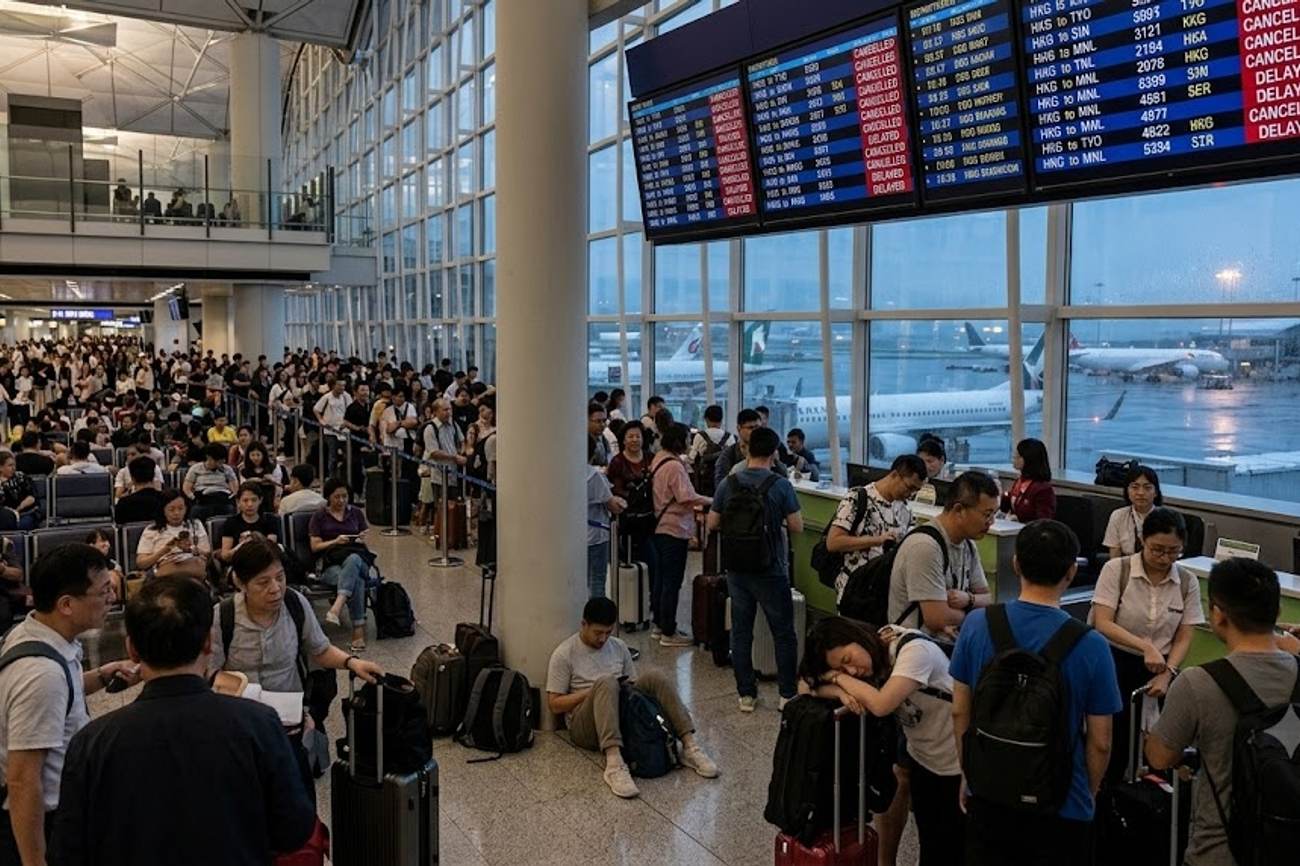
Image generated by AI
A massive operational bottleneck across the Asia-Pacific and Gulf aviation corridors triggered 3,487 flight delays and 177 cancellations within a single 24-hour cycle, stranding hundreds of international travelers and severely straining intercontinental connections. Recorded on September 19, 2026, by real-time airspace monitoring networks, this systemic disruption follows on the heels of the previous day's tally of 4,331 delays and 241 cancellations, underscoring acute operational fragility across premier aviation hubs including Delhi, Shanghai, Tokyo, Jakarta, and Abu Dhabi. A convergence of localized convective weather, saturated air traffic control slots, compressed aircraft turnaround times, and severe rotational displacement has created an escalating domino effect that leaves connecting passengers with truncated transfer windows and widespread missed itineraries.
As civil aviation networks operate near peak post-pandemic capacity, the tolerance for operational variance has diminished to near zero. A minor surface delay at a primary gateway now compounds geometrically as aircraft cycle through multi-leg daily rotations. From the northern gateways of Tokyo Haneda and Beijing Capital to the equatorial hubs of Jakarta Soekarno-Hatta and Kuala Lumpur, international airlines are struggling to reposition out-of-sequence flight crews and aircraft frames, transforming regional schedule slippage into a multi-continental passenger crisis.
Network Fragility: Saturated Corridors and Rotational Cascade Failures
The scale of the current disruption exposes structural vulnerabilities within the global hub-and-spoke transit model. Modern commercial aviation depends on tight turnarounds where narrowbody aircraft frequently operate six to eight short-haul legs per day, and long-haul widebody jets operate continuous international loops with minimal ground buffer. When unfavorable atmospheric conditions or ground handling shortages delay an initial morning departure at a primary facility like Shanghai Pudong or Delhi Indira Gandhi International, that single frame remains chronically behind schedule for the remainder of its operating day.
Compounding this rotational friction is the extreme concentration of airspace demand across Asian transit corridors. According to real-time flight telemetry verified by FlightAware at 3:22 pm ET on September 19, 2026 (11:22 pm GST), schedule deviations accelerated during afternoon departure banks across India, Greater China, and Southeast Asia. When departure slots at high-density facilities like Tokyo Haneda or Hong Kong International are missed, air traffic controllers must assign delayed aircraft to secondary holding patterns, generating fuel burn penalties and triggering mandatory crew rest timeouts that force carriers into emergency flight cancellations.
Industry oversight bodies, including the International Air Transport Association (IATA), have repeatedly cautioned that rapid fleet re-expansion without corresponding investments in air traffic management automation and ground service staffing creates systemic bottlenecks. In this environment, regional weather events that would ordinarily produce localized delays now trigger continent-wide ripple effects, grounding aircraft thousands of miles away from the initial storm front.
Hub and Carrier Disruption Audit: Quantifying Delays, Cancellations, and Failure Rates
The operational failure manifested unevenly across Asian and Middle Eastern facilities, with specific megahubs absorbing disproportionate delay volumes while others suffered high cancellation frequencies.
| Airport Gateway Hub | IATA Code | Flight Delays Logged | Flight Cancellations Logged | Primary Disruption Catalyst |
|---|---|---|---|---|
| Indira Gandhi International (Delhi) | DEL | 280 Delays | 7 Cancellations | Saturated runway slots & domestic carrier rotation delays |
| Shanghai Pudong International | PVG | 270 Delays | 6 Cancellations | Airspace slot restrictions & inbound aircraft hold patterns |
| Jakarta Soekarno-Hatta International | CGK | 220 Delays | 24 Cancellations | Severe carrier fleet displacement & localized weather |
| Tokyo Haneda Airport | HND | 209 Delays | 7 Cancellations | High domestic frequency pressure & flow control restrictions |
| Tan Son Nhat International (Ho Chi Minh) | SGN | 181 Delays | 3 Cancellations | Terminal apron congestion & convective storms |
| Kuala Lumpur International | KUL | 177 Delays | 4 Cancellations | Connecting hub delays & regional feeder displacement |
| Hong Kong International | HKG | 126 Delays | 2 Cancellations | Typhoon-adjacent wind shear alerts & transit holds |
| Guangzhou Baiyun International | CAN | 93 Delays | 11 Cancellations | Pearl River Delta convective activity & slot holds |
| Shanghai Hongqiao International | SHA | 83 Delays | 5 Cancellations | Domestic trunk route cascading delays |
| Beijing Capital International | PEK | 81 Delays | 11 Cancellations | Flow control restrictions & northern weather systems |
| Chengdu Tianfu International | TFU | 62 Delays | 3 Cancellations | Regional feeder sequencing holds |
| Cochin International Airport | COK | 24 Delays | 2 Cancellations | Peninsular feeder delays connecting through northern hubs |
Concurrently, carrier-level metrics revealed sharp disparities in operational resilience, with several budget and regional airlines registering catastrophic on-time degradation.
| Airline Carrier | Country of Origin | Flight Cancellations | Flight Delays | Delay Percentage Rate | Cancellation Rate |
|---|---|---|---|---|---|
| China Eastern Airlines | China | 18 Cancellations | 215 Delays | 9% Delay Rate | Highest absolute cancellations |
| Air China | China | 10 Cancellations | 107 Delays | Normal baseline band | Elevated cancellation volume |
| China Southern Airlines | China | 4 Cancellations | 91 Delays | 4% Delay Rate | Moderate fleet absorption |
| Batik Air | Indonesia | 15 Cancellations | 55 Delays | 18% Delay Rate | 4% Cancellation Rate |
| Citilink | Indonesia | 8 Cancellations | 45 Delays | Mid-tier regional impact | Island route consolidation |
| Garuda Indonesia | Indonesia | 3 Cancellations | 32 Delays | Controlled domestic buffer | Flagship route prioritization |
| TransNusa | Indonesia | 1 Cancellation | 11 Delays | Secondary route impact | Isolated operational hold |
| SpiceJet | India | 9 Cancellations | 29 Delays | 42% Delay Rate | 13% Cancellation Rate (Worst recorded) |
| Akasa Air | India | 4 Cancellations | 12 Delays | 7% Delay Rate | Targeted narrowbody resets |
| Saudia | Saudi Arabia | 6 Cancellations | 221 Delays | 41% Delay Rate | Extensive Gulf transit slippage |
| Flynas | Saudi Arabia | 2 Cancellations | 119 Delays | 37% Delay Rate | Severe low-cost schedule strain |
| VietJet Air | Vietnam | 1 Cancellation | 159 Delays | 38% Delay Rate | Dense domestic corridor slippage |
| Vietnam Airlines | Vietnam | 2 Cancellations | 72 Delays | 19% Delay Rate | Moderate international buffer |
| Turkish Airlines | Türkiye | 2 Cancellations | 143 Delays | 8% Delay Rate | Long-haul rotation delays |
| Qatar Airways | Qatar | 2 Cancellations | 69 Delays | 11% Delay Rate | Doha connecting bank adjustments |
| FlyDubai | UAE | 4 Cancellations | 40 Delays | 13% Delay Rate | Gulf regional feeder compression |
| Air Arabia | UAE | 3 Cancellations | 41 Delays | 17% Delay Rate | Point-to-point schedule slippage |
| All Nippon Airways (ANA) | Japan | 2 Cancellations | 115 Delays | Trunk line flow controls | High domestic connection volume |
| ANA Wings | Japan | 5 Cancellations | 71 Delays | Regional island buffer strain | Feeder connection timeouts |
Greater China: Mass Cancellations Across the Eastern Seaboard
In China, the disruption was characterized by intense volume concentration across Shanghai, Beijing, Guangzhou, Shenzhen, Chengdu, Chongqing, and Nanjing. China Eastern recorded the single highest cancellation total in the entire dataset, canceling 18 flights while enduring 215 delays. Combined with Air China's 10 cancellations and China Southern's 4 cancellations, mainland carriers accounted for a significant share of the total regional grounding. Because Chinese airspace is strictly managed with tight civil aviation corridors, convective weather across the Yangtze River Delta quickly paralyzed operations at both Shanghai Pudong (270 delays) and Hongqiao (83 delays), trapping aircraft on taxiways for hours.
South Asia: Saturated Runways and Extreme Low-Cost Strain
In India, Indira Gandhi International Airport in Delhi emerged as the most severely delayed airport in Asia, recording 280 delays alongside 7 cancellations. The capital's congested runway layout struggled to absorb off-schedule arrivals, which rapidly overwhelmed regional carriers. SpiceJet posted the worst reliability metrics in the continent: an alarming 42% delay rate and a 13% cancellation rate across its operational schedule. In southern India, Cochin International Airport registered 24 delays and 2 cancellations, illustrating how aircraft cycling through northern hubs exported operational delays into peninsular transit routes.
Southeast Asia: Jakarta's Cancellation Crisis and Indochina Delays
Jakarta Soekarno-Hatta International Airport recorded 24 cancellations—the highest single-airport cancellation tally in Asia—alongside 220 delayed departures. Indonesia's domestic aviation network suffered immediate fractures, with Batik Air forced to cancel 15 flights while suffering an 18% delay rate, and Citilink canceling 8 flights. In Vietnam, Tan Son Nhat International Airport in Ho Chi Minh City logged 181 delays, with budget operator VietJet Air registering 159 delays (a 38% delay rate), proving that low-cost carriers operating minimal turnaround times have virtually no capacity to recover once regional airspace slows.
The Gulf Super-Connectors: Westbound Transit Disruption
The disruption reverberated directly into the Middle Eastern mega-hubs that bridge Asia with Europe and Africa. In Saudi Arabia, Saudia experienced severe operational degradation, posting 221 delays and 6 cancellations to yield a 41% delay rate, while low-cost operator Flynas suffered 119 delays (a 37% delay rate). Regional Gulf feeders including FlyDubai (40 delays, 4 cancellations) and Air Arabia (41 delays, 3 cancellations) faced connecting bank failures, while Qatar Airways and Turkish Airlines logged 69 and 143 delays respectively. Because Asian transit passengers rely heavily on two-hour connection windows in Doha, Dubai, and Istanbul, these delays guaranteed widespread missed intercontinental connections.
Expert Analysis: The Economics of Rotational Gridlock and Connecting Risks
For travelers booking this route, the direct consequence of interconnected network failures is an abrupt collapse in transfer reliability at mid-route connecting hubs. When an airline operates with a 38% to 42% delay rate—as documented with SpiceJet, Saudia, and VietJet—a standard ninety-minute international layover becomes statistically unviable. Passengers who booked tight connections through Delhi, Shanghai Pudong, Jakarta, or Kuala Lumpur found their outbound flights departing before their inbound aircraft reached the gate, stranding them in transit zones without immediate accommodation options.
The pricing pressure this creates means that same-day and next-day rebooking alternatives become prohibitively expensive. When 177 flights are scrubbed and thousands are delayed, passenger queues immediately flood airline customer service desks seeking seat reassignments. In markets where passenger load factors routinely exceed 85%, surviving flights have very little spare capacity to absorb displaced travelers. Consequently, distressed passengers seeking independent flights on competing airlines face astronomical walk-up ticket fares, while regional hotel rooms flanking major airports command aggressive surge pricing.
From an operational perspective, the vulnerability of modern ultra-lean airline operations has been laid bare. To maximize return on invested capital, airlines minimize ground time, scheduling aircraft turnarounds in as little as 35 to 45 minutes for narrowbodies. While this maximizes daily flight utilization, it eliminates the operational buffer required to absorb air traffic control flow restrictions. When an airline like China Eastern or Batik Air experiences double-digit cancellations, aircraft and flight crews end up out of position across multiple outstations. Resetting this logistical matrix requires days of empty ferry flights and deadheading crew rotations, meaning the schedule hangover will persist long after initial weather clears.
In parallel, international passenger rights protections vary widely across the affected jurisdictions, creating significant legal disparities for stranded travelers. Under Indian civil aviation regulations overseen by the Directorate General of Civil Aviation (DGCA), passengers delayed beyond specified thresholds are entitled to refreshments and alternative transport, but compensation for operational delays deemed extraordinary or weather-induced is routinely denied. Similarly, passengers traversing Chinese or Indonesian hubs often find that complimentary hotel accommodations are provided only under specific carrier-fault definitions. Travelers who failed to secure comprehensive independent travel insurance face total out-of-pocket exposure for unexpected overnight layovers, missed cruise departures, and non-refundable lodging reservations across their destination itineraries.
Key Takeaways
- Severe aviation network disruptions across Asia and the Gulf resulted in 3,487 delayed flights and 177 cancellations on September 19, 2026, following 4,331 delays the preceding day.
- Delhi Indira Gandhi International led the continent in delays with 280 delayed flights, while Jakarta Soekarno-Hatta suffered the highest cancellation volume at 24 groundings.
- China Eastern logged the highest carrier cancellations (18 flights), while India's SpiceJet recorded the worst reliability breakdown with a 42% delay rate and 13% cancellation rate.
- Gulf transit carriers including Saudia (221 delays, 41% rate) and Flynas (119 delays, 37% rate) suffered severe schedule slippage, disrupting connections to Europe and Africa.
- Travelers navigating Asian hubs must avoid tight transfer windows under two hours, carry essential medication in cabin baggage, and maintain real-time flight tracking via official airline applications.
FAQ: Asian Aviation Disruptions 2026
What caused the widespread flight disruptions across Asia on September 19, 2026? A confluence of localized convective storms, saturated air traffic control corridors, compressed aircraft turnarounds, and compounding rotational delays caused 3,487 delays and 177 cancellations across major hubs in China, India, Indonesia, Japan, and the Gulf.
Which airports in Asia recorded the highest numbers of delayed and cancelled flights? Indira Gandhi International Airport in Delhi recorded the highest delays at 280 flights, followed closely by Shanghai Pudong with 270 delays. Jakarta Soekarno-Hatta Airport registered the highest total cancellations across Asia with 24 flights grounded.
Which airlines experienced the most severe operational breakdowns? China Eastern experienced the highest cancellations with 18 grounded flights. SpiceJet recorded the highest failure percentages with a 42% delay rate and 13% cancellation rate, while Saudia logged 221 delays representing a 41% operational delay rate.
What immediate rights do passengers have if their flight is cancelled in Asia? Passenger compensation rights depend on the governing jurisdiction and cause of delay. Most carriers offer complimentary rebooking on the next available flight or a full refund. However, meals and hotel vouchers are frequently restricted if delays are classified under weather or air traffic control directives.
In an aviation network stretched to its structural limits, a single missed departure slot can strand an entire continent's travelers.
Related Travel Guides
- Turkish Airlines Bangladesh Marks 15 Years With Dhaka Half Marathon Boosting Tourism and Global Connections
- Flights Cancelled Over The US As Atlanta, Houston, And More Airports Cancel 473 And Delay 2,723, Impacting Air Travel
- Minnesota’s MSP Airport Wins Best Mega Airport Award Again as Passenger Experience Sets New Benchmark
Disclaimer
This article is for informational and educational purposes only. It does not constitute legal, financial, or professional advice. While we strive to provide accurate and up-to-date information, travel policies, regulations, and conditions change rapidly. Always verify information with official sources before making travel decisions. Nomad Lawyer makes no representations about the accuracy, reliability, completeness, or suitability of the information provided. Readers should consult qualified professionals for advice specific to their circumstances. The views expressed in this article are those of the author and do not necessarily reflect the views of Nomad Lawyer.
Preeti Gunjan
Contributor & Community Manager
A passionate traveller and community builder. Preeti helps grow the Nomad Lawyer community, fostering engagement and bringing the reader experience to life.
Learn more about our team →