
France Teams Up With Italy and More as Europe’s Most-Loved Destinations Enter a New Era of EES Border Checks for Travellers
France Teams Up With Italy and More as Europe’s Most-Loved Destinations Enter a New Era of EES Border Checks for Travellers

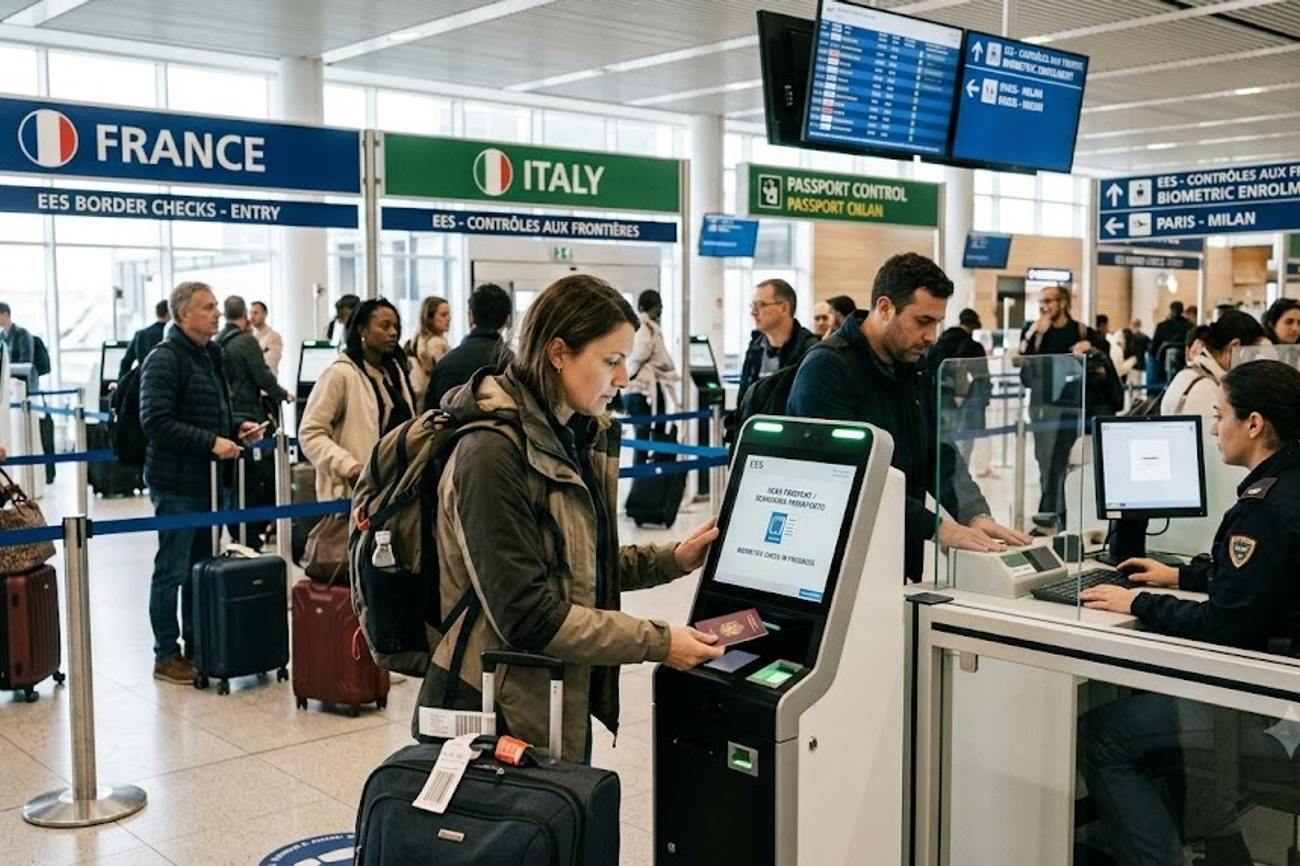
Image generated by AI
[Brussels, May 2025] — France and Italy are coordinating border management strategies as the European Union prepares to implement the Entry/Exit System (EES), a digital biometric tracking framework that threatens to create significant bottlenecks at some of the world's most visited gateways.
The EES is a mandatory digital registration system covering 29 European nations, designed to replace manual passport stamping with biometric data collection for non-EU nationals. While the system aims to modernize border security, the sheer volume of tourist traffic in Western Europe—highlighted by EU tourist accommodation reaching nearly 3.1 billion nights in 2025—raises urgent concerns regarding processing delays at airports, ferry terminals, and rail crossings.
The Biometric Trigger
The catalyst for this shift is the EU's transition to a centralized digital ledger of arrivals and departures. Under the new mandate, non-EU citizens making short-term stays must provide biometric information, including fingerprints and facial images, during their first qualifying entry into the Schengen Area.
This transition is occurring against a backdrop of surging travel demand. International guest nights across the EU rose 3.4% in 2025, putting unprecedented pressure on the European Union Aviation Safety Agency (EASA) and national border authorities to maintain flow without compromising security. Because the initial registration process is more time-consuming than traditional stamping, the first point of entry for any traveler becomes a high-risk zone for congestion.
Markets Under Pressure
The impact of EES is not uniform; it is concentrated in "super-destinations" where accommodation demand is peaking. The following countries are identified as primary hotspots for potential border delays based on 2025 accommodation data:
| Destination | 2025 Accommodation Nights | Market Position |
|---|---|---|
| Italy | 476.9 million* | Europe's No. 2 tourism market |
| France | 471.7 million* | Europe's largest tourism market |
| Germany | 442.1 million* | Top 4 EU market |
| Greece | 119.0 million | Mediterranean hub |
| Portugal | 80 million+ | International holiday market |
| Switzerland | 62.0 million | Alpine/City tourism center |
| Belgium | 21.4 million | Record-level demand |
| Malta | 12.2 million (hotel only) | Tourism-dominant economy |
*Figures based on total tourist-accommodation nights via Eurostat.
France remains the primary focal point for these disruptions. In 2025, France welcomed 102 million international tourists, generating 743 million nights across all accommodation types. With international tourism receipts hitting a record €77.5 billion—a 9% year-on-year increase—the pressure on the French Ministry of the Interior to streamline EES processing at Charles de Gaulle and other major ports is critical.
What This Means for Travelers
For the average traveler, the EES is not a visa replacement but a processing change. If you are a non-EU national without a long-stay visa or qualifying residence permit, your travel experience will change in the following ways:
1. The "First-Entry" Delay Your first crossing into the EES zone will be the slowest. You will be required to provide biometric data, which cannot be skipped. If you are flying into Paris before taking a train to Brussels or a flight to Rome, the Paris gateway will be where the bulk of your processing occurs.
2. Buffer Time Requirements Standard arrival windows are no longer sufficient. Travelers should add at least 60 to 90 minutes to their airport arrival estimates to account for biometric kiosks and manual verification queues.
3. Transit Friction While Ireland and Cyprus remain outside the EES framework, those moving between the 29 participating countries will find that while internal borders are generally open, the initial digital "handshake" at the external border is non-negotiable.
4. Logistics Shifts In compact regions like Belgium—which saw a record 44.84 million overnight stays in 2024—the reliance on rail networks (Brussels to Bruges or Ghent) remains high. However, the initial entry point into the Schengen zone (often a major hub like Brussels Airport) will be the primary bottleneck.
The Road to Implementation
The immediate focus for France and Italy is the deployment of hardware and personnel to handle the 2025 surge. With Italy recording 476.9 million accommodation nights and France close behind at 471.7 million, the two nations are the "heavy lifters" of European tourism. Any failure in EES rollout in these two countries could trigger a systemic backup across the entire Schengen Area.
Regulatory bodies are currently auditing the capacity of ferry terminals and international rail crossings, which historically have fewer biometric kiosks than major airports. Travelers are advised to monitor updates from the European Commission regarding the specific rollout dates for each member state to avoid being caught in "Day 1" congestion.
FAQ: EES Border Checks 2025
Do I need a new visa for the EES? No. The EES is a digital entry/exit registration system, not a visa. It tracks when you enter and leave the EU using biometrics. You still need your passport and any required visas (like Schengen visas) as usual.
Who is exempt from EES biometric registration? Holders of qualifying residence permits and those with long-stay visas are generally exempt. EU, EEA, and Swiss citizens are also not subject to these specific biometric requirements.
Which countries are NOT part of the EES? Ireland and Cyprus are currently outside the EES framework. Travelers entering these countries will follow their own national border protocols rather than the EES biometric system.
How long does the first EES registration take? While it varies by airport, the first-time registration of biometric data (fingerprints and facial scans) takes significantly longer than traditional passport stamping. Travelers should expect delays during peak summer periods.
Prepare for longer queues and digital checkpoints as Europe swaps stamps for scans.
Tags: #EES2025 #SchengenBorder #FranceTourism2025 #ItalyTourism2025 #EUBorderControl #BiometricTravel
Related Travel Guides
Disclaimer
This article is for informational and educational purposes only. It does not constitute legal, financial, or professional advice. While we strive to provide accurate and up-to-date information, travel policies, regulations, and conditions change rapidly. Always verify information with official sources before making travel decisions. Nomad Lawyer makes no representations about the accuracy, reliability, completeness, or suitability of the information provided. Readers should consult qualified professionals for advice specific to their circumstances. The views expressed in this article are those of the author and do not necessarily reflect the views of Nomad Lawyer.
Raushan Kumar
Founder & Lead Developer
Full-stack developer with 11+ years of experience and a passionate traveller. Raushan built Nomad Lawyer from the ground up with a vision to create the best travel and law experience on the web.
Learn more about our team →