
British Airways BA295 Boeing 777 Declares Mid-Air Emergency Over Ireland: Rapid 28,000-Foot Descent and Heathrow Return
British Airways flight BA295 to Chicago executed an emergency descent from 37,000 to 9,000 feet over Ireland, squawking 7700 before returning safely to London Heathrow.

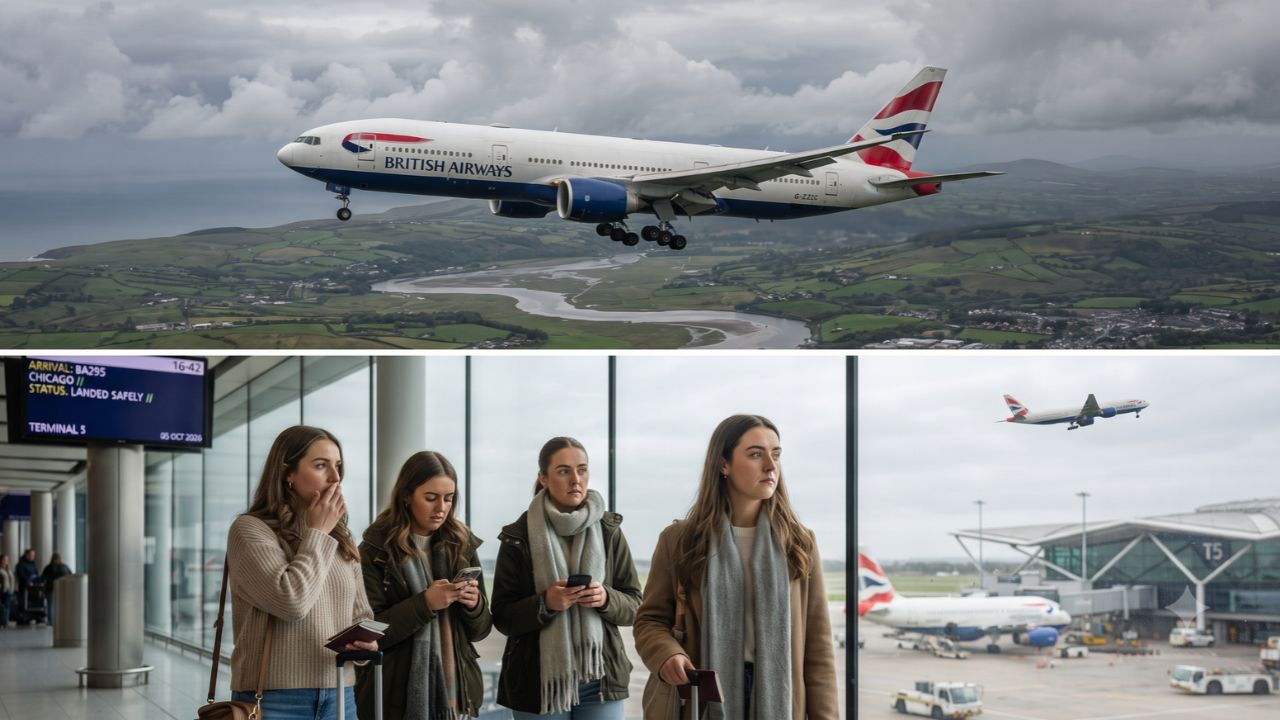
Image generated by AI
Cruising at 37,000 feet just as the Atlantic oceanic tracks began over western Ireland, British Airways flight BA295 plunged 28,000 feet in minutes before turning back toward London. The Boeing 777-200ER, registered as G-VIIA and carrying transatlantic passengers bound for Chicago O'Hare International Airport on 5 October 2026, squawked the international emergency transponder code 7700 while leveling off at 9,000 feet. The long-haul widebody aircraft executed an immediate 180-degree turn, heading back across Irish and British airspace to make an uneventful emergency landing at London Heathrow Airport, where all passengers disembarked normally via terminal gates.
While rapid mid-air descents naturally provoke anxiety, aviation protocols dictate immediate altitude reductions into breathable, non-pressurized airspace whenever technical anomalies, environmental alarms, or pressurization discrepancies occur.
Flight Profile: The Timeline of BA295's Mid-Air Reversal
Flight BA295 departed London Heathrow on its scheduled long-haul crossing to Chicago O'Hare. Radar tracking records confirm the aircraft reached its standard cruising altitude of approximately 37,000 feet before declaring a general aircraft emergency while traversing Irish airspace.
Rather than proceeding west into the remote North Atlantic Organized Track System where diversion airfields are hours away, the flight crew initiated a rapid descent to 9,000 feet, broadcast emergency transponder code 7700, and coordinated an air-traffic control vector back toward Britain.
Incident Flight Data Breakdown
| Flight Parameter | Recorded Incident Detail |
|---|---|
| Flight Number | BA295 |
| Operating Carrier | British Airways |
| Route | London Heathrow (LHR) to Chicago O’Hare (ORD) |
| Aircraft Model | Boeing 777-200ER |
| Registration Number | G-VIIA |
| Date of Incident | 5 October 2026 |
| Emergency Coordinates | Irish Airspace / Western Routing |
| Cruising Altitude | Approximately 37,000 feet |
| Level-Off Altitude | Approximately 9,000 feet |
| Total Altitude Drop | Approximately 28,000 feet |
| Transponder Squawk | 7700 (General In-Flight Emergency) |
| Diversion Destination | London Heathrow Airport (LHR) |
| Final Operational Outcome | Safe landing, normal passenger disembarkation |
Official statements from British Airways characterized the turnback as a precautionary response to an unconfirmed technical issue. Ground personnel at Heathrow met the aircraft, and travelers were provided with hotel accommodations and rebooked on subsequent transatlantic flights.
Transponder Codes and Emergency Descent Protocols
In commercial aviation, transponder squawk codes provide immediate, digital classification of an aircraft's operational status to air traffic control radar screens:
| Squawk Code | Standard International Meaning | Operational Context |
|---|---|---|
| 7700 | General Aircraft Emergency | Declared by BA295; grants priority routing and cleared airspace |
| 7600 | Radio Communication Failure | Loss of two-way radio contact between cockpit and ATC |
| 7500 | Unlawful Interference | Hijacking or security breach on board |
| 7000 | Standard VFR Conspicuity | Routine visual flight rules code used in UK airspace |
Under standard procedures defined by the UK Civil Aviation Authority, descending to 10,000 feet or below allows both crew and passengers to breathe ambient atmospheric air without requiring supplemental oxygen masks. Although rapid altitude reductions can occur during cabin depressurization events, guidelines also mandate emergency descents for distinct operational anomalies, including electrical warnings, cockpit smoke alerts, or engine parameter fluctuations.
The Air Accidents Investigation Branch (AAIB) monitors formal safety filings from UK air carriers, though no fleet-wide groundings or structural safety alerts were issued following the incident.
What Makes Oceanic Transatlantic Transitions Unique
The airspace corridor extending across western Ireland represents the critical gateway between high-density European radar coverage and oceanic procedural airspace. Before jetliners enter North Atlantic routes, flight crews must ensure all redundant systems—including engine fire suppression, dual environmental control systems, and satellite communications—function with zero margin of error.
When technical warnings occur near Ireland, captains face a calculated choice: continue toward isolated diversion strips like Shannon Airport (SNN) or Keflavik in Iceland, or return directly to their primary maintenance hub at Heathrow. Because the aircraft remained fully controllable and stabilized at 9,000 feet, flying back to London avoided stranding passengers and airframe components at an outstation lacking specialized Boeing 777 line-maintenance facilities.
Visitor Insider Tips
- Understanding Long-Haul Disruption Entitlements: Under UK/EU 261 passenger rights regulations, transatlantic travelers experiencing delays exceeding four hours due to technical aircraft substitutions are entitled to duty of care (meals, refreshments, and hotel accommodation) provided by the operating airline.
- Transatlantic Flight Planning: If you fly regularly between London and North American gateways, keep essential medications, chargers, international travel adapters, and a change of clothes in your carry-on bag rather than checked luggage in case of an unexpected same-day turnback.
- Heathrow Hub Recovery Strategy: During severe flight cancellations or returns at Heathrow Terminal 5, bypass long customer service queues in the main concourse by using the British Airways mobile app or phone support to secure alternate flight connections through partners in the Oneworld alliance.
- Flight Status Verification: Do not rely on third-party rumor boards during mid-flight diversions. Check live status updates directly on official airline portals and verified flight tracking channels.
Cultural and Environmental Context
Modern commercial aviation operates under stringent fail-safe engineering where pilots proactively treat ambiguous technical indications as full emergencies. Rather than risking unpredictable weather over the North Atlantic, returning aircraft to major hub stations preserves passenger safety and prevents emergency services from being activated in remote regional airfields.
Furthermore, fuel management protocols during mid-flight turnbacks require flight crews to calculate landing weights carefully. When long-haul widebody aircraft descend unexpectedly with heavy fuel loads intended for transatlantic crossings, pilots either dump excess kerosene at designated high altitudes over open water or execute overweight landing inspections upon touchdown, minimizing ground safety risks and environmental impact on local communities.
FAQ: Transatlantic Flight Emergencies and Traveler Rights 2026
Why did BA295 return to London Heathrow instead of landing in Ireland? Heathrow is British Airways' primary maintenance base, offering dedicated engineering teams, replacement Boeing 777 aircraft, and extensive hotel infrastructure for rebooking transatlantic travelers without logistical delay.
Does a 7700 emergency code mean an aircraft is about to crash? No. Code 7700 informs air traffic control of any abnormal condition requiring priority handling, immediate altitude change, or direct routing to an airfield.
Did BA295 suffer cabin depressurization? Neither British Airways nor safety regulators have confirmed cabin depressurization. Emergency descent protocols are standard for several technical malfunctions requiring lower cruising altitudes.
Are other British Airways Boeing 777 flights affected? No. The incident was an isolated technical issue on airframe G-VIIA, and British Airways continues normal operations across its long-haul Boeing 777 fleet.
In transatlantic aviation, turning back to the departure gate at the first sign of technical uncertainty remains the ultimate hallmark of modern flight safety.
Related Travel Guides
Over 3,100 Flight Delays Hit 47 Asian Airports Amid Severe Weather and Airspace Restrictions
The 10 Best Transatlantic Flight Routes and Airport Hubs, According To Reddit
Disclaimer
This article is for informational and educational purposes only. It does not constitute legal, financial, or professional advice. While we strive to provide accurate and up-to-date information, travel policies, regulations, and conditions change rapidly. Always verify information with official sources before making travel decisions. Nomad Lawyer makes no representations about the accuracy, reliability, completeness, or suitability of the information provided. Readers should consult qualified professionals for advice specific to their circumstances. The views expressed in this article are those of the author and do not necessarily reflect the views of Nomad Lawyer.
Raushan Kumar
Founder & Lead Developer
Full-stack developer with 11+ years of experience and a passionate traveller. Raushan built Nomad Lawyer from the ground up with a vision to create the best travel and law experience on the web.
Learn more about our team →