
Over 3,100 Flight Delays Hit 47 Asian Airports Amid Severe Weather and Airspace Restrictions
Severe weather and regional airspace restrictions trigger 3,115 flight delays and 235 cancellations across 47 Asian hubs including Tokyo, Jakarta, Delhi, and Ho Chi Minh City.

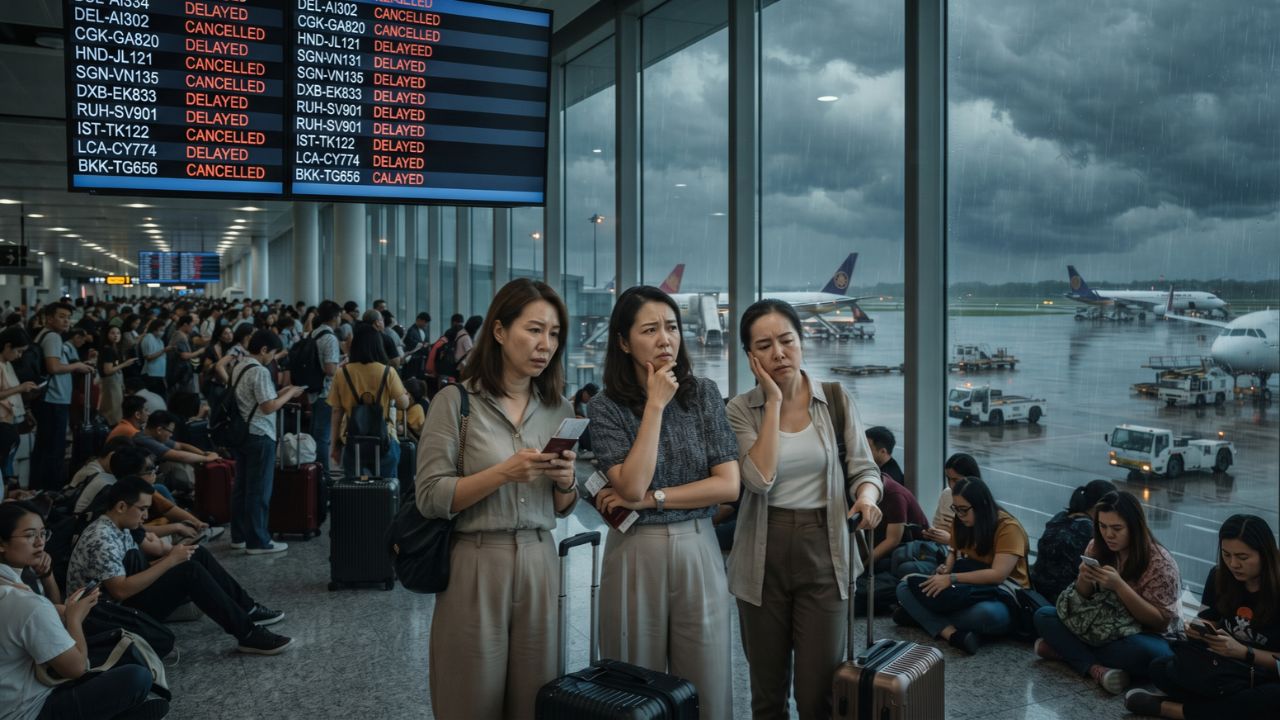
Image generated by AI
While high-altitude Tibetan plateau airstrips like Daocheng Yading saw cancellation rates hit a staggering 60% on arrival boards, major commercial gateways from Tokyo to Jakarta experienced cascading ground halts affecting 3,115 delayed flights and 235 outright cancellations across 47 airports. Real-time aviation tracking logged on 4 October 2026 at 3:12 p.m. ET (6 October 2026 at 4:12 a.m. Tokyo Time, GMT+9) reveals how monsoon squalls across Indonesia and Vietnam collided with East Asian tropical weather fronts and Middle Eastern airspace constraints, following an already chaotic previous day of 220 cancellations and 2,979 delays across the continent.
For independent travelers navigating regional transit corridors, these systemic bottlenecks demonstrate why relying on tight flight connections through primary Asian hubs can suddenly derail travel itineraries stretching from the Himalayas to the Mediterranean coast of Cyprus.
Severe Weather and Airspace Pressures Disrupt 47 Asian Aviation Hubs
The operational strain extended across East Asia, South Asia, Southeast Asia, and the Middle East. Tropical weather patterns, high crosswinds, and localized downpours created severe ground holds, forcing air traffic controllers to space out takeoffs and landings.
Vietnam's primary international gateway, Tan Son Nhat International Airport (SGN) in Ho Chi Minh City, registered 199 delayed flights alongside three cancellations. In Japan, Tokyo International Airport (HND / Haneda) logged 184 delays and three cancellations. In India, Indira Gandhi International Airport (DEL) in Delhi recorded 187 delays and four cancellations, while Kempegowda International Airport (BLR) in Bengaluru logged 141 delays and four cancellations.
Secondary Indian aviation hubs also felt regional ripples: Sardar Vallabhbhai Patel International in Ahmedabad (AMD) recorded 20 delays and four cancellations (1% origin, 1% destination cancellation rate), Pune / Lohegaon Air Force Base (PNQ) registered 17 delays and three cancellations (1% origin cancellation), Navi Mumbai International (NMI) logged 12 delays with an unusually high 12 cancellations (8% origin and 10% destination cancellation rates), and Jammu (IXJ) posted two delays and three cancellations (14% origin cancellation rate).
In China, dual-hub metropolitan systems and regional networks absorbed heavy disruption. Chongqing Jiangbei International (CKG) recorded 101 delays and three cancellations, Chengdu Tianfu International (TFU) logged 84 delays and eight cancellations, Beijing Capital International (PEK) posted 81 delays and five cancellations, and Chengdu Shuangliu International (CTU) registered 76 delays and five cancellations. Regional Chinese hubs followed: Guiyang Longdongbao (KWE) reported 56 delays and three cancellations, Wuhan Tianhe (WUH) recorded 45 delays and three cancellations, while Tianjin Binhai International (TSN) and Harbin Taiping International (HRB) each recorded 31 delays and three cancellations. Ningbo Lishe International (NGB) recorded 29 delays and six cancellations (1% origin, 2% destination cancelled).
High-altitude remote airstrips experienced extreme proportional disruption: Qamdo Bangda (BPX) recorded nine delays and five cancellations (30% origin and 20% destination cancelled), Pan Zhi Hua Bao An Ying (PZI) registered five delays and two cancellations (50% origin cancelled), and Daocheng Yading (DCY) logged four delays and five cancellations (40% origin and 60% destination cancelled). Kunming Changshui (KMG) and Nanjing Lukou (NKG) maintained stable operations with zero recorded cancellations.
Across the Middle East and Eastern Mediterranean, King Khalid International (RUH) in Riyadh posted 222 delays and 11 cancellations (1% origin, 1% destination cancelled), Ben Gurion International (TLV) logged 173 delays and five cancellations (1% destination cancelled), and Istanbul Airport (IST) recorded 166 delays and two cancellations. Dubai International (DXB) recorded 146 delays and 10 cancellations, King Abdulaziz International (JED) in Jeddah logged 129 delays and eight cancellations (1% origin, 1% destination cancelled), and Abu Dhabi International (AUH) registered 99 delays and five cancellations (1% destination cancelled). Antalya (AYT) in Turkey recorded 85 delays and one cancellation, Larnaca International (LCA) in Cyprus registered 63 delays and two cancellations (1% origin cancelled), and Sharjah International (SHJ) recorded 54 delays and two cancellations.
Regional Middle Eastern points also logged disruptions: Abha Regional (AHB) had 32 delays and four cancellations (5% origin, 4% destination cancelled), Queen Alia International (AMM) in Amman reported 25 delays and one cancellation, Bahrain International (BAH) logged 22 delays and eight cancellations (4% origin, 4% destination cancelled), Kuwait International (KWI) had 14 delays and two cancellations, and Ramon Airport (ETM) recorded two delays and three cancellations. Specialized domestic routes saw point cancellations: Najran Domestic (EAM) recorded four cancellations (50% origin cancelled), Yanbu Domestic (YNB) had four cancellations (50% destination cancelled), and Gizan Regional had four cancellations. In Pakistan, Islamabad International (ISB) logged 26 delays and five cancellations (5% origin, 3% destination cancelled), while Jinnah International (KHI) in Karachi registered 23 delays and four cancellations (2% origin, 2% destination cancelled).
In Indonesia, Jakarta’s Soekarno-Hatta International (CGK) recorded a 2% origin and 1% destination cancellation rate. Secondary Indonesian hubs registered noticeable impact: Bubung (LUW) posted a 40% origin cancellation rate, Sultan Thaha (DJB) reported 12% destination cancellations, Halim Perdanakusuma (HLP) logged 7% destination cancellations, Sultan Mahmud Badaruddin II (PLM) in Palembang had 6% origin and 9% destination cancellations, Sam Ratulangi (MDC) in Manado recorded 7% origin and 6% destination cancellations, Sultan Hasanuddin (UPG) in Makassar had 2% origin and 4% destination cancellations, and Kuala Namu (KNO) in Medan posted 2% destination cancellations.
Airline Disruption Rates Across Asian Carriers
| Airline | Delays Recorded | Delay Share (%) | Cancellations | Cancellation Share (%) |
|---|---|---|---|---|
| Philippines AirAsia | 41 | 56% | 2 | 2% |
| Israir | 41 | 51% | 4 | 5% |
| SpiceJet (India) | 24 | 38% | 5 | 7% |
| flyadeal (Saudi Arabia) | 44 | 26% | 1 | 0% |
| Jetstar Japan | 23 | 25% | 1 | 1% |
| Etihad Airways (UAE) | 80 | 24% | 1 | 0% |
| Thai Vietjet Air | 30 | 23% | 1 | 0% |
| Flydubai (UAE) | 66 | 22% | 2 | 0% |
| Citilink (Indonesia) | 54 | 21% | 6 | 2% |
| Garuda Indonesia | 49 | 20% | 1 | 0% |
| Myanmar Airways International (MAI) | 13 | 19% | 4 | 6% |
| Pelita Air Service (Indonesia) | 10 | 15% | 1 | 1% |
| Vietnam Airlines | 57 | 15% | 3 | 0% |
| Tianjin Airlines (China) | 62 | 14% | 6 | 1% |
| Tibet Airlines (China) | 34 | 14% | 1 | 0% |
| Sichuan Airlines (China) | 91 | 11% | 4 | 0% |
| Spring Airlines (China) | 69 | 10% | 3 | 0% |
| Shandong Airlines (China) | 59 | 9% | 2 | 0% |
| ANA Wings (Japan) | 25 | 7% | 2 | 0% |
| Royal Jordanian | 9 | 6% | 1 | 0% |
| China Southern Airlines | 147 | 5% | 2 | 0% |
| Dalian Airlines (China) | 2 | 2% | 2 | 2% |
| Kuwait Airways | 1 | 1% | 2 | 2% |
Data tracked via real-time monitoring channels in coordination with FlightAware and international civil aviation authorities.
What Makes Regional Asian Transit Corridors Unique
Navigating regional aviation across Asia requires an understanding of diverse geographic microclimates and administrative jurisdictions. In Southeast Asia, equatorial convective activity builds rapidly during afternoon hours, turning clear morning approaches over Ho Chi Minh City or Jakarta into holding patterns. In contrast, remote Himalayan facilities like Daocheng Yading (perched at 4,411 meters above sea level) depend entirely on early morning thermal stability; once mountain wind shears pick up by mid-day, approach corridors close immediately.
Similarly, transit hubs in the Arabian Gulf and Eastern Mediterranean operate within narrow flight channels shaped by international airspace restrictions. A two-hour ground hold in Riyadh or Dubai does not merely delay a single departure; it causes aircraft rotations across Mumbai, Bangkok, and Tokyo to miss subsequent airport curfew windows, triggering secondary delays thousands of kilometers away.
Visitor Insider Tips
- Buffer Connection Times in Monsoon Seasons: Never book self-transfers or separate-ticket connections under four hours when transiting high-volume hubs like Tan Son Nhat, Delhi, or Tokyo Haneda. If transferring to island ferries in Indonesia (via Makassar or Manado) or domestic flights in Vietnam, schedule an overnight stay in the hub city.
- Flight Timing Strategy: Book departures scheduled before 09:00 local time. Early morning flights utilize aircraft that remained parked overnight at the airfield, avoiding the cascading delay rotations that accumulate across carriers like Philippines AirAsia (56% delay rate) or Israir (51% delay rate) by late afternoon.
- Luggage and Ground Transit Hacks: When flying through weather-prone regional networks, keep two days of clothes, chargers, and prescription medications in your cabin baggage. If stranded in Jakarta, take the direct rail link (Railink) from Soekarno-Hatta into central BNI City Station to avoid toll-road gridlock caused by monsoon rain.
- Document Everything at the Gate: If your flight is canceled or delayed beyond three hours, immediately request a written flight interruption manifest (FIM) or delay verification stamp from the ground desk before leaving the transit lounge. This documentation is required by travel insurance providers and airline customer desks.
Cultural and Environmental Context
Mass transit disruptions underscore how environmental pressures influence regional infrastructure. Across Southeast Asia and South Asia, civil aviation authorities are upgrading runway drainage systems and adopting satellite-guided navigation to handle intense seasonal weather events linked to shifting regional climate patterns.
Simultaneously, travelers stranded in secondary cultural hubs can alleviate strain on overburdened airport facilities by supporting neighborhood economies. Choosing locally owned guesthouses and family-run warungs or street-food stalls near transit hubs in Jakarta, Chengdu, or Ho Chi Minh City channels tourism spending directly into local communities during travel disruptions, rather than concentrating expenditure inside terminal retail concessions.
FAQ: Navigating Asian Flight Disruptions 2026
How do I check if my specific flight is affected during widespread airport delays? Track your specific aircraft registration number and inbound flight path using the airline's mobile app or live flight trackers, rather than relying solely on general airport departure screens.
What compensation rights do passengers have for delayed flights in Asia? Compensation policies vary by jurisdiction and carrier. While statutory meal and hotel vouchers apply for mechanical delays, weather-related disruptions are classified as force majeure, making comprehensive private travel insurance essential.
What should I do if my high-altitude flight in western China or the Himalayas is canceled? Rebook the earliest departure for the following morning immediately at the airport ticketing counter, as high-altitude airfields rarely operate afternoon flights due to dangerous wind conditions.
Can I leave the airport during an extended flight delay in Tokyo or Jakarta? Yes, provided you hold valid visa entry privileges or transit visa exemptions. Ensure you re-clear airport security and immigration at least two hours before the revised departure time.
When regional skies turn unpredictable across Asia, patience and a flexible transit strategy remain the traveler's greatest assets.
Related Travel Guides
Air Astana Expands Central Asia–Japan Connectivity With Direct Almaty to Tokyo Flights
The 10 Best Airport Transit Strategies for Southeast Asia Flights, According To Reddit
Disclaimer
This article is for informational and educational purposes only. It does not constitute legal, financial, or professional advice. While we strive to provide accurate and up-to-date information, travel policies, regulations, and conditions change rapidly. Always verify information with official sources before making travel decisions. Nomad Lawyer makes no representations about the accuracy, reliability, completeness, or suitability of the information provided. Readers should consult qualified professionals for advice specific to their circumstances. The views expressed in this article are those of the author and do not necessarily reflect the views of Nomad Lawyer.
Preeti Gunjan
Contributor & Community Manager
A passionate traveller and community builder. Preeti helps grow the Nomad Lawyer community, fostering engagement and bringing the reader experience to life.
Learn more about our team →