British Airways Boeing 787 Dreamliner Stranded on Muddy Grass Verge During Heathrow Departure to Lagos

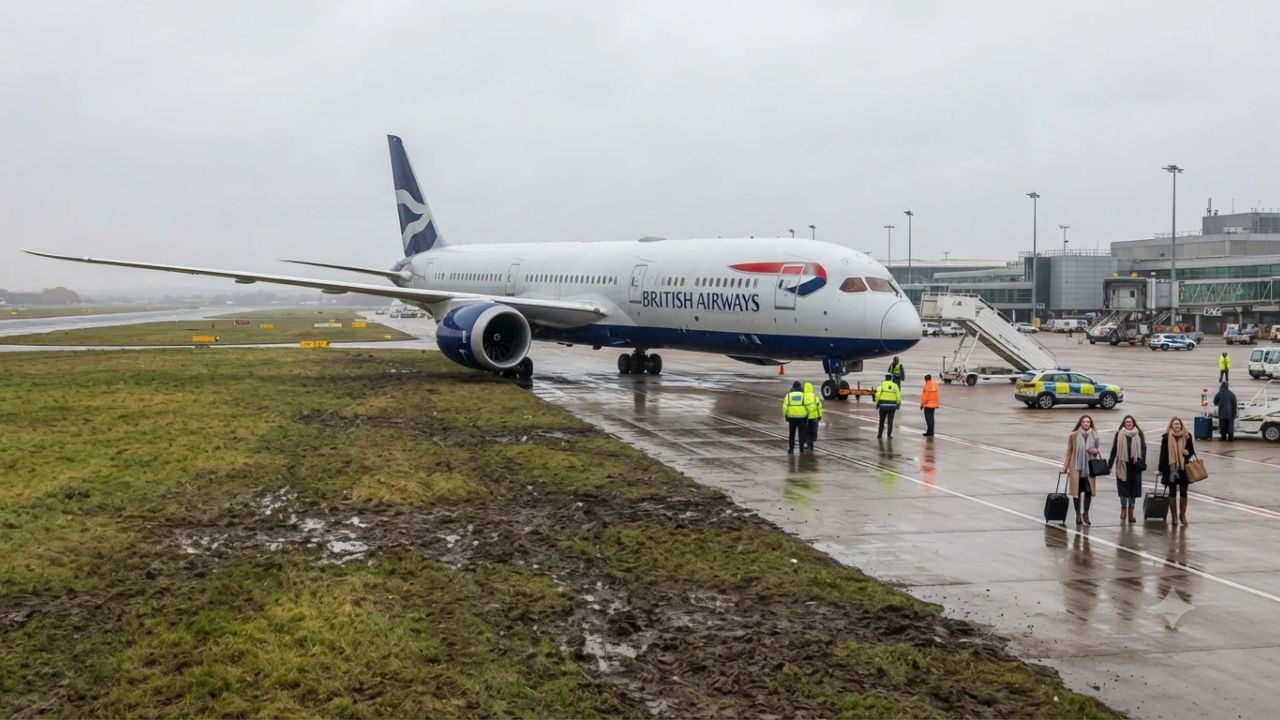
A British Airways Boeing 787-10 Dreamliner operating long-haul international flight BA75 to Lagos, Nigeria, suffered a taxiway excursion at London Heathrow Airport on 17 November 2026, becoming immobilized after its nose landing gear veered onto a rain-softened grass verge during pre-departure ground movement. Airport emergency crews and ground handlers responded promptly to the stranded widebody jet, deploying mobile stairs to deplane all passengers and transfer them back to Terminal 5 without any reported injuries. While the localized ground incident prompted temporary taxiway adjustments and flight rebooking procedures, Heathrow’s dual-runway infrastructure maintained regular flight operations throughout the day.
The incident occurred while flight BA75 was taxiing toward its assigned runway for departure to Murtala Muhammed International Airport in Lagos. Under low-speed ground maneuvering, the front gear of the 254-tonne widebody aircraft exited the asphalt pavement and sank into the rain-soaked soil lining the taxiway edge. The event represents a ground taxiway excursion rather than a runway excursion, meaning the aircraft was traveling at slow taxi speed, had not initiated its takeoff roll, and did not experience an in-flight emergency or hard landing. Airport operations teams and airline engineers worked to stabilize the airframe, evaluate the nose gear assembly, and coordinate specialized heavy extraction equipment to return the aircraft to paved apron surfaces.
========================================================================================
FLIGHT BA75 TAXIWAY INCIDENT AT LONDON HEATHROW: OPERATIONAL SCORECARD
========================================================================================
Operating Carrier                British Airways (Flag Carrier of the United Kingdom)
Flight Identification            BA75 / BAW75 (Scheduled Long-Haul Passenger Service)
Date and Time of Event           Tuesday, 17 November 2026 (Pre-Departure Phase)
Origin Gateway                   London Heathrow Airport (LHR / EGLL), United Kingdom
Destination Gateway              Murtala Muhammed Int'l Airport (LOS / DNMM), Lagos, Nigeria
Aircraft Model                   Boeing 787-10 Dreamliner (Widebody Twin-Engine Jet)
Aircraft Registration            G-ZBLF (Delivered to British Airways in 2020)
Incident Classification          Low-Speed Taxiway Excursion (Ground Movement)
Landing Gear Involved            Nose Landing Gear (Immobilized in Muddy Soft Soil)
Injuries Recorded                Zero (No Passenger or Crew Injuries Reported)
Passenger Evacuation Method      Controlled Deplaning via Mobile Passenger Stairs
Passenger Transport              Airside Apron Shuttle Buses to Terminal 5
Airport Operational Status       Normal Dual-Runway Operations (Localized Taxiway Reroutes)
Investigation Authority          Air Accidents Investigation Branch (AAIB) / BA Safety
Regulatory Framework             UK Civil Aviation Authority (CAA) & UK261 Passenger Rights
========================================================================================
Source: Heathrow Airport Operations Disclosures & Flight Tracking Data (2026).
========================================================================================
Ground Incident Mechanics: Deconstructing the BA75 Taxiway Excursion
In aviation safety taxonomy, a clear distinction exists between runway excursions and taxiway excursions. A runway excursion involves an aircraft departing the runway surface during a high-speed takeoff roll or landing deceleration, situations characterized by high kinetic energy, aerodynamic forces, and elevated risk of structural compromise. In contrast, a taxiway excursion occurs during low-speed ground maneuvering—typically at speeds between 8 and 15 knots—as an aircraft navigates between passenger terminals, de-icing pads, and active runway holding points.
During flight BA75’s pushback and taxi-out from Terminal 5, the flight crew followed standard air traffic control ground taxi instructions toward the active departure runway. As the aircraft negotiated a turn along the paved taxiway network, the dual-wheel nose landing gear drifted past the paved tarmac shoulder and entered the soft turf verge. Persistent autumn rainfall across southern England had left unpaved airside ground thoroughly saturated, causing the nose wheels to sink several inches into the mud and stripping the aircraft of ground steering traction.
========================================================================================
AVIATION SAFETY INCIDENT TAXONOMY: TAXIWAY VS. RUNWAY EXCURSIONS
========================================================================================
Parameter                  Taxiway Excursion (BA75 Event)   Runway Excursion (High-Risk)
----------------------------------------------------------------------------------------
Operating Speed            Low Speed (Approx. 5–15 Knots)   High Speed (100–160+ Knots)
Operational Phase          Taxi-Out / Pushback / Apron      Takeoff Roll or Landing Rollout
Kinetic Energy Level       Minimal (Slow Ground Movement)   Extreme (High Kinetic Energy)
Passenger Evacuation       Controlled Mobile Stair DeplaningEmergency Slide Deployment
Structural Stress Level    Localized (Nose Gear / Tires)    High Risk (Airframe / Wing Spar)
Airport Disruption Scope   Localized Taxiway Diversions     Runway Closure & Mass Delays
Typical Contributing CausesSteering Slip, Wet Edge, VisibilityAquaplaning, Windshear, Overrun
========================================================================================
Following the loss of forward momentum, the flight crew followed safety protocols by holding the aircraft stationary and notifying Heathrow Ground Control. Heathrow Airport Fire and Rescue Services (AFRS) responded as a standard precautionary measure. Firefighters and ground safety marshals inspected the exterior of the Boeing 787-10, confirming that fuel tanks remained intact, hydraulic lines showed no external leakage, and the composite fuselage had suffered no visible structural damage.
Because the aircraft was stable and grounded safely, emergency evacuation slides were neither required nor deployed. Airport operations dispatched mobile passenger stair trucks to the taxiway. Ground crews boarded the aircraft to assist passengers in retrieving carry-on belongings before directing them down the covered stairs to waiting apron shuttle buses, which ferried them back to Terminal 5.
Fleet and Aircraft Profile: The Boeing 787-10 Dreamliner at Heathrow
The aircraft involved in the incident, registered as G-ZBLF, is a Boeing 787-10 Dreamliner delivered to British Airways in 2020. Measuring 68.3 meters (224 feet) in length, the 787-10 is the longest variant in Boeing’s composite Dreamliner family, designed for high-capacity medium- and long-haul international routes.
========================================================================================
BOEING 787-10 DREAMLINER (G-ZBLF) TECHNICAL & CONFIGURATION PROFILE
========================================================================================
Manufacturer                     The Boeing Company (Commercial Airplanes)
Model Variant                    Boeing 787-10 Dreamliner
Registration / Manufacturer SN   G-ZBLF / MSN 60638
Powerplants                      2x Rolls-Royce Trent 1000 High-Bypass Turbofans
Maximum Takeoff Weight (MTOW)    254,000 kg (560,000 lbs)
Overall Aircraft Length          68.30 meters (224 feet 1 inch)
Wingspan                         60.10 meters (197 feet 3 inches)
Airframe Material Composition    50% Carbon-Fiber Composite, 20% Aluminum, 15% Titanium
Cabin Interior Configuration     Four-Class Premium Configuration (256 Total Seats)
- First Class Suites             8 Dedicated Private Suites (1-2-1 Layout)
- Club World Business Class      48 Club Suite Flat Beds with Sliding Privacy Doors
- World Traveller Plus           35 Premium Economy Recliners (2-3-2 Layout)
- World Traveller Economy        165 Standard Long-Haul Economy Seats (3-3-3 Layout)
Operating Base                   London Heathrow Airport (Terminal 5)
========================================================================================
Source: British Airways Fleet Disclosures & Boeing Commercial Aircraft Specifications.
========================================================================================
British Airways operates the 787-10 in a four-class premium configuration accommodating up to 256 passengers. The variant incorporates a stretched fuselage that provides 15 percent more passenger capacity and 40 percent more cargo volume than the baseline 787-8, while burning roughly 25 percent less fuel per seat than the previous-generation widebodies it replaced.
The 787-10 features an advanced steer-by-wire nose gear steering system controlled via cockpit hand tillers and rudder pedals. The steering system utilizes electrical signals sent to electro-hydraulic actuators to turn the dual nose wheels up to 70 degrees during low-speed apron taxiing. Safety investigators will review digital flight data recorder (FDR) telemetry to examine nosewheel steering angle inputs, ground speed, braking pressure, and tire adhesion dynamics leading up to the pavement departure.
The Strategic London–Lagos Air Corridor: Trade, Energy, and Diaspora Links
The route connecting London Heathrow (LHR) and Murtala Muhammed International Airport in Lagos (LOS) is one of the most commercially critical and profitable routes in British Airways’ intercontinental network. Covering a flight distance of approximately 5,000 kilometers (3,100 miles) with an average flight time of six hours and 30 minutes, the corridor connects the financial core of the United Kingdom with West Africa's largest economic metropolis.
========================================================================================
LONDON HEATHROW (LHR) TO LAGOS (LOS) ROUTE METRICS & PROFILE
========================================================================================
Metric / Dimension               Strategic Routing Detail
----------------------------------------------------------------------------------------
Route Origin Airport             London Heathrow Airport (LHR / EGLL)
Route Destination Airport        Murtala Muhammed International Airport (LOS / DNMM)
Great Circle Distance            5,021 km (3,120 statute miles / 2,711 nautical miles)
Scheduled Flight Duration        6 Hours 35 Minutes (Non-Stop Sector)
Primary Passenger Segments       Corporate Business, Energy Sector, Education, VFR
Cargo Commodities                Pharmaceuticals, Oil Equipment, Technology, Perishables
Annual Capacity on Corridor      Over 350,000 Non-Stop Passenger Seats Annually
Alternative Heathrow Competitor  Virgin Atlantic (Airbus A350-1000 Daily Service)
Connecting Hub Competitors       Air France (CDG), KLM (AMS), Lufthansa (FRA), Qatar (DOH)
Regional Economic Significance   Links UK Capital to Nigeria's US$ 400B+ National Economy
========================================================================================
Passenger demand on the London–Lagos corridor is anchored by four key market segments:
- Visiting Friends and Relatives (VFR): A vibrant British-Nigerian diaspora numbering hundreds of thousands relies on direct non-stop flights between London and Lagos, with demand surging sharply from mid-November through January for holiday family gatherings.
- Energy and Industrial Commerce: Nigeria remains Africa’s largest petroleum producer. Multi-national energy conglomerates, engineering consultancies, and financial institutions maintain routine corporate travel between London, Lagos, and the Niger Delta.
- Academic and Professional Mobility: Thousands of Nigerian international students attending British universities travel across this corridor at the conclusion of autumn academic terms.
- Air Cargo Freight: In addition to passengers, the belly-hold capacity of the Boeing 787-10 transports critical freight, including cold-chain medical supplies, computing hardware, and industrial spare parts bound for West African commercial centers.
Because of the high load factors and high proportion of premium-cabin travelers on the Lagos route, any operational disruption immediately triggers complex passenger re-accommodation challenges. When a widebody flight carrying over 200 passengers is delayed or cancelled, airlines must mobilize rebooking desks across competing non-stop carriers or route passengers through European continental hubs.
Heathrow Airport Operations: Capacity, Resilience, and Disruption Containment
London Heathrow stands as the busiest two-runway airport on earth, operating at more than 98 percent of its government-mandated capacity cap. The facility’s ability to absorb localized ground incidents without triggering system-wide delays illustrates the operational containment strategies employed by its air traffic controllers and airside safety teams.
========================================================================================
LONDON HEATHROW AIRPORT ANNUAL OPERATIONAL BENCHMARKS (2025–2026 CONTEXT)
========================================================================================
Operational Indicator            Official Annual Benchmark Metric
----------------------------------------------------------------------------------------
Total Annual Passengers (2025)   84.5 Million Passengers (Growth from 83.9M in 2024)
Passenger Aircraft Movements     475,596 Total Commercial Aircraft Movements
African Continental Traffic      Approximately 3.4 Million Passengers Annually
Total Air Cargo Tonnage          Approximately 1.59 Million Tonnes Handled
Security Queue Performance       97.3% of Passengers Screened Within Five Minutes
Active Runways                   2 Parallel Runways (09L/27R and 09R/27L)
Daily Aircraft Movements         Approx. 1,300 Takeoffs and Landings per 24 Hours
Dual Runway Operations Mode      Segregated Operations (One Landing, One Departing)
========================================================================================
Source: Heathrow Airport Holdings Ltd (HAHL) Annual Regulatory Filings.
========================================================================================
Heathrow’s layout relies on segregated runway operations, where one runway handles arriving flights while the parallel runway manages departures, alternating runways at 15:00 daily to provide noise relief to surrounding London communities. When flight BA75’s nose gear left the taxiway pavement, the incident occurred along an airside taxi link, leaving both primary runways completely clear.
Air traffic controllers at NATS (National Air Traffic Services) immediately re-routed following aircraft via alternative parallel taxiways, such as Taxiways Alpha, Bravo, and Victor. While ground maneuvering ground to a temporary halt in the immediate sector surrounding the immobilized Dreamliner, arrival and departure runways continued processing flights with minimal average holding delays. This localized containment prevented the type of mass cancellations or airport-wide ground stops that occur when an aircraft becomes disabled directly on an active runway surface.
Technical Aircraft Recovery: Extracting a 254-Tonne Widebody from Mud
Recovering an immobilized widebody aircraft that has sunk into soft ground is one of the most delicate operations in airport maintenance. A loaded Boeing 787-10 Dreamliner has a maximum takeoff weight of 254 tonnes. Applying blunt towing force with standard airport tugs risks fracturing the nose gear strut, damaging internal steering actuators, or causing torque twisting across the forward composite pressure bulkhead.
========================================================================================
TECHNICAL PROTOCOL: WIDEBODY AIRCRAFT SOFT-GROUND RECOVERY
========================================================================================
Stage  Action Item                     Engineering & Operational Requirement
----------------------------------------------------------------------------------------
1      Stabilization & Fuel Offload    Pumping jet fuel to lower weight below landing limits
2      Deflation / Shoring Analysis    Assessing mud depth and nosewheel tire integrity
3      Pneumatic Lifting Bags          Positioning multi-stage rubber air cushions under fuselage
4      Excavation & Ramp Placement     Digging out mud and laying reinforced composite mats
5      Multi-Point Tow Bridle Rigging  Distributing pulling force to main gear towing eyes
6      Controlled Extraction Winching  Pulling aircraft smoothly back onto paved taxiway
7      NDT Structural Inspection       Non-destructive testing of landing gear and mounts
========================================================================================
The Engineering Recovery Methodology
Airline maintenance teams and Heathrow recovery specialists utilize specialized equipment specified in the Boeing 787 Aircraft Recovery Manual (ARM):
- Weight Reduction via Fuel Offloading: Before moving the aircraft, fuel tankers may connect to the aircraft's single-point fueling receptacle to pump out thousands of liters of kerosene, significantly lowering the overall gross weight and reducing ground-bearing pressure on the sunken gear.
- Pneumatic Lifting Cushions: High-capacity multi-chamber pneumatic rubber cushions are inserted beneath approved lifting points along the fuselage and wing roots. Gradually inflated with low-pressure air, these cushions gently raise the airframe without inducing point-load stress on the carbon-fiber composite skin.
- Ground Shoring and Composite Mats: Once the nose wheels are lifted clear of the mud ruts, excavation crews dig out the suctioning soil and position heavy-duty fiberglass or aluminum ground mats (Terra-Mats) beneath the tires. These interlocking trackway panels distribute weight evenly and form a firm temporary road surface back to the asphalt taxiway.
- Balanced Multi-Point Winching: Rather than pulling on the fragile nose landing gear, recovery engineers attach certified heavy-duty nylon towing bridles to the main landing gear legs. Heavy aircraft recovery tractors or synchronized ground winches slowly pull the aircraft backward or forward onto solid pavement under constant strain monitoring.
Following extraction, the aircraft must undergo rigorous Non-Destructive Testing (NDT), including ultrasonic inspections of landing gear attachment pins, hydraulic line pressure integrity checks, and nosewheel steering calibration before the aircraft is cleared to re-enter commercial passenger service.
Passenger Rights and Legal Protections Under UK261
Passengers affected by the disruption of flight BA75 benefit from consumer protections under United Kingdom aviation law. Following the UK's departure from the European Union, the provisions of EU Regulation 261/2004 were transposed into domestic law as The Air Passenger Rights and Air Travel Organisers’ Licensing (Amendment) (EU Exit) Regulations 2019, commonly designated as UK261.
========================================================================================
UK261 STATUTORY PASSENGER ENTITLEMENTS FOR LONG-HAUL FLIGHT DISRUPTIONS
========================================================================================
Disruption Type             Statutory Entitlement               Timeframe / Scope
----------------------------------------------------------------------------------------
Immediate Duty of Care      Food & Refreshment Vouchers         Delays exceeding 4 hours
Telecommunication Access    Complimentary Phone Calls / Emails  Provided upon request
Overnight Accommodation     Complimentary Hotel Room & Transfer If delayed until following day
Rerouting Option            Earliest Available Flight to Lagos  On operating airline or rival
Ticket Refund Option        100% Cash Refund of Unused Sectors  If delay exceeds 5 hours
Statutory Cash Compensation £520 per Passenger (Sector >3,500km)If delay on arrival >4 hours*
========================================================================================
*Note: Compensation applies only if disruption is within the airline's operational control.
========================================================================================
The Mandatory Duty of Care
Regardless of what caused the taxiway excursion, British Airways is legally obligated under UK261 to provide an immediate Duty of Care to all ticketed passengers once a long-haul delay exceeds four hours:
- Food and Refreshment Provisions: Passengers must receive meal vouchers redeemable at airport food and beverage outlets. If airport retail vouchers cannot be distributed due to technical outages, passengers are entitled to claim reasonable reimbursement for food and non-alcoholic drinks by submitting itemized receipts.
- Hotel Lodging and Ground Transfers: Because long-haul replacement flights, replacement crew assignments, or alternative aircraft deployments often take many hours to assemble, passengers facing an involuntary overnight delay must be provided with complimentary hotel lodging and round-trip transfers between Heathrow and the hotel.
- Special Assistance: Airlines must give priority attention to passengers with reduced mobility, unaccompanied minors, and families traveling with young infants.
Rerouting Versus Ticket Refunds
If a flight is cancelled or delayed by more than five hours, passengers have the legal right to choose between two mutually exclusive options:
- Re-routing to Lagos: The airline must transport the passenger to Murtala Muhammed International Airport at the earliest opportunity under comparable transport conditions. If British Airways does not have available seats on its own subsequent services, UK Civil Aviation Authority guidelines state that the airline must examine rebooking passengers on competing carriers operating direct or indirect services, such as Virgin Atlantic, Air France, KLM, Lufthansa, or Qatar Airways.
- Full Ticket Refund: Passengers who decide not to travel due to the delay are entitled to a 100 percent refund of the ticket price for the parts of the journey not made, processed within seven business days via the original payment method.
The £520 Financial Compensation Question
Under UK261, passengers on long-haul flights covering distances greater than 3,500 kilometers (London to Lagos is approximately 5,020 km) are entitled to fixed statutory cash compensation of £520 per passenger if they arrive at their final destination four or more hours behind schedule.
However, payment of this statutory compensation is subject to legal exemptions:
- Extraordinary Circumstances Defense: An airline is exempt from paying cash compensation if it can prove that the cancellation or delay was caused by "extraordinary circumstances which could not have been avoided even if all reasonable measures had been taken." Examples include air traffic management ground stops, unexpected severe meteorological phenomena, or third-party airport infrastructure failures.
- Operational Controllability: If safety investigations establish that the taxiway excursion resulted from pilot steering error, misjudgment of pavement boundaries, or an onboard mechanical fault within the aircraft’s steer-by-wire system, the event is classified as inherent to the normal exercise of the carrier’s activity. Under such findings, British Airways cannot invoke the extraordinary circumstances defense, and affected passengers would have strong legal grounds to claim the full £520 statutory compensation.
Affected passengers are advised to retain all original boarding passes, electronic tickets, airline text alerts, and out-of-pocket receipts while the formal operational cause is established.
Official Inquiries: What Formal Safety Investigations Must Determine
Following any commercial aircraft taxiway excursion, several independent and internal safety reviews are initiated to uncover the root causes and prevent recurrence.
========================================================================================
SAFETY INVESTIGATION INQUIRY MATRIX: FLIGHT BA75 GROUND INCIDENT
========================================================================================
Inquiry Angle                  Key Evidence & Data Examined        Investigating Body
----------------------------------------------------------------------------------------
Cockpit Flight Telemetry       CVR Audio, FDR Heading & Steering   Air Accidents Invest. Branch
Ground Pavement Surface        Skid Marks, Friction Index, Mud     Heathrow Airport Ltd & CAA
Air Traffic Ground Guidance    Ground Control Radios & Radar Plots NATS Air Traffic Control
Aircraft Mechanical Systems    Nose Gear Actuators & Hydraulics    Boeing & British Airways
Crew Workload & Visibility     Taxiway Lighting & Surface Markings AAIB Human Factors Division
========================================================================================
The investigation will examine several critical technical variables:
- Flight Data and Voice Recorders: Investigators will download data from the solid-state Cockpit Voice Recorder (CVR) and Flight Data Recorder (FDR) to verify cockpit communications, steering tiller inputs, brake application pressure, and taxi speed profiles immediately preceding the excursion.
- Taxiway Lighting and Visual Markings: Heathrow’s taxiways feature centerline lighting, edge reflectors, and yellow painted surface markings. The inquiry will determine whether low-contrast visibility, twilight conditions, or reflections from wet pavement contributed to the crew misjudging the taxiway boundary.
- Surface Friction and Soil Saturation: Engineers will test the friction coefficient of the asphalt surface and analyze whether standing water or rubber deposits caused tire slippage during the turn.
- Steering Subsystem Integrity: Technicians will inspect the nosewheel steering metering valve, steering collar, and electrical wiring harnesses to verify whether any intermittent un-commanded steering bias occurred.
Until formal findings are published by the UK Air Accidents Investigation Branch (AAIB) or internal British Airways safety bulletins, attributing the incident to pilot error or mechanical failure remains speculative.
Practical Traveler Field Guide: Managing Flight Delays on Long-Haul Hub Routes
For travelers flying long-haul intercontinental routes out of major international hubs like London Heathrow, unexpected ground disruptions require methodical response strategies.
========================================================================================
STRATEGIC TRAVELER ACTION PLAN FOR AIRSIDE FLIGHT DISRUPTIONS
========================================================================================
Step   Action Item                     Key Recommendation for Passengers
----------------------------------------------------------------------------------------
1      Stay Informed via Digital Apps  Monitor the official airline app for gate & aircraft updates
2      Document Disruption Timeline    Photograph flight information display boards (FIDS)
3      Secure Duty of Care Vouchers    Request food and beverage vouchers at customer service desks
4      Request Alternative Rerouting   Ask agents to search partner airlines (SkyTeam/Star Alliance)
5      Retain Itemized Receipts        Keep all physical & digital receipts for food, taxis & hotel
6      Manage Luggage Retrieval        Confirm whether checked baggage is returned or kept in transit
7      File Formal UK261 Claims        Submit statutory claims through the airline's official portal
========================================================================================
- Monitor Airline Mobile Apps: When an aircraft is deplaned on the tarmac, gate staff and terminal agents often face long lines. Airline smartphone applications frequently update with rebooking options and replacement flight schedules faster than busy terminal customer service counters.
- Clarify Baggage Logistics: Widebody flights carry hundreds of checked bags in cargo containers. In tarmac incidents, ground handlers must unload containers to retrieve passenger baggage or transfer it to replacement aircraft. Passengers should clarify with baggage service agents whether their luggage will be returned at Terminal 5 or transferred automatically to a rescheduled service.
- Verify Onward Ground Arrangements: Travelers arriving late into Lagos must coordinate with ground transportation, private drivers, and hotel reception teams. Murtala Muhammed International Airport operates with dedicated security protocols for evening and late-night arrivals; having pre-arranged pickup services updated with revised arrival times is essential for safe transfers into Victoria Island, Ikoyi, or Ikeja.
- Avoid Speculative Third-Party Claim Agencies: While passenger compensation firms offer to file UK261 claims on behalf of travelers, they often charge fees between 25 and 40 percent of the payout. Passengers can submit UK261 claims directly through British Airways’ online portal at no cost, escalating to the CAA or an approved Alternative Dispute Resolution (ADR) body such as AviationADR if a claim is contested.
Comprehensive Frequently Asked Questions
What happened to British Airways flight BA75 at London Heathrow?
On 17 November 2026, British Airways flight BA75, a Boeing 787-10 Dreamliner scheduled to fly from London Heathrow to Lagos, Nigeria, experienced a low-speed taxiway excursion. While taxiing toward its departure runway, the aircraft's nose landing gear veered off the paved tarmac into a soft, muddy grass verge, bringing the aircraft to a halt.
Were there any injuries during the incident?
No. There were zero reported injuries among the passengers and flight crew. Because the aircraft was traveling at slow taxi speed on the ground, the incident did not involve high-speed impacts or violent deceleration.
How were passengers evacuated from the aircraft?
Emergency slides were not deployed. Mobile passenger stair trucks were brought alongside the aircraft on the taxiway, allowing passengers to deplane in a calm, controlled manner before being transported by shuttle buses back to Terminal 5.
What aircraft type and registration were involved?
The aircraft was a Boeing 787-10 Dreamliner registered in the United Kingdom as G-ZBLF, powered by Rolls-Royce Trent 1000 engines and configured with four passenger cabin classes.
Did the incident close London Heathrow Airport?
No. Heathrow Airport maintained normal dual-runway flight operations throughout the day. The excursion was confined to an airside taxiway, allowing air traffic controllers to route other arriving and departing flights via adjacent taxiways with minimal disruption.
What is the difference between a taxiway excursion and a runway excursion?
A taxiway excursion occurs at low taxi speeds (usually under 15 knots) while maneuvering between gates and runways. A runway excursion happens at high speeds during takeoff or landing rollouts, carrying significantly greater risk of airframe damage and severe injury.
What rights do passengers have under UK261 for this disruption?
Under UK261 regulations, passengers are entitled to a mandatory Duty of Care (food, drinks, communications, and hotel accommodation if delayed overnight). If delayed more than five hours, passengers can choose between a full ticket refund or rerouting on the earliest available flight. If the delay on arrival exceeds four hours and the cause is determined to be within the airline's operational control, passengers are entitled to £520 in statutory cash compensation.
Why does recovering a widebody aircraft from mud require specialized equipment?
A fully loaded Boeing 787-10 weighs up to 254 tonnes. Pulling it with standard airport tow tugs could snap the nose gear or warp the composite fuselage. Recovery teams must offload fuel, use pneumatic lifting cushions, lay reinforced ground trackway mats, and pull using certified winches attached to the stronger main landing gear.
Is British Airways still operating flights between London and Lagos?
Yes. The incident was an isolated ground event involving a single aircraft (G-ZBLF). Scheduled flights between London Heathrow and Lagos continue to operate according to standard airline timetables using other widebody aircraft in the fleet.
What is the primary cause of the taxiway excursion?
The exact cause remains under formal investigation by the UK Air Accidents Investigation Branch (AAIB) and British Airways safety teams. Potential factors being evaluated include low-contrast surface visibility, ground friction, and steering control telemetry. No official cause has been confirmed.
Strategic Aviation Insights: Infrastructure Margins and Fleet Management
The ground event involving flight BA75 highlights key operational realities governing contemporary commercial aviation:
========================================================================================
STRATEGIC LESSONS IN AIRPORT GROUND RESILIENCE & WIDEBODY OPERATIONS
========================================================================================
Operational Challenge                     Strategic Aviation Industry Solution
----------------------------------------------------------------------------------------
High-density ground traffic at hubs.      Multi-layered parallel taxiways & rerouting nodes.
Heavy widebody aircraft on soft soil.     Rigid adherence to recovery manuals & lifting mats.
Tarmac evacuations without panic.         Controlled stair deplaning rather than slide escapes.
Consumer rights during major delays.      Automated digital vouchers & UK261 statutory clarity.
Preserving high-yield premium routes.     Quick fleet substitution & partner airline interlining.
========================================================================================
First, modern high-density airport hubs like London Heathrow must maintain robust airside taxiway redundancies. When a widebody aircraft becomes immobilized on a primary taxiway, the presence of bypass loops and parallel connectors ensures that an isolated mechanical or navigational issue does not paralyze an entire hub processing over 1,300 daily flights.
Second, the decision to deplane passengers via covered mobile stairs rather than deploying emergency evacuation slides demonstrates prudent risk assessment by the flight crew and airport incident commanders. Evacuation slides carry inherent risks of passenger friction burns, sprains, and fractures, particularly among elderly travelers or parents carrying infants. When an aircraft is completely stable on level ground with no fire hazard, orderly stair deplaning represents the safest course of action.
Finally, the incident underscores the vulnerability of airline schedules on high-demand, high-yield long-haul routes. With widebody aircraft utilization rates maximized across global networks, absorbing an unscheduled aircraft grounding requires rapid maintenance recovery and dynamic passenger rebooking. By enforcing rigorous aircraft inspections, maintaining transparent passenger care standards, and conducting meticulous safety investigations, the global aviation sector preserves the safety margins that define modern international commercial air travel.
Related Travel Guides
- London Unveils Free Festive Food and Cocktail Garden at Bishop’s Square Spitalfields for Winter 2026
- Uruguay Reintroduces 100% VAT Exemption for Foreign Tourists as Summer Season Begins Under Decree 271/026
- Ecuador El Niño Flooding Disrupts Mainland Travel as Galápagos Tourism Rebounds with Normal Flights and Cruises
- German Airports Deploy Real-Time Baggage Tracking as New EU Passenger Rights Mandate Standardized Claim Forms and Rerouting by 2027
This article is for informational purposes. Flight routes, passenger regulations, visa rules, and transit advisories are subject to change by airlines and aviation authorities. Readers are advised to verify schedules and travel documentation with relevant carriers and border agencies before departure.
Related Stories
British Airways Unveils 2027 Network Expansion: Melbourne Kangaroo Route and Tanzania Safari Flights
British Airways Revives Long-Haul Meal Pre-Orders on Las Vegas Flights: Inside the World Traveller Plus Dining Trial