
Boston Leads Miami, Seattle and Dallas as Runway Works Raise New Travel Concerns Across the US Through 2027
Boston Leads Miami, Seattle and Dallas as Runway Works Raise New Travel Concerns Across the US Through 2027

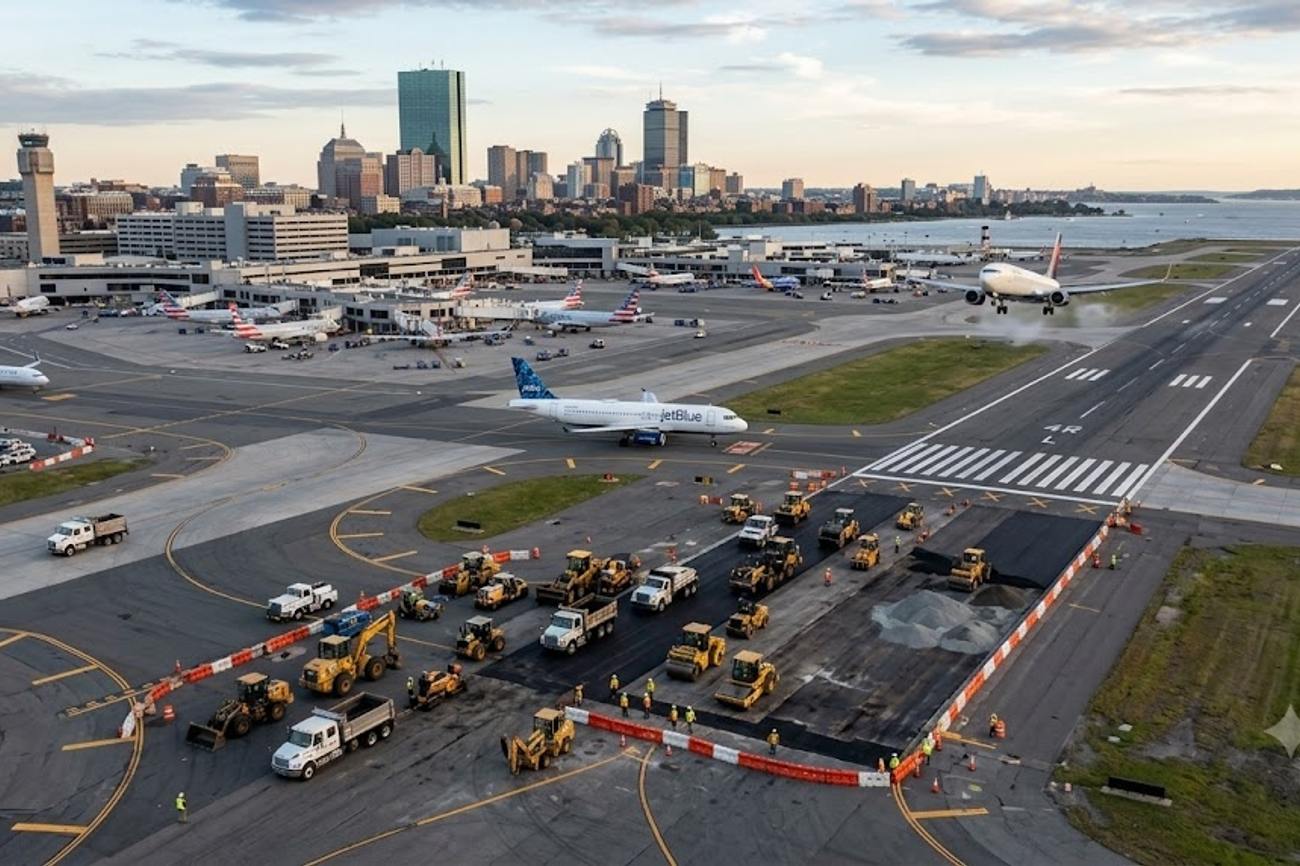
Image generated by AI
Are you planning a trip through a major US hub between now and May 2027? You need to know that several key gateways are operating with reduced runway and taxiway capacity, which significantly alters how air traffic is managed during peak hours and bad weather.
US Airport Infrastructure Restrictions 2026-2027
The Federal Aviation Administration (FAA) has flagged a series of critical infrastructure projects across the United States that will limit operational flexibility at several primary airports. While these projects do not guarantee flight cancellations, they remove the "safety valve" that air traffic controllers usually rely on when weather turns or traffic spikes.
The most immediate pressure is centered on the East Coast, specifically at Boston Logan, where multiple runway constraints are active. However, the long-term logistics challenge shifts to Texas, where Dallas/Fort Worth and Houston Hobby are managing closures that extend well into 2027. For the frequent traveler, the risk is not the construction itself, but the lack of alternative routing options when a primary runway or taxiway is unavailable.
Route and Schedule Details
The following table outlines the specific FAA-listed restrictions. Use these dates to determine if your transit window overlaps with periods of reduced airport capacity.
| Airport | Restriction Detail | End Date | Status |
|---|---|---|---|
| Boston Logan (BOS) | Runway 09/27 (Closed then Limited) | 31 Oct | Active |
| Boston Logan (BOS) | Runway 15R/33L (Limited Ops) | 1 Nov | Active |
| Baltimore/Washington (BWI) | Runways 10/28 and 15R/33L (Closed) | 10 Oct | Active |
| Philadelphia (PHL) | Runway 27R Glide-Slope (Out of Service) | 15 Oct | Active |
| Miami (MIA) | Taxiway Closures | 9 Nov | Active |
| Seattle-Tacoma (SEA) | Runway 16C/34C (Closed) | 15 Nov | Active |
| San Francisco (SFO) | Runway 01R/19L & Taxiway W (Construction) | 15 Nov | Active |
| Houston Hobby (HOU) | Runway 04/22 (Closed) | 31 Dec | Active |
| Houston Hobby (HOU) | Runway 13L/31R (Closed) | 9 Jan 2027 | Active |
| Dallas/Fort Worth (DFW) | Runway 18L/36R (Closed) | 15 May 2027 | Active |
Traveler Logistics Guide
Navigating an airport with reduced infrastructure requires a shift in how you plan your arrival and connection windows. Here is the professional strategy for managing these specific restrictions.
1. Connection Buffer Optimization When transiting through BOS, SEA, or SFO before mid-November, increase your minimum connection time (MCT) by at least 60 to 90 minutes. While the plane may land on time, taxiway construction—specifically at SFO and MIA—can lead to longer-than-usual transit times from the runway to the gate. This "ground lag" is often not reflected in the flight's arrival time but can cause you to miss a tight connection.
2. Monitoring Instrument Landing Systems (ILS) The situation at Philadelphia (PHL) is unique because the issue is electronic (glide-slope equipment) rather than physical. A glide-slope failure means aircraft may have to use less precise approach methods, which can lead to increased spacing between aircraft during low-visibility weather. If you are flying into PHL before 15 October during a storm or heavy fog, expect higher probabilities of holding patterns and arrival delays.
3. Digital Verification Workflow Do not rely solely on your itinerary. Implement this three-step check 24 hours before departure:
- Check the FAA's official operational updates for any sudden changes to runway availability.
- Verify your gate assignment via the airline's mobile app to see if taxiway closures have shifted your aircraft to a remote stand.
- Review the official airport website (for BOS) or respective hub sites for terminal-specific alerts.
4. Baggage and Ground Transport At airports like DFW and HOU, where closures are long-term, the primary impact is on the "flow" of the airport. If your flight is diverted to a secondary runway, you may be parked at a gate further from your planned ground transport or rental car pickup. Allow an extra 20 minutes for the walk to the parking garage or ride-share zone.
Regional Connectivity Impact
The concentration of these works creates a "bottleneck effect" across the US transit map. On the East Coast, the simultaneous restrictions at BOS, BWI, and PHL mean that if a weather system hits the Northeast, there are fewer alternative runways to distribute traffic. This increases the likelihood of "ground stops" where the FAA halts departures to prevent overcrowding in the air.
In the West, the synchronized end dates of 15 November for both SEA and SFO suggest a coordinated push to clear infrastructure hurdles before the Thanksgiving holiday rush. Travelers flying these routes in early November should be particularly vigilant, as airlines will be pushing maximum capacity through limited runways.
The Texas situation is the most significant for long-term logistics. With DFW’s Runway 18L/36R closed until 15 May 2027, the airport is operating with a permanently reduced footprint for nearly a year. For those using DFW as a primary international gateway, this means the airport has less "surge capacity" to handle unexpected delays, making the timing of your arrival and departure more sensitive to operational hiccups.
FAQ: US Airport Restrictions 2026-2027
Do I need to change my flight because of these closures? No. These are operational restrictions, not airport closures. Flights are still operating; however, the airport has fewer options for landing and takeoff. Only change your flight if your airline notifies you of a specific schedule change.
Will my bags be delayed because of runway construction? Not directly. However, if taxiway closures at MIA or SFO lead to aircraft being parked at non-standard gates, it can occasionally slow down the transfer of luggage from the plane to the carousel.
How long should my layover be at DFW or BOS? Given the reduced flexibility through May 2027 (DFW) and November (BOS), I recommend a minimum layover of 2.5 to 3 hours for domestic connections and 4 hours for international-to-domestic transfers.
Does a "limited operations" status mean the runway is closed? No. "Limited operations" means the runway is available but may have restrictions on the types of aircraft that can use it, the time of day it is available, or the specific approach patterns allowed.
Stay flexible with your timing and always verify your gate status in real-time to avoid the construction bottleneck.
#BOS-Runway-2026 #DFW-Infrastructure-2027 #FAA-Airport-Restrictions #US-Transit-Logistics #SFO-SEA-Construction
Related Travel Guides
- US Healthcare Jobs Face AI Revolution: EMTs and Paramedics Among 10 Professions With Near-Zero Replacement Risk
- Qatar Airways Overtakes Emirates And Gulf Rivals With Award-Winning Premium Experience, Strong Connectivity And Advanced Onboard Services
- British Columbia Aligns With Quebec And More Canadian Destinations Accelerate 6% Digital Tourism Growth Through New Technology
Disclaimer
This article is for informational and educational purposes only. It does not constitute legal, financial, or professional advice. While we strive to provide accurate and up-to-date information, travel policies, regulations, and conditions change rapidly. Always verify information with official sources before making travel decisions. Nomad Lawyer makes no representations about the accuracy, reliability, completeness, or suitability of the information provided. Readers should consult qualified professionals for advice specific to their circumstances. The views expressed in this article are those of the author and do not necessarily reflect the views of Nomad Lawyer.
Kunal K Choudhary
Co-Founder & Contributor
A passionate traveller and tech enthusiast. Kunal contributes to the vision and growth of Nomad Lawyer, bringing fresh perspectives and driving the community forward.
Learn more about our team →