
Astana Secures Massive 438 Billion Tenge Investment as Eurasia’s New Luxury Tourism Capital
Kazakhstan’s capital is engineering a total structural overhaul, leveraging aggressive visa-free policies to pull high-yield tourists away from traditional Asian and European hubs.

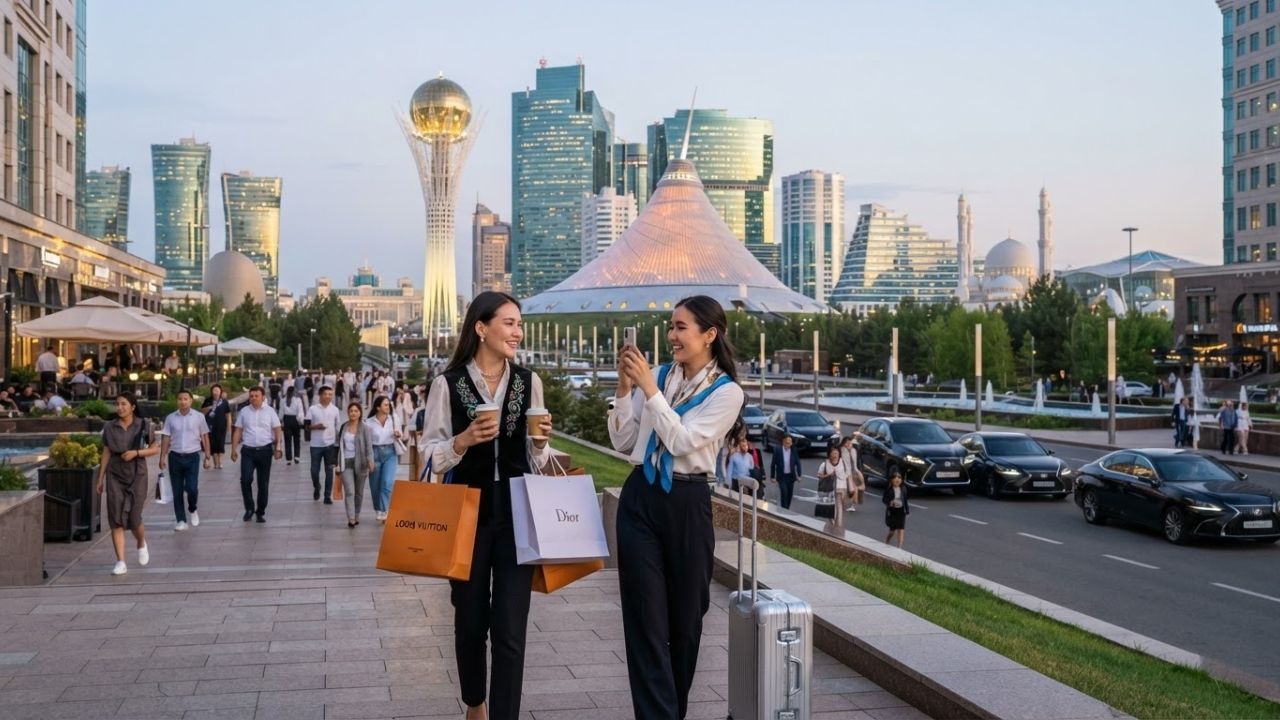
Image generated by AI
[Astana, July 3] — Astana is aggressively rewriting the Eurasian hospitality landscape. Surging past all other administrative regions in Kazakhstan, the futuristic capital secured an unprecedented 438.3 billion tenge in tourism-related infrastructure funding over the past year. This massive cash injection is accelerating rapidly; financial data from the first five months of 2026 confirms that mid-year investments have already hit 250 billion tenge—a near 100% increase compared to the same period last year. Institutional developers are actively flooding the city with capital, engineering a complete structural transition to support a new wave of high-yield international travel.
This infrastructural arms race is directly tied to a massive spike in passenger volume. Last year, Astana processed over 1.6 million visitors, including more than 380,000 foreign tourists. Early 2026 metrics indicate the surge is compounding, with first-quarter arrivals jumping an aggressive 12 percent year-on-year. While legacy markets like Russia, Germany, and the United States maintain a reliable baseline, Astana has successfully triggered an explosive demographic shift. By heavily leveraging new visa-free agreements and expanding regional flight corridors into Nursultan Nazarbayev International Airport, the city is aggressively siphoning massive tourist volumes from China, Uzbekistan, and the United Arab Emirates.
Global Brands Erase Luxury Room Shortages
To prevent severe capacity bottlenecks ahead of upcoming peak convention seasons, municipal authorities have formally authorized 33 major hospitality projects valued at over 265.7 billion tenge. Over the next two to three years, an aggressive construction pipeline will deliver 24 state-of-the-art hotel properties across the skyline. Elite international flags—including Swissôtel, Holiday Inn, and Wyndham Garden—are actively breaking ground on massive four- and five-star flagships. These mega-structures are engineered to completely eliminate the city's current luxury inventory shortage while injecting massive exhibition spaces directly into the corporate downtown sector.
Urban Eco-Tourism Anchors Diversification Strategy
Astana is refusing to rely solely on corporate architecture. Planners are heavily diversifying the city's appeal by injecting massive sustainable recreation zones directly into the urban fringe. The centerpiece of this strategy is Les Eco Park, a spectacular eco-sanctuary fully backed by 25 billion tenge in private corporate financing. By delivering massive public swimming facilities, specialized children’s eco-camps, and an expansive roadside service network without requiring tourists to leave the city limits, Astana is successfully cornering both the elite corporate delegate and the eco-conscious family demographic.
Aggressive International Marketing Procurement
To guarantee future occupancy rates for these massive new developments, municipal marketing teams are executing a ruthless global promotional strategy. Throughout 2026, official Astana delegations have dominated international travel exhibitions across Germany, China, and South Korea, successfully finalizing more than 400 commercial negotiations with foreign corporate partners. Furthermore, the city formally joined three premier international tourism organizations this year, securing unprecedented promotional leverage across major Western and Asian networks. To handle the incoming volume on the ground, specialized visitor centers are now operating 24/7 at heavy foot-traffic zones like the iconic Baiterek Monument.
Key Facts Breakdown
- Total Tourism Funding: Secured 438.3 billion tenge last year; 250 billion tenge in the first five months of 2026.
- Visitor Metrics: Processed over 1.6 million visitors last year, with Q1 2026 arrivals jumping 12% YoY.
- New Demographics: Visa-free policies triggered massive arrival spikes from China, Uzbekistan, and the UAE.
- Hospitality Pipeline: 33 projects valued at 265.7 billion tenge, delivering 24 new hotels (including Swissôtel, Holiday Inn, Wyndham Garden).
- Eco-Tourism Anchor: Les Eco Park secured 25 billion tenge in private financing.
Why This Matters
Our analysis of the capital flow indicates that Astana is executing a masterclass in market disruption. By aggressively securing 438.3 billion tenge in infrastructure capital, the city is deliberately positioning itself to intercept high-spending Asian and Middle Eastern travelers who are increasingly avoiding the heavily congested, hyper-inflated traditional European capitals. The rapid influx of Swissôtel and Wyndham Garden proves that global corporate algorithms view Astana not as a regional anomaly, but as a highly stable, long-term profit center. Furthermore, the strategic weaponization of visa-free agreements for Chinese and UAE demographics proves that Kazakhstan is highly agile, successfully engineering diplomatic policies explicitly to feed its newly constructed hotel pipelines.
Industry Outlook
Market trends suggest that Astana's aggressive marketing in South Korea, China, and Germany will severely threaten established tourism hubs in Eastern Europe and the Caucasus over the next 36 months. Expect Nursultan Nazarbayev International Airport to furiously expand its transit infrastructure, actively lobbying major Asian and Middle Eastern carriers to utilize Astana as a primary regional layover hub. Concurrently, local hospitality operators must brace for intense scrutiny; municipal planners are actively enforcing mandatory service training across all top-tier hotels and transport providers to guarantee international compliance. If the 24 new hotel properties open on schedule, Astana will possess the exact physical capacity required to monopolize the Central Asian corporate convention sector by 2028.
Related Travel Guides
- Riga Aggressively Doubles Tourist Tax for 2027 to Fund Major Baltic Corporate Travel Expansion
- US Domestic Travel Collapses Under Historic 72-Million Passenger Gridlock
- APAC Travel Demand Surges as India and Australia Anchor Massive Market Rebound
- Morocco Secures 4.5% Economic Growth Forecast for 2026 as Tourism and Heavy Industry Merge
- India Triggers Massive Outdoor Tourism Boom as Camping Infrastructure Scales
Disclaimer
This article is for informational and educational purposes only. It does not constitute legal, financial, or professional advice. While we strive to provide accurate and up-to-date information, travel policies, regulations, and conditions change rapidly. Always verify information with official sources before making travel decisions. Nomad Lawyer makes no representations about the accuracy, reliability, completeness, or suitability of the information provided. Readers should consult qualified professionals for advice specific to their circumstances. The views expressed in this article are those of the author and do not necessarily reflect the views of Nomad Lawyer.
Kunal K Choudhary
Co-Founder & Contributor
A passionate traveller and tech enthusiast. Kunal contributes to the vision and growth of Nomad Lawyer, bringing fresh perspectives and driving the community forward.
Learn more about our team →