
US Customs and Border Protection to Deploy Biometric Walkthrough Scans at 38 Airport Terminals in 2026
U.S. Customs and Border Protection is soliciting proposals for biometric facial capture systems at 38 airport terminals to eliminate kiosks for Global Entry members.

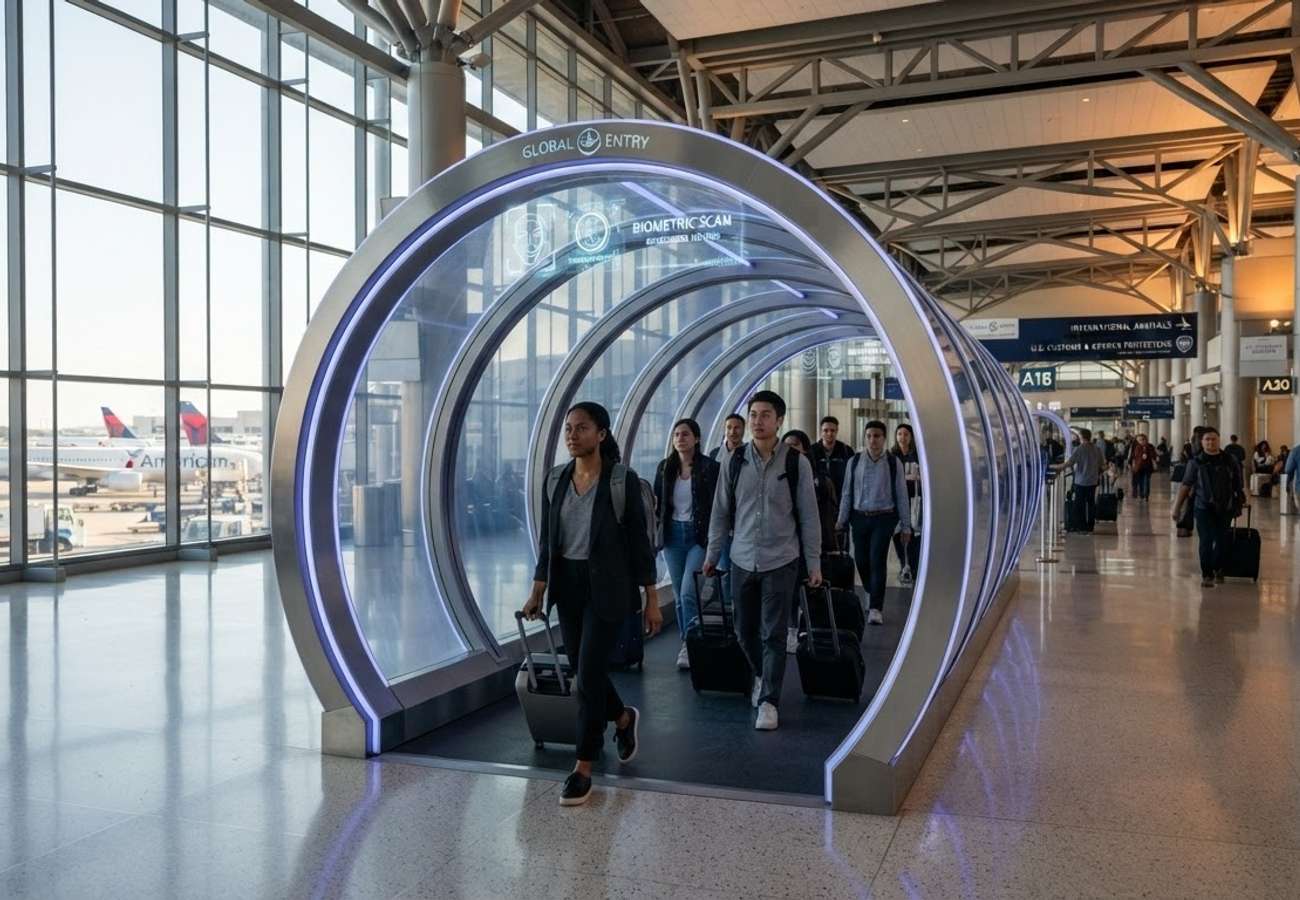
Image generated by AI
807 million travelers have already been processed using facial comparison technology, a figure that underscores the aggressive pivot by U.S. authorities toward a fully contactless border. In a new move to further erode the friction of international arrivals, U.S. Customs and Border Protection (CBP) has issued a solicitation for a "biometric walkthrough capture lane" system. This initiative aims to replace the traditional stop-and-scan kiosk model with an integrated archway that identifies Global Entry members as they move through the terminal, effectively turning the act of walking into the act of identity verification.
The Transition from Kiosks to Continuous Flow
For years, the Global Entry experience has relied on a "stop-and-verify" mechanism. Members currently locate dedicated lanes, interact with a facial recognition kiosk, provide a fingerprint, and answer digital declaration questions. While the U.S. Customs and Border Protection (CBP) has introduced the Trusted Traveler app to streamline this, the physical bottleneck of the kiosk remains a primary pain point during peak transit hours.
The new procurement goal is the implementation of self-supporting archways equipped with specialized cameras and integrated lighting. These structures are designed to capture high-resolution facial images of passengers in motion, which are then instantaneously transmitted to the Traveler Verification Service (TVS) for matching. This shift represents a move from "active" verification—where the traveler initiates the scan—to "passive" verification, where the infrastructure monitors the traveler.
Infrastructure Scope and Targeted Hubs
CBP is not deploying this technology uniformly across all ports of entry. Instead, the agency is targeting 38 specific terminals across 30 airports. These locations were selected based on "saturation," meaning they exhibit the highest volume of Global Entry participants.
The following table details the primary hubs identified in the modernization solicitation:
| Airport | Location |
|---|---|
| John F. Kennedy International Airport | New York |
| Newark Liberty International Airport | New Jersey |
| Los Angeles International Airport | California |
| San Francisco International Airport | California |
| Hartsfield-Jackson Atlanta International Airport | Georgia |
| Dallas-Fort Worth International Airport | Texas |
| Chicago O’Hare International Airport | Illinois |
| Miami International Airport | Florida |
| Washington Dulles International Airport | Virginia |
| Seattle-Tacoma International Airport | Washington |
| Boston Logan International Airport | Massachusetts |
| Philadelphia International Airport | Pennsylvania |
The operational logic is rooted in previous data from Los Angeles International Airport. When facial biometric kiosks were first introduced there in 2020, processing times for pre-approved travelers plummeted by nearly 90%, dropping from an average of 45 seconds per person to under six seconds. With a membership base exceeding 13 million, CBP believes that removing the six-second stop entirely is the only way to prevent systemic congestion.
Expert Analysis: The Cost of Seamlessness
For the frequent flyer, the immediate consequence of this rollout is a drastic reduction in "dwell time" upon arrival. However, from a regulatory and legal perspective, the move toward "continuous flow" biometrics shifts the power dynamic between the traveler and the state.
When a traveler uses a kiosk, there is a clear, conscious interaction with a machine. A walkthrough archway, conversely, integrates surveillance into the architecture of the airport. This creates a scenario where the "consent" to be scanned is implied by the act of entering the lane. For those booking flights into the hubs listed above, the efficiency gain is undeniable, but it comes with an increased reliance on the International Air Transport Association (IATA) standards for digital identity and biometric data sharing.
Furthermore, the risk associated with Global Entry status has never been higher. The program is a privilege, not a right. Recent precedents show that CBP is utilizing this "trusted" status as leverage for broader compliance. For instance, a U.S. lawyer recently had their status revoked after refusing to provide device passwords to officers, and another traveler lost their perks after $22,016 in undeclared cash was discovered in their luggage. The irony of the "seamless" experience is that while the physical barrier is disappearing, the digital scrutiny is intensifying.
The pricing pressure on airlines to move passengers through terminals faster also drives this adoption. Every minute a passenger spends in a customs queue is a minute they are not spending in a lounge or moving toward a connecting flight, which impacts overall airport throughput and efficiency metrics.
Key Takeaways
- End of the Kiosk: Global Entry members at 38 targeted terminals will soon be identified via biometric archways while walking, eliminating the need to stop at a terminal.
- Strategic Deployment: The rollout focuses on 30 high-saturation airports, including JFK, LAX, and Hartsfield-Jackson, where Global Entry membership is most concentrated.
- Proven Efficiency: The goal is to build upon the 90% reduction in processing time seen during the 2020 LAX kiosk rollout.
- Status Volatility: Global Entry remains a revocable privilege; non-compliance with CBP requests (such as device passwords) or undeclared currency can lead to immediate termination of status.
- Broader Integration: This is part of a larger August 2026 plan to implement passport-free checks across all U.S. airports.
FAQ: CBP Biometric Walkthroughs 2026
Do I have to use the biometric walkthrough lanes? Yes, if you are using the Global Entry lane. However, the TSA and CBP generally maintain that passengers can opt out of facial recognition in favor of manual identity verification, though reporting suggests this can vary by officer.
Which airports are getting the new facial scan archways? The system is being deployed at 38 terminals across 30 airports, including major hubs like JFK, LAX, O'Hare, and Miami International.
Can I lose my Global Entry status for refusing a scan? While you can opt for manual processing, Global Entry is a "trusted traveler" program. CBP reserves the right to revoke membership if they determine a traveler is no longer "low-risk" or fails to comply with security protocols.
Is this different from the Trusted Traveler app? Yes. The app allows you to bypass kiosks via a mobile device, but the new archways remove the need for any interaction—app or kiosk—as you simply walk through the lane.
The era of the passport stamp is dying; the era of the digital shadow has arrived.
Related Travel Guides
Disclaimer
This article is for informational and educational purposes only. It does not constitute legal, financial, or professional advice. While we strive to provide accurate and up-to-date information, travel policies, regulations, and conditions change rapidly. Always verify information with official sources before making travel decisions. Nomad Lawyer makes no representations about the accuracy, reliability, completeness, or suitability of the information provided. Readers should consult qualified professionals for advice specific to their circumstances. The views expressed in this article are those of the author and do not necessarily reflect the views of Nomad Lawyer.
Naina Thakur
Contributor & Travel Specialist
Travel enthusiast and legal writer covering visa regulations, responsible tourism, and cultural journeys across global destinations.
Learn more about our team →