
Riskiest U.S. Airports for Connecting Flights: DFW, Newark, Denver, and O'Hare Layover Guide
BTS data highlights the most challenging US airports for connecting flights. Complete guide to terminal transfers, delay risks, and layover strategies at DFW, EWR, DEN, and ORD.

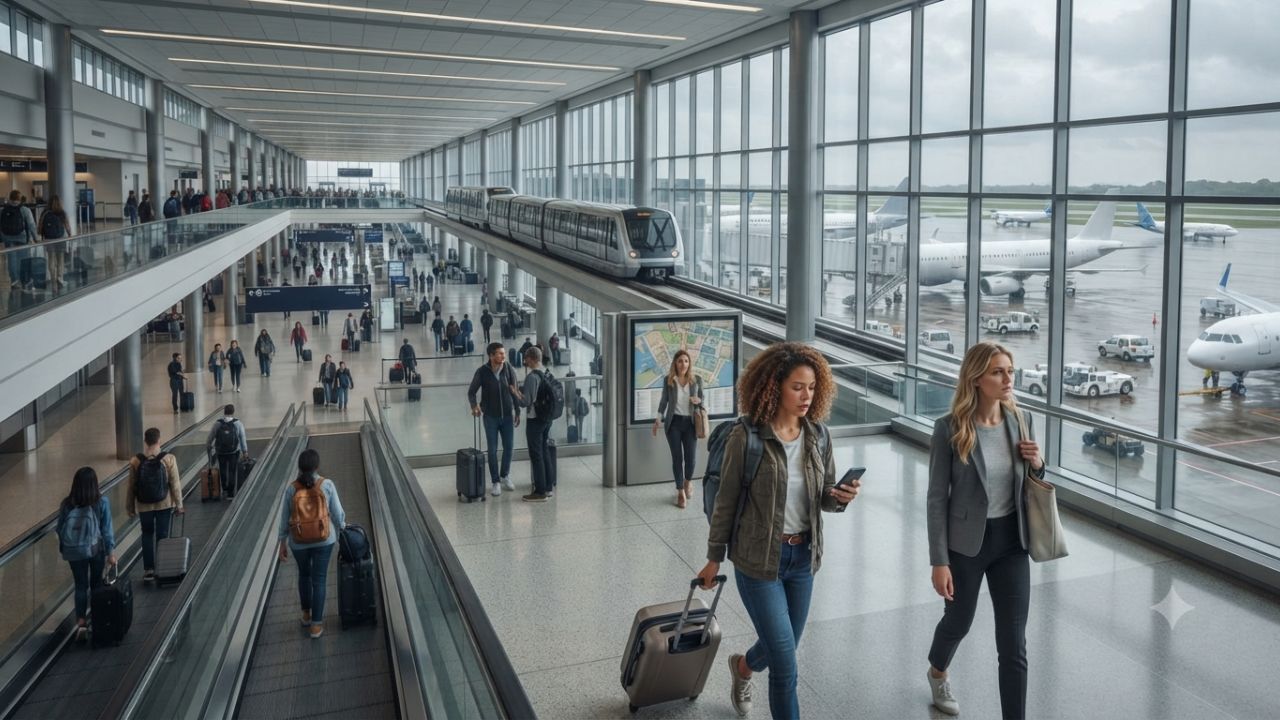
Tight flight connections across major US hubs like DFW, Newark, and Denver can expose travelers to missed flights and terminal delays.
Navigating connecting flights across major United States aviation hubs has become one of the most stressful aspects of modern air travel as tight layovers, sprawling terminal layouts, and cascading airspace delays turn short connections into high-risk journeys. Analyzing Bureau of Transportation Statistics performance data reveals that major airports including Dallas/Fort Worth (DFW), Newark Liberty (EWR), Denver (DEN), and Chicago O'Hare (ORD) require careful layover planning due to complex terminal transfers and recurring delay exposure.
[WASHINGTON] — Air travelers booking domestic and international itineraries through major U.S. hubs face growing operational challenges when making flight connections. According to performance data compiled by the Bureau of Transportation Statistics (BTS), short layovers leave little room for error when inbound flights encounter weather holds, air traffic congestion, or extended gate transfers.
While direct point-to-point flights carry single-flight operational risks, connecting itineraries rely on multiple moving parts. Passengers transitioning between domestic gates or clearing U.S. Customs and Border Protection (CBP) during international arrivals must factor in walking distances, inter-terminal trains, and TSA re-screening procedures.
Ranked Comparison: Riskiest U.S. Airports for Connecting Passengers
Based on BTS on-time performance metrics, cancellation exposure, terminal layout complexity, and international transfer requirements, the following U.S. hubs present the most significant connection challenges for travelers.
| Rank | Airport Name | Code | City / State | Primary Connection Risk Factor | BTS On-Time Performance Context |
|---|---|---|---|---|---|
| 1 | Dallas/Fort Worth Int'l | DFW | Dallas–Fort Worth, TX | Sprawling hub; cascading network weather delays | High connecting volume hub |
| 2 | Newark Liberty Int'l | EWR | Newark, NJ | Congested Northeast airspace; frequent air traffic holds | Vulnerable to regional ATC outages |
| 3 | Chicago O’Hare Int'l | ORD | Chicago, IL | Complex Terminal 5 transfers; severe winter weather | 70% departure on-time rate |
| 4 | Denver International | DEN | Denver, CO | Massive land footprint; long CBP & TSA re-screening | Mountain weather & long concourse trains |
| 5 | John F. Kennedy Int'l | JFK | New York, NY | Multiple non-connected terminals; NYC congestion | Complex international re-check rules |
| 6 | LaGuardia Airport | LGA | New York, NY | High cancellation exposure & NYC airspace delays | Restrained runway capacity |
| 7 | Hartsfield-Jackson Atlanta | ATL | Atlanta, GA | Massive connecting volume; severe summer storms | 77% departure on-time rate |
| 8 | Miami International | MIA | Miami, FL | International-to-domestic CBP processing delays | Tropical storm & Caribbean weather |
| 9 | Los Angeles International | LAX | Los Angeles, CA | Up to 2-mile post-security walks between terminals | Inter-terminal shuttle congestion |
| 10 | San Francisco Int'l | SFO | San Francisco, CA | Marine layer fog delays & runway spacing limits | Air traffic flow control restrictions |
| 11 | Boston Logan Int'l | BOS | Boston, MA | Northeast corridor weather & airspace delays | Coastal fog & winter storms |
| 12 | Philadelphia Int'l | PHL | Philadelphia, PA | Regional ATC telecom vulnerability & congestion | Northeast airspace dependence |
| 13 | Reagan Washington National | DCA | Washington, D.C. | High cancellation rate; perimeter slot limits | Constrained regional operations |
Detailed Breakdown of Top U.S. Connection Hubs
1. Dallas/Fort Worth International Airport (DFW)
DFW is one of the world's busiest connecting hubs. While its 24-hour Skylink automated train connects all five terminals within 5 to 9 minutes, DFW’s main vulnerability stems from its sheer scale and network position. When severe thunderstorms hit North Texas, delays cascade rapidly across American Airlines' global flight schedule, causing missed connections for thousands of transfer passengers.
2. Newark Liberty International Airport (EWR)
Operating in the tightly constrained New York airspace, Newark is frequently subjected to Federal Aviation Administration (FAA) ground delay programs due to thunderstorms and air traffic staffing. On September 21, 2026, a major communications failure at an FAA air traffic facility in Philadelphia paralyzed Newark operations, demonstrating how regional infrastructure failures disrupt connecting flights long before aircraft reach the gate.
3. Chicago O’Hare International Airport (ORD)
Chicago O’Hare combines severe winter weather with complex terminal geometry. While Terminals 1, 2, and 3 are connected airside post-security, passengers transferring to or from international flights at Terminal 5 must often exit the secure area, ride the Airport Transit System (ATS), and clear TSA security screening again. BTS data places O’Hare’s departure on-time rate at 70 percent.
4. Denver International Airport (DEN)
Spanning 53 square miles, Denver International is the largest U.S. airport by land area. Although an automated concourse train links Terminals A, B, and C, international arriving passengers must clear CBP customs, collect checked baggage, re-check luggage, pass TSA screening, and board concourse trains—making a 90-minute international connection extremely tight.
5. Los Angeles International Airport (LAX)
LAX has completed post-security walkway connections linking Terminals 1 through 8, but the full walking distance stretches up to 2 miles. Passengers opting for terminal shuttle buses must navigate heavy curb traffic during peak hours, creating timing bottlenecks for tight connections.
| Airport Transfer Type | Minimum Safe Connection Buffer | Key Layover Risk Mitigation Strategy |
|---|---|---|
| Domestic-to-Domestic (Same Terminal) | 45 to 60 Minutes | Verify gate location on airline mobile app upon landing |
| Domestic-to-Domestic (Terminal Transfer) | 90 Minutes | Check if post-security walkway or airside bus exists |
| International-to-Domestic (CBP Arrival) | 2 to 2.5 Hours | Utilize Mobile Passport Control (MPC) app or Global Entry |
| Domestic-to-International | 90 to 120 Minutes | Ensure luggage is checked through to final overseas destination |
Expert Strategies for Managing Risky Flight Connections
- Avoid Minimum Connection Times (MCT): Booking platforms often sell 35-to-45-minute layovers that leave zero margin for minor inbound delays. Select layovers of at least 90 minutes for domestic routes and 2.5 hours for international arrivals.
- Utilize Mobile Passport Control (MPC): Travelers returning to the U.S. without Global Entry can download the free MPC app to access expedited CBP processing lanes at DEN, ORD, JFK, MIA, and LAX.
- Carry Essential Items in Hand Luggage: Pack medication, valuable electronics, and a change of clothes in cabin baggage in case checked luggage fails to make a tight connection.
- Choose Early Morning Flights: Flights departing before 9:00 AM experience fewer weather-related and aircraft-rotation delays compared to afternoon and evening departures.
Frequently Asked Questions
Which U.S. airport has the highest connection risk for travelers?
Dallas/Fort Worth (DFW) and Newark Liberty (EWR) rank among the highest risk hubs due to DFW's cascading network delay exposure during Texas storms and Newark's chronic Northeast airspace congestion.
How much time should I allow for an international-to-domestic connection in the U.S.?
Travelers should allow at least 2 to 2.5 hours for international-to-domestic connections at hubs like DEN, ORD, JFK, MIA, or LAX to clear CBP customs, recheck baggage, and pass TSA screening.
Do I have to go through security again when connecting flights at Chicago O'Hare (ORD)?
Transfers between Terminals 1, 2, and 3 remain airside post-security. However, transfers involving Terminal 5 (international) may require exiting the secure area and undergoing TSA screening unless using designated airside transfer buses.
How does Skylink work at Dallas/Fort Worth (DFW)?
DFW's Skylink train operates 24/7 inside the secure area, connecting all 5 terminals with trains arriving every 2 minutes. The average journey takes 5 minutes, with a maximum travel time of 9 minutes between opposite terminals.
Related Travel Guides
Disclaimer
This article is for informational and educational purposes only. It does not constitute legal, financial, or professional advice. While we strive to provide accurate and up-to-date information, travel policies, regulations, and conditions change rapidly. Always verify information with official sources before making travel decisions. Nomad Lawyer makes no representations about the accuracy, reliability, completeness, or suitability of the information provided. Readers should consult qualified professionals for advice specific to their circumstances. The views expressed in this article are those of the author and do not necessarily reflect the views of Nomad Lawyer.
Kunal K Choudhary
Co-Founder & Contributor
A passionate traveller and tech enthusiast. Kunal contributes to the vision and growth of Nomad Lawyer, bringing fresh perspectives and driving the community forward.
Learn more about our team →