Thanksgiving Flight Disruptions 2026: Northeast Storm Threat and Hub Delays Guide

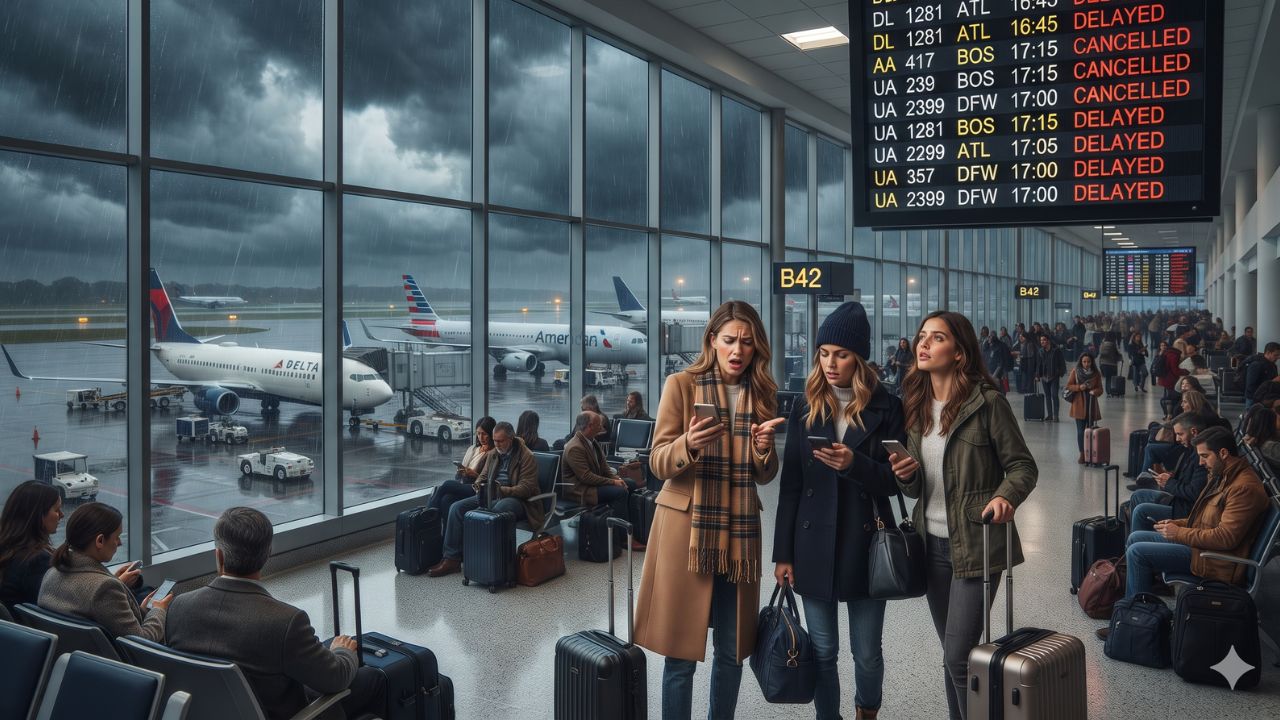
A single carrier, Delta Air Lines, generated nearly half of all nationwide flight cancellations as an automated weight-and-balance computer failure collided with early storm fronts heading toward the eastern seaboard. By midday on 23 November 2026, air operations across the United States registered 2,392 delays and 198 ground cancellations, signalling an early breakdown in holiday flight reliability days before Thanksgiving Day.
The disruptions reflect a dual vulnerability in American air transit: carrier-specific IT vulnerabilities converging with rapid cyclogenesis along the Atlantic coastline. Real-time aviation tracking records confirmed through FlightAware establish that flight holds are heavily concentrated at major transfer hubs including Atlanta, Dallas/Fort Worth, Orlando, and the congested New York-Boston aviation corridor.
Two Converging Crises: Technical Fallback and Rapid Cyclogenesis
Operational data indicates that travel disruptions are not scattered randomly, but clustered tightly around specific operational centers. In Atlanta, Hartsfield-Jackson International (ATL) bore the heaviest single-facility impact, logging 265 flight delays and 44 cancellations. This prolonged operational drag stems directly from an automated system glitch affecting Delta's aircraft weight-and-balance computations at its primary headquarters hub. The outage triggered a temporary ground stop followed by a prolonged ground delay program, forcing dispatchers and ground handlers into labor-intensive manual safety verification workarounds.
Simultaneously, meteorologists at the National Weather Service are tracking a rapidly intensifying low-pressure system forecast to develop into a bomb cyclone over the urban Northeast on Thanksgiving Day. Through rapid cyclogenesis—a rapid drop in atmospheric pressure exceeding 24 millibars in 24 hours—the approaching storm system is predicted to unleash 50 mph wind gusts, widespread coastal flooding, and blinding torrential downpours across airports from Baltimore/Washington to Boston Logan.
Ahead of the main frontal boundary, Northeast gateways are already buckling under initial precipitation and air traffic management spacing constraints. John F. Kennedy International (JFK) posted 105 delays and 8 cancellations, LaGuardia (LGA) marked 89 delays and 15 cancellations, Boston Logan (BOS) registered 78 delays and 11 cancellations, and Baltimore/Washington International (BWI) logged 46 delays and 7 cancellations.
Airline and Airport Disruption Metrics: Thanksgiving Travel 2026
The operational spread reveals how regional weather and hub-specific bottlenecks distribute across major domestic airlines and airports:
| Carrier / Airline | Flight Delays Recorded | Ground Cancellations | Primary Operational Strain |
|---|---|---|---|
| Southwest Airlines | 532 delays | 5 cancellations | Network-wide turnaround delays |
| American Airlines | 405 delays | 5 cancellations | DFW & East Coast slot constraints |
| Delta Air Lines | 402 delays | 92 cancellations | ATL weight-and-balance system glitch |
| United Airlines | 118 delays | 14 cancellations | Midwest weather & gate holds |
| Endeavor Air | 118 delays | 8 cancellations | Regional feeder aircraft positioning |
| JetBlue | 111 delays | 13 cancellations | Northeast corridor congestion |
| Alaska Airlines | 42 delays | 14 cancellations | West Coast storm systems |
| Airport Hub (IATA Code) | Delays Logged | Cancellations Logged | Regional Weather & Traffic Driver |
|---|---|---|---|
| Hartsfield-Jackson Atlanta (ATL) | 265 | 44 | Delta IT outage & dispatch backlogs |
| Dallas/Fort Worth International (DFW) | 197 | 9 | Mid-continent weather transfers |
| Orlando International (MCO) | 132 | 19 | Holiday tourist volume & feeder holds |
| Harry Reid International (LAS) | 114 | 7 | Western airspace sequencing |
| Los Angeles International (LAX) | 110 | 11 | Pacific winter moisture system |
| Fort Lauderdale International (FLL) | 108 | 12 | South Florida thunderstorms |
| John F. Kennedy International (JFK) | 105 | 8 | Pre-storm surface wind & approach spacing |
| Minneapolis–St. Paul (MSP) | 96 | 15 | Northern tier freeze & de-icing lines |
| LaGuardia Airport (LGA) | 89 | 15 | Strict runway configuration limits |
| Boston Logan International (BOS) | 78 | 11 | Coastal wind & inbound queue holds |
| Baltimore/Washington (BWI) | 46 | 7 | Mid-Atlantic routing delays |
What Makes This Thanksgiving Weather System Exceptionally Risky
Unlike winter blizzards that produce dry powdery snow, late-autumn bomb cyclones create multi-hazard threats along the coastal urban corridor. The combination of intense wind shear at approach altitudes and heavy ground rainfall severely restricts airport acceptance rates.
When sustained winds exceed 35 knots and gusts push toward 50 mph, the Federal Aviation Administration must deactivate crosswind runways at constrained hubs like LaGuardia and Boston Logan. This immediately cuts arrival capacities by over 50%, triggering airborne holding patterns that propagate westward to Chicago, Denver, and Dallas.
In addition, simultaneous Pacific moisture surging across California creates coast-to-coast routing bottlenecks. Aircraft operating transcontinental runs risk exceeding crew duty hours while taxiing on wet aprons, sparking cascading cancellations across subsequent flight legs.
Visitor Insider Tips for Holiday Air Travel Survival
Air travelers navigating this week's storm systems should adopt proactive defensive strategies:
- Book the 6:00 AM Departure Slot: Early morning flights are the most reliable option during winter storms. Aircraft parked at gates overnight do not depend on inbound connections, making them far more likely to depart before midday air-traffic ground delay programs take effect.
- Leverage Same-Day Flight Changes Early: As soon as an airline issues a weather waiver, change your itinerary to an earlier morning departure or an alternative transit hub before afternoon squalls arrive.
- Bypass Checked Baggage Completely: Checked bags will not keep pace with emergency rerouting. Travel carry-on only so you can rebook on alternative carriers without waiting in multi-hour baggage claim lines if your flight is disrupted.
- Monitor Inbound Tail Numbers: Track where your incoming aircraft is originating using flight-tracking software. If your inbound plane is held in Atlanta or Minneapolis, your departure will slip regardless of local weather.
Cultural and Infrastructure Context of Modern Holiday Gridlock
Thanksgiving remains the most concentrated travel period in the United States, channeling over 30 million travelers through security checkpoints in a single week. With airline fleets flying near 90% capacity, rebooking open seats after cancellations can take up to 48 hours.
The simultaneous reliance on centralized cloud dispatch software has introduced single-point vulnerabilities. When automated weight, balance, and fuel calculation tools glitch—as seen at Delta's Atlanta operations—federal safety rules require slow manual cargo computations before takeoff. When software bugs intersect with rapid cyclogenesis, traveler agility and early departures are essential to reaching family gatherings on time.
FAQ: Navigating Thanksgiving Air Travel 2026
What should I do if my flight is canceled due to weather?
Immediately open your airline app to accept automatic rebooking options, while concurrently calling the carrier’s international reservation line or contacting support via text for faster agent access.
Will airlines pay for hotels during weather cancellations?
Under Department of Transportation regulations, airlines are not legally required to provide hotel vouchers for cancellations caused by severe weather or air traffic control ground stops.
How early should I arrive at the airport this week?
Arrive at least 2.5 hours before domestic departures and 3.5 hours for international flights. Security screening queues and curbside bag drops experience extreme delays during Thanksgiving week.
Can I get a full refund if my flight is significantly delayed?
Yes. If an airline cancels your flight or makes a significant schedule change (typically over three hours), you are entitled to a full cash refund, even on non-refundable tickets.
During severe holiday travel weather, proactive decisions made before leaving home determine whether you arrive at the dinner table or remain stranded on the concourse floor.
Related Travel Guides
This article is for informational purposes. Flight routes, passenger regulations, visa rules, and transit advisories are subject to change by airlines and aviation authorities. Readers are advised to verify schedules and travel documentation with relevant carriers and border agencies before departure.
Related Stories
The Zero-Buffer Holiday: Why Thanksgiving Air Travel Fails and How Travelers Can Adapt
US Holiday Travel Rush Faces Disruption Risks Following Nationwide FAA Telecommunications Outage