
Singapore, Japan And More Countries Lead Asia’s Digital Border Revolution with Biometric E-Gates and Cyber Resilience
Singapore, Japan And More Countries Lead Asia’s Digital Border Revolution with Biometric E-Gates and Cyber Resilience

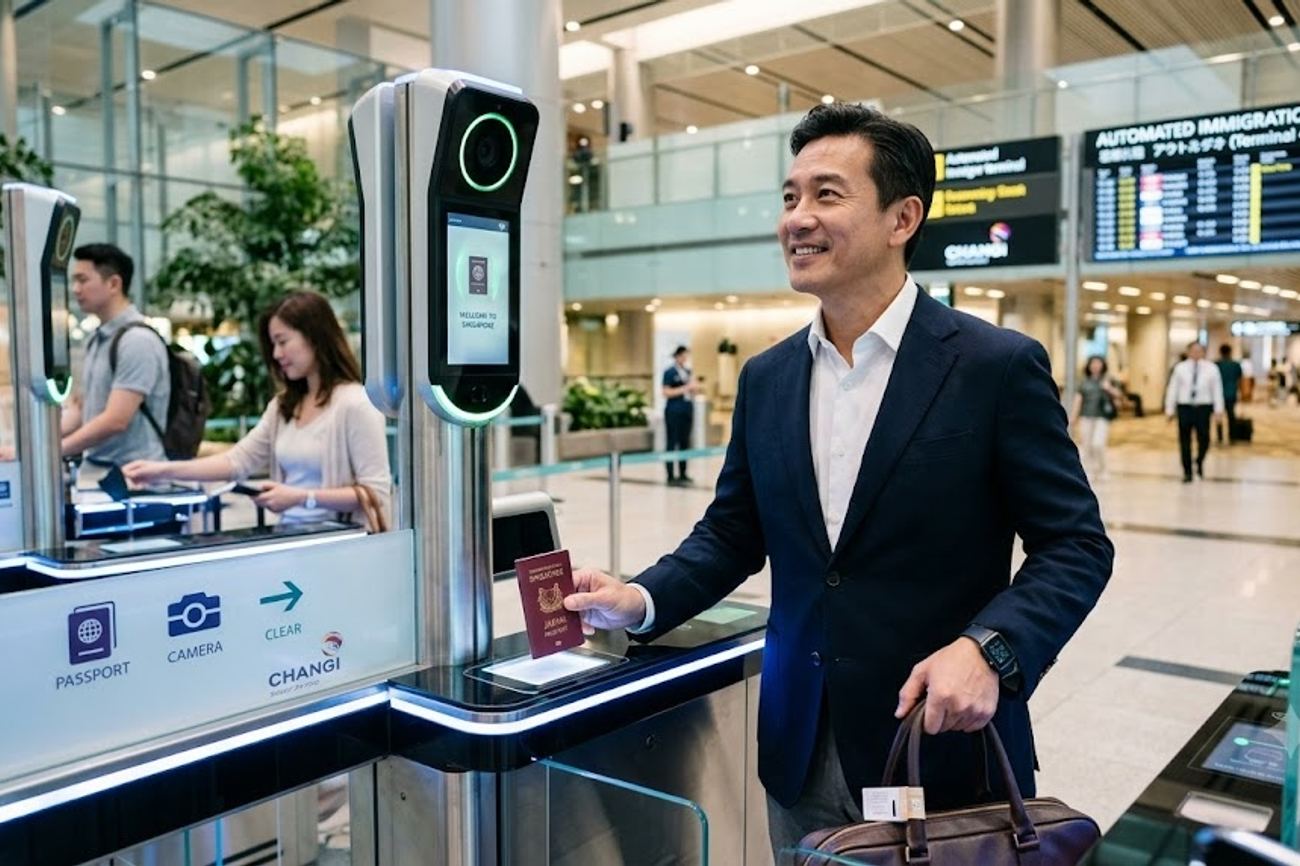
Image generated by AI
The transition from physical passport verification to biometric algorithms in the Asia-Pacific has accelerated the speed of border clearance by 60%, reducing average processing times from 25 seconds to 10 seconds per passenger. This shift represents a fundamental move away from the ICAO Document 9303 standards of physical machine-readable zones (MRZ) toward a distributed, algorithmic pre-clearance model where sovereign authority is now exercised via cloud infrastructure and cryptographic key management.
The Biometric Pivot in Numbers: APAC Border Infrastructure
The digitization of the Asia-Pacific border stack is no longer a theoretical upgrade but a deployed operational reality. The scale of this transition is best illustrated by the pilot deployment of token-less clearance at Singapore Changi Airport’s Terminal 3, where over 1.5 million travelers utilized biometric verification within the first 15 days of operation. This volume demonstrates a massive shift in passenger throughput capacity, moving away from human-centric checkpoints to automated, multi-spectrum camera pods.
The technical architecture driving this change relies on the integration of Advance Passenger Processing (APP) and Advance Passenger Information (API) feeds. By the time an aircraft departs its origin, the destination country's immigration engine has already interrogated the passenger manifest against national security watchlists and civil databases. This "remote perimeter" approach means the legal right to enter a country is adjudicated in cloud microservices thousands of miles before the traveler physically arrives.
However, this efficiency introduces a concentrated attack surface. The aggregation of dual-iris scans, facial biometric vectors, and Personally Identifiable Information (PII) into centralized or hybrid cloud repositories transforms civilian aviation infrastructure into high-value targets for state-sponsored Advanced Persistent Threats (APTs). According to data trends tracked by IATA, the reliance on these APIs means that a single server outage or connectivity failure can lead to immediate airport gate shutdowns and flight cancellations, particularly for budget carriers that lack the manual processing redundancies of legacy flag carriers.
Comparative Analysis of APAC Digital Border Frameworks
The deployment of these systems varies significantly by nation, reflecting different philosophies on data sovereignty and technical architecture. While Singapore utilizes a sovereign hybrid cloud with ephemeral tokens, India is experimenting with W3C Self-Sovereign Identity (SSI) through the DigiYatra pilot, shifting the data burden to edge devices rather than centralized servers.
The following table delineates the current technical and statutory landscape across the four primary APAC hubs:
| Country | Primary Platform | Biometric Modality | Technical Architecture | Governance Framework | Key Tech Partners |
|---|---|---|---|---|---|
| Singapore | Token-Less Clearance | Facial & Dual-Iris | Sovereign Hybrid Cloud | Immigration Act / PDPA | NEC, IDEMIA, SITA |
| Japan | Visit Japan Web | 2D/3D Facial Extraction | Centralized Gov Cloud | APPI | NEC, Airport Authorities |
| India | DigiYatra (Pilot) | Facial Vectorization | W3C SSI / Edge-Device | DPDP Act | Digi Yatra Foundation |
| Thailand | ETA Gateway | ABC Facial Matching | Centralized E-Visa Cloud | PDPA | Airports of Thailand |
When comparing these systems, Singapore's model is the most aggressive in terms of throughput, achieving a 60% increase in speed. Japan's approach is more session-based, focusing on local e-gate interactions. India's move toward SSI is a direct response to the data residency concerns highlighted by the UNWTO, attempting to decouple identity verification from centralized government databases to mitigate the risk of mass data breaches.
What This Means for Travelers
The shift to algorithmic borders changes the "critical path" of travel. The most important part of your journey is no longer the physical queue at the airport, but the digital submission process occurring 72 hours before departure.
1. The "Digital Pre-Clearance" Window Because sovereign jurisdictions now project their borders outward via Electronic Travel Authorizations (ETAs) and API feeds, any discrepancy in your digital submission can lead to a boarding denial. If you are traveling to Thailand or Japan, ensuring your ETA or Visit Japan Web profile is 100% aligned with your passport data is now a prerequisite for boarding, not just for entry.
2. Biometric Enrollment Requirements Travelers should expect an increase in "pre-enrollment" requirements. As seen with Singapore’s token-less system, the efficiency of the 10-second clearance is only possible if your biometric token is already linked to your flight manifest. Travelers who opt out of biometric enrollment or have outdated digital records will likely be routed to manual lanes, where the 25-second average clearance time is now the "slow" benchmark, potentially leading to significant delays during peak hours.
3. Data Privacy Risks With the centralization of dual-iris and facial scans, travelers are essentially trading biological privacy for temporal efficiency. If you are concerned about data residency, monitor the statutory frameworks of your destination. For example, India's DPDP Act and Singapore's PDPA provide different levels of recourse for data breaches. Travelers should review the "Data Sovereignty" clauses of the platforms they use to ensure they understand where their biometric vectors are stored.
Forward Projection: The End of the Physical Document
Based on the current trajectory of the Asia-Pacific market, we are moving toward a "Zero-Document" environment. The success of the Changi Terminal 3 pilot suggests that physical passports will eventually transition from being primary identity documents to being "backup" recovery keys.
We can project that by 2027, the integration of SSI (Self-Sovereign Identity) will expand from India to other APAC nations, allowing travelers to carry their encrypted identity tokens on personal devices, which are then "handshaked" with airport sensors. This would solve the current vulnerability of centralized cloud repositories by distributing the data. However, the short-term trend remains centered on the "Sovereign Data Fortress" model, where governments consolidate biometric data to enhance intelligence-driven risk profiling.
The operational shift mentioned by ICA Commander Alan Koo—redeploying frontline staff to risk profiling—indicates that while the average traveler will experience a frictionless 10-second transit, those flagged by the algorithm will face much more intensive scrutiny. The "algorithmic border" does not remove security; it simply concentrates it on a smaller, high-risk percentage of the population.
FAQ: APAC Biometric Borders 2024
Will my travel time actually decrease? Yes, if you use token-less lanes. In Singapore, clearance times have dropped from 25 seconds to 10 seconds. However, this depends on your flight carrier transmitting APP data correctly to the immigration cloud before you land.
Is it safe to provide dual-iris and facial scans? These are stored in sovereign clouds with hardware security modules (HSMs). While more efficient, they create a centralized target for cyberattacks. Review the PDPA or DPDP acts of the respective countries for data protection rights.
Can I still use a physical passport? Yes, but you will likely be diverted to manual lanes. As automated throughput increases, manual lanes may become more congested, as staffing is shifted toward intelligence-driven risk profiling rather than routine document checking.
Which airlines are best for this? Carriers that are fully integrated with SITA or NEC infrastructure and provide seamless API/APP data feeds to the ICA or Thai ETA gateways offer the most frictionless experience.
The border is no longer a line on a map, but a line of code in a cloud.
Tags: Singapore-ICA-Biometrics, APAC-Border-Digitization, Changi-Tokenless-Clearance, Biometric-Data-Sovereignty-2024, API-APP-Passenger-Processing
Related Travel Guides
Disclaimer
This article is for informational and educational purposes only. It does not constitute legal, financial, or professional advice. While we strive to provide accurate and up-to-date information, travel policies, regulations, and conditions change rapidly. Always verify information with official sources before making travel decisions. Nomad Lawyer makes no representations about the accuracy, reliability, completeness, or suitability of the information provided. Readers should consult qualified professionals for advice specific to their circumstances. The views expressed in this article are those of the author and do not necessarily reflect the views of Nomad Lawyer.
Raushan Kumar
Founder & Lead Developer
Full-stack developer with 11+ years of experience and a passionate traveller. Raushan built Nomad Lawyer from the ground up with a vision to create the best travel and law experience on the web.
Learn more about our team →