
China Aligns With Many Other Asian Markets as Airport Growth Outpaces Hotel Supply
China Aligns With Many Other Asian Markets as Airport Growth Outpaces Hotel Supply

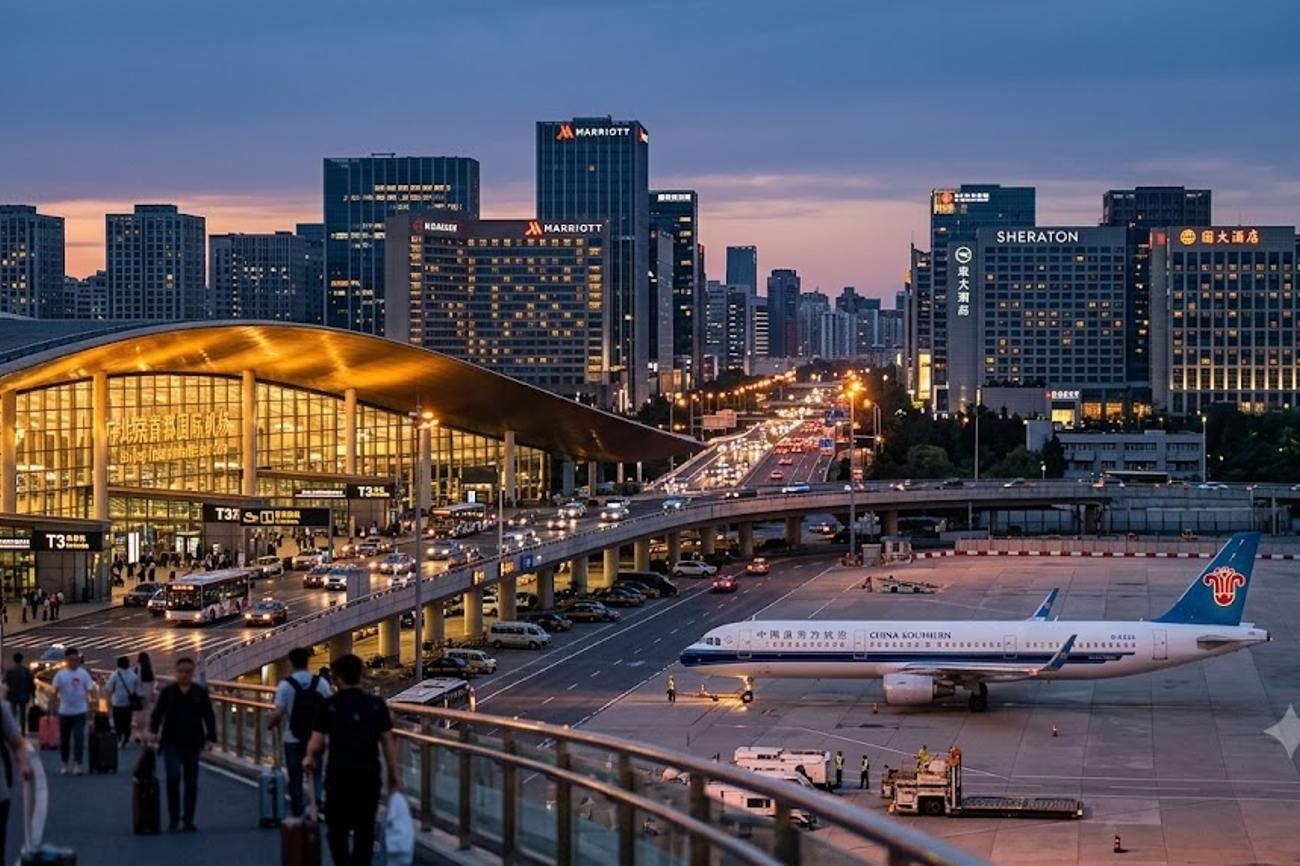
Image generated by AI
[Singapore, May 2026] — Asia-Pacific aviation is entering a period of aggressive expansion that is currently outstripping the region's ability to provide adequate hotel accommodations. While airports are projected to see annual passenger growth of 4.8% between 2025 and 2028, the hospitality sector is struggling with a fragmented development pipeline, leading to a critical imbalance between arrival volumes and available room inventory.
The surge in travel is being driven by structural shifts in domestic mobility and a strengthening of international networks, particularly in Southern Asia and Vietnam. However, a significant gap has emerged between "planned" hotel projects and "active" construction, meaning that while corporate pipelines show growth, actual bed capacity is not increasing fast enough to prevent sharp spikes in room rates and occupancy levels across major hubs.
The Aviation Growth Catalyst
The primary driver of this imbalance is a sustained acceleration in air traffic. According to forecasts from ACI Asia-Pacific and Middle East, the region is poised for a 4.8% compound annual growth rate (CAGR) in passenger traffic through 2028. This growth is not uniform; Southern Asia is leading the charge with a projected annual increase of 6.3%, while South-eastern Asia follows at 5.1%.
Vietnam has emerged as a primary growth engine, with passenger traffic expected to climb by 8.1% annually. Simultaneously, Eastern Asia is seeing a resurgence in international throughput, projected at 6.6% annual growth, largely fueled by the return of outbound Chinese travelers.
China's aviation scale provides a blueprint for this expansion. In 2025, Chinese civil airports managed 1.529 billion passenger trips, marking a 4.8% year-on-year increase. More notably, international-route throughput surged by 18.7%. By the end of 2025, China operated 270 certified civil transport airports, 41 of which processed more than 10 million passengers annually.
The Hospitality Supply Gap
While aviation infrastructure is scaling rapidly, the hotel sector is moving at a slower, less synchronized pace. At the close of 2025, the hotel construction pipeline for Asia-Pacific (excluding China) totaled 2,323 projects and 433,241 rooms. While the number of projects grew by 11% year-on-year, the actual number of rooms only rose by 5%.
A critical breakdown exists between planning and execution:
- Under Construction: Only 890 projects (189,271 rooms) are currently being built.
- Near-Term Starts: 398 projects (77,767 rooms) are scheduled to break ground within 12 months.
- Early Planning: 1,035 projects (166,203 rooms) remain in the conceptual phase.
This discrepancy creates a "phantom supply" effect. Travelers cannot stay in a project that is merely in the planning stage, and construction delays, financing hurdles, and regulatory approvals often push these rooms years beyond their projected opening dates. Furthermore, the pipeline is heavily skewed toward luxury and high-end chain hotels, leaving a severe shortage of midscale and affordable accommodation in central city districts.
Regional Impact Analysis
The pressure is most acute in markets where aviation growth, high occupancy, and rising room rates converge with limited new inventory.
India: The Pricing Power Hub
India represents the most aggressive pricing cycle in the region. In 2025, national hotel occupancy hovered between 63% and 65%, with average daily rates (ADR) reaching ₹8,500–₹8,700 and Revenue Per Available Room (RevPAR) sitting between ₹5,400 and ₹5,600.
Despite strong development—including 64,118 branded-room signings across 586 properties in 2025—only 14,199 rooms actually opened across 176 properties. This lag allows hotels to maintain significant pricing power.
Delhi: Infrastructure vs. Inventory
The aviation surge in Delhi is evident at Indira Gandhi International Airport, which handled 79.3 million passengers in FY 2024–25, a 7.6% increase over the previous year's 73.7 million. The airport expanded its capacity further in August 2024 with the opening of the new Terminal 1, which can now handle 40 million passengers annually.
This capacity increase has coincided with a tightening hotel market. Delhi's occupancy rose from 73% in 2024 to 76% in 2025, while the ADR climbed from US$123 to US$130, and RevPAR increased from US$89 to US$99.
Bengaluru: The Business Travel Squeeze
Bengaluru showcases a trend where pricing grows faster than occupancy. In 2025, occupancy rose slightly from 65% to 67%, but ADR jumped significantly from US$95 to US$108, pushing RevPAR from US$62 to US$73. This indicates that corporate and tech-sector demand is allowing hotels to raise rates even without a massive spike in room fills.
Mumbai: High-Volume Pressure
Mumbai continues to operate at massive scale. Chhatrapati Shivaji Maharaj International Airport handled 55.12 million passengers in FY 2024–25, up from 52.8 million the previous year (a 4.4% increase). International traffic specifically rose from 14.3 million to 15.6 million, with nearly 1,000 daily air traffic movements maintaining constant pressure on the city's limited hospitality footprint.
What This Means for Travelers
For the modern nomad or business traveler, the "aviation-hospitality gap" translates into three immediate practical realities:
- Price Volatility: Expect significant spikes in room rates in Indian and Vietnamese hubs. Because airport capacity is expanding faster than hotel rooms, "last-minute" bookings in cities like Delhi or Bengaluru are becoming prohibitively expensive.
- The "Mid-Tier" Vacuum: While new luxury hotels are opening, the shortage of quality mid-scale and budget-friendly options is worsening. Travelers should expect to either pay a premium for luxury or sacrifice quality in the budget sector.
- Booking Lead Times: The traditional window for booking accommodation is shrinking. With occupancy rates climbing in major Asian hubs, the "wait and see" approach to booking hotels is now a high-risk strategy.
The 2026-2028 Outlook
The coming three years will be defined by whether the "early planning" phase of hotel development can be accelerated into "active construction." If the 1,035 projects currently in early planning do not move toward completion, the region will face a systemic hospitality crisis that could potentially throttle the very aviation growth the airports are preparing for.
Investors are now shifting focus toward "branded-room signings," but the real metric for travelers will be the "opening date." Until the 166,203 rooms in the planning pipeline become physical beds, the trend of rising ADRs and tightening availability will persist across the Asia-Pacific corridor.
FAQ: Asia-Pacific Travel 2026
Why are hotel prices rising even when new hotels are being announced? There is a massive gap between "pipeline" projects and "open" rooms. Many announced hotels are in early planning or facing construction delays, meaning they don't add actual capacity to the market for several years, despite appearing in corporate growth reports.
Which Asian countries are seeing the fastest growth in air travel? Vietnam is leading with a projected 8.1% annual passenger growth, followed by Southern Asia at 6.3% and South-eastern Asia at 5.1%. China is also seeing a major surge in international-route throughput.
How has the airport expansion in Delhi affected hotel stays? The increase in passenger capacity at Indira Gandhi International Airport (especially the new Terminal 1) has driven more visitors into the city, pushing occupancy up to 76% and increasing the average daily rate to US$130.
Is the hotel shortage affecting all types of accommodation? Yes, but mid-scale and affordable options are the hardest hit. Most new development is focused on high-end luxury chains, leaving a shortage of centrally located, moderately priced hotels for business and leisure travelers.
The race is on to see if Asia's hotels can keep pace with its runways.
Tags: #IndiraGandhiInternationalAirport #ChhatrapatiShivajiMaharajInternationalAirport #AsiaPacificAviation2026 #VietnamTravelGrowth #IndiaHospitalityMarket #ACIAsiaPacific
Related Travel Guides
Disclaimer
This article is for informational and educational purposes only. It does not constitute legal, financial, or professional advice. While we strive to provide accurate and up-to-date information, travel policies, regulations, and conditions change rapidly. Always verify information with official sources before making travel decisions. Nomad Lawyer makes no representations about the accuracy, reliability, completeness, or suitability of the information provided. Readers should consult qualified professionals for advice specific to their circumstances. The views expressed in this article are those of the author and do not necessarily reflect the views of Nomad Lawyer.
Preeti Gunjan
Contributor & Community Manager
A passionate traveller and community builder. Preeti helps grow the Nomad Lawyer community, fostering engagement and bringing the reader experience to life.
Learn more about our team →