
Delhi's Saheli Smart Pink Card Launches: Unlimited Free Transit for Women Confirmed
Delhi government officially launches Saheli Smart Pink Card with unlimited free transit for women on DTC buses. Handling 2 million daily female commuter trips with zero charges confirmed. Learn how this digital innovation transforms women's mobility across India's capital.

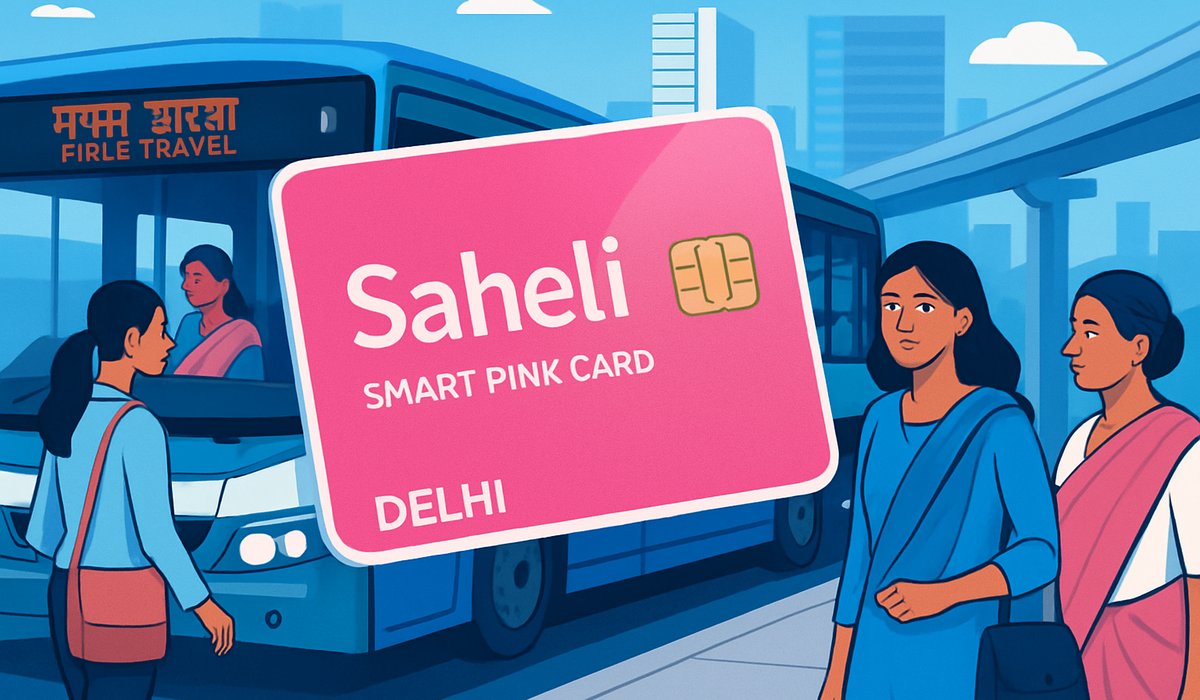
Image generated by AI
Quick Summary
- Zero-Cost Transit: Saheli Smart Pink Card guarantees unlimited free travel on all Delhi Transport Corporation (DTC) buses with no hidden charges
- Scale & Impact: Processes 2 million female commuter trips daily across DTC's 4.5 million total daily journeys
- Government Initiative: Launched under Chief Minister Rekha Gupta's administration to enhance women's economic participation and mobility
- Digital Accuracy: Smart card technology eliminates discrepancies in subsidy accounting through precise trip tracking
- 3-Month Enrollment: Extended registration window eliminates overcrowding and ensures convenient card acquisition for all eligible women
Delhi's Saheli Smart Pink Card: Revolutionary Free Transit for Women Just Launched
Delhi's Chief Minister Rekha Gupta has officially confirmed that the Saheli Smart Pink Card guarantees completely free, unlimited public transportation for women across the National Capital Region. The government's digital transit initiative, spearheaded through partnership with Delhi Transport Corporation (DTC), eliminates all ambiguity about charges, fees, and transfer conditions—women simply tap their card and travel without financial obligation. This landmark transportation policy addresses decades of transit accessibility challenges while simultaneously advancing women's economic participation through quantifiable fare relief.
The initiative resolves widespread confusion circulating on social media and within political discussions regarding potential hidden costs, transfer restrictions, and charge triggers. The Chief Minister's recent video clarification definitively established that zero charges apply—regardless of frequency, duration between trips, or number of bus transfers within any timeframe.
Understanding the Saheli Smart Pink Card System
The Saheli Smart Pink Card represents a technological leap forward in transparent public subsidy management. Rather than relying on pass-based systems vulnerable to fraud or inaccurate accounting, the digital card automatically records every journey through tap-based verification. This creates comprehensive data capturing 2 million daily female commuter trips across DTC's 4.5 million total daily journeys—previously impossible to track precisely.
Each tap generates an instantaneous digital record transmitted to government systems. The Delhi government reimburses DTC directly for actual journeys completed, ensuring subsidies reach intended beneficiaries rather than disappearing through administrative gaps. This technological precision distinguishes the Saheli card from conventional fare-waiver systems that estimate rider populations rather than counting individual trips.
The card's digital architecture ensures functionality across consecutive trips regardless of timing. Whether women transfer buses within five minutes or ten minutes—or make twenty trips daily—the system records each journey and processes subsidy reimbursement identically. No hidden algorithms trigger charges during rapid transfers; no debt accumulates from frequency patterns.
Addressing Misinformation and Public Concerns
Chief Minister Gupta explicitly countered false narratives suggesting the free travel privilege would face restrictions for transfer commuters. Certain political actors disseminated claims that consecutive bus transfers would incur penalties or activate hidden charges—statements the government categorized as calculated misinformation intended to discourage card adoption.
The administration emphasized that these allegations represented blatant falsehoods contradicting the technological functionality of the card system. Women were actively encouraged to test the cards personally, verifying that transfer functionality operates flawlessly without charge implications. The government's transparency messaging highlighted that 100% reliability characterizes the technology for back-to-back trips.
This misinformation campaign illuminated the critical difference between the previous untracked transit system and the current digital infrastructure. The old model—lacking precise accounting mechanisms—inadvertently created financial opacity that benefited private interests through unaccounted subsidies. The new system prioritizes public transparency through verifiable, individual trip documentation.
Strategic Implementation: Three-Month Enrollment Window
The Delhi government established an expandable three-month registration and distribution timeline to accommodate the city's vast population of female residents. This extended window deliberately prevents enrollment center overcrowding while ensuring no citizen experiences artificial urgency or panic-driven decision-making.
The acquisition process has been systematized for maximum accessibility—no requirement for extended queue times, no complex documentation procedures, and no bureaucratic obstacles. Administrative infrastructure has been deliberately scaled to handle enrollment efficiently, with multiple registration centers distributed across Delhi's zones. The streamlined process ensures that geographic location, employment schedules, or mobility constraints don't prevent eligible women from obtaining cards.
Women were assured they could obtain cards at personal convenience throughout the extended enrollment period. The government prioritized removing participation barriers rather than creating them through time pressure or resource scarcity.
Impact on Women's Economic Participation
The Saheli Smart Pink Card extends far beyond simple fare elimination—it fundamentally reshapes women's economic participation across Delhi and the National Capital Region. By removing transportation expense burdens from household budgets, the initiative directly increases disposable income available for other essential needs, education, or economic activity.
For working women, students, and female entrepreneurs, predictable zero-transit costs enable safer financial planning and expand employment opportunities previously constrained by daily commuting expenses. Women can pursue employment across wider geographic areas when transit costs cease consuming household resources. The cumulative economic impact across 2 million daily female commuter trips substantially increases women's economic security across Delhi.
The system also creates documented mobility data previously unavailable. Government analytics can now identify high-transit corridors, peak travel times, and geographic patterns of women's economic activity. This data informs future infrastructure investments, ensuring public resources allocate toward areas demonstrating documented demand.
Government Accountability Through Technology
The Delhi administration emphasized that the smart card system operates as an institutional integrity mechanism rather than a beneficiary benefit alone. Every card tap triggers state treasury reimbursement to DTC—directly covering commuting expenses from government accounts. This direct payment model eliminates intermediaries, administrative opacity, and potential fund diversion.
The previous unaccounted-for transit system inadvertently enabled questionable practices through lack of verification. The digital card system implements rigorous financial accountability where every subsidy is traceable to specific trips and individual passengers. This technological vigilance protects public funds while guaranteeing delivered benefits reach intended recipients.
Data Revolution: From Estimates to Precise Accounting
The transition from rough population estimates to granular individual trip data represents administrative advancement across India's public transportation sector. Previously, DTC budgeted women's free travel subsidies based on estimated ridership percentages. These estimates frequently diverged dramatically from actual figures, creating either surplus allocations or underfunded programs.
The Smart Pink Card's tap-based system eliminates estimation uncertainty. Every single journey generates a verifiable digital record stored in government databases. If 1.2 million women complete 2.1 million daily trips, the system captures exactly those numbers—not educated guesses. Government accounting responds to actual demand rather than speculative predictions.
This precision extends bureaucratic planning capabilities across other transit franchise areas and public service programs. When administrators access reliable usage data, infrastructure investments align with genuine demand patterns rather than assumptions. The Saheli Smart Pink Card serves as pilot program demonstrating how scaled digital systems improve public resource allocation across India's massive metropolitan areas.
Enrollment Process and Accessibility
The Saheli Smart Card registration process has been deliberately simplified to ensure barrier-free access across Delhi's diverse female population. Multiple enrollment centers operate throughout the city's zones, with extended hours and multi-language support services. Women can complete registration in minutes without extensive documentation or verification procedures.
The process requires basic identification (Aadhaar card, voter ID, or passport) and a simple form capturing address information. Digital processing systems immediately issue cards or arrange pickup within 24-48 hours. No fees apply; the entire process operates as costless public service.
Mobile enrollment units operate in high-density residential areas, preventing requirement to travel significant distances for registration. Markets, community centers, and transit hubs host registration stations, ensuring convenient access during shopping, commuting, or daily activities. Evening and weekend hours accommodate women with inflexible work schedules.
Long-Term Vision for Delhi's Public Transportation
The Delhi government positioned the Saheli Smart Pink Card as foundational to comprehensive public transit modernization across India's capital. The initiative demonstrates how digital technology integrates with equity-focused policy to create simultaneous improvements in service delivery, financial accountability, and passenger benefit.
Future infrastructure planning will leverage Saheli card data to optimize bus routes, improve frequency on high-demand corridors, and expand coverage to currently underserved areas. The technology enables real-time monitoring of transit system performance while identifying passenger experience challenges requiring administrative attention.
The administration remains committed to maintaining completely free transit indefinitely. No circumstance—political transition, budgetary pressure, or external influence—will trigger restoration of transit fares for women passengers. The zero-charge commitment represents permanent policy rooted in equity principles.
FAQ: Common Questions About Saheli Smart Pink Card
Q: Does the Saheli Smart Pink Card charge fees if I transfer between buses? A: No. The card functions entirely free regardless of transfer frequency, timing, or duration between consecutive trips. Transfers within five minutes, ten minutes, or hours incur zero additional charges. The system contains no hidden algorithms triggering transfer penalties.
Q: Is there a limit to how many trips I can take daily? A: No limits apply. The card permits unlimited daily travel across all DTC bus routes. Whether you take 5 trips or 25 trips daily, all remain completely free. No daily, weekly, or monthly caps restrict usage.
Q: How long is the three-month registration window? A: The enrollment period extends three months from official launch to provide ample time for all eligible women to obtain cards without overcrowding registration centers. You can register at any point during this window—no deadline urgency applies.
Q: What identification is required for card acquisition? A: Basic identification suffices—Aadhaar card, voter ID, passport, or driver's license. You'll provide address confirmation and complete a simple one-page enrollment form. The process requires minimal documentation.
Q: Will card registration information be kept confidential? A: Yes. Government data protection protocols govern all card registration information. Personal data remains confidential and is used exclusively for trip tracking and subsidy administration.
What This Means for Travelers and Commuters
The Saheli Smart Pink Card represents transformational policy affecting 14 million women across Delhi and the National Capital Region. For daily commuters, students, female entrepreneurs, and visiting women travelers, the zero-cost unlimited transit capability fundamentally reimagines mobility options. Geographic constraints imposed by transit expense collapse entirely when travel becomes costless.
Female business travelers visiting Delhi benefit from unlimited public transportation access, enabling deeper city exploration without transit expense calculations. Tourist women can navigate Delhi's attractions across distant zones without budgeting transportation costs. Students can access educational institutions across expanded geographic areas previously impractical due to daily transit expense burdens.
The policy's implementation signals broader institutional commitment to women's empowerment through technology and transparent governance. As other Indian cities observe Delhi's success, similar programs may expand nationally, potentially transforming women's mobility across India's urban centers.
Disclaimer
This article is for informational and educational purposes only. It does not constitute legal, financial, or professional advice. While we strive to provide accurate and up-to-date information, travel policies, regulations, and conditions change rapidly. Always verify information with official sources before making travel decisions. Nomad Lawyer makes no representations about the accuracy, reliability, completeness, or suitability of the information provided. Readers should consult qualified professionals for advice specific to their circumstances. The views expressed in this article are those of the author and do not necessarily reflect the views of Nomad Lawyer.
Preeti Gunjan
Contributor & Community Manager
A passionate traveller and community builder. Preeti helps grow the Nomad Lawyer community, fostering engagement and bringing the reader experience to life.
Learn more about our team →