
Minneapolis Airport Outpaces Detroit and More as Best US Airports Redefine the Passenger Journey
Minneapolis Airport Outpaces Detroit and More as Best US Airports Redefine the Passenger Journey

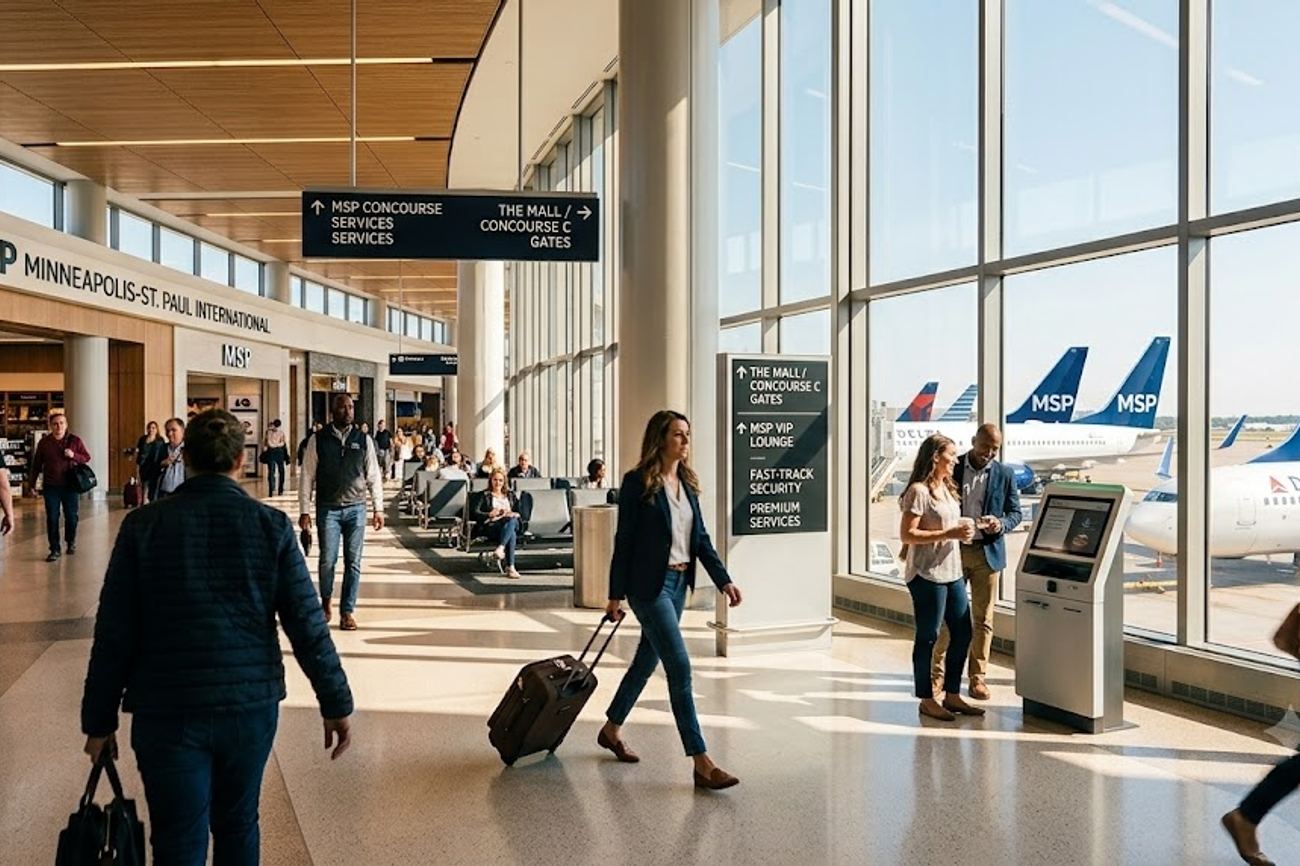
Image generated by AI
Minneapolis–Saint Paul International Airport (MSP) has secured the top spot for North American mega airports for three consecutive years, currently holding a J.D. Power satisfaction score of 684 out of 1,000. This stability at the top is a stark contrast to the volatility seen in passenger satisfaction scores during the immediate post-pandemic recovery phase, signaling a shift from "survival mode" operations to a strategic focus on passenger experience (PaxEx).
The Passenger Experience Metric — Analyzing the Satisfaction Gap
The data from the latest J.D. Power study reveals a distinct performance gap between "Mega" airports (those handling 33 million+ passengers annually) and "Large" airports (10 million to 32.9 million passengers). While MSP leads the Mega category with 684 points, it is outperformed in absolute terms by Tampa International Airport, which scored 715. This 31-point differential suggests that as passenger volume scales beyond the 33 million threshold, maintaining peak satisfaction becomes exponentially more difficult due to the logistical friction of massive crowds.
MSP’s success is not accidental but the result of targeted capital expenditures in terminal fluidity. By prioritizing wider corridors and increased seating capacity, MSP has mitigated the "bottleneck effect" that typically plagues hubs of its size. For a facility handling over 36 million passengers in 2025, the ability to maintain a 684 score indicates a successful decoupling of volume growth from service degradation.
Comparative Benchmarks: Mega vs. Large Hubs
When analyzing the competitive landscape, a clear pattern emerges: airports that integrate local identity and aggressive spatial expansion outperform those relying solely on operational efficiency. Phoenix Sky Harbor, for instance, is managing an aggressive growth trajectory, having welcomed 52.33 million passengers in 2024—a 7.5% year-over-year increase. To sustain this, Phoenix is adding 173,000 square feet via the Terminal 3 North 2 Concourse project.
The data suggests that "Large" airports currently have a competitive advantage in passenger sentiment because they can offer a more intimate, less chaotic environment. Tampa’s move to increase capacity from 25 million to 35 million passengers via the Airside D terminal (adding 16 gates) is a strategic gamble to see if it can maintain its 715-point satisfaction lead while transitioning into the "Mega" category.
| Airport | Category | J.D. Power Score | Annual Passenger Volume | Key Infrastructure Shift |
|---|---|---|---|---|
| Tampa (TPA) | Large | 715 | 25M $\rightarrow$ 35M (Projected) | Airside D (16 new gates) |
| Portland (PDX) | Large | 708 | 10M - 32.9M | Terminal Transformation/Localism |
| Dallas Love (DAL) | Large | 698 | 10M - 32.9M | City-centric simplicity |
| Minneapolis-St Paul (MSP) | Mega | 684 | 36M+ | Terminal widening & flow optimization |
| Detroit (DTW) | Mega | 663 | 33M+ | Hub efficiency & connectivity |
| Phoenix (PHX) | Mega | 642 | 52.33M (2024) | Terminal 3 North 2 (+173k sq ft) |
Practical Traveler Advisory and Strategic Insights
For the individual traveler, these data points translate into specific booking and transit strategies. The correlation between high satisfaction scores and "terminal fluidity" means that airports like MSP, TPA, and PDX are currently the lowest-stress environments for connections.
If you are routing through a Mega hub like Phoenix (PHX) during its current expansion phase, expect higher congestion levels despite the 7.5% growth in capacity. The data indicates that while the airport is growing, the satisfaction score (642) lags behind MSP (684), suggesting that infrastructure is currently chasing demand rather than leading it. Travelers should allocate an additional 30-45 minutes for terminal navigation at PHX compared to MSP.
Furthermore, the success of Portland’s "sense of place" model suggests that travelers who prioritize airport amenities and local culture should favor PDX. The shift toward local business integration means the airport is no longer just a transit point but a destination in itself. According to IATA, the modernization of passenger touchpoints is a primary driver in overall trip satisfaction, making the choice of hub a critical component of the travel experience.
Infrastructure Trajectory and Market Movement
The industry is moving toward a "Boutique Mega-Hub" model. We see this in the divergence between Detroit’s efficiency-first approach (663 points) and Portland’s experience-first approach (708 points). The market is shifting away from the sterile, one-size-fits-all terminal design toward environments that mirror the destination city.
As airports like Tampa move from "Large" to "Mega" status, the industry will be watching to see if the 700+ satisfaction threshold can be maintained at a 35-million-passenger volume. Historical data from OAG suggests that as airports hit the 30-million-passenger mark, operational complexities typically cause a dip in passenger sentiment. Tampa’s Airside D project is a direct attempt to break this historical trend.
We are also seeing a regional shift in the Midwest. With MSP and DTW both scoring highly in the Mega category, the Midwest is positioning itself as the gold standard for hub efficiency in North America. This is likely a response to the systemic failures seen in coastal mega-hubs, where aging infrastructure has struggled to keep pace with the surge in passenger counts reported by Statista.
FAQ: North American Airport Trends 2025
Will airport satisfaction scores improve as more terminals expand? Not necessarily. While Phoenix is adding 173,000 square feet, satisfaction often depends on "flow" rather than just "size." The data shows that MSP’s focus on wider spaces and better routing—rather than just raw square footage—is what sustains its top ranking.
Is it better to fly through a "Large" airport or a "Mega" airport? Statistically, yes. The top three "Large" airports (Tampa, Portland, Dallas Love) all scored higher (698-715) than the top three "Mega" airports (642-684). Smaller hubs currently offer a more streamlined, higher-satisfaction experience.
Which airports are currently the best for stress-free connections? Based on the J.D. Power data, Minneapolis–Saint Paul (MSP) is the most reliable Mega hub for a smooth journey. For those not restricted to Mega hubs, Tampa (TPA) offers the highest overall passenger satisfaction score at 715.
How does airport growth affect ticket prices? Expansion, such as Tampa’s 16 new gates, increases capacity. According to general aviation economic patterns, increased capacity can lead to more airline competition and a broader range of flight options, which may stabilize or lower fares over the long term.
The data is clear: the era of the sterile terminal is ending, replaced by a race for spatial fluidity and regional identity.
Related Travel Guides
- American Airlines Joins United and More as Rising Fuel Prices Rattle US Holiday Flights
- Biman Bangladesh Airlines BG201 Sylhet to London Flight Sees Mid-Air Passenger Brawl as Cabin Crew Intervenes
- Turkey Travel Spotlight as Corendon Airlines Streamlines UK Antalya Flights With New 2027 Summer Schedule
Disclaimer
This article is for informational and educational purposes only. It does not constitute legal, financial, or professional advice. While we strive to provide accurate and up-to-date information, travel policies, regulations, and conditions change rapidly. Always verify information with official sources before making travel decisions. Nomad Lawyer makes no representations about the accuracy, reliability, completeness, or suitability of the information provided. Readers should consult qualified professionals for advice specific to their circumstances. The views expressed in this article are those of the author and do not necessarily reflect the views of Nomad Lawyer.
Raushan Kumar
Founder & Lead Developer
Full-stack developer with 11+ years of experience and a passionate traveller. Raushan built Nomad Lawyer from the ground up with a vision to create the best travel and law experience on the web.
Learn more about our team →