British Airways Revives Long-Haul Meal Pre-Orders on Las Vegas Flights: Inside the World Traveller Plus Dining Trial

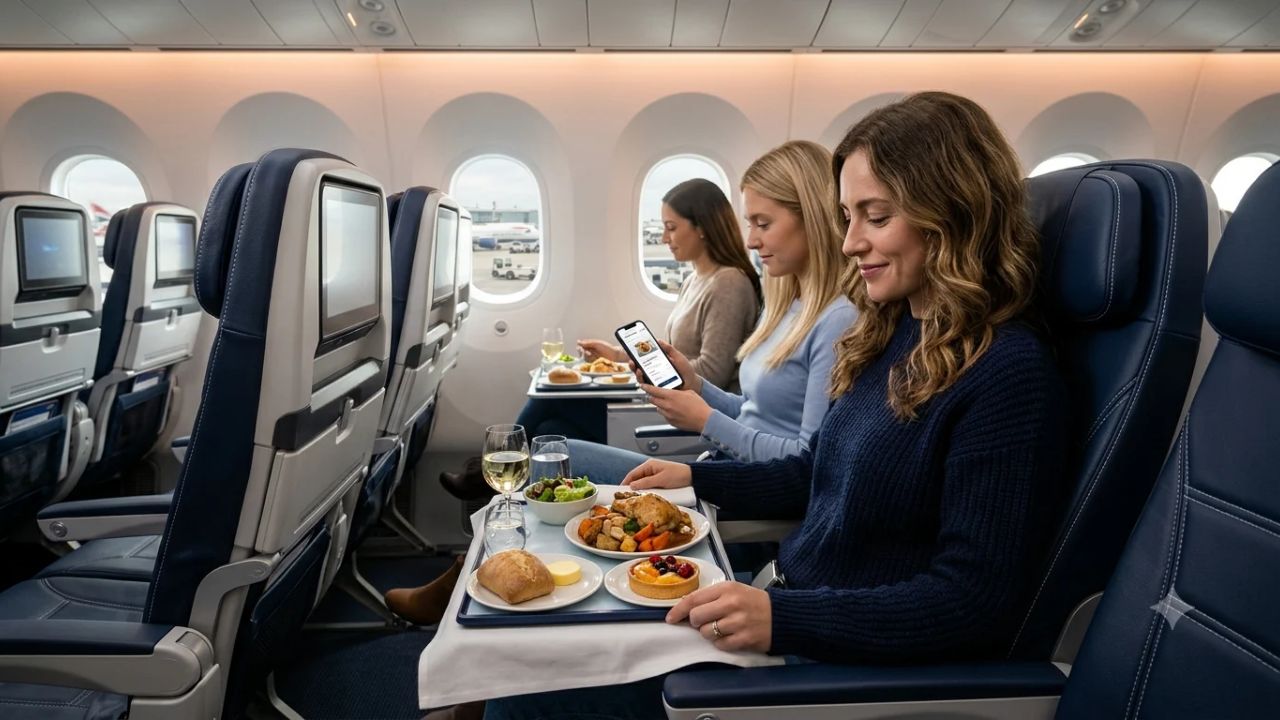
British Airways reintroduces advance meal pre-ordering on flights between London Heathrow and Las Vegas, providing World Traveller Plus passengers guaranteed choice from the onboard menu.
LONDON, November 3, 2026 — British Airways has officially reinstated its long-haul passenger meal pre-ordering facility through a targeted operational trial, offering premium economy passengers traveling between London Heathrow and Las Vegas advance selection of their main onboard dining courses. The service represents the airline's first step toward restoring advance catering choices following a multi-year hiatus triggered by the pandemic and subsequent logistical postponements. Restricted exclusively to travelers seated in the carrier's World Traveller Plus cabin on the London Heathrow (LHR) to Harry Reid International Airport (LAS) corridor, the complimentary feature allows fliers to lock in their preferred hot entrée via the airline's digital portal before stepping foot inside the terminal.
[!NOTE] Key Operational Summary of the Las Vegas Trial: The meal pre-order facility is available exclusively to passengers ticketed in World Traveller Plus on British Airways-operated flights between London Heathrow and Las Vegas. The digital selection window opens seven days (168 hours) before scheduled departure and closes promptly 24 hours prior to take-off via the Manage My Booking platform on ba.com and the mobile app. The service is complimentary and draws directly from the existing onboard menu. Passengers requiring special dietary, religious, or medical meals must continue to book via the dedicated Special Meals channel, as standard pre-ordering does not accommodate medical or allergy requirements.
BRITISH AIRWAYS MEAL PRE-ORDER SERVICE TIMELINE & LIFECYCLE
| [ PRE-FLIGHT SELECTION WINDOW: 7 DAYS TO 24 HOURS PRIOR TO DEPARTURE ] |
|---|
| * Platform: British Airways 'Manage My Booking' (Website or Mobile App). |
| * Eligibility: Confirmed World Traveller Plus ticket on London Heathrow (LHR) to Las Vegas (LAS). |
| * Menu Scope: Choice of hot main courses drawn directly from the scheduled onboard cycle. |
| * Cost: Free of charge; selection can be modified until the 24-hour cutoff. |
| [ 24-HOUR CATERING LOCKDOWN & PRODUCTION MANIFEST ] |
| * Digital manifest transmitted to Heathrow flight catering production kitchens (DO & CO). |
| * Meal trays assembled, chilled, and assigned to specific seat numbers on galley stowage plans. |
| [ INFLIGHT DELIVERY & CABIN SERVICE (LHR ==> LAS) ] |
| * Cabin crew cross-reference pre-order manifests via digital tablets during initial drinks run. |
| * Confirmed main courses served directly to pre-ordered passengers before general cabin cart. |
| * Non-participating passengers select from remaining onboard options, subject to availability. |
The Las Vegas Testing Ground: Restoring Passenger Control After Pandemic Suspension
The selection of the London Heathrow to Las Vegas route as the proving ground for British Airways' resurrected meal pre-order service reflects a calculated operational strategy. Spanning over 5,200 nautical miles with scheduled flight durations exceeding ten and a half hours westbound, the transatlantic corridor represents one of the network's most demanding non-stop leisure and convention routes. Passengers traveling on flight BA275 face an extensive daytime flight across multiple time zones, where onboard dining plays an outsized role in shaping overall passenger satisfaction and comfort.
By focusing the trial strictly on World Traveller Plus, British Airways is directing the service to a customer demographic that delivers outsized commercial margins. Premium economy fliers pay substantial fare premiums over World Traveller economy, expecting elevated personal comfort without committing to the multi-thousand-pound cost of a lie-flat Club World business-class seat. However, one of the most persistent operational pain points in premium economy cabins has historically been meal availability. Because galleys carry fixed ratios of chicken, beef, pasta, or fish dishes based on broad historical averages, passengers seated in the rear rows of the cabin frequently discover that their preferred dish has run out by the time the service trolley reaches their row.
Offering pre-departure selection on the Las Vegas route resolves this customer friction point entirely. By allowing passengers to secure their preferred main course up to seven days in advance, British Airways eliminates the disappointment of missed choices while granting travelers psychological peace of mind. In addition, the operational choice of Las Vegas allows catering teams to observe pre-ordering adoption across a balanced mix of affluent holidaymakers, casino high-rollers, and international conference delegates attending major trade exhibitions, providing rich behavioral data ahead of potential fleet-wide expansion.
The physical dining environment inside World Traveller Plus underscores why advance choice carries such high perceived value among travelers. Unlike standard economy meal service delivered in foil containers, British Airways serves premium economy meals on real porcelain chinaware, accompanied by full-sized metal cutlery, linen napkins, and glassware. Entrées are developed in partnership with Vienna-based gourmet catering specialist DO & CO, requiring precise heating profiles inside aircraft steam convection ovens. Because human taste buds experience up to a thirty percent reduction in sensitivity to sweet and salty flavors at thirty-five thousand feet due to pressurized cabin air and low ambient humidity, menu designers rely on umami-rich sauces, slow-braised meats, and aromatic herbs. Giving passengers guaranteed access to their chosen entrée ensures that these culinary investments deliver their intended sensory impact rather than ending in service disappointment.
The demographic makeup of the Heathrow–Las Vegas city pair provides an ideal operational laboratory for evaluating digital dining engagement. Harry Reid International Airport serves a diverse passenger cross-section, ranging from leisure travelers seeking entertainment and luxury hospitality along the Las Vegas Strip to corporate delegations attending international conventions such as AWS re:Invent, the Consumer Electronics Show, and premier medical symposiums. These business and tech-oriented fliers demonstrate high digital literacy and active smartphone app usage, making them particularly receptive to pre-departure digital interactions. By monitoring how eagerly this digitally adept passenger base adopts meal pre-selection through Manage My Booking, British Airways network planners can accurately forecast adoption rates across other high-yield North American routes like San Francisco, Seattle, and Boston.
The Multi-Year Reintroduction Saga: From 2020 Suspension to 2024 Postponement
The launch of the Las Vegas trial marks the culmination of a protracted, six-year effort by British Airways to restore a personalized service that was once an established feature of its long-haul proposition. Prior to early 2020, advance meal selection was widely available to passengers departing London Heathrow across all three premium travel tiers: First, Club World, and World Traveller Plus. Travelers could routinely log into their bookings and reserve their preferred entrees, allowing the airline to gauge demand patterns with high precision.
BRITISH AIRWAYS PRE-ORDER SERVICE: HISTORICAL TIMELINE
| Column 1 |
|---|
| [ PRE-2020 ERA: ESTABLISHED MULTI-CABIN PRE-SELECTION ] |
| * Available across First, Club World, and World Traveller Plus on Heathrow long-haul departures. |
| * Reliable passenger engagement; streamlined galley loading across transatlantic routes. |
| [ EARLY 2020: PANDEMIC-INDUCED TOTAL SUSPENSION ] |
| * Global international flight groundings and catering kitchen sanitary shutdowns. |
| * Transition to simplified, pre-packaged cold food boxes; advance meal pre-orders suspended. |
| [ 2023 PROPOSAL: THE EXPANSIVE NETWORK-WIDE BLUEPRINT ] |
| * Ambitious plan to launch trials across New York (JFK), Los Angeles (LAX), Chicago, & San Diego. |
| * Considered historic expansion into World Traveller (Economy) across all flight segments. |
| [ JANUARY 2024: INDEFINITE OPERATIONAL POSTPONEMENT ] |
| * IT integration complexities, catering contractor disputes, and supply chain friction. |
| * Carrier officially shelves wide-scale rollout plans; pre-ordering remains dormant. |
| [ NOVEMBER 2026: DISCIPLINED LAS VEGAS TARGETED TRIAL ] |
| * Pragmatic reboot: Single route (Heathrow–Las Vegas) and single cabin (World Traveller Plus). |
| * Controlled data gathering to prove catering accuracy before committing to network rollout. |
The onset of the COVID-19 pandemic in early 2020 abruptly dismantled this operational architecture. As international borders closed and flight schedules collapsed into volatility, airline catering operations were stripped down to rudimentary essentials. To minimize physical contact and navigate severe kitchen staffing constraints, airlines across the globe transitioned to standardized, pre-packaged snack boxes, indefinitely mothballing bespoke passenger service options. While British Airways progressively restored its hot food service, multi-course dining, and signature fine chinaware as passenger traffic rebounded, the advance digital meal selection system remained offline.
A major attempt to revive the concept surfaced in mid-2023. British Airways formulated an ambitious proposal to launch an expansive meal pre-ordering pilot covering multiple high-profile North American gateways, including New York JFK, Los Angeles, Chicago O'Hare, and San Diego. Most radically, the 2023 blueprint contemplated extending pre-ordering access across all passenger cabins, potentially opening meal selection to World Traveller economy passengers for the first time in the airline's history.
However, the ambitious scope of the 2023 proposal collided with harsh operational realities. Integrating high-volume economy pre-ordering across multiple international catering hubs proved technologically and logistically insurmountable. In January 2024, reports confirmed that British Airways had indefinitely postponed the project due to software integration friction within its legacy booking engines and catering operational bottlenecks at Heathrow. The November 2026 trial on the Las Vegas route represents a deliberate philosophical pivot: abandoning high-risk, all-cabin network rollouts in favor of a disciplined, single-route proof-of-concept that tests software stability and galley logistics before scaling wider.
At the heart of the technical friction that stalled the 2024 rollout was the challenge of synchronizing legacy airline IT systems with modern flight catering databases. British Airways relies on the Amadeus Altéa passenger service system to handle reservations, inventory, and ticketing, while third-party catering partners operate independent enterprise resource planning software to manage flight kitchen assembly lines. Bridging these disparate digital platforms proved immensely complicated when flights experienced routine operational changes, such as aircraft equipment swaps, last-minute cabin reconfigurations, or passenger seat reassignments. If a traveler selected a braised beef dish while seated in row 22, and an equipment change shifted their seat to row 26 on a different aircraft subtype, earlier IT iterations struggled to transfer the meal preference accurately, risking onboard chaos and passenger frustration.
Airside catering logistics at London Heathrow added another layer of operational complexity. DO & CO operates vast flight catering facilities situated around the perimeter of Heathrow Airport, preparing and chilling tens of thousands of meals every twenty-four hours across dozens of long-haul departures. Delivering meals to the correct aircraft requires strict coordination with airport security screening, specialized high-lift catering trucks, and rigid departure pushback schedules. In a batch-catered environment, loading standardized meal cart ratios is relatively straightforward. Transitioning to customized, seat-specific catering requires foolproof barcode tracking, dedicated stowage maps for galley carts, and fail-safe verification protocols to ensure that every pre-ordered tray lands in the designated aircraft chiller. The disciplined Las Vegas trial allows ground operations to perfect these physical assembly workflows on a single daily departure before expanding across high-frequency transatlantic banks.
Operational and Environmental Dynamics: The IATA Cabin Waste Challenge
While passenger convenience forms the consumer-facing justification for pre-ordering, the underlying financial and environmental incentives for British Airways are rooted in commercial catering efficiency and weight reduction. Managing inflight catering across a global long-haul network is an extraordinarily complex logistical discipline governed by narrow operating margins, perishable ingredient lifespans, and strict aviation safety weight restrictions.
On a typical Boeing 777-300ER or Boeing 787-10 Dreamliner departing Heathrow, catering trucks load hundreds of meals into specialized galley chillers. Because passengers without pre-orders choose their meals spontaneously during flight, airlines are forced to over-cater every departure, loading surplus portions of each entrée to prevent running out of popular dishes. This practice introduces severe economic waste: unconsumed hot meals that have been heated in aircraft convection ovens cannot be legally re-chilled or served on subsequent flights under international food hygiene regulations, forcing ground handlers to incinerate or landfill thousands of untouched meals daily.
THE AIRLINE CABIN WASTE FOOTPRINT (IATA GLOBAL BENCHMARKS)
| Column 1 |
|---|
| [ IATA AVIATION SUSTAINABILITY FORUM GLOBAL DATA ] |
| * Average Cabin Waste Generated: 0.94 KILOGRAMS PER PASSENGER per flight. |
| * Total Industry Cabin Waste (2023): 3.6 MILLION TONNES worldwide. |
| * 2040 Projection: Cabin waste volume projected to DOUBLE to 7.2 MILLION TONNES without reform. |
| [ HOW PRE-ORDERING TRANSFORMS CATERING LOGISTICS ] |
| * Eliminates 'Uplift Guesswork': Catering kitchens prepare precise quantities of each dish. |
| * Direct Weight Reduction: Minimizes redundant surplus meals hauled across the Atlantic Ocean. |
| * Fuel Burn Mitigation: Lower aircraft payload reduces fuel consumption and carbon emissions. |
| * Food Waste Abatement: Untouched prepared meals are not sent to airport incinerators. |
The environmental scale of this challenge has been thoroughly documented by the International Air Transport Association (IATA). Audits conducted by IATA's Aviation Sustainability Forum revealed that commercial passenger flights generate an average of 0.94 kilograms of cabin waste per passenger. Across the international airline industry, this translated into an astonishing 3.6 million tonnes of cabin waste in 2023 alone. IATA warned that under current passenger volume growth projections, worldwide airline cabin waste could double to more than 7.2 million tonnes annually by 2040.
Food and beverage waste represents a substantial proportion of this global tonnage. By securing advance meal confirmations from passengers before departure, British Airways and its catering partner DO & CO can transition from predictive guesswork to demand-driven precision production. Knowing exact passenger preferences enables flight kitchens to load accurate dish ratios, reducing the unnecessary over-provisioning of meals that are destined for disposal. Beyond this, trimming surplus food weight off long-haul aircraft yields direct fuel burn savings, supporting the airline's broader net-zero environmental targets.
The environmental urgency of curbing catering waste is amplified by rigorous international biosecurity and public health legislation. Under retained European Union and United Kingdom animal byproduct regulations, international catering waste originating from flights arriving outside specific veterinary territories is classified as high-risk Category 1 waste. To eliminate any possibility of introducing foreign animal pathogens or agricultural diseases into domestic livestock populations, these regulations mandate that all unconsumed food items, packaging, and catering materials aboard arriving international aircraft must be incinerated at extremely high temperatures or buried in specially designated deep-landfill sites. Because airlines are legally prohibited from donating surplus prepared meals to local food banks or composting unconsumed organic waste from long-haul flights, reducing catering volume prior to aircraft departure represents the single most effective lever for eliminating food waste at the source.
Beyond direct food waste abatement, the weight savings achieved through precision catering deliver measurable improvements in aircraft fuel efficiency. A fully loaded twin-aisle widebody aircraft like the Boeing 777-200ER or 787-9 operates under stringent payload-to-fuel calculations. Every kilogram of surplus equipment, water, or catering carried on a ten-hour transatlantic sector requires additional jet fuel burn simply to transport that mass through the upper atmosphere. In traditional uncoordinated catering models, airlines routinely load ten to twenty percent surplus meals across premium cabins to buffer against unpredictable choices. By replacing these surplus safety buffers with confirmed pre-order manifests, British Airways can reduce onboard payload by dozens of kilograms per flight. Multiplied across hundreds of annual transatlantic frequencies, these incremental weight reductions directly lower carbon dioxide emissions, helping parent company International Airlines Group advance its committed pathway toward net-zero aviation operations by 2050.
Competitive Benchmarking: British Airways vs. Virgin Atlantic and Global Peers
The reintroduction of meal pre-ordering is also driven by fierce transatlantic competition. Along the North Atlantic corridor, British Airways competes directly against Virgin Atlantic, Delta Air Lines, and American Airlines for lucrative corporate and premium leisure travelers. Among UK-based carriers, Virgin Atlantic has established a clear lead in passenger-facing digital dining technology.
Virgin Atlantic operates a mature, highly publicized meal pre-selection service spanning its Upper Class (business class), Premium (premium economy), and selected Economy cabins on international routes. Virgin's platform opens seven days prior to departure and closes 24 hours before take-off, mirroring the technical parameters adopted by British Airways. However, Virgin's widespread route availability gives it a distinct marketing advantage over British Airways' single-route Las Vegas trial.
TRANSATLANTIC MEAL PRE-ORDERING: CARRIER COMPARISON
| Entity / Route | Metrics | Operational Status |
|---|---|---|
| Service Parameter | British Airways (2026 Trial) | Virgin Atlantic (Active Network) |
| :--- | :--- | :--- |
| Operating Status | Limited Operational Pilot | Fully Established System |
| Route Network Scope | London Heathrow to Las Vegas Only | Multiple Selected Long-Haul Routes |
| Eligible Cabins | World Traveller Plus (Prem Econ) | Upper Class, Premium, Select Econ |
| Selection Window | 7 Days to 24 Hours Pre-Departure | 7 Days to 24 Hours Pre-Departure |
| Menu Options | Standard Scheduled Onboard Menu | Standard Onboard Rotational Menu |
| Service Fee | Complimentary | Complimentary |
| Special Dietary Meals | Handled via Separate Portal | Handled via Separate Portal |
Beyond the UK market, global network carriers have long utilized advance meal selection as a core competitive differentiator. Singapore Airlines' renowned Book the Cook program allows premium passengers to select from dozens of bespoke gourmet creations curated by an international culinary panel, far exceeding standard onboard galley selections. In the United States, Delta Air Lines has integrated digital pre-selection into its smartphone app across international and domestic premium cabins, sending automated push notifications to passengers several days before departure.
For British Airways, successfully expanding the Las Vegas trial across its long-haul network is essential to preserving the competitive standing of World Traveller Plus. As airlines introduce increasingly sophisticated premium economy seats featuring privacy wings, 4K entertainment screens, and noise-canceling headsets, soft-product elements like guaranteed meal choices become the critical tiebreaker for travelers deciding where to direct their travel budgets.
Major North American carriers have demonstrated that pre-ordering programs gain rapid traction when paired with proactive mobile customer engagement. Delta Air Lines, for example, integrates its digital dining portal directly into the Fly Delta mobile app, dispatching automated alerts to ticketed passengers when the pre-selection window opens seventy-two hours prior to flight. This proactive prompting has propelled passenger pre-order participation rates above sixty percent on key transcontinental and transatlantic routes, giving catering teams exceptionally high inventory visibility. Similarly, American Airlines allows business and premium economy travelers to reserve onboard entrées thirty days in advance, while United Airlines has steadily expanded digital pre-ordering across domestic transcontinental routes and select international services. For transatlantic travelers evaluating flights between London and major American hubs, seamless mobile dining management has increasingly transitioned from a novelty perk into a baseline service expectation.
This competitive dynamic is particularly acute because premium economy has emerged as the most financially lucrative real estate aboard widebody aircraft. Airline revenue management data consistently reveals that premium economy cabins generate higher revenue per square meter of cabin floor space than either long-haul economy or lie-flat business class. Passengers purchasing World Traveller Plus fares are willing to invest discretionary income for tangible comfort enhancements, but they are also exceptionally sensitive to perceived service lapses. When an airline charges double or triple standard economy fares yet fails to provide a passenger's preferred entrée choice, customer satisfaction scores plummet disproportionately. Restoring pre-departure meal selection reinforces the premium value proposition, safeguarding high-yield passenger loyalty in an intensely competitive North Atlantic marketplace.
The Digital Cabin Crew Revolution: Inside the iOrder Project
The passenger-facing meal pre-order trial coincides with a parallel digital revolution taking place inside British Airways' aircraft cabins. In a related project known internally as iOrder, the airline has begun rolling out an enterprise iOS-based mobile application designed to modernize onboard service delivery for cabin crew.
THE DIGITAL AIRLINE CATERING ECOSYSTEM (PRE-ORDER + iORDER)
| [ PRE-FLIGHT: PASSENGER PRE-ORDER PORTAL ] |
|---|
| * Passenger selects preferred entree via Manage My Booking between Day -7 and Day -1. |
| * Data streams directly into British Airways' centralized catering operations database. |
| [ IN-FLIGHT: CREW iORDER DIGITAL TABLET APPLICATION ] |
| * Flight attendants in Club World replace handwritten paper manifests with secure iPad/iPhones. |
| * System displays passenger seat maps annotated with loyalty status, allergies, & pre-orders. |
| * Cabin crew digitally log onboard drink choices, meal delivery status, & second-service snacks. |
| [ POST-FLIGHT: CLOSED-LOOP PREDICTIVE ANALYTICS ] |
| * Aggregated consumption data feeds machine-learning models to optimize future menu rotations. |
| * Identifies regional taste patterns and eliminates chronically unpopular menu items. |
Traditionally, British Airways flight attendants recorded passenger dining and beverage choices manually, scribbling orders onto paper seat maps balanced on galley counters. This analog methodology was prone to handwriting misinterpretations, made it difficult to cross-reference dietary alerts quickly, and provided zero structured post-flight data to airline catering planners.
Under the iOrder initiative, cabin crew in Club World utilize dedicated enterprise iPhones to record passenger meal and beverage orders digitally at the seat. The application provides flight attendants with real-time visibility over passenger loyalty status, previously logged preferences, and special meal assignments. While the passenger pre-order trial captures consumer intent before departure, iOrder captures real-time consumption behaviors inflight. When combined, these two digital streams establish a closed-loop data architecture that allows British Airways catering executives to track passenger dining preferences with unprecedented analytical granularity.
The integration of iOrder into the onboard workflow fundamentally elevates the crew's operational efficiency and interpersonal interaction with travelers. Rather than spending valuable cabin service time shuffling through paper passenger manifests and cross-referencing seat letters against galley ovens, flight attendants can view an intuitive, color-coded seat diagram on their handheld enterprise devices. The interface highlights pre-ordered main courses with distinct visual tags, allowing crew members to deliver meals swiftly and personalize interactions by addressing passengers by name and acknowledging their selected dish. If an operational irregularity occurs—such as an oven malfunction that affects specific meal trays—the application enables crew to identify affected seats instantly and execute structured service recovery protocols before passenger dissatisfaction escalates.
Over the long term, the convergence of passenger pre-ordering data and iOrder onboard analytics provides British Airways with a sophisticated predictive intelligence engine. Historically, airline menu development depended on sporadic passenger surveys and anecdotal feedback from cabin crew debriefs, which often failed to capture subtle shifts in consumer taste across different global travel corridors. By aggregating data from thousands of pre-order selections and onboard consumption records, data science teams can analyze precise culinary trends across specific routes, departure times, and passenger demographics. Dishes that consistently experience low pre-selection rates or high onboard refusal can be retired rapidly, while universally popular entrées can be scaled across broader network rotations. This closed-loop analytical framework transforms inflight catering from an inflexible logistical cost center into a dynamic, responsive service asset.
Comprehensive Catering Verification Matrix
The following analytical matrix summarizes the technical architecture, operating parameters, and administrative rules governing British Airways' 2026 meal pre-order initiative:
| Operational Dimension | Policy Specification | Technical Implementation | Passenger Action Required |
|---|---|---|---|
| Operating Route | London Heathrow (LHR) to Las Vegas (LAS) | Active strictly on flight BA275 and designated return legs | Verify flight is British Airways-operated and connects LHR and LAS. |
| Eligible Travel Cabin | World Traveller Plus (Premium Economy) | Limited strictly to premium economy inventory | Available only to confirmed tickets in W, E, or T booking classes. |
| Selection Window | Opens 7 days (168h); Closes 24h before departure | Managed via automated time-lock on ba.com booking engine | Access Manage My Booking within the active 6-day ordering window. |
| Culinary Scope | Scheduled rotational onboard main courses | Draws from standard galley inventory (e.g., braised beef, chicken, pasta) | Select preferred dish; no additional restaurant-style dishes provided. |
| Pricing & Cost | Complimentary / Zero Additional Surcharge | Integrated into baseline ticket entitlements | None; free service for all ticketed passengers in the cabin. |
| Dietary Requirements | Excluded from pre-order portal | Managed exclusively via dedicated Special Meals department | Request Vegan, Kosher, Halal, or Gluten-Free via Special Meals. |
| Booking Changes | Not automatically transferred to new flights | Pre-orders purge automatically upon rebooking or schedule change | Re-access Manage My Booking on new flight to submit fresh selection. |
| Allergy Advisory | No allergen-free cabin environment guaranteed | Ingredients viewable online; catering cross-contact risks remain | Inform cabin crew of severe food allergies upon boarding aircraft. |
Passenger Booking Protocols and Operational Safeguards
Travelers preparing to board British Airways flights between London Heathrow and Las Vegas should observe several essential booking protocols to maximize the benefits of the trial:
- Monitor the 24-Hour Cutoff Strictly: The digital pre-order window shuts down automatically exactly 24 hours prior to scheduled departure. This hard cutoff is required to allow catering teams at Heathrow to finalize oven load plans and deliver chilled meal carts to the aircraft. Passengers who miss the deadline cannot request advance selection through customer service agents or airport check-in desks.
- Distinguish Pre-Orders from Special Dietary Meals: The pre-order tool is designed solely to select from standard commercial menu options. Passengers who require medically tailored meals (such as low-sodium or diabetic menus) or religious meals (such as Glatt Kosher or Halal certified) must not use the pre-order tool. Selecting a standard pre-ordered dish will overwrite and cancel previously requested special dietary meals in the airline's global distribution system.
- Manage Disruption and Aircraft Swaps: In the event of irregular flight operations, severe weather delays, or last-minute aircraft substitutions, British Airways does not guarantee that pre-ordered meals will follow passengers onto rebooked flights. When flights are re-timed or passengers are reaccommodated onto alternative services, travelers must log back into Manage My Booking to confirm whether pre-selection remains active.
- In-Cabin Delivery Sequence: Flight attendants review pre-order manifests prior to commencing service. Passengers who have pre-ordered will typically have their selections verified by crew members before the meal cart proceeds down the aisle, ensuring that their chosen hot entree is reserved and delivered promptly.
Frequently Asked Questions About British Airways Meal Pre-Ordering
What is the new British Airways meal pre-order trial?
British Airways has reintroduced advance meal selection through a targeted operational trial, allowing eligible long-haul passengers to choose their preferred main course before departure rather than waiting for inflight cart service.
Which routes and cabins are eligible for the meal pre-order trial?
The trial is currently restricted to passengers traveling in World Traveller Plus (premium economy) on flights operating between London Heathrow (LHR) and Las Vegas Harry Reid International Airport (LAS). Other long-haul routes and cabins (First, Club World, World Traveller economy) are excluded from the initial trial.
How do passengers select their meals and what is the booking window?
Eligible passengers log into Manage My Booking on the British Airways website or mobile app. The ordering window opens seven days (168 hours) before departure and closes 24 hours prior to scheduled take-off. Selections can be modified anytime before the 24-hour cutoff.
Is there an extra fee to pre-order meals on British Airways?
No. The meal pre-order service is completely free of charge for eligible World Traveller Plus travelers. The selections are drawn directly from the scheduled onboard menu options.
Does the meal pre-order system accommodate special dietary requirements?
No. Passengers requiring vegetarian, vegan, religious (kosher, halal), or medically tailored meals must request them through the airline's dedicated Special Meals portal. Standard main-course pre-ordering does not substitute for certified dietary arrangements.
Related Travel Guides
- Grand Hyatt The Red Sea Debuts on Shura Island: A Bold New Era of Luxury in Saudi Arabia
- WTTC Membership Surges in 2026: Meliá, Barceló, and Uber Return
- Venice Luxury Revival: Airelles Palladio Reopens on Giudecca with New Guerlain Spa
- Hastings Line Reopens: Grove Hill Tunnel Repairs Complete Major Kent and East Sussex Rail Upgrades
This article is for informational purposes. Flight routes, passenger regulations, visa rules, and transit advisories are subject to change by airlines and aviation authorities. Readers are advised to verify schedules and travel documentation with relevant carriers and border agencies before departure.
Related Stories

Jet Airways vs. Boeing NCLAT Battle: Why Manufacturer Litigation Offers No Quick Ticket Refunds for Indian Travel Agents

Solomon Airlines Overhauls Flight Schedules from December 2026: Inside the Brisbane, Honiara, and Munda Network Restructuring