
Millisecond Software Failure Triggers Major UK Flight Disruption and Passenger Chaos
Millisecond Software Failure Triggers Major UK Flight Disruption and Passenger Chaos

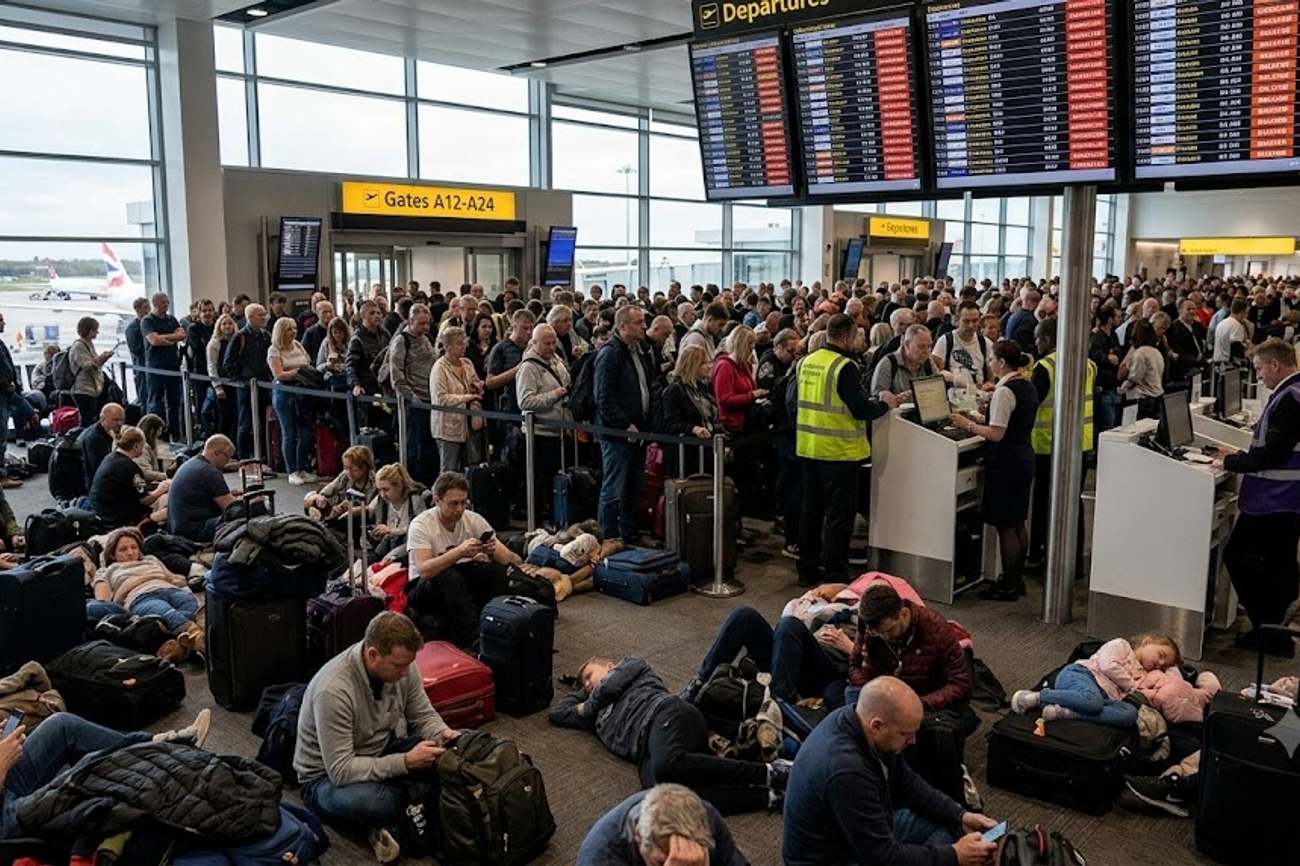
Image generated by AI
The UK’s air traffic infrastructure manages 2.5 million flights and over 300 million passengers annually, yet a single software defect lasting one millisecond was sufficient to disrupt more than 2,000 flights on 8 September 2026. This event underscores a growing fragility in aviation hubs where system interconnectivity transforms minor technical glitches into multi-day operational collapses. When compared to the systemic failure of August 2023, the September 2026 incident reveals that even after the implementation of 34 regulatory recommendations, the UK's aviation backbone remains susceptible to "black swan" technical events.
The September 2026 Outage in Numbers
The scale of the 8 September disruption provides a stark data point for analyzing the volatility of modern hub-and-spoke aviation. The primary trigger was a software defect within the National Air Traffic Services (NATS) flight-processing system, specifically involving the handling of aircraft identification, or "squawk" codes.
The technical failure occurred during a precise overlap between a manual request and a higher-priority system process. The window for this corruption was approximately one millisecond. While the temporal footprint of the error was nearly instantaneous, the operational footprint was massive:
- Total Flights Impacted: Over 2,000 flights were cancelled, diverted, or delayed.
- Passenger Volume: Hundreds of thousands of travelers experienced disruptions.
- Airspace Restrictions: Primary restrictions remained in place until approximately 7:30 pm on 8 September.
- Geographic Scope: Disruptions spanned London Heathrow, Gatwick, Manchester, Birmingham, Edinburgh, Luton, and Bristol.
This data demonstrates that in a high-density airspace environment, there is no such thing as a "small" software error. The corruption of data within the flight-processing system forced NATS to implement immediate airspace restrictions to maintain safety standards. Because major UK airports function as global connecting hubs, the ripple effect extended far beyond domestic routes. A passenger traveling from Mumbai to Edinburgh via Heathrow, for instance, faced delays regardless of whether their specific aircraft or airline experienced a technical fault.
Comparative Context: 2023 vs. 2026
To understand the trajectory of UK aviation resilience, we must compare the September 2026 event with the major NATS failure of August 2023. While both resulted in widespread chaos, the root causes and regulatory responses differ significantly. The 2023 event led to a comprehensive independent review that generated 34 specific recommendations for system hardening. By June 2026, the Civil Aviation Authority (CAA) had confirmed that these recommendations were either fully implemented or integrated into the regulatory framework.
Despite these upgrades, the 2026 incident proves that "resilience" is a moving target. The 2023 failure was a broader systemic collapse, whereas the 2026 event was a highly specific, rare software sequence. This suggests that while the UK has mitigated known failure modes, it remains vulnerable to "edge case" anomalies.
| Metric | August 2023 Failure | September 2026 Failure |
|---|---|---|
| Primary Cause | Systemic Process Failure | 1ms Software Defect (Squawk Codes) |
| Regulatory Status | Pre-Recommendation Phase | Post-34 Recommendation Implementation |
| Flight Impact | Widespread Cancellations | 2,000+ Flights Affected |
| Recovery Time | Multiple Days | Hours (Technical) / Days (Operational) |
| Attribution | Systemic Instability | Rare Technical Sequence |
According to data trends tracked by IATA, the global aviation industry is increasingly reliant on automated flight-processing systems to handle rising passenger volumes. The UK experience mirrors a global trend where the margin for error is shrinking as airspace density increases. When a system handling 300 million passengers annually fails, the recovery is not instantaneous because aircraft and crews are displaced, creating a "logistical hangover" that persists long after the software is patched.
Practical Traveler Advisory and Strategic Insights
The September 2026 outage shifts the risk profile for travelers using UK hubs. The data confirms that your journey's success is no longer solely dependent on your airline's reliability, but on the stability of the national air traffic infrastructure.
1. The Compensation Gap Travelers must be aware that the CAA has indicated that disruptions caused by the NATS incident likely fall under "extraordinary circumstances." This is a critical distinction in the UK’s passenger-rights framework. Under these conditions, passengers are unlikely to receive standard financial compensation for delays or cancellations. However, the "duty of care" remains. Under UK261 regulations, airlines are still required to provide:
- Food and refreshments.
- Hotel accommodation if an overnight stay is required.
- A choice between a full refund or rerouting for cancelled flights.
2. Booking Strategies for Hub Users If you are routing through London Heathrow or Gatwick, the interconnected nature of these hubs means that a failure in one sector can freeze the entire network. To mitigate this, travelers should:
- Increase Connection Windows: Avoid tight connections (under 3 hours) at UK hubs, as a technical glitch in the NATS system can cause a cascade of missed flights.
- Documentation: Keep all receipts for food and lodging if the airline fails to provide them during a disruption. The CAA notes that airlines may be expected to reimburse reasonable costs when assistance is not provided.
- Monitor System Health: Use real-time flight tracking data from providers like OAG to identify patterns of delays before arriving at the airport.
Forward Projection: The Resilience Gap
The UK government's mandate for the CAA to conduct an independent review within six months indicates a lack of confidence in current resilience benchmarks. The trajectory suggests that the aviation industry is entering a phase of "hyper-fragility," where the systems required to manage 2.5 million flights are so complex that they create new, unpredictable failure points.
We can expect the upcoming CAA report to focus on "graceful degradation"—the ability of a system to fail partially without collapsing entirely. If NATS cannot demonstrate a way to isolate software defects without shutting down entire sectors of airspace, we will likely see a push for decentralized air traffic management or increased investment in redundant, parallel processing systems.
Furthermore, as global tourism continues to grow—a trend documented by the UNWTO—the pressure on these systems will only increase. The 2026 incident is a leading indicator that software stability is now the primary bottleneck for aviation growth in the UK. The industry is moving toward a model where "resilience" is measured not by the absence of errors, but by the speed of recovery from a one-millisecond failure.
FAQ: UK Air Traffic Disruptions 2026
Will flight prices increase due to these technical failures? Directly, no. However, if the CAA mandates expensive system overhauls for NATS, these costs may eventually be passed down to airlines and subsequently to passengers through higher airport fees or ticket prices.
Is it a good time to book flights through UK hubs? Yes, but with caution. While the software defect is identified, the independent review is ongoing. Travelers should prioritize flights with flexible change policies and maintain generous connection windows to account for potential systemic volatility.
Which airlines are most affected by NATS failures? All airlines operating in UK airspace are affected, but hub-carrier airlines (like those centered at Heathrow) face the greatest operational pressure due to the complex rotation of aircraft and crews.
Can I claim compensation for a NATS-related delay? Standard cash compensation is unlikely because the CAA classifies these as "extraordinary circumstances." However, you are still entitled to "duty of care" (hotels, meals) and rerouting or refunds under UK261.
In an era of millisecond errors, the most valuable travel asset is no longer a first-class ticket, but a flexible itinerary.
#NATS-Software-Failure-2026 #UK-Aviation-Resilience #CAA-Regulatory-Review #Heathrow-Operational-Volatility #UK261-Passenger-Rights
Related Travel Guides
Disclaimer
This article is for informational and educational purposes only. It does not constitute legal, financial, or professional advice. While we strive to provide accurate and up-to-date information, travel policies, regulations, and conditions change rapidly. Always verify information with official sources before making travel decisions. Nomad Lawyer makes no representations about the accuracy, reliability, completeness, or suitability of the information provided. Readers should consult qualified professionals for advice specific to their circumstances. The views expressed in this article are those of the author and do not necessarily reflect the views of Nomad Lawyer.
Raushan Kumar
Founder & Lead Developer
Full-stack developer with 11+ years of experience and a passionate traveller. Raushan built Nomad Lawyer from the ground up with a vision to create the best travel and law experience on the web.
Learn more about our team →