
Southern Rail Derailment Near Lewes Injures 11 Passengers and Halts East Sussex Rail Traffic 2026
A Southern Rail service from London Victoria to Eastbourne derailed near Lewes on August 13, 2026, injuring 11 people and triggering a major safety inquiry into track stability.

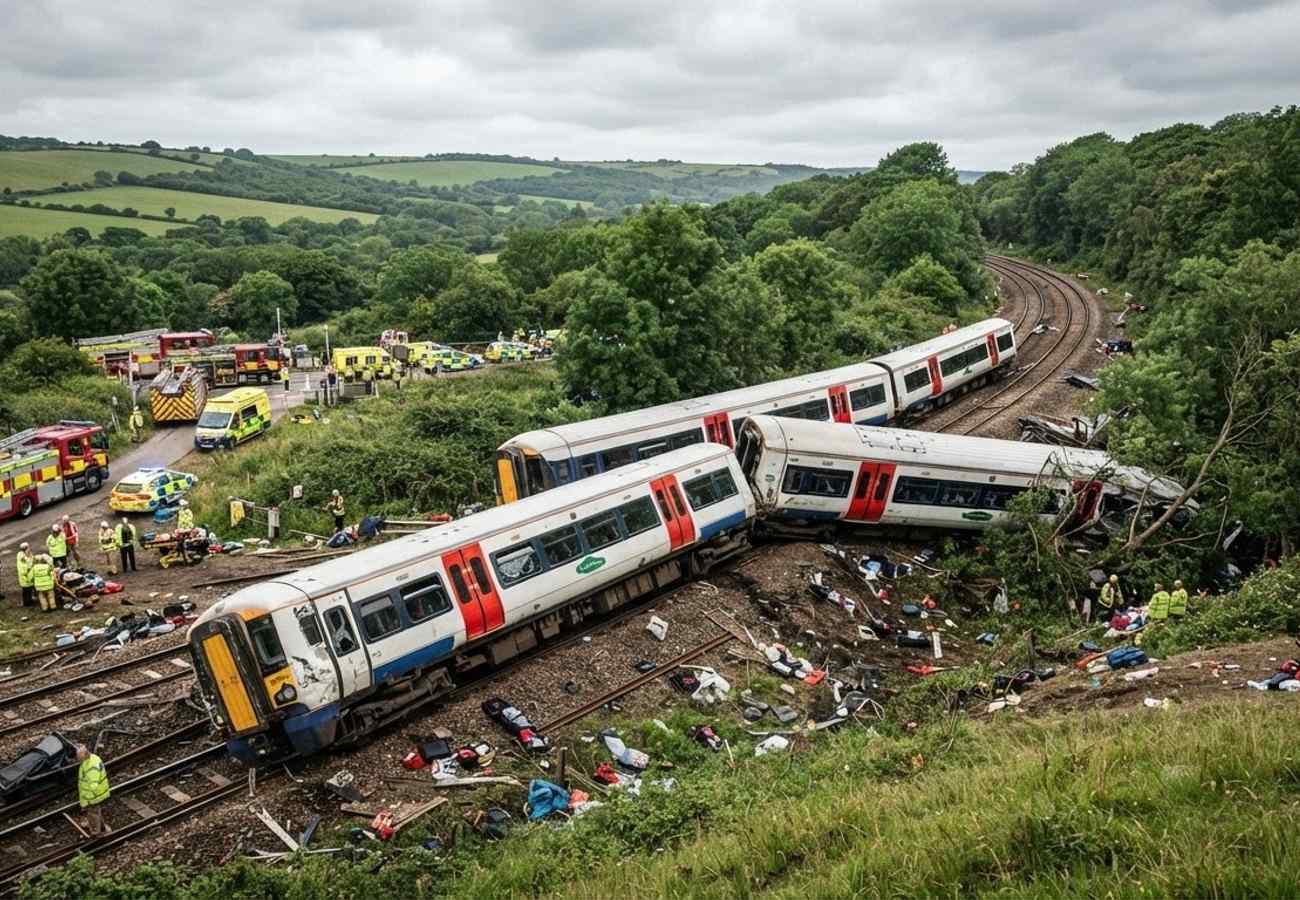
Image generated by AI
Eleven passengers were injured and several carriages overturned when a Southern Rail service derailed near Lewes, East Sussex, on August 13, 2026.
The incident, which occurred on a high-traffic regional corridor, has triggered a major emergency response and an extensive safety inquiry into the stability of the rail infrastructure.
Incident Details: London Victoria to Eastbourne Service
On the afternoon of 13 August 2026, a Southern Rail passenger service traveling from London Victoria to Eastbourne left the tracks in the immediate vicinity of Lewes railway station. The train was transporting approximately 150 passengers at the time of the accident.
Visual evidence from the scene confirms that at least four carriages derailed, with several rolling onto their sides. The crash occurred on a section of the line bordered by trees and embankments, complicating the initial rescue efforts.
Passengers and onboard staff initiated evacuations via emergency exits before specialist teams arrived. Reports from inside the carriages describe a sudden jolt and violent shaking as the rear portion of the train exited the rails, causing luggage and personal items to be thrown across the interiors.
Casualty Report and Emergency Response
Local authorities declared a major incident, deploying a significant fleet of emergency vehicles, including fire engines, ambulances, and police units. Air ambulance helicopters were also deployed as a precautionary measure.
Casualty Breakdown:
- Total Injured: 11 people
- Serious Injuries: 2 passengers
- Minor/Moderate Injuries: 9 passengers (including cuts, bruises, and possible fractures)
- Fatalities: 0 reported
A triage point was established near the line to assess passengers before they were transported to regional hospitals.
Regional Network Disruption
The derailment occurred on a critical artery linking London with Brighton, Eastbourne, and other south coast destinations. The immediate aftermath saw a total suspension of services through Lewes, creating a ripple effect across the Southern and Thameslink networks.
- Affected Routes: London to Eastbourne, Hastings, and Brighton.
- Service Status: Extensive cancellations and heavy delays.
- Mitigation: Implementation of bus replacement services for stranded passengers.
The timing of the crash—during the peak summer travel season—has caused significant congestion at nearby stations and is expected to impact local tourism and hospitality businesses relying on rail access to the South Downs.
Preliminary Analysis of Infrastructure Failure
While a definitive cause has not been established, initial evidence suggests a failure in the track formation. Observations of the crash site revealed distorted rails and disturbed ballast on the curve where the derailment began.
Our analysis of the environmental factors indicates that heavy rainfall in the days preceding August 13 may have played a role. Saturated soil often leads to ground movement or localized landslips, which compromise the stability of the trackbed. This aligns with broader industry trends where extreme weather is increasingly linked to embankment failures and washouts on the UK rail network.
Investigation and Regulatory Review
A comprehensive investigation is now underway, utilizing parallel inquiries by the rail operator and the infrastructure owner, alongside an independent national rail accident specialist review.
The investigative process will focus on:
- Physical Evidence: Analysis of rails, sleepers, and ballast.
- Technical Data: Review of onboard data recorders and signaling logs.
- Operational Factors: Evaluation of train speed, handling, and recent maintenance logs.
- Environmental Impact: Assessment of drainage system performance during recent weather events.
The findings will likely determine if current landslip monitoring protocols or speed restrictions during severe weather require urgent revision.
Incident Summary Data
| Detail | Specification |
|---|---|
| Date of Incident | August 13, 2026 |
| Operator | Southern Rail |
| Route | London Victoria $\rightarrow$ Eastbourne |
| Passenger Count | Approx. 150 |
| Carriages Derailed | 4+ |
| Total Injuries | 11 |
| Location | Near Lewes, East Sussex |
Why This Matters
From a logistical perspective, this incident highlights a critical vulnerability in the UK's regional rail infrastructure: the intersection of aging embankments and volatile weather patterns. For travelers on the south coast routes, this is not merely a one-off accident but a signal of potential systemic instability during extreme weather events.
The fact that the derailment occurred on a curve suggests a potential failure in lateral resistance—where the ballast can no longer hold the track in place. For the aviation and transport industry, this underscores the necessity of shifting from "scheduled maintenance" to "predictive maintenance" using real-time soil and track sensors to prevent catastrophes before they occur.
Industry Outlook
Expect a temporary increase in speed restrictions across the East Sussex corridor as engineers conduct emergency inspections of similar embankments. In the medium term, this incident will likely accelerate the adoption of advanced landslip monitoring technology across the Southern network. Passengers should anticipate continued volatility in timetables as recovery efforts conclude and safety certifications are re-issued for the Lewes section.
Infrastructure stability remains the primary bottleneck for rail reliability in 2026.
Related Travel Guides
Disclaimer
This article is for informational and educational purposes only. It does not constitute legal, financial, or professional advice. While we strive to provide accurate and up-to-date information, travel policies, regulations, and conditions change rapidly. Always verify information with official sources before making travel decisions. Nomad Lawyer makes no representations about the accuracy, reliability, completeness, or suitability of the information provided. Readers should consult qualified professionals for advice specific to their circumstances. The views expressed in this article are those of the author and do not necessarily reflect the views of Nomad Lawyer.
Kunal K Choudhary
Co-Founder & Contributor
A passionate traveller and tech enthusiast. Kunal contributes to the vision and growth of Nomad Lawyer, bringing fresh perspectives and driving the community forward.
Learn more about our team →