
Lewes Bonfire 2026 Imposes Total Transport Lockdown: Complete Rail Suspensions and Road Closures Announced

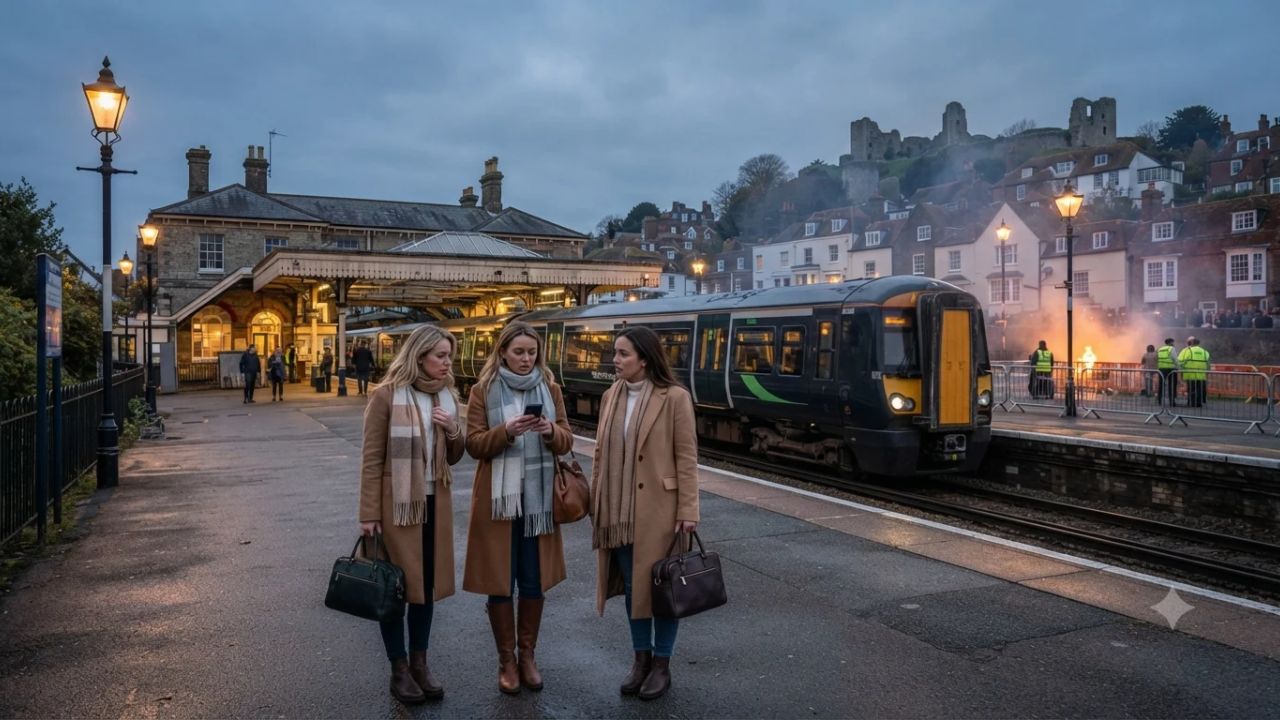
Image generated by AI
Executing an unprecedented public safety quarantine across the East Sussex transit grid, rail services through five regional stations will terminate completely at 5:00 PM on Thursday, 5 November 2026, alongside mandatory vehicular cordons closing five major arterial junctions from 4:45 PM. Orchestrated by a multi-agency command including Sussex Police, East Sussex County Council, and Southern Railway, the aggressive lockdown is designed to physically prevent tens of thousands of external spectators from entering the narrow medieval corridors of Lewes during its annual Guy Fawkes bonfire processions.
The severity of the coordinated transit denial reflects grave crowd-density concerns. Emergency planners anticipate record attendance because 5 November falls on a weekend cycle, raising the prospect of catastrophic crowd compression through constricted historic lanes packed with thick pyrotechnic smoke, deafening acoustic concussions, and hundreds of thousands of live fireworks. Faced with non-negotiable safety mandates, the multi-agency command—uniting police, municipal councils, regional fire services, and local bonfire societies—has issued an unambiguous, unified directive to external travelers: do not travel to Lewes, and choose organized fireworks displays in local communities instead.
The Geometry of Crowd Compression: Why Medieval Streets Force a Regional Rail Shutdown
The physical layout of Lewes creates a logistical nightmare during mass public gatherings. Flanked by steep chalk hills and bisected by the River Ouse, the historic county town features narrow, winding residential avenues that lack the spatial capacity to absorb surging crowds. When seven independent bonfire societies march with blazing tar barrels, burning crosses, and hand-carried pyrotechnic torches, the risk of crush asphyxiation, crowd panic, or severe burn trauma escalates exponentially. To protect vulnerable groups, civil emergency commanders have formally classified the entire festival environment as strictly unsuitable for children, young families, and domestic pets.
Managing this geographic hazard requires systematically deconstructing regional transport access. Operating through a Joint Command, Control and Communication Center, authorities including East Sussex Fire and Rescue, Highways, South East Coast Ambulance, St John Ambulance, and Lewes District Council have prioritized transit disruption over convenience. Rather than expanding rail capacity to shuttle festival-goers, passenger trains will actively bypass Lewes station and four adjacent rural stations—Falmer, Cooksbridge, Glynde, and Southease—from 5:00 PM until regular service resumes on the morning of Friday, 6 November 2026. This operational suspension effectively severs direct rail transit across the Sussex Downs, forcing regional commuters traveling between London, Brighton, Eastbourne, and Seaford to radically alter their afternoon schedules.
| Operational Vector | Mandatory Cutoff Timestamp | Operational Window & Scope | Core Traveler Directive |
|---|---|---|---|
| Regional Rail Stations | 5:00 PM (5 November 2026) | Total closure until morning of 6 November | Trains bypass Lewes, Falmer, Cooksbridge, Glynde, Southease |
| London Victoria Departures | 3:24 PM / 3:54 PM (5 Nov) | Last direct services to Eastbourne and Ore | Commuters must depart central London by early afternoon |
| Arterial Highway Cordons | 4:45 PM (5 November 2026) | Complete vehicular blockade of five junctions | External visitor traffic barred; no public parking provided |
| Resident Vehicle Movement | 4:00 PM (5 November 2026) | Strict deadline for home parking | Vehicles left on street subject to immediate towing |
Timetable Restrictions and Vehicular Cordons: The Operational Lockdown Matrix
The mechanics of the transport quarantine are divided into rigid operational phases. Outbound rail commuters departing central London face aggressive deadlines: the final service from London Victoria to Eastbourne calling at affected intermediate stations departs at 3:24 PM, followed by the last train to Ore at 3:54 PM. At Lewes station itself, platforms will close permanently for the night following four final departures: the 16:44 to Brighton (calling at all stations), the 16:55 to London Victoria (calling at Cooksbridge, Wivelsfield, and onward trunk points), the 16:59 to Ore (calling at Polegate, Eastbourne, and all coastal stops), and the final 17:02 departure to Seaford, which calls at all intermediate stops with the explicit exclusion of Southease.
Simultaneously, road access into the town will be sealed off at 4:45 PM. Sussex Police and highways marshals will establish static checkpoints across five vital road junctions: the A27 junction with the A277 Brighton Road at Ashcombe Roundabout, the A275 Offham Road junction with the B2116 Plumpton Road, the C7 Kingston Road junction with C324 Wellgreen Lane, the A26 junction with the A2029 Malling Street, and the A26 Church Lane junction with Mayhew Way. Local residents must park their personal vehicles off street before 4:00 PM, while external drivers face an absolute prohibition on entry, with no event parking facilities provided anywhere within the municipal perimeter.
Emergency medical readiness is positioned to handle severe thermal and blast trauma. Medical teams from St John Ambulance will deploy across designated first aid posts throughout the town. Authorities urge the public never to touch spent fireworks or burning torches, highlighting standard burn treatment protocols: cooling thermal injuries under cold running water for a minimum of 20 minutes, removing restrictive clothing or jewelry before localized swelling begins, and covering the trauma loosely with clean plastic cling film to prevent infection before contacting emergency services on 999.
Expert Analysis: The Ethics and Economics of Transit Denial as Crowd Control
For travelers booking this route, the direct consequence is that standard journey itineraries between London and the Sussex coast collapse after mid-afternoon, forcing commuters to detour via Three Bridges or coastal bus links. Passengers attempting to connect through southern England under guidance from National Rail will find that the rail network functions not as a public conveyor, but as a deliberate barrier designed to starve the festival of foot traffic.
The pricing pressure this creates means localized rideshare tariffs and private parking on the periphery of the closure zone reach extortionate surge rates. By closing regional stations and blocking arterial highways, authorities deliberately force external visitors to confront prohibitive physical friction. While this strategy successfully shields the emergency services from managing dangerous surges in the town center, it imposes heavy collateral costs on regional businesses, non-participating commuters, and university students commuting to Falmer. This approach represents a stark departure from conventional event management: while standard stadium fixtures add supplemental rail capacity, Lewes remains one of the few places where authorities intentionally disable critical national infrastructure to preserve public order.
Key Takeaways
- Complete rail suspensions take effect across Lewes, Falmer, Cooksbridge, Glynde, and Southease from 5:00 PM on 5 November until the morning of 6 November 2026.
- Strict vehicular road closures seal five major arterial junctions into Lewes starting at 4:45 PM, with zero parking provided for external visitors.
- Outbound commuters from London Victoria must catch the 3:24 PM (Eastbourne) or 3:54 PM (Ore) services to ensure transit before the network lockdown.
- The final departures from Lewes station occur between 16:44 and 17:02, after which all passenger station access is barred.
- Public safety organizations strongly urge outside residents to avoid traveling to Lewes, explicitly designating the event unsuitable for children, families, and pets.
FAQ: Lewes Bonfire Travel Restrictions and Rail Suspensions 2026
What time do trains stop running to Lewes on 5 November 2026?
Trains stop calling at Lewes and nearby rural stations (Falmer, Cooksbridge, Glynde, and Southease) from 5:00 PM on 5 November until the start of normal service on 6 November.
What time do road closures begin around Lewes?
Road closures across all five major arterial junctions into Lewes take effect at 4:45 PM on Thursday, 5 November 2026, barring non-essential vehicular access.
When is the last train from London Victoria to Lewes?
The last direct London Victoria services stopping at affected stations depart at 3:24 PM (for Eastbourne) and 3:54 PM (for Ore). Later services will bypass the area entirely.
Why are external visitors told not to attend Lewes Bonfire?
Extreme crowd density, narrow historic lanes, heavy smoke, and extensive pyrotechnics create severe crush and fire hazards, making the environment dangerous for visitors, children, and pets.
By turning public transit deactivation into its primary safety barrier, East Sussex demonstrates that managing heritage crowd risks sometimes demands freezing an entire regional transport corridor in place.
Disclaimer
This article is for informational and educational purposes only. It does not constitute legal, financial, or professional advice. While we strive to provide accurate and up-to-date information, travel policies, regulations, and conditions change rapidly. Always verify information with official sources before making travel decisions. Nomad Lawyer makes no representations about the accuracy, reliability, completeness, or suitability of the information provided. Readers should consult qualified professionals for advice specific to their circumstances. The views expressed in this article are those of the author and do not necessarily reflect the views of Nomad Lawyer.
Kunal K Choudhary
Co-Founder & Contributor
A passionate traveller and tech enthusiast. Kunal contributes to the vision and growth of Nomad Lawyer, bringing fresh perspectives and driving the community forward.
Learn more about our team →