
How to Qualify for a Lithuanian Passport by Descent: Ancestry Records and Eligibility
Discover how to qualify for a Lithuanian passport by descent. Learn interwar citizenship requirements, essential archival records, MIGRIS application steps, and dual nationality rules.

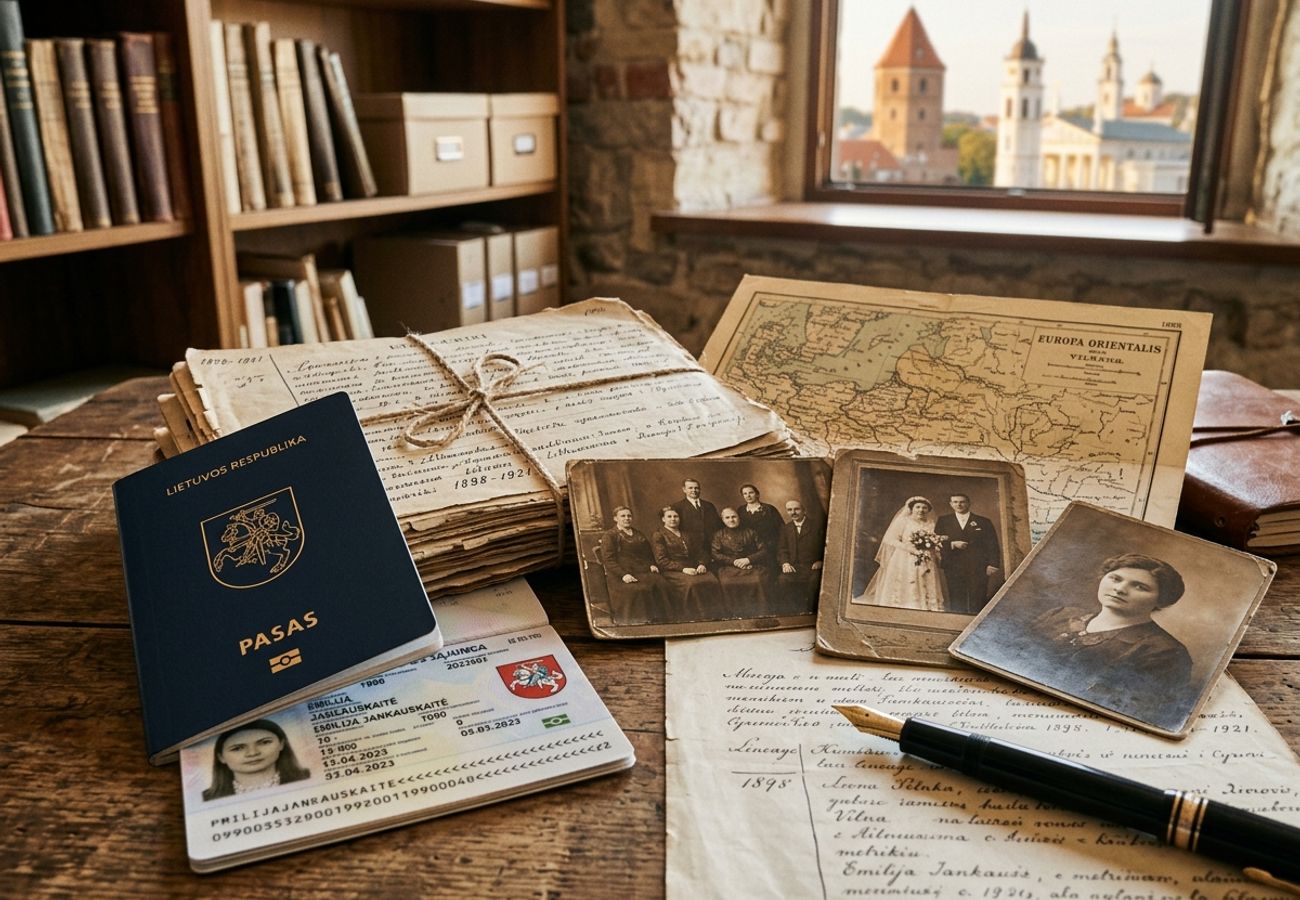
Photo by Nomad Lawyer Visa Desk / Step-by-step documentation and archive requirements for obtaining a Lithuanian passport by descent
There is only one test for Lithuanian passport by descent. A parent, grandparent or great-grandparent had to be a citizen of the Republic of Lithuania prior to 15 June 1940, when the country was occupied by the Soviet troops. Generally, the descendant may regain citizenship if that ancestor subsequently emigrated or was deported prior to 11 March 1990, and may continue to hold the same nationality. The remainder of the process involves demonstrating this on paper. Use of family stories, surnames and old photos can assist the search, however only documents are considered by the Migration Department.
Who Can Qualify for a Lithuanian Passport by Descent
Birthplace plays almost no role here. Lineage is what counts. Lithuanian law lets citizenship pass down through parents, grandparents and great-grandparents, as long as the first ancestor in the line held citizenship of the interwar Republic. Lithuanian passport by descent eligibility is assessed person by person along the family line, not for the family as a whole. Two cousins who share a great-grandfather can get different results if one side of the tree has missing records. Once citizenship is confirmed, the passport itself is a separate and fairly routine step.
At that point a Lithuanian passport can be requested at a Lithuanian consulate or a Migration Department office. Descendants of people deported to Siberia or forced to flee in 1944 usually meet the conditions too, as long as that ancestor held Lithuanian citizenship before 15 June 1940.
Lithuanian Citizenship by Descent Requirements in Practice
Three conditions have to line up. The ancestor held Lithuanian citizenship before 15 June 1940. That person left Lithuania or was exiled before 11 March 1990, when independence was restored. And the applicant can document every generation in between. Meeting all three opens the door to dual citizenship, which Lithuania otherwise allows only in narrow cases.
Specialists at www.lithuaniancitizenship.com point out that the first condition is where most files succeed or fail. An ancestor who emigrated in 1910 was a subject of the Russian Empire, not a citizen of Lithuania. These rules come from the Law on Citizenship of the Republic of Lithuania. The Migration Department applies them and has not examined why an ancestor left since the 2016 amendments. That change made the Lithuanian citizenship by descent requirements far more predictable.
Key Ancestry Records for a Lithuanian Passport Through Ancestry
A complete file usually draws on institutions in two or three countries. Applicants are most often asked for:
- Birth, marriage and death certificates for each generation back to the Lithuanian ancestor
- Interwar proof of citizenship, such as a Lithuanian internal or foreign passport, a military record or a civil registry extract
- Emigration, deportation or naturalization papers showing when and how the ancestor left
- Apostilles and certified translations for every document issued outside Lithuania
Many interwar passport applications survive in the Lithuanian Central State Archives in Vilnius, often with the holder's photo and signature. Ordering a search there early saves months. A single missing link usually halts the whole case until it is found.
Lithuanian Citizenship Through Grandparents and Great-Grandparents
Most applicants today are two or three generations removed from the original citizen. The relatives who can anchor a claim include:
- A grandparent who held Lithuanian citizenship before the 1940 occupation.
- A great-grandparent whose status appears in archival records, provided each generation after them is fully documented.
- A parent who has already had Lithuanian citizenship confirmed, which shortens the applicant's own file considerably.
The further back the anchor ancestor, the more the case depends on an unbroken chain of civil records. A great-grandparent route is entirely possible. It simply leaves less room for gaps, especially where a birth was registered in one country and a marriage in another.
Lithuanian Passport Application from Abroad: How It Works
Since 15 November 2021, every request has gone through MIGRIS, the Migration Department's online portal. The applicant creates an account, uploads scans of the full file and pays the state fee. Originals are then shown at a Lithuanian embassy or consulate, or at a department office in Lithuania. Review commonly takes several months and can run past a year if officials request extra archive checks.
After a positive decision, the passport application is handled separately. It requires a personal visit, because the document is biometric and fingerprints are taken on the spot. The Lithuanian Ministry of Foreign Affairs lists consular contacts for applicants who live outside Lithuania.
Common Obstacles in Proving Lithuanian Passport Eligibility
The spelling problem is the source of most delays. A surname can be used in Polish, Russian, and English in various records, and Jonas may be written as John, Kazimieras as Casimir, and so on. The relationship between each version should be clearly established with the same person. Many parish and municipal registers have also been lost during the war, and in such cases as these, other sources of information, such as church books or school records, are required.
A more difficult issue is that of descendants of those who emigrated before 1918. They were never citizens of the Republic; therefore, restoration is not available. There's only one other way, which is the Lithuanian-origins route, and that generally involves renouncing other citizenship.
Who Actually Gets a Lithuanian Passport by Descent
The eligibility for a Lithuanian passport by descent is based on one fact: the citizenship of a Lithuanian citizen at the time of his departure from Lithuania before 15 June 1940 and before 11 March 1990, and the connection of the applicant to the citizen by documents for each generation. If the applicant's ancestor emigrated prior to 1918, then he or she should be aware from the outset that the restoration application will be unsuccessful.
The archives should be used first, rather than the application form, for those with a qualifying grandparent or great-grandparent. The best method for having a MIGRIS file approved is to secure the interwar proof first and then construct the birth and marriage chain around it, which helps avoid repeated requests for additional proof. If someone has descended from Lithuanian ancestors, the strength of that paper trail will determine the outcome for that person.
Related Travel Guides
- Bulgaria Digital Nomad Visa: Requirements for Remote Workers in Sofia and Bansko
- The Ultimate Guide to Staying Connected While Travelling Internationally: eSIM, Roaming, and Tech Setup
- Fiji Will Be a Big Name Followed by Tonga and Others as Highly Potential Budget-Friendly Retirement Retreats in 2027
Disclaimer
This article is for informational and educational purposes only. It does not constitute legal, financial, or professional advice. While we strive to provide accurate and up-to-date information, travel policies, regulations, and conditions change rapidly. Always verify information with official sources before making travel decisions. Nomad Lawyer makes no representations about the accuracy, reliability, completeness, or suitability of the information provided. Readers should consult qualified professionals for advice specific to their circumstances. The views expressed in this article are those of the author and do not necessarily reflect the views of Nomad Lawyer.
Raushan Kumar
Founder & Lead Developer
Full-stack developer with 11+ years of experience and a passionate traveller. Raushan built Nomad Lawyer from the ground up with a vision to create the best travel and law experience on the web.
Learn more about our team →