Bahamas Mandates Digital Arrival Card to Streamline Border Entry, Merging Immigration and Customs Declarations Online

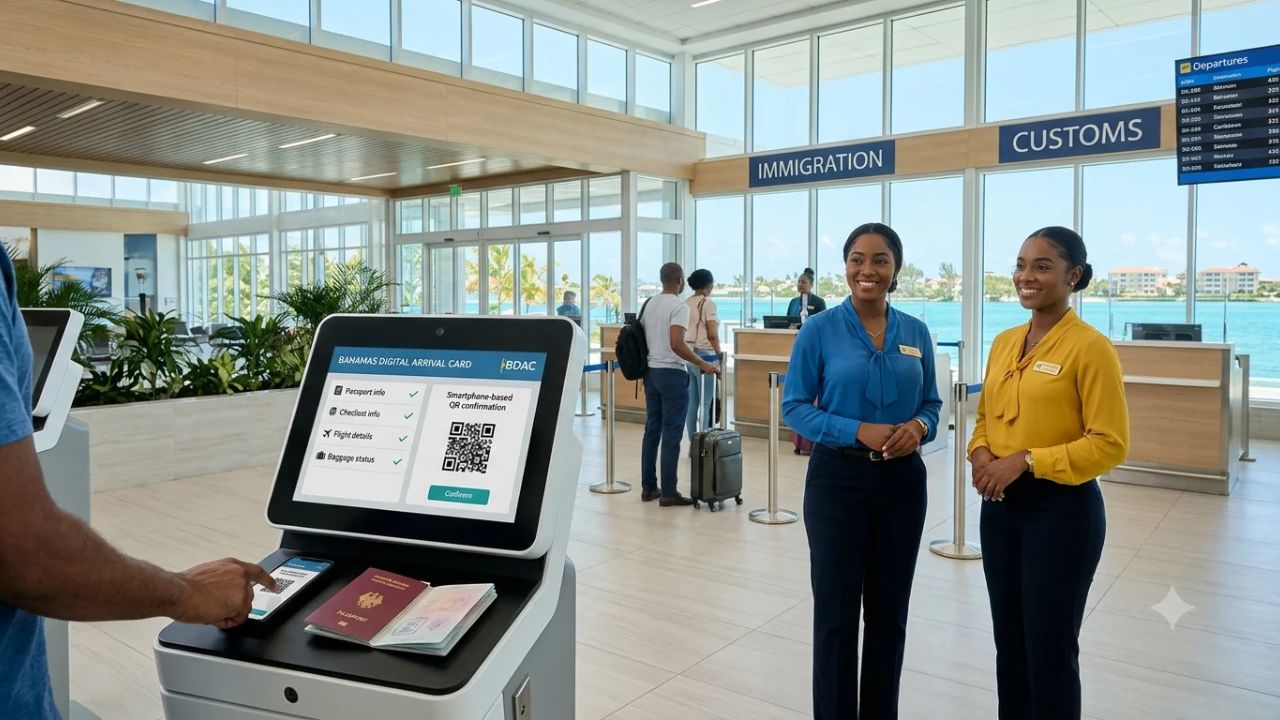
The Government of the Bahamas has advanced the nationwide rollout of the Bahamas Digital Arrival Card, unifying international passenger immigration documentation and customs declarations into a single pre-departure electronic system designed to eliminate physical paper entry forms.
First introduced under a controlled pilot programme on 5 May 2026 by the Ministry of Tourism, Investments and Aviation in Nassau, the Bahamas Digital Arrival Card (BDAC) marks a historic transition in the archipelago’s border management architecture. Developed through an inter-agency partnership between tourism authorities, the Bahamas Department of Immigration, and the Bahamas Customs Department, the online platform allows arriving international travelers to register their biographical, travel, and customs details before departing for the islands.
While initially deployed across select international commercial flights to test system resilience, the official government-hosted entry portal now displays comprehensive instructions requiring arriving visitors to complete digital submissions prior to arrival. The initiative reflects a wider Caribbean trend toward paperless border control, intended to enhance administrative efficiency, modernize passenger processing, and strengthen national border security across the nation’s international airports and maritime cruise ports.
The Evolution of the Bahamas Digital Arrival Card
For decades, international travelers entering the Commonwealth of the Bahamas were required to complete two separate physical paper forms: a white paper immigration card distributed aboard incoming flights or vessels, and a separate paper customs declaration form presented to customs officers in the baggage hall.
The introduction of the Bahamas Digital Arrival Card replaces this duplicative physical paperwork with an integrated digital workflow. By establishing a shared online gateway, the Bahamian government enables travelers to complete both statutory border requirements simultaneously from any internet-connected computer, tablet, or smartphone before boarding their inbound flight or cruise ship.
| Operational Dimension | Confirmed Government Specification | Border Administration Context |
|---|---|---|
| Official System Name | Bahamas Digital Arrival Card (BDAC) | National electronic border declaration portal |
| Initial Launch Date | 5 May 2026 (Controlled Pilot Phase) | Introduced on selected commercial flight corridors |
| Leading Executive Agency | Ministry of Tourism, Investments and Aviation | Coordinates national tourism policy and visitor experience |
| Border Enforcement Partners | Department of Immigration & Customs Department | Maintain separate statutory mandates via shared portal |
| Primary System Goal | Eliminating paper immigration and customs forms | Transitions processing to pre-arrival electronic records |
| Family Group Submissions | One consolidated form permitted per family unit | Covers spouses and eligible dependents traveling together |
| Statutory Legal Foundation | Formal amendments enacted to the Immigration Act | Established legal validity of digital border declarations |
| Measured Time Savings | Not established by official data | Processing times depend on airport passenger volumes |
| Universal Port Enforcement Date | Transitioned from pilot to general portal mandate | Operating status should be verified with transport operators |
The platform's inter-agency design is central to its operational stability. While tourism officials focus on optimizing the visitor arrival experience, the Department of Immigration retains full constitutional authority over passport validation, entry visas, and authorized lengths of stay. Simultaneously, the Bahamas Customs Department enforces import duties, prohibited goods restrictions, and currency disclosure rules. Integrating both agencies into a unified digital entry portal eliminates conflicting passenger data and provides border agencies with advance passenger information (API) prior to aircraft touchdown.
Legislative Foundations: Enacting Amendments to the Immigration Act
The digital transformation of national borders involves complex administrative law. In the Bahamas, border documentation represents a legally binding statutory declaration. Consequently, transitioning from signed paper cards to online digital forms required comprehensive statutory reform.
Prior to launching the pilot on 5 May 2026, the Bahamian Parliament debated and passed critical amendments to the national Immigration Act. These legislative modifications established:
- Legal Equivalence: Electronic declarations submitted through the approved government web portal carry the identical legal validity, penalties, and obligations as traditional signed physical immigration cards.
- Data Protection and Sharing: Statutory authorizations permitting the secure transfer of passenger manifest data between commercial transport operators, the Department of Immigration, and the Customs Department.
- Enforcement Authority: Continued legal standing for immigration and customs officers to question travelers, request physical documentation, and issue lawful administrative directions based on digital records.
To prevent operational disruptions during the initial transition, the Ministry of Tourism maintained a dual-track framework throughout the spring and summer of 2026. Arriving passengers on unequipped flight corridors or those unable to access the web portal were permitted to submit conventional paper forms while authorities evaluated platform stability, server bandwidth, and user feedback.
Step-by-Step Portal Navigation and Verification Protocols
The official Bahamas Digital Arrival Card portal incorporates rigorous verification steps to ensure passenger data integrity and prevent fraudulent submissions.
Travelers preparing to enter the Bahamas must navigate several structured data collection screens, providing detailed biographical and journey parameters.
| Portal Stage | Mandatory Information Collected | Technical and Verification Safeguards |
|---|---|---|
| 1. User Authentication | Active personal email address | Two-step email verification code required to initiate session |
| 2. Biographical Information | Full legal names, date of birth, gender, nationality | Names and birth dates must match machine-readable passport zones |
| 3. Travel Documentation | Passport number, issuing country, expiration date | Optional optical passport scan tool assists automated data entry |
| 4. Journey Details | Country/city of departure, arrival date, transport mode | Commercial flight number or maritime vessel identification required |
| 5. Port of Entry Selection | Specific Bahamian island and airport/port of arrival | Directs digital records to relevant island border checkpoint |
| 6. Accommodation Details | Registered resort, hotel name, rental address, or yacht | Verified against national licensed tourism accommodations |
| 7. Customs Declarations | Value of new goods, commercial cargo, physical currency | Legally binding declarations subject to physical inspection |
Strict Non-Editing Rule After Submission
A defining technical characteristic of the BDAC portal is the finality of submission. Once a traveler completes all screens and formally submits their arrival card, the record is locked and cannot be edited online. The portal explicitly cautions travelers to review their passport numbers, spelling of names, and arrival dates with extreme diligence.
If a traveler makes an error—such as mistyping a passport digit or entering an incorrect arrival date—the submitted card cannot be modified. In such cases, the traveler must generate an entirely new submission or notify border control officers upon arrival in Nassau, Freeport, or the Family Islands, which may result in secondary administrative processing delays.
Consolidated Family Submissions
To streamline processing for vacationing families, the portal permits the head of household or a primary adult traveler to complete a single consolidated Digital Arrival Card covering all traveling family members. Eligible family members typically include spouses and dependent children sharing the identical itinerary, arrival flight, and accommodation booking.
Integrating Customs Declarations into the Electronic System
A major operational innovation of the BDAC is the incorporation of full customs reporting into the pre-arrival workflow. Previously, customs declarations were addressed only after passengers retrieved their luggage from airport baggage carousels.
Under the digital system, international visitors complete mandatory customs disclosures before boarding their departing aircraft:
| Customs Declaration Category | Specific Regulatory Guidelines | Traveler Compliance Obligation |
|---|---|---|
| Personal Effects & Clothing | Used clothing, personal electronics, and toiletries | Exempt from duty when intended exclusively for personal use |
| New Goods & Unopened Gifts | Purchased items, electronics, gifts, and commercial samples | Must be itemized with purchase values; subject to duty assessment |
| Commercial Merchandise | Goods intended for resale, business use, or commercial display | Requires commercial customs clearance and formal invoices |
| Currency and Monetary Instruments | Physical cash, traveler's cheques, and negotiable instruments | Mandatory declaration when aggregate value reaches statutory limits |
| Agricultural & Prohibited Items | Fresh meats, fruits, vegetables, plants, and firearms | Strictly controlled; require specialized import permits from authorities |
Completing an electronic customs declaration does not waive a traveler's legal duties under Bahamian customs law. Customs officers stationed in arrival halls retain full statutory authority to select passengers for random physical baggage examinations, request commercial purchase receipts, and audit declared currency sums. However, having declarations processed electronically allows customs agents to rapidly clear low-risk travelers, reducing terminal choke points.
Alignment with National Biometric Immigration Systems
The deployment of the Bahamas Digital Arrival Card forms the initial phase of a comprehensive modernization strategy across Bahamian border management agencies.
In the government's 2026 Speech from the Throne, executive leaders detailed a multi-year roadmap to establish a National Biometric Immigration System across the archipelago's major international transport hubs, most notably Lynden Pindling International Airport (NAS) in Nassau and Grand Bahama International Airport (FPO) in Freeport.
Key elements of this future border vision include:
- Biometric Automated Border Gates (E-Gates): Dedicated electronic passenger gates utilizing facial recognition technology to process pre-screened low-risk passengers without manual passport stamping.
- Automated Overstay Detection: Centralized software tracking passenger entries and exits, generating real-time automated alerts when foreign visitors exceed authorized visitor periods.
- Enhanced Document Fraud Detection: Machine-learning systems identifying fraudulent travel documents, altered passport chips, and imposters attempting illegal entry.
An important operational distinction must be understood: the Bahamas Digital Arrival Card is an electronic documentation and declaration platform, not biometric hardware. The current rollout of the BDAC does not automatically mean automated biometric gates are operational for all arriving passengers. Instead, the digital arrival card serves as the foundational data layer that will supply traveler manifests into future automated biometric screening gates as physical airport terminal infrastructure is upgraded.
Critical Distinctions: BDAC Versus Entry Visas and Legal Admission
Travelers, airlines, and travel advisors must recognize the precise legal scope of the Bahamas Digital Arrival Card to prevent denied boarding or border entry refusals.
1. The BDAC Is Not an Entry Visa
The Digital Arrival Card is an administrative declaration tool; it is neither a visa nor a travel authorization waiver. Citizens of countries that require an entry visa to visit the Bahamas—such as nationals of specific African, Asian, and Middle Eastern countries—must continue to apply for and obtain an official Bahamian visa from a Bahamian embassy, consulate, or official visa portal prior to travel. Submitting a Digital Arrival Card does not bypass or replace visa mandates.
2. The BDAC Does Not Guarantee Admission
Possession of a confirmed BDAC confirmation receipt does not constitute an absolute right of entry into the Commonwealth of the Bahamas. Under Bahamian law, immigration officers at port-of-entry control booths maintain complete discretionary authority to inspect original travel documents, examine financial sufficiency, verify return airline tickets, inquire into criminal history, and grant or deny leave to enter.
3. Responsibilities for Airlines and Tourism Operators
International airlines operating scheduled services into the Bahamas bear legal responsibility under international civil aviation treaties to verify passenger entry compliance before boarding. Airlines must ensure that passengers possess:
- A valid original passport with required remaining validity.
- Appropriate entry visas where applicable based on passenger citizenship.
- Confirmed evidence of a completed Bahamas Digital Arrival Card submission where required by current operational directives.
Tour operators, cruise lines, and hotel chains across Nassau, Grand Bahama, Exuma, and Eleuthera are actively updating pre-departure client information packets, ensuring inbound guests arrive at boarding gates with completed digital cards to guarantee frictionless entry into the country.
Frequently Asked Questions
What is the Bahamas Digital Arrival Card (BDAC)?
The BDAC is an official online platform introduced by the Bahamian government that combines immigration entry documentation and customs declarations into a single digital submission, replacing traditional paper arrival forms.
When must international travelers complete the digital arrival card?
Travelers should complete the digital card online prior to departing for the Bahamas. The portal requires biographical details, passport information, flight or vessel numbers, and customs disclosures before arrival.
Does the Bahamas Digital Arrival Card replace an entry visa?
No. The BDAC is an administrative border entry form, not an entry visa. Travelers from nationalities that require a visa to enter the Bahamas must obtain an official visa prior to travel in addition to completing the digital arrival card.
Can a submitted Digital Arrival Card be edited online?
No. Once a digital arrival card is submitted, the record is locked and cannot be edited through the web form. Travelers must carefully verify all passport numbers, name spellings, and flight details before final submission.
Related Travel Guides
This article is for informational purposes. Flight routes, passenger regulations, visa rules, and transit advisories are subject to change by airlines and aviation authorities. Readers are advised to verify schedules and travel documentation with relevant carriers and border agencies before departure.
Related Stories

Saudi Arabia Expands Tourism Access to 72 Countries: Visa-Free and eVisa Framework Drives Vision 2030 Growth

Grenada Approves Visa-Free Entry for Nigerian Passport Holders to Catalyze Caribbean-West Africa Tourism and Trade