
Flights Cancelled Throughout Europe As 1,562 Delays And 81 Cancellations Disrupted Air Travel Across London And 11 Others
Flights Cancelled Throughout Europe As 1,562 Delays And 81 Cancellations Disrupted Air Travel Across London And 11 Others

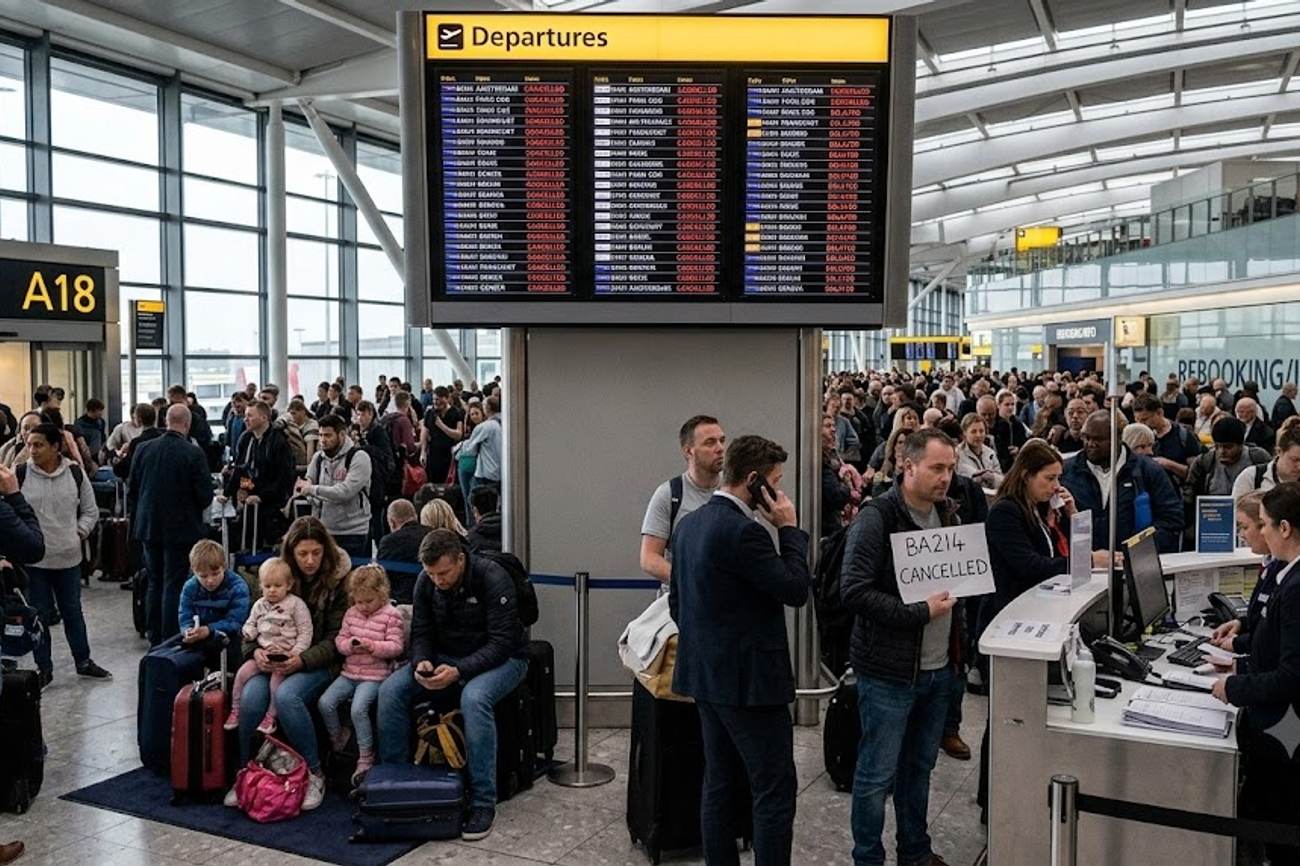
Image generated by AI
1,562 recorded delays and 81 cancellations across eight European nations signal a systemic fragility in the continent's primary aviation arteries. This snapshot of operational instability, captured on 19 September 2026, reveals a disruption pattern concentrated in the "mega-hubs" of Germany, the Netherlands, and the United Kingdom, where the intersection of high traffic volume and rigid scheduling creates a volatile environment for the modern traveler.
The Anatomy of Hub Congestion
The data suggests that European aviation is currently struggling with a "bottleneck effect," where disruptions at a few key nodes trigger a cascade of failures across the network. Frankfurt and Amsterdam Schiphol emerged as the primary epicenters of this instability. Frankfurt, the primary fortress for Lufthansa, bore the brunt of the delays with 239 recorded instances. The severity here is not just in the raw number, but in the percentage of failure: 20% of departing flights and 15% of arriving flights were delayed.
Similarly, Amsterdam Schiphol acted as a significant point of failure, recording 227 delays and 18 cancellations. The concentration of these disruptions is heavily tied to the hub-and-spoke model. At Schiphol, KLM accounted for 109 of those delays and 16 of the cancellations, demonstrating how a struggle within a single dominant carrier can effectively paralyze an entire airport's efficiency.
The disruption was not limited to the mainland. In the UK, London Heathrow recorded 161 delays and four cancellations, with British Airways accounting for 91 of those delays. Manchester followed closely with 155 delays and three cancellations. The fact that Manchester recorded a 20% delay rate for departing flights—matching the high failure rate of Frankfurt—indicates that regional hubs are now experiencing the same volatility previously reserved for global gateways.
Operational Failure Metrics by Airport and Carrier
The following data outlines the specific distribution of disruptions across the most affected European nodes.
| Airport | Total Delays | Total Cancellations | Primary Carrier Impact | Departure Delay Rate |
|---|---|---|---|---|
| Frankfurt | 239 | 4 | Lufthansa (90 delays) | 20% |
| Amsterdam Schiphol | 227 | 18 | KLM (109 delays) | 17% |
| London Heathrow | 161 | 4 | British Airways (91 delays) | 12% |
| Manchester | 155 | 3 | easyJet (54 delays) | 20% |
| Paris CDG | 153 | 5 | Air France (64 delays) | 10% |
| Palma de Mallorca | 152 | 2 | Ryanair (24 delays) | N/A |
| Munich | 140 | 4 | Lufthansa (51 delays) | 15% |
From a carrier perspective, the disparity between delays and cancellations reveals different operational strategies. Lufthansa suffered the highest volume of delays at 141, spread across its Munich and Frankfurt bases. In contrast, Ryanair adopted a more aggressive cancellation strategy, recording 32 cancellations—the highest of any airline—despite having fewer total delays (105) than Lufthansa or easyJet.
Expert Analysis: The Cost of "Tight" Rotations
For travelers booking routes through these hubs, the data reveals a critical cause-and-effect relationship: the industry is operating with zero margin for error. When a hub like Frankfurt sees a 20% departure delay rate, it is rarely the result of a single event. Instead, it is the result of "aircraft rotation" failure.
In modern aviation, a single aircraft may perform four to six short-haul sectors a day. If the first flight from Munich to Frankfurt is delayed by 45 minutes due to crew scheduling or maintenance, every subsequent flight that aircraft is scheduled to perform is automatically compromised. This is why we see Lufthansa recording 141 delays across two cities; the aircraft are simply unable to "catch up" to their schedules.
The pricing pressure created by this instability is invisible but potent. When airlines like Ryanair record 32 cancellations, they are often making a cold financial calculation. For low-cost carriers, it is sometimes cheaper to cancel a flight entirely and rebook passengers on a later service than to pay for crew overtime or airport slot penalties associated with a massive delay. For the passenger, this means that while a "delay" is an inconvenience, a "cancellation" is a strategic business decision by the airline to protect its margins.
Furthermore, the concentration of failures at International Air Transport Association (IATA) regulated hubs suggests that airport congestion is now a primary driver of instability. When 18 cancellations occur at Schiphol, it creates a vacuum in slot timing, forcing other airlines to adjust their arrivals, which then ripples across the European airspace. Travelers are no longer just buying a seat on a plane; they are betting on the operational health of the entire European corridor.
Key Takeaways
- Hub Volatility: Frankfurt and Manchester are currently the highest-risk airports for departures, both exhibiting a 20% delay rate.
- Carrier Divergence: Lufthansa is the most prone to delays (141), while Ryanair is the most likely to cancel flights outright (32).
- Systemic Concentration: The majority of disruptions are concentrated in "Fortress Hubs" (Frankfurt, Schiphol, Heathrow), where a single airline's failure impacts the entire airport.
- Operational Fragility: High delay rates in Munich (15% departure / 13% arrival) and Frankfurt suggest that aircraft rotation and crew scheduling are the primary points of failure.
FAQ: European Flight Disruptions 2026
What should I do immediately if my flight is cancelled at a major hub? Immediately check the airline's official app or website for rebooking options. Document everything: save your original boarding pass and all receipts for food or hotels. Confirm your baggage status before leaving the terminal to avoid lost luggage during the re-routing process.
Why does Ryanair have more cancellations than Lufthansa despite fewer delays? Low-cost carriers often utilize a different operational model. It is frequently more cost-effective for them to cancel a flight and move passengers to a later service than to absorb the costs of crew timeouts or airport slot penalties associated with long delays.
Which European airports currently have the highest risk of departure delays? Based on recent data, Frankfurt and Manchester are the highest risk, both recording a 20% delay rate for departing flights. Amsterdam Schiphol follows closely with a 17% departure delay rate.
How do "knock-on effects" impact my connecting flight? Because aircraft and crews rotate through multiple cities, a delay in one city (e.g., Munich) often causes a delay in the next (e.g., Frankfurt). If your first leg is delayed, there is a high probability your connecting aircraft is also behind schedule.
The margin between a seamless journey and a stranded passenger has never been thinner.
Tags: Lufthansa, Ryanair, Frankfurt Airport, Amsterdam Schiphol, European Aviation 2026, Flight Disruption Analysis
Related Travel Guides
Disclaimer
This article is for informational and educational purposes only. It does not constitute legal, financial, or professional advice. While we strive to provide accurate and up-to-date information, travel policies, regulations, and conditions change rapidly. Always verify information with official sources before making travel decisions. Nomad Lawyer makes no representations about the accuracy, reliability, completeness, or suitability of the information provided. Readers should consult qualified professionals for advice specific to their circumstances. The views expressed in this article are those of the author and do not necessarily reflect the views of Nomad Lawyer.
Kunal K Choudhary
Co-Founder & Contributor
A passionate traveller and tech enthusiast. Kunal contributes to the vision and growth of Nomad Lawyer, bringing fresh perspectives and driving the community forward.
Learn more about our team →