
Flights Cancelled Sweep Through Asia with 241 Cancellations and 4,331 Delays Affecting Aleppo, Hanoi and More Airports
Flights Cancelled Sweep Through Asia with 241 Cancellations and 4,331 Delays Affecting Aleppo, Hanoi and More Airports

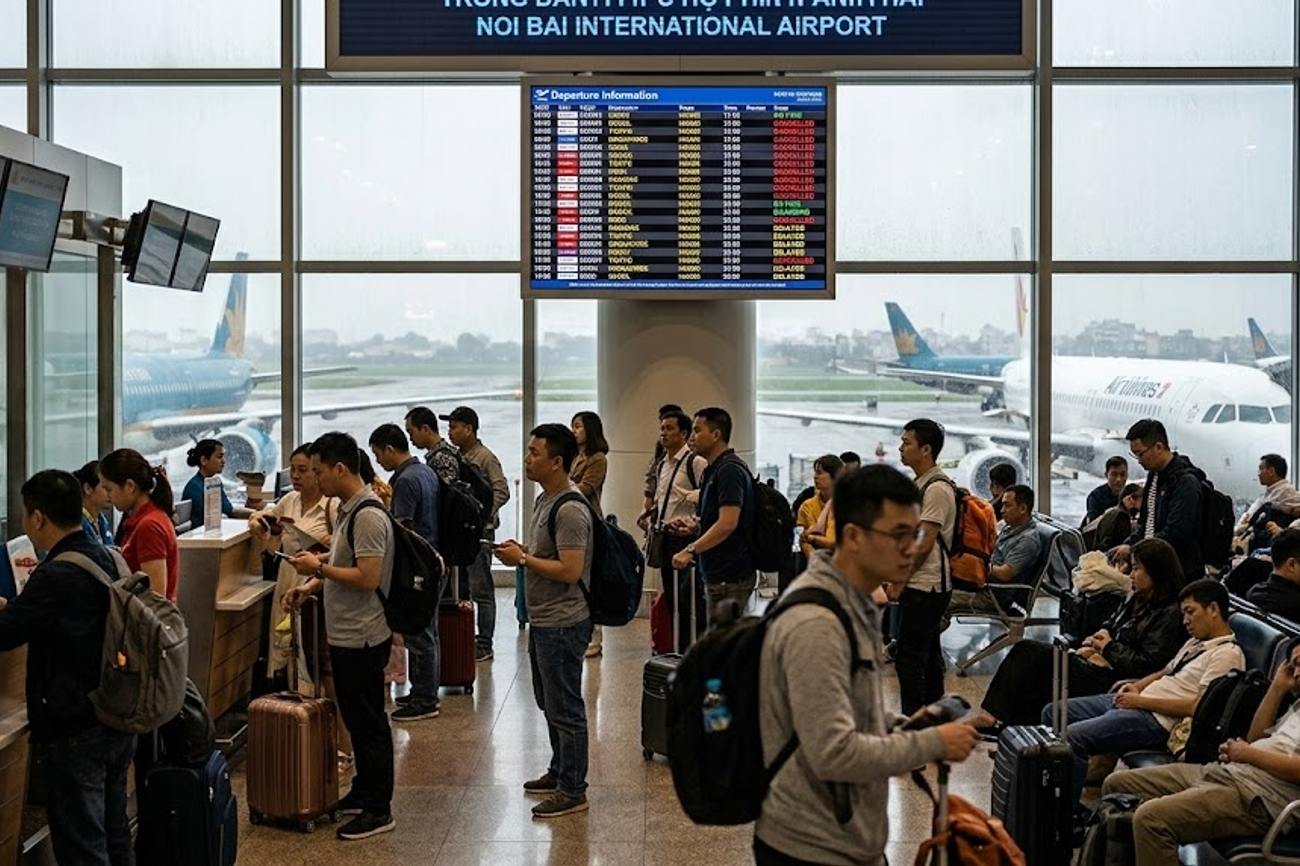
Image generated by AI
[Singapore, May 2024] — A massive wave of operational failures has paralyzed aviation networks across Asia and the Middle East, resulting in 4,331 flight delays and 241 total cancellations. The disruption has triggered a systemic collapse of scheduling across major hubs, leaving thousands of passengers stranded or delayed as airlines struggle to manage aircraft rotation and network demands.
The crisis is the result of a compounding series of failures involving severe weather constraints, airport traffic congestion, and rigid network scheduling. The impact is most acute in Southeast Asia and China, where the interconnected nature of regional flight paths has created a domino effect; a single delay at a primary hub is now triggering immediate operational failures at secondary destinations.
Systemic Network Failures
The current instability is driven by a combination of aircraft rotation issues—where a plane cannot arrive at its next destination because it is stuck at a previous one—and severe weather-related constraints. These factors have placed intense pressure on the International Civil Aviation Organization (ICAO) standards for traffic flow management.
The fragility of the Asian aviation grid is evident in the data, where high-volume transfer hubs are experiencing a surge in "knock-on" delays. When major gateways like Singapore Changi or Shanghai Pudong face bottlenecks, the ripple effect extends to smaller regional airports, creating a gridlock that airlines are currently unable to resolve in real-time.
Regional Impact Analysis
The disruption is widespread, affecting multiple countries and dozens of airports. The following data outlines the most severe operational pressures:
Southeast Asia Hubs
- Bangkok (BKK): Suvarnabhumi International reported 298 delays (12%) and 3 cancellations.
- Jakarta (CGK): Soekarno-Hatta International saw 241 delays (18%) and 18 cancellations (5%).
- Kuala Lumpur (KUL): International operations recorded 266 delays (21%) and 2 cancellations.
- Singapore (SIN): Changi Airport reported 188 delays (7%) and 2 cancellations.
- Hanoi (HAN): Noi Bai International recorded 189 delays (12%) and 2 cancellations.
- Da Nang (DAD): International operations saw 92 delays (30%) and 2 cancellations.
- Indonesia Regional: Kuala Namu reported 45 delays (18%) and 3 cancellations; Sepinggan reported 22 delays (21%) and 4 cancellations.
Chinese Aviation Network
- Shanghai (PVG): Pudong International recorded 223 delays (12%) and 10 cancellations (1%).
- Guangzhou (CAN): Baiyun International recorded 188 delays (12%) and 7 cancellations (1%).
- Beijing (PEK/PKX): Capital International saw 89 delays (6%) and 12 cancellations; Daxing International recorded 119 delays (6%) and 4 cancellations.
- Other Hubs: Shenzhen Bao’an (154 delays/14%), Xi’an Xianyang (117 delays/16%), Chongqing Jiangbei (93 delays/16%), and Kunming Changshui (91 delays/16%).
- Tianjin (TSN): Binhai International reported 59 delays (23%) and 5 cancellations (1%).
Indian Gateways
- Delhi (DEL): Indira Gandhi International recorded 235 delays (15%) and 7 cancellations.
- Mumbai (BOM): Chhatrapati Shivaji International recorded 196 delays (15%) and 3 cancellations.
- Kolkata (CCU): Netaji Subhash Chandra Bose International saw 33 delays (27%) and 3 cancellations (10%).
- Hyderabad (HYD): Rajiv Gandhi International reported 45 delays (12%) and 4 cancellations (1%).
- Srinagar (SXR): Recorded 8 delays (16%) and 3 cancellations (5%).
Middle East and Other Regions
- Aleppo (ALP): Reported 18% origin cancellations.
- Homalin (HOX): Experienced total collapse with 100% origin and destination cancellations.
- Kalaymyo (KMV): Recorded 100% destination cancellations.
- Mandalay (MDL): Reported 44% origin and 37% destination cancellations.
- Najran (EAM): Recorded 40% origin and 33% destination cancellations.
Carrier Performance Data
The operational strain is reflected in the performance of major airlines, some of which are seeing double-digit delay percentages.
China and Japan China Eastern is among the hardest hit in East Asia, recording 312 delays (12%) and 27 cancellations (1%). Air China reported 118 delays (6%) and 24 cancellations (1%). In Japan, Japan Airlines recorded 103 delays (13%) and 2 cancellations, while StarFlyer saw 7 delays (10%) and 1 cancellation.
India IndiGo has faced significant pressure with 310 delays (15%) and 8 cancellations. Air India recorded 95 delays (15%) and 4 cancellations. SpiceJet reported the highest percentage of disruption among Indian carriers, with 25 delays (27%) and 10 cancellations (10%).
Southeast Asia and Middle East Batik Air recorded 65 delays (21%) and 18 cancellations (5%), while Garuda Indonesia saw 44 delays (18%) and 3 cancellations (1%). Indonesia AirAsia reported 21 delays (24%) and 2 cancellations (2%). In the Middle East, FlyDubai recorded 61 delays (21%) and 6 cancellations (2%), and Saudia reported 51 delays (9%) and 12 cancellations (2%). Qatar Airways recorded 77 delays (12%) and 1 cancellation.
Practical Traveler Advisory and Strategic Insights
For passengers currently booking or traveling within these corridors, the "on-time" status of a flight is currently unreliable. The high percentage of delays at hubs like Da Nang (30%) and Kolkata (27%) suggests that short-haul flights are particularly vulnerable.
Immediate Passenger Impacts:
- Connection Risks: If you have a layover at BKK, CGK, or KUL, the probability of a missed connection is significantly elevated. Travelers should verify minimum connection times.
- Airport Congestion: Due to the volume of delays, terminals are experiencing higher-than-normal passenger density. Expect longer queues at security and check-in.
- Booking Volatility: Flight schedules are fluid. A flight listed as "scheduled" may be subject to a last-minute cancellation if the incoming aircraft is delayed at a previous port.
Travelers are advised to monitor their flight status through official airline apps and the Federal Aviation Administration (FAA) or equivalent local civil aviation authorities for broader airspace alerts.
Recovery Timeline and Next Steps
Airlines are currently in a "recovery phase," attempting to reset aircraft rotations to their original schedules. However, because the disruptions are systemic rather than isolated to one airline, recovery depends on the simultaneous stabilization of airport traffic across multiple countries.
The priority for carriers is the redistribution of aircraft to high-demand hubs to prevent further cancellations. Until the backlog of delayed flights is cleared, passengers should expect intermittent instability in flight timings.
FAQ: Asia Aviation Disruptions 2024
What should I do if my flight is delayed at a major Asian hub? Immediately contact your airline via their mobile app or customer service line. If you have a connecting flight, ask the agent to rebook you on the next available service before you land to avoid long queues at the transfer desk.
Are my rights to compensation applicable for these delays? Compensation depends on the airline's home country and the cause of the delay. Weather is typically considered an "extraordinary circumstance," but aircraft rotation issues may be compensable. Review your carrier's contract of carriage.
How far in advance should I arrive at the airport? Given the operational pressure at airports like Suvarnabhumi and Soekarno-Hatta, travelers should arrive at least 4 hours before international departures to account for increased security and check-in congestion.
Which airports are currently seeing the highest cancellation rates? While major hubs have low cancellation percentages, regional airports like Homalin (HOX) and Kalaymyo (KMV) have seen 100% cancellation rates. Always check the specific airport code before departing for the terminal.
Aviation networks remain in a state of high volatility as hubs struggle to reset.
Related Travel Guides
- Los Angeles Air Travel Expands as Delta Adds Monterey, Philadelphia and More Flights to Boston, Seattle and Houston: What You Need to Know
- Air Canada Strengthens North American Aviation Leadership With Back-to-Back Skytrax Recognition
- Over 60 Cancellations and 1,130 Delays Disrupt Middle East Travel at Muscat, Dubai and Other Airports
Disclaimer
This article is for informational and educational purposes only. It does not constitute legal, financial, or professional advice. While we strive to provide accurate and up-to-date information, travel policies, regulations, and conditions change rapidly. Always verify information with official sources before making travel decisions. Nomad Lawyer makes no representations about the accuracy, reliability, completeness, or suitability of the information provided. Readers should consult qualified professionals for advice specific to their circumstances. The views expressed in this article are those of the author and do not necessarily reflect the views of Nomad Lawyer.
Kunal K Choudhary
Co-Founder & Contributor
A passionate traveller and tech enthusiast. Kunal contributes to the vision and growth of Nomad Lawyer, bringing fresh perspectives and driving the community forward.
Learn more about our team →