Flights Cancelled Over Asia at Bengaluru, Guangzhou and More Airports with 4,160 Delays and 248 Cancellations

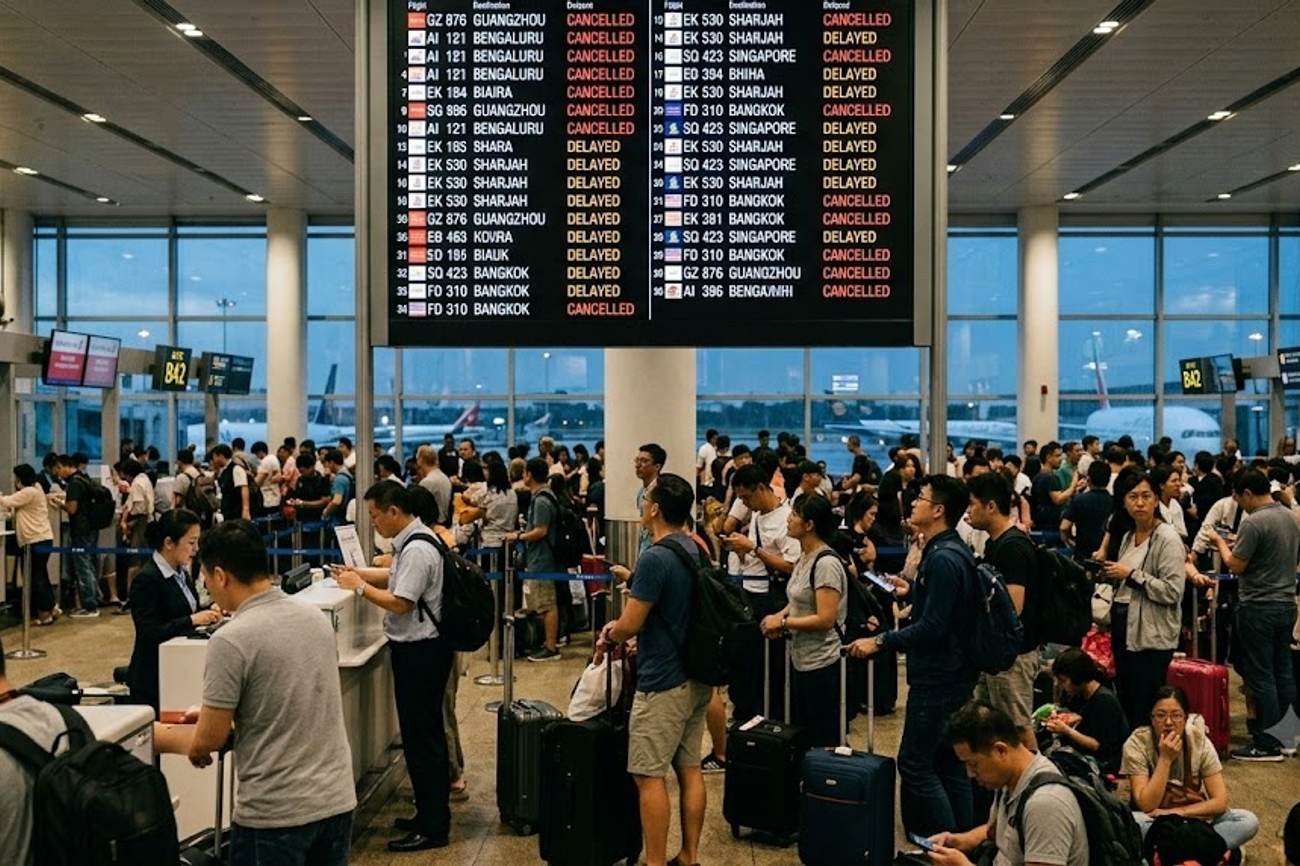
Image generated by AI
**Sharjah Airport
Major aviation networks are experiencing extensive disruption, resulting in 4,160 delays and 248 cancellations of flights around Asia at Bengaluru, Guangzhou, and other a**
Major aviation networks are experiencing extensive disruption, resulting in 4,160 delays and 248 cancellations of flights around Asia at Bengaluru, Guangzhou, and other airports. Significant delays and cancellations occurred on flights throughout Asia today at major airports, such as Bengaluru and Guangzhou. In addition, heavy air traffic, weather-related difficulties, aircraft rotation problems, and airport congestion put pressure on carriers’ operations. As a result, travelers at crowded airports have to deal with extended wait times, altered schedules, and unclear connections. The disruptions show how Asia’s aviation infrastructure is under increasing strain as airports deal with increased passenger demand and difficult operating issues.
Asia Airports Experience Widespread Flight Delays and Cancellations
The disruption pattern shows that some of Asia’s busiest aviation hubs faced the highest impact. Major international gateways recorded hundreds of delayed flights, affecting passengers travelling for business, tourism, and connecting journeys.
Among the most affected airports, Tokyo Int’l (Haneda) recorded the highest number of delays with 495 delayed flights and 4 cancellations. Guangzhou Baiyun Int’l in China followed with 450 delays and 3 cancellations, showing significant pressure at two of Asia’s key aviation hubs.
Other major airports also reported substantial disruption. Tan Son Nhat Int’l in Vietnam recorded 268 delays and 4 cancellations, while Kuala Lumpur Int’l in Malaysia reported 197 delays and 3 cancellations. Shanghai Pudong Int’l in China experienced 196 delays and 13 cancellations, making it one of the airports with the highest cancellation numbers.
Additional airports affected included Narita Int’l in Japan with 169 delays and 2 cancellations, Hong Kong Int’l with 145 delays and 4 cancellations, and Jakarta Soekarno-Hatta Int’l in Indonesia with 147 delays and 28 cancellations. Jakarta recorded the highest cancellation figure among the listed airports.
India also experienced disruption across major aviation centres. Indira Gandhi Int’l Airport in Delhi recorded 122 delays and 10 cancellations, while Bengaluru Int’l reported 59 delays and 3 cancellations. Chhatrapati Shivaji Int’l Airport in Mumbai recorded 42 delays and 9 cancellations, adding pressure to India’s major international travel routes.
China, Japan and Southeast Asia Remain Major Disruption Zones
China experienced some of the largest airport impacts in the provided data. Guangzhou, Shanghai, Beijing, Chengdu, Chongqing, Kunming, Hangzhou, and other Chinese aviation hubs recorded high levels of delayed flights.
The recent flight cancellations and delays across Asia, including at Bengaluru and Guangzhou airports, have been attributed to a combination of factors, including weather conditions and air traffic control issues. For the most up-to-date information on flight schedules and travel advisories, passengers can visit the official website of the Airports Authority of India for latest updates. This resource provides critical information for travelers affected by the disruptions.
Beijing Capital Int’l Airport recorded 125 delays and 13 cancellations, while Chongqing Jiangbei Int’l reported 123 delays and 9 cancellations. Chengdu Tianfu Int’l recorded 109 delays and 8 cancellations, and Chengdu Shuangliu Int’l recorded 65 delays and 9 cancellations. Other affected Chinese airports included Kunming Changshui Int’l with 84 delays and 9 cancellations, Xi’an Xianyang Int’l with 95 delays and 3 cancellations, and Xiamen Gaoqi Int’l with 76 delays and 4 cancellations.
Japan also experienced major delays, especially at Tokyo airports. Haneda recorded the highest delay figure, while Narita Int’l recorded 169 delays and 2 cancellations. The disruption affected passengers connecting through some of Asia’s busiest international routes.
Across Southeast Asia, Indonesia, Malaysia, Vietnam, and the Philippines saw notable impacts. Jakarta Soekarno-Hatta Int’l recorded 147 delays and 28 cancellations, while Ngurah Rai/Bali Intl recorded 62 delays and 5 cancellations. Juanda Int’l in Indonesia reported 36 delays and 7 cancellations, while Sultan Hasanuddin Int’l recorded 27 delays and 9 cancellations.
Airlines Across Asia Report Significant Schedule Disruptions
Airlines operating across Asia also faced operational challenges. The provided airline data shows disruption among major carriers from China, Indonesia, India, Vietnam, Japan, Malaysia, Hong Kong, and Gulf markets.
China Eastern recorded 21 cancelled flights with a 0% cancellation rate and 347 delayed flights with an 11% delay rate, making it one of the airlines with the highest number of delayed flights.
Air China reported 21 cancellations with a 1% cancellation rate and 124 delays with a 6% delay rate. China Southern Airlines recorded 2 cancellations with a 0% cancellation rate and 281 delays with a 12% delay rate.
Indonesian airlines also experienced disruption. Batik Air recorded 21 cancellations with a 6% cancellation rate and 44 delays with a 14% delay rate. Citilink reported 15 cancellations with a 5% cancellation rate and 33 delays with a 12% delay rate.
Passengers affected by the flight cancellations and delays are advised to contact their respective airlines for assistance with rebooking or refunds. The Civil Aviation Administration of China website offers guidance on passenger rights and procedures for filing complaints. By understanding their rights and options, travelers can better navigate the challenges posed by these flight disruptions.
Other airlines affected included Sichuan Airlines with 8 cancellations at a 1% rate and 100 delays at a 13% rate, Shenzhen Airlines with 6 cancellations at a 0% rate and 116 delays at a 15% rate, and AirAsia with 7 cancellations at a 1% rate and 70 delays at a 15% rate.
Several carriers recorded higher delay percentages. Vietnam Airlines reported 4 cancellations at a 1% rate and 106 delays at a 29% delay rate. SpiceJet in India recorded 3 cancellations at a 4% cancellation rate and 29 delays at a 46% delay rate, the highest delay percentage among the listed airlines.
Other affected airlines included Cathay Pacific with 4 cancellations and 74 delays at a 17% delay rate, ANA Wings with 3 cancellations and 72 delays at a 20% delay rate, and PAL Express with 3 cancellations and 39 delays at a 25% delay rate.
Middle Eastern carriers operating Asian routes were also impacted. Saudia recorded 9 cancellations at a 1% rate and 73 delays at a 13% delay rate. FlyDubai reported 3 cancellations at a 1% rate and 29 delays at a 10% delay rate, while Air Arabia recorded 4 cancellations at a 1% rate and 26 delays at an 11% delay rate.
What Affected Passengers in Should Do Now
Passengers in Asia affected by these disruptions should check their flight status directly with their airline before travelling to the airport.
Real-time updates can help travellers avoid unnecessary waiting and identify schedule changes early. Travellers with connecting flights should allow additional time between journeys, especially when departing from heavily affected airports such as Tokyo Haneda, Guangzhou Baiyun, Shanghai Pudong, Jakarta Soekarno-Hatta, and Delhi Indira Gandhi.
The impact of these flight cancellations and delays extends beyond passenger logistics, affecting local tourism industries as well. For insights into how these disruptions might influence travel plans and destinations, the Singapore Tourism Board website provides valuable information on alternative destinations and activities in the region. By exploring these resources, travelers can make informed decisions about their travel itineraries and find ways to mitigate the effects of flight cancellations. Passengers whose flights have been cancelled should contact airlines immediately to understand available options, including rebooking, alternative flights, or updated travel arrangements. Keeping digital copies of booking confirmations, travel documents, and airline notifications can help speed up assistance. Those travelling for important appointments or international connections should consider flexible travel plans until operations return to normal. Data Verification Notice
The data has been extensively curated by our editorial team using real-time aviation figures recorded on 22 September 2026 at 3:31 pm ET USA (23 September 2026, 2:31 am Indochina Time (GMT+7)). Primary Source: FlightAware. Verification Protocol: All statistics have been independently reviewed and cross-checked by our human editorial desk. Timestamped records, data logs and feed snapshots are securely archived internally to support historical accuracy and editorial transparency. Note: Real-time flight-tracking figures reflect active airspace and operational data. Minor variations may occur when compared with information displayed at individual airport terminals or airline departure gates.
Yesterday, major airports across Asia face 890 Cancellations and 4,632 Delays amid Typhoon Dujuan. Click here to read the full report.
Verified by Tuhin Sarkar
Airline Delays Asia a
FAQ: Flights Cancelled Over Asia at Bengaluru 2026
What airports are affected? Bengaluru, Guangzhou, and several other Asian airports.
How many flights are delayed? 4,160 flights have been delayed so far.
Can I get a refund for cancellations? Yes, contact your airline for refund or rebooking options.
How can I check my flight status? Check your airline's website or mobile app for updates.
Related Travel Guides
- Jetstar Elevates International Journeys as Qantas Points Unlock More Business Class Upgrade Opportunities
- Flights Cancelled Swept The United States As New York, Atlanta, And More Face 192 Cancellations And 2,094 Delays, Disrupting Travel
- Condor and American Airlines Partner to Fulfill Dream Transatlantic Journeys
This article is for informational purposes. Flight routes, passenger regulations, visa rules, and transit advisories are subject to change by airlines and aviation authorities. Readers are advised to verify schedules and travel documentation with relevant carriers and border agencies before departure.
Related Stories
India Launches International Digi Yatra Biometric Trials at 7 Major Airports for 2027 Expansion

Avoiding Major Hubs: Using Portsmouth and Regional US Airports for Winter Travel 2026-27