
Chiang Mai International Airport Becomes A Rising Asian Travel Hub As Millions Of Passengers Boost Tourism
Chiang Mai International Airport Becomes A Rising Asian Travel Hub As Millions Of Passengers Boost Tourism

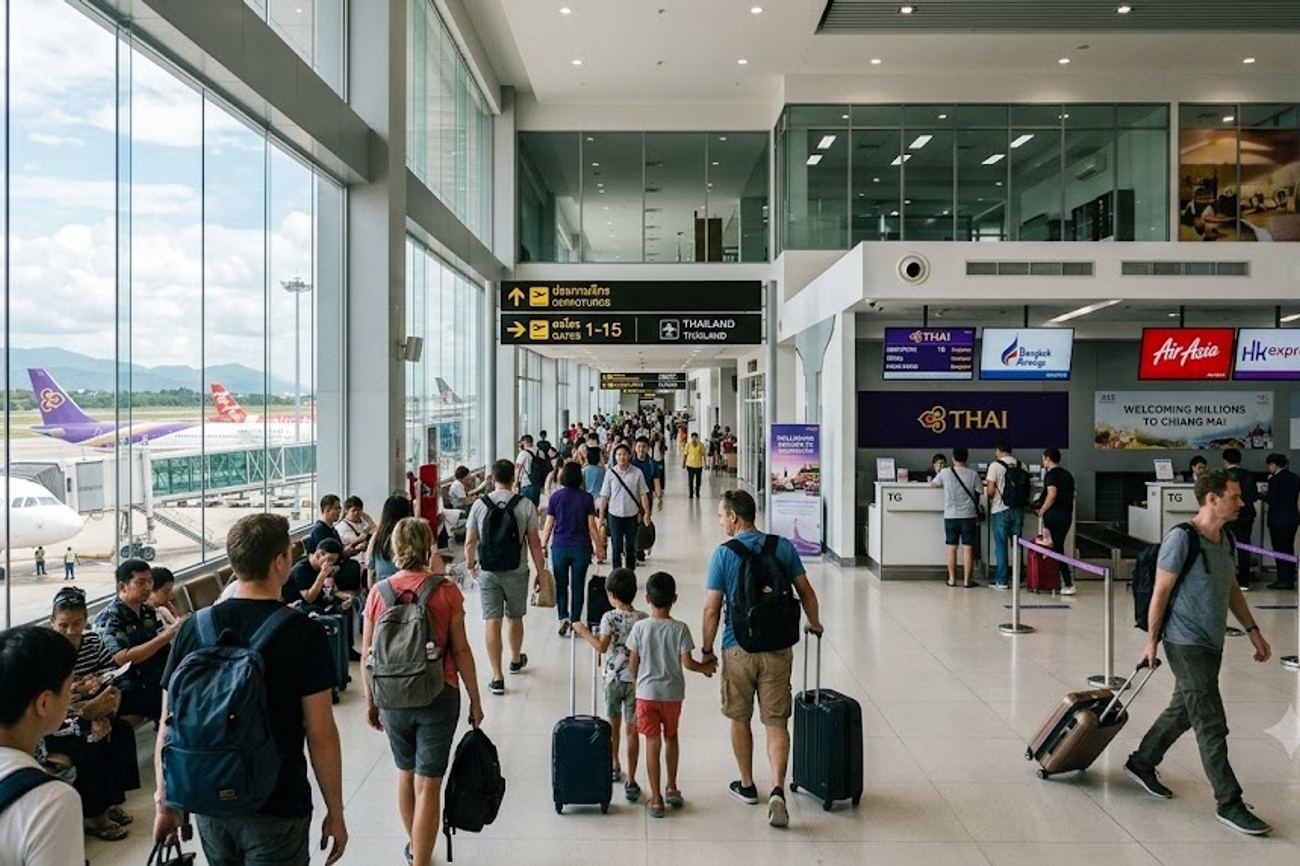
Image generated by AI
International travel volumes at Chiang Mai International Airport surged by 14% year-on-year during the first eight months of 2026, a stark contrast to the flat growth seen in total passenger numbers. This divergence indicates a strategic shift in the airport's utility, moving from a primarily domestic transit point to a specialized international gateway for Northern Thailand.
The Northern Gateway in Numbers: 2026 Performance
The data from the first eight months of 2026 reveals an airport operating at high capacity but facing macroeconomic headwinds. Chiang Mai International Airport processed 6.53 million passengers across 43,544 total flights. When isolating international operations, the numbers highlight a growing reliance on overseas markets: 13,232 of those flights were international, representing more than 30% of all flight movements.
Equally significant is the passenger composition. International travelers now account for nearly 30% of total airport traffic. This shift is heavily weighted toward East Asian markets; travelers from China and South Korea currently contribute more than half of all international arrivals. This concentration suggests that Northern Thailand's tourism recovery is currently tethered to the economic health and travel appetite of these two specific nations.
Despite these gains, the broader data shows a plateau in total volume. Total passenger and flight counts remained nearly identical to 2025 levels. This stagnation is not a result of low demand—as evidenced by the 14% jump in international volume—but rather a consequence of operational constraints. Rising fuel costs and increased airline operating expenses have forced carriers to optimize schedules, preventing the total volume from scaling alongside the demand.
Regional Connectivity and Market Benchmarks
To understand the trajectory of Chiang Mai, one must compare its current recovery against the broader aviation trends reported by IATA. While global aviation is grappling with cost pressures, Chiang Mai is aggressively pursuing a "hub-and-spoke" restoration strategy. The airport is not merely waiting for traffic to return; it is actively diversifying its route map to reduce dependence on domestic feeds.
The most telling metric is the projected year-end total. The airport anticipates reaching 9.97 million travelers by the close of 2026. This projection is predicated on the "Winter Schedule," which commences in late October and typically sees a surge in capacity from the Northern Hemisphere.
The following table illustrates the shift in operational focus between the 2025 baseline and the 2026 performance metrics:
| Metric | 2025 Period (Approx.) | 2026 (First 8 Months) | Variance/Trend |
|---|---|---|---|
| Total Passengers | ~6.5 Million | 6.53 Million | Flat Growth |
| International Volume | Base Level | +14% YoY | Strong Growth |
| International Flight Share | < 30% | > 30% | Increasing |
| Passenger Projection | N/A | 9.97 Million (Full Year) | Scaling Up |
| Key Market Share | Diversified | > 50% China/S. Korea | High Concentration |
This data suggests that while the "ceiling" for total passengers was hit during the first eight months due to costs, the "floor" for international travel has risen significantly. The resumption of the Abu Dhabi–Chiang Mai route is a critical data point here; it signals a return to long-haul connectivity, moving the airport beyond a regional feeder and back toward its status as a global destination.
What This Means for Travelers
The current data indicates a tightening of capacity during the shoulder season but a massive influx during the peak winter window. For those planning travel to Northern Thailand, the following data-driven adjustments are necessary:
- Booking Windows for Q4: With the winter schedule beginning in late October and projected year-end totals hitting 9.97 million, flights to Chiang Mai will reach peak load factors. Travelers should secure bookings 12-16 weeks in advance to avoid the price spikes associated with the restored Abu Dhabi and East Asian routes.
- Airport Transit Times: The installation of six new aircraft boarding bridges as of August 21 has improved aircraft handling efficiency. However, the simultaneous construction of a new fire station, cargo building, and Control Post 2 suggests that ground-side infrastructure is still in a state of flux. Expect potential bottlenecks in landside transport and security queues.
- Route Optimization: The increase in direct connectivity to Incheon, Shanghai, and Jinghong means travelers from East Asia can bypass Bangkok entirely. Those traveling from the Middle East should prioritize the restored Abu Dhabi link to reduce total travel time by several hours.
For more comprehensive data on regional airport performance and capacity shifts, travelers and investors can monitor OAG for real-time flight schedule changes.
Infrastructure Trajectory and Future Projections
The investment in physical assets suggests that the airport authority expects the 9.97 million passenger mark to be a baseline rather than a peak. The completion of the boarding bridge replacements on August 21 is a tactical move to increase "turnaround efficiency"—reducing the time an aircraft spends at the gate.
When an airport invests in a new cargo building and dedicated ground support equipment parking, it is signaling a shift toward logistics and high-frequency operations. This suggests that Chiang Mai is positioning itself to handle larger aircraft models and more frequent rotations.
Looking toward 2027, the trend indicates a move toward "Premium Tourism." The data shows that while volume is flat, the type of traveler is changing. The growth in wellness and heritage tourism, coupled with long-haul routes like Abu Dhabi, indicates a shift toward higher-spending international visitors. If the 14% international growth rate continues, Chiang Mai will likely surpass its pre-pandemic international traffic benchmarks by the end of the next fiscal cycle.
FAQ: Chiang Mai Aviation Trends 2026
Will flight prices to Chiang Mai increase in late 2026? Yes. The combination of rising fuel costs and the surge in winter demand (projected 9.97 million annual passengers) typically drives prices up. Booking before the late-October schedule shift is recommended.
Which international markets are driving the most growth? China and South Korea are the primary drivers, currently accounting for more than 50% of all international passengers using the airport.
Is the airport currently under construction? Yes. While boarding bridges are complete, work continues on a new fire station, cargo building, and Control Post 2, which may impact airport navigation.
Are there new direct routes available? Yes, connectivity is expanding to Incheon, Shanghai, and Jinghong, with the Abu Dhabi–Chiang Mai route resuming after its summer suspension.
As Northern Thailand pivots from domestic reliance to international integration, the data confirms that Chiang Mai is no longer just a stopover, but a primary destination hub.
Tags: Chiang Mai International Airport, Thailand Tourism Growth 2026, East Asian Aviation Demand, Northern Thailand Infrastructure, International Passenger Volume 2026
Related Travel Guides
- Virgin Australia Launches Travel Media Network: Transforming 21 Million Passenger Journeys
- Virgin Atlantic Reshapes Long-Haul Strategy: Five Heathrow Routes Scaled Back Amid Fleet Reallocation
- Vietnam Airlines Signs Paris Agreement for Five Airbus A350-900 Jets: Long-Haul Fleet Strategy and Traveler Guide
Disclaimer
This article is for informational and educational purposes only. It does not constitute legal, financial, or professional advice. While we strive to provide accurate and up-to-date information, travel policies, regulations, and conditions change rapidly. Always verify information with official sources before making travel decisions. Nomad Lawyer makes no representations about the accuracy, reliability, completeness, or suitability of the information provided. Readers should consult qualified professionals for advice specific to their circumstances. The views expressed in this article are those of the author and do not necessarily reflect the views of Nomad Lawyer.
Kunal K Choudhary
Co-Founder & Contributor
A passionate traveller and tech enthusiast. Kunal contributes to the vision and growth of Nomad Lawyer, bringing fresh perspectives and driving the community forward.
Learn more about our team →