
British Airways UAE Flights Face Deep Cuts as Emirates and Etihad Gain Ground Across the UK Market
British Airways UAE Flights Face Deep Cuts as Emirates and Etihad Gain Ground Across the UK Market

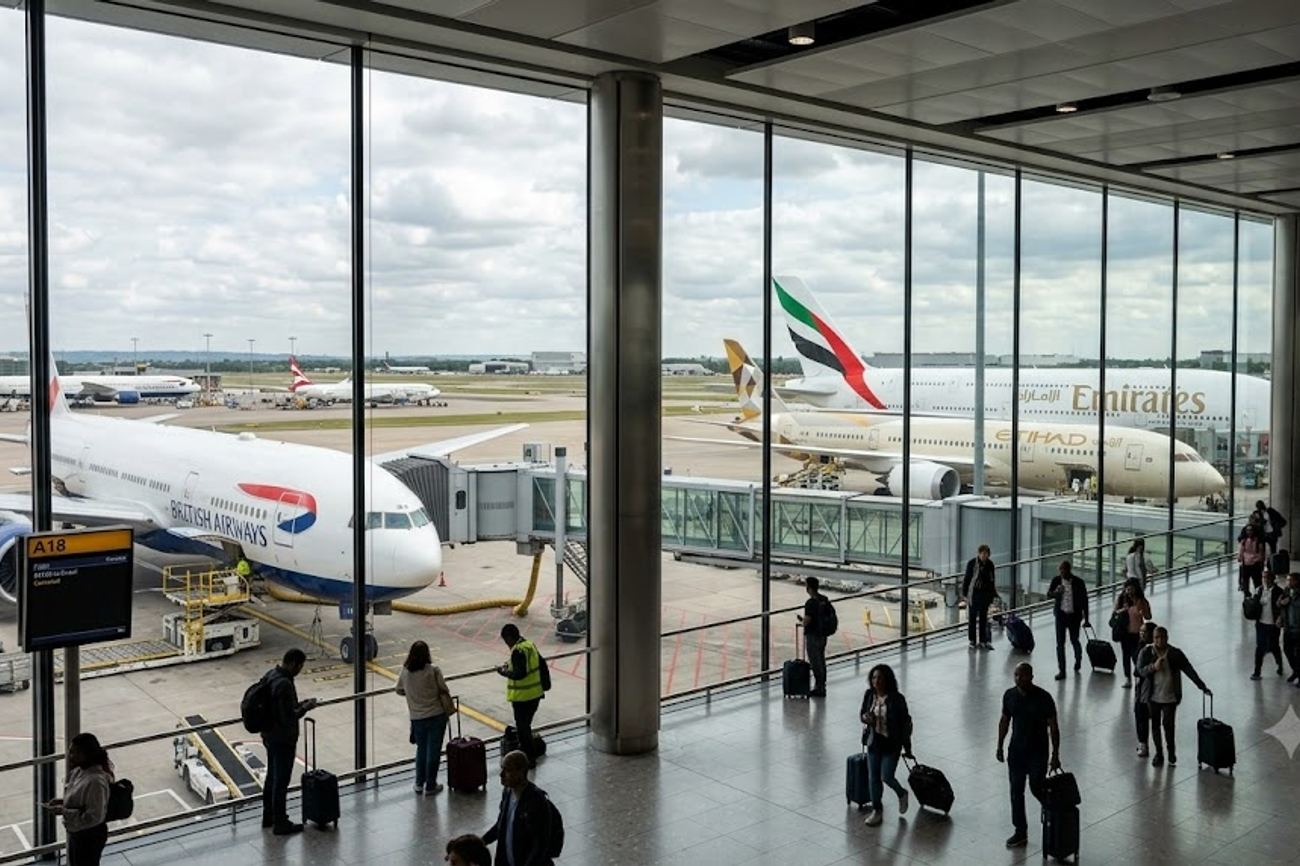
Image generated by AI
[London, October 2026] — British Airways will resume flights to Dubai on November 3, 2026, but the carrier is returning to the United Arab Emirates with a significantly diminished operational footprint. The airline is abandoning its previous high-frequency model in favor of a cautious, phased restart that leaves a substantial gap in connectivity to the UAE capital.
The UK-based carrier will launch its return with a single daily service between London and Dubai during the winter season. While British Airways plans to increase this frequency to two daily flights during the summer of 2027, this still falls short of the three daily services operated prior to the February disruption. More critically, the airline has pushed the restoration of its Abu Dhabi service back to the winter 2027-28 season, extending the absence of direct BA flights to the capital by several months.
The Catalyst for Network Contraction
The current scheduling shift follows a period of disruption that began in February, during which British Airways maintained a robust presence in the UAE with 28 weekly round trips. This previous capacity included three daily flights to Dubai and one daily flight to Abu Dhabi. The decision to return with a reduced schedule suggests a strategic pivot by the airline as it re-evaluates its Middle East network.
By prioritizing Dubai over Abu Dhabi, British Airways is acknowledging the differing market dynamics of the two hubs. The airline has stated that these revised schedules are intended to provide customers with greater clarity and a more reliable planning horizon while internal reviews of the regional network continue. However, the gap between the Dubai restart and the Abu Dhabi return indicates that the airline no longer views the two cities as equal priorities for its UK-UAE connectivity.
Market Impact and Route Analysis
The reduction in capacity creates a void in the market that is being actively filled by regional incumbents. The following table outlines the shift in British Airways' operational capacity:
| Route | Pre-February Operation | Winter 2026-27 | Summer 2027 | Expected Full Return |
|---|---|---|---|---|
| Dubai (DXB) | 3 Daily | 1 Daily | 2 Daily | TBD |
| Abu Dhabi (AUH) | 1 Daily | Suspended | Suspended | Winter 2027-28 |
| Total UAE Trips | 28 Weekly | Substantially Lower | Below Previous | TBD |
The absence of British Airways in Abu Dhabi provides a prolonged competitive advantage to Etihad Airways, which currently maintains a dominant position on the route. Etihad continues to operate up to four non-stop flights daily between London and Abu Dhabi, alongside direct services from Manchester.
In Dubai, the reduced BA frequency benefits Emirates, which manages a massive operation at Dubai International (DXB). The timing of BA's reduced capacity coincides with a surge in UK demand; Emirates Deputy President and Chief Commercial Officer Adnan Kazim recently reported that UK bookings for the October mid-term break rose by 10 per cent year-on-year.
Practical Traveler Advisory and Strategic Insights
For the average passenger, the "return" of British Airways to the UAE is not a return to normalcy, but a transition to a restricted service. The primary impact is the loss of scheduling flexibility. When an airline operates three daily flights, passengers can easily shift their departure times to accommodate business meetings or recover from flight delays. With only one or two daily options, the margin for error disappears.
Direct Passenger Impacts:
- Abu Dhabi Bound Travelers: Passengers specifically seeking a British Airways itinerary to the UAE capital will find no availability until the winter 2027-28 season. You cannot assume the Dubai restart implies a simultaneous return to Abu Dhabi.
- Connecting Passengers: Dubai serves as a global gateway to 291 destinations. A reduction in London-Dubai frequency limits the "feed" for passengers using the UK as a starting point for onwards travel to Asia, Africa, and Australasia.
- Pricing Dynamics: With reduced competition from BA, the remaining carriers—specifically Emirates and Etihad—hold greater pricing power over the London-UAE corridor.
- Airport Logistics: Travelers with existing hotel bookings in Abu Dhabi should be cautious about booking replacement flights into Dubai (DXB). While the cities are geographically close, the transfer involves additional time and cost.
The Dubai Hub Ecosystem
The scale of the market BA is partially exiting is highlighted by recent data from Dubai Airports. In 2025, Dubai International (DXB) recorded its busiest year in history, welcoming 95.2 million passengers—a 3.1 per cent annual increase. The United Kingdom remains a primary driver of this growth, contributing 6.3 million passengers to the airport's total.
London specifically stands as the leading city destination for DXB, with 3.9 million passengers recorded in 2025. The airport's overall infrastructure supported 454,800 flight movements in 2025 with an annual seat load factor of 77.6%.
Because DXB operates as a massive transfer hub rather than a simple destination, BA's decision to limit its frequency affects more than just tourists. It impacts the broader flow of international commerce and transit between the UK and 108 different international carriers that operate through the Dubai hub.
Future Outlook and Network Recovery
The roadmap for British Airways suggests a slow, cautious climb back to previous capacity levels. The increase to two daily flights in summer 2027 is a incremental step, but the long-term strategy for the UAE remains opaque. The airline's continued "review" of the Middle East network suggests that the 28-weekly-trip model may never fully return in its original form.
Industry analysts will be watching the winter 2027-28 window closely to see if the Abu Dhabi service actually resumes as scheduled. If BA further delays the AUH restart, it would signal a permanent strategic shift away from the UAE capital in favor of the higher-volume Dubai market. In the interim, the London-UAE corridor will remain a duopoly of the UAE's state-backed carriers, with BA acting as a secondary player with limited frequency.
FAQ: British Airways UAE Operations 2026-2028
When can I fly British Airways to Dubai again? Services resume on November 3, 2026. Initially, there will be one flight daily from London. This will increase to two daily flights during the summer 2027 season.
Is British Airways returning to Abu Dhabi? Yes, but not immediately. The airline has scheduled its return to Abu Dhabi for the winter 2027-28 season. Direct BA flights to the capital remain suspended until that time.
What are my alternatives for flying to Abu Dhabi right now? Etihad Airways remains the primary option, offering up to four non-stop flights daily from London and direct services from Manchester to Abu Dhabi.
Will the reduced flights affect my connecting flight to Asia? Potentially. Because there are fewer daily departures from London to Dubai, your window for connecting to onwards flights via DXB is narrower, reducing your flexibility if your first leg is delayed.
A cautious return for BA, but a wide-open door for the Gulf giants.
Related Travel Guides
- Korean Air Maps a 92-Destination Global Network Through Seoul, Linking Asia, Europe and the Americas
- Korean Air Flight Delays Explained: How Weather and Airport Congestion Disrupt South Korea Travel
- Iran Showcases Remarkable Tourism Transformation as Climate-Resilient Villages Set New Global Standards
Disclaimer
This article is for informational and educational purposes only. It does not constitute legal, financial, or professional advice. While we strive to provide accurate and up-to-date information, travel policies, regulations, and conditions change rapidly. Always verify information with official sources before making travel decisions. Nomad Lawyer makes no representations about the accuracy, reliability, completeness, or suitability of the information provided. Readers should consult qualified professionals for advice specific to their circumstances. The views expressed in this article are those of the author and do not necessarily reflect the views of Nomad Lawyer.
Raushan Kumar
Founder & Lead Developer
Full-stack developer with 11+ years of experience and a passionate traveller. Raushan built Nomad Lawyer from the ground up with a vision to create the best travel and law experience on the web.
Learn more about our team →