Barcelona-El Prat Airport Faces 15% Flight Capacity Cut as Aena Closes Runways for €3.1 Million Taxiway Upgrade

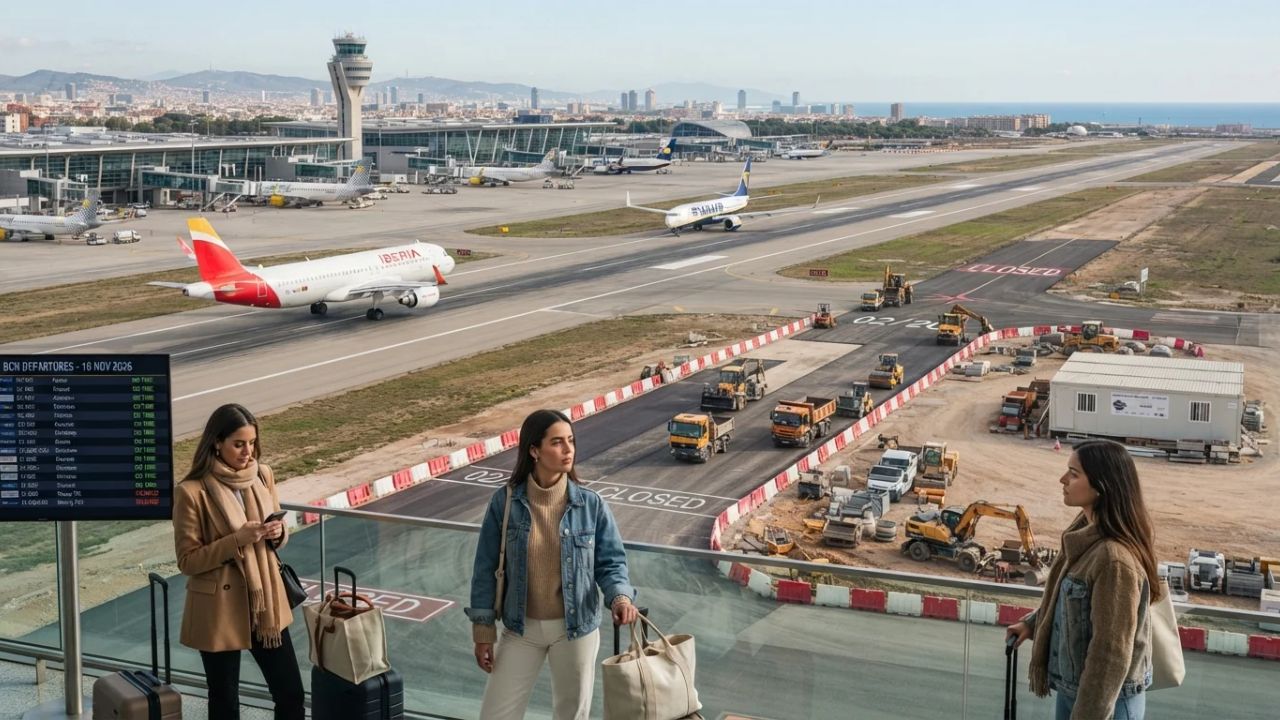
Spain’s second-busiest international aviation hub, Josep Tarradellas Barcelona-El Prat Airport (BCN), is undergoing an intense 11-day operational contraction between November 16 and November 26, 2026, as airport managing authority Aena temporarily shutters two of the facility's three runways to advance a €3.1 million civil engineering upgrade. The simultaneous closure of diagonal Runway 02/20 and primary inland Runway 06L/24R has forced the airport into a single-runway operating configuration, stripping 1,441 scheduled flight slots from airline timetables and reducing total aerodrome flight capacity by approximately 15%. With all arriving and departing flights funneled exclusively through coastal Runway 06R/24L, air traffic controllers, airlines, and ground crews face heightened operational vulnerability to weather anomalies and tactical flow controls, while long-haul carriers navigate critical payload adjustments on the shorter coastal tarmac.
The infrastructure project centers on constructing a modern rapid-exit taxiway (RET) connecting cross-runway 02/20 with parallel taxiway T4, an enhancement engineered to shorten runway occupancy times, optimize landing sequences, and reduce aircraft fuel burn once fully operational. However, the temporary consolidation of all flight movements onto a single coastal strip coincides with peak autumn corporate mobility, including the staging of the global Airports Innovate 2026 aviation conference hosted by Aena in Barcelona, and follows widespread regional rail disruptions across Catalonia’s Rodalies network. While airlines and airport slot coordinators adjusted flight inventories months in advance to avoid widespread last-minute cancellations, the compressed runway layout leaves travelers facing extended taxi times, tight connecting buffers, and acute exposure to cascading European air traffic management delays.
========================================================================================
BARCELONA-EL PRAT AIRPORT (BCN) RUNWAY RESTRICTIONS FACT SHEET
========================================================================================
Operational Dimension           Official Aeronautical Detail
----------------------------------------------------------------------------------------
Airport Identifier              Josep Tarradellas Barcelona-El Prat (ICAO: LEBL / IATA: BCN)
Airport Managing Authority      Aena S.M.E., S.A.
Air Navigation Service Provider ENAIRE (Spanish Air Navigation Directorate)
Principal Restriction Window    Monday, 16 November through Thursday, 26 November 2026
Standard Operations Resumption  Friday, 27 November 2026 (Subject to operational readiness)
Active Operating Runway         Runway 06R/24L (Coastal Runway - 2,660m × 60m)
Temporarily Closed Runways      Runway 02/20 (Diagonal/Cross - 2,540m × 45m)
                                Runway 06L/24R (Inland Long Runway - 3,352m × 60m)
Eliminated Flight Slots         1,441 Scheduled Flight Movements Removed
Aerodrome Capacity Contraction  Approximately 15% Reduction in Declared Hourly Capacity
Capital Investment Valuation    €3.1 Million Infrastructure Upgrade
Core Engineering Objective      New Rapid-Exit Taxiway linking Runway 02/20 with Taxiway T4
Total Project Lifecycle         12.5 Months (Phased works extending through September 2027)
Air Traffic Impact Profile      Single-runway mixed mode; payload limits on long-haul flights
========================================================================================
Source: Aena Press Disclosures, ENAIRE Aeronautical Information Publications, and Spanish Slot Coordination (AECFA).
========================================================================================
Runway Geometry and Aerodrome Configuration at Barcelona-El Prat
Josep Tarradellas Barcelona-El Prat Airport operates on a specialized runway layout designed to balance high-capacity flight operations with rigorous environmental and noise abatement restrictions imposed by neighboring coastal municipalities.
Under standard operating conditions, the airport utilizes a segregated parallel runway configuration:
- Runway 06L/24R (Inland Runway): Measuring 3,352 meters (10,997 feet) in length, this is the airport's longest runway, situated adjacent to Terminal 1 and primary maintenance facilities. In standard daytime operations (specifically the West Configuration, landing 24R and departing 24L), it functions primarily as the dedicated arrival runway or accommodates heavy long-haul widebody departures requiring maximum takeoff run available (TORA).
- Runway 06R/24L (Coastal Runway): Measuring 2,660 meters (8,727 feet) in length, this strip runs parallel to 06L/24R closer to the Mediterranean Sea. Under standard procedures, it handles departing aircraft, which execute a mandatory immediate right turn toward the sea upon takeoff to minimize acoustic impact over the densely populated communities of Gavà Mar and Castelldefels.
- Runway 02/20 (Diagonal / Cross Runway): Measuring 2,540 meters (8,333 feet) in length, this transverse strip intersects the approaches of the parallel runways. It is deployed primarily during nighttime operations to facilitate nocturnal noise-relief configurations (landing on Runway 02 over the sea and departing on Runway 24L) or during extreme meteorological events when severe southerly crosswinds compromise parallel runway safety.
========================================================================================
BARCELONA-EL PRAT AERODROME RUNWAY SPECIFICATIONS
========================================================================================
Runway Designation  Dimensions (Length × Width) Surface Type  Operational Role in Standard Flow
----------------------------------------------------------------------------------------
06L/24R (Inland)    3,352 m × 60 m (10,997 ft)  Asphalt       Preferred for long-haul heavy departures
                                                              and standard parallel arrivals
06R/24L (Coastal)   2,660 m × 60 m (8,727 ft)   Asphalt       Standard departure runway with immediate
                                                              coastal noise-abatement turn
02/20 (Diagonal)    2,540 m × 45 m (8,333 ft)   Asphalt       Nighttime noise abatement arrivals/departures;
                                                              crosswind operational contingency
========================================================================================
The Single-Runway Bottleneck on Runway 06R/24L
Between November 16 and November 26, this multi-runway flexibility ceases to exist. With Runway 02/20 closed for deep civil works and Runway 06L/24R temporarily de-energized and closed to facilitate construction logistics and taxiway realignments, the entire aerodrome relies on Runway 06R/24L.
Operating a high-density international hub on a single strip requires mixed-mode operations, where arriving aircraft and departing flights alternate on the same piece of asphalt. In standard segregated operations, an arriving aircraft touching down on 06L does not impede a departure rolling down 06R. Under the single-runway temporary regime, air traffic controllers at ENAIRE must create substantial spacing gaps between consecutive arrivals to allow departing aircraft to line up, take off, and clear the runway envelope. This structural requirement reduces the airport's peak hourly movement rate from roughly 78 movements per hour down to approximately 66 movements per hour.
Anatomy of the 1,441 Slot Reduction: Pre-Emptive Planning vs. Tactical Flight Delays
A critical distinction for aviation analysts, airlines, and passengers is the difference between a planned flight slot cancellation and a sudden, day-of-travel flight cancellation.
========================================================================================
SLOT SUPPRESSION VS. FLIGHT CANCELLATION DYNAMICS
========================================================================================
Operational Concept      Mechanics and Airline Implementation
----------------------------------------------------------------------------------------
Airport Flight Slot      An official authorization granted by Spanish Airport Slot Coordination
                         (AECFA) permitting an airline to utilize airport runway and terminal
                         infrastructure for an arrival or departure at a designated time.
Slot Elimination (1,441) A pre-planned, structural reduction in available flight windows
                         negotiated months prior between Aena, ENAIRE, and commercial airlines.
Airline Schedule Action  Carriers consolidated frequencies, merged low-load flights, and paused
                         selected seasonal routes weeks before November 16, preventing chaos.
Passenger Protection     Affected ticket holders received advance notification, rebooking options,
                         or ticket refunds more than 14 days before departure.
Tactical Delays          Operational holding patterns, ground delay programs (GDP), and gate holds
                         arising when single-runway movements encounter unexpected weather or tech snags.
========================================================================================
The removal of 1,441 slots across the 11-day restriction window represents an intentional, managed reduction in capacity rather than an operational collapse. Months before the first bulldozers arrived on the airfield, Aena and ENAIRE coordinated with the Spanish Slot Coordination agency (AECFA) and major carrier stakeholders, including IAG (Vueling, Iberia, British Airways), Ryanair, easyJet, Lufthansa Group, and Air France-KLM.
Because the capacity cut was established well in advance, airlines restructured their November schedules. Carriers operating high-frequency domestic and European routes—such as the Madrid-Barcelona Puente Aéreo (Air Shuttle) or rotations to Paris, London, and Rome—consolidated multiple daily flights into fewer frequencies operated with higher seat load factors or larger aircraft gauges. Consequently, passengers holding confirmed bookings during the November 16–26 window are flying on verified, adjusted timetables rather than facing surprise gate cancellations.
However, the 15% reduction in declared capacity strips the aerodrome of its operational buffer. When an airport operates at 100% of its available single-runway capacity, the slightest disruption—such as a disabled aircraft on a taxiway, localized Mediterranean sea fog, or an uncooperative passenger—triggers compounding air traffic flow management (ATFM) delays that ripple through the European airspace network.
Engineering the €3.1 Million Rapid-Exit Taxiway: Technical Analysis of Runway 02/20 and Taxiway T4
The physical driver of the current restriction is a targeted €3.1 million infrastructure project designed to eliminate a longstanding ground-movement bottleneck on Runway 02/20.
========================================================================================
TECHNICAL BREAKDOWN: RUNWAY 02/20 RAPID-EXIT TAXIWAY (RET) PROJECT
========================================================================================
Engineering Component    Technical Specification & Civil Scope
----------------------------------------------------------------------------------------
Investment Allocation    €3,100,000 Capital Works Expenditure
Primary Feature          High-Speed / Rapid-Exit Taxiway connecting Runway 02/20 with Taxiway T4
Design Turnoff Speed     Standard design allows aircraft turnoff speeds of 50 knots (93 km/h),
                         contrasting with conventional 90-degree exits requiring 15 knots (28 km/h).
Civil Pavement Works     High-strength asphaltic concrete overlay engineered for heavy aircraft loads;
                         demolition and grading of unpaved airfield safety strips.
Drainage Infrastructure  Subsurface stormwater collection networks, reinforced culverts, and
                         hydrocarbon separation interceptors to protect surrounding Llobregat wetlands.
Aeronautical Ground      Installation of flush centerline LED lights, high-intensity runway status
Lighting (AGL)           lights (RWSL), and green rapid-exit taxiway indicator lights (RETILs).
Electrical Substations   Underground duct banks and secondary power distribution loop integration.
Total Project Duration   12.5 Months (Total project span with overnight phases into 2027).
========================================================================================
The Physics of Runway Occupancy Time (ROT)
In modern air traffic control, runway capacity is governed by Runway Occupancy Time (ROT)—the exact number of seconds an aircraft occupies the active runway from the moment its main landing gear crosses the threshold until its tail completely clears the runway hold-short marking.
When aircraft land on Runway 02/20 without a rapid-exit taxiway, pilots must apply aggressive reverse thrust and heavy wheel braking to decelerate the aircraft from touchdown speeds of roughly 140 knots down to a walking pace of 15 knots before executing a sharp 90-degree turn onto a conventional exit taxiway. This process typically consumes between 55 and 70 seconds of active runway time.
The new rapid-exit taxiway connects Runway 02/20 with parallel taxiway T4 at a gentle 30-degree exit angle. This geometry allows commercial airliners to exit the landing strip at speeds of up to 50 knots (93 km/h).
- Runway Occupancy Time decreases from roughly 60 seconds down to 38–45 seconds per arrival.
- Controllers can reduce longitudinal radar separation between consecutive arriving aircraft on final approach from 5 nautical miles down to 3.5 or 4 nautical miles.
- Landing aircraft vacate directly into the primary ground taxi network toward Terminal 1 and Terminal 2, preventing taxiway gridlock and cutting taxi-in fuel consumption.
Why This Upgrade Does Not Increase Total Airport Capacity
Aena has explicitly emphasized that constructing this rapid-exit taxiway will not increase Barcelona-El Prat's legally declared slot capacity.
The airport’s ultimate capacity ceiling is constrained not by runway concrete, but by binding environmental court rulings and noise agreements established with the neighboring communities of Gavà and Castelldefels. The upgrade is designed to improve operational punctuality, enhance ground-traffic safety margins, reduce aircraft idling emissions, and provide ENAIRE controllers with greater resilience during crosswind and nocturnal operations.
Noise Abatement, Coastal Trajectories, and the Delicate Acoustic Balance
Operating Barcelona-El Prat Airport requires a precarious compromise between aerodrome throughput and acoustic preservation. The surrounding geography features the Mediterranean Sea directly to the south and east, but dense residential beachfront municipalities immediately to the southwest and northwest.
========================================================================================
ACOUSTIC AND NOISE ABATEMENT PROTOCOLS AT BARCELONA-EL PRAT
========================================================================================
Operational Regime       Standard Environmental Flight Path  Temporary Single-Runway Reality
----------------------------------------------------------------------------------------
Departures on 06R/24L    Aircraft take off towards the sea;  Departures maintain coastal turn;
(Coastal Strip)          immediate right turn towards water  higher frequency of departures
                         protects Gavà Mar residential zone  generates continuous acoustic exposure.
Arrivals on 06R/24L      Straight-in approach over sea       Arrivals overfly sea approach;
(Temporary Mixed Mode)   or down coastal corridor            descending jets share single strip
                                                             with departing aircraft.
Inland Strip (06L/24R)   Normally used for landings to keep  CLOSED FOR WORKS; transfers all
                         noise over industrial airfield      movements to the coastal shoreline.
Nocturnal Operations     Runway 02 over-the-sea landings     TEMPORARILY RESTRICTED; requires
                         eliminate overnight urban noise     specialized night flow management.
========================================================================================
During standard operations, departures off coastal Runway 24L execute an immediate right banking maneuver away from the shoreline, ensuring that aircraft climb rapidly over open water and keep acoustic footprints below statutory decibel thresholds. Arriving flights typically land on inland Runway 24R, traversing industrial and logistical zones.
Under the temporary single-runway regime on 06R/24L, the concentration of both arrivals and departures on the coastal strip disrupts this acoustic balance. While departing flights continue to fly coastal departure profiles, the sheer frequency of aircraft movements along the shoreline increases significantly. Aena and ENAIRE have implemented specialized noise monitoring protocols across automated acoustic sensors situated in Gavà Mar to verify that airline flight crews adhere strictly to published Standard Instrument Departures (SIDs) and noise-preferential climb profiles throughout the 11-day restriction window.
Aircraft Performance and Payload Penalties: Long-Haul Departures on Coastal Runway 06R/24L
One of the least recognized operational impacts of the November runway closures involves aircraft takeoff performance, specifically concerning long-haul, widebody passenger and cargo flights.
Aena's preliminary operational safety assessment identified approximately 40 scheduled aircraft movements that may require tactical payload adjustments during the 11-day closure.
========================================================================================
TAKEOFF RUNWAY COMPARISON: BARCELONA-EL PRAT OPERATING STRIPS
========================================================================================
Runway Metric            Runway 06L/24R (Inland Long Runway) Runway 06R/24L (Active Coastal Runway)
----------------------------------------------------------------------------------------
Takeoff Run Available    3,352 Meters (10,997 Feet)          2,660 Meters (8,727 Feet)
Available Runway Deficit Baseline Reference                  -692 Meters (-2,270 Feet)
Clearway / Stopway       Fully equipped emergency overruns   Standard coastal overrun margins
Applicable Aircraft TypesAll heavy widebody types            Short-to-medium haul jets; heavy
                         (A350-900/1000, B777-300ER, B787)   widebodies face payload limits
Payload Impact on BCN    Unrestricted maximum takeoff weight Heavy long-haul flights to the Americas
                         (MTOW) across all weather ranges    or Asia may require weight cuts
========================================================================================
The 692-Meter Runway Shortfall
The fundamental challenge lies in the 692-meter (2,270-foot) length differential between the closed inland runway (3,352m) and the operating coastal runway (2,660m).
For standard narrowbody twin-engine aircraft—such as the Airbus A320 family or Boeing 737 series flying short-haul European routes—a runway length of 2,660 meters is more than adequate for maximum takeoff weight (MTOW) operations under typical autumn temperatures.
However, for fully loaded, long-haul widebody aircraft departing on non-stop intercontinental routes—such as flights to Miami, New York JFK, Los Angeles, Buenos Aires, or Singapore operated by Boeing 777-300ER, Boeing 787-9, or Airbus A350-900 aircraft—the shorter coastal runway imposes critical performance calculations:
- Takeoff Distance Required (TODR): A heavy widebody carrying full passenger loads, heavy cargo pallets, and maximum fuel reserves requires significant runway distance to achieve rotation speed ($V_r$) and clear screen height in the event of an engine failure at decision speed ($V_1$).
- Payload Restrictions: On days with tailwinds, elevated ambient temperatures, or wet runway surfaces, airline dispatchers may be forced to enact load penalties. This involves capping bellyhold cargo tonnage, offloading standby passenger bookings, or adjusting fuel reserves to ensure the aircraft conforms to Accelerate-Stop Distance Available (ASDA) limits on Runway 06R/24L.
- Alternative Fuel Stops: In extreme operational scenarios, long-haul flights facing restrictive weight constraints on the 2,660-meter strip may schedule a brief technical refueling stop (for example, at Madrid-Barajas or Shannon) rather than shedding paying passengers or high-value cargo.
Concurrent Regional Strains: Airports Innovate 2026 Summit and Catalonian Rail Vulnerabilities
The operational strain at Barcelona-El Prat is compounded by external transport and business pressures unfolding simultaneously across Catalonia during mid-to-late November.
========================================================================================
CONCURRENT REGIONAL AND TRANSPORT PRESSURES IN BARCELONA (NOVEMBER 2026)
========================================================================================
External Event / Factor  Dates & Institutional Scope         Operational Impact on Aviation
----------------------------------------------------------------------------------------
Airports Innovate 2026   23–25 November 2026                 Surge in international aviation delegates,
Global Conference        Co-organized by ACI EUROPE,         airline executives, and airport officials
                         ACI Asia-Pacific & Middle East,     arriving via BCN; heightened VIP movements
                         and ACI World; hosted by Aena       and demand for premium ground transport.
Renfe / Rodalies Rail    Industrial action on 17 November    Cancellations equivalent to 40% of minimum
Disruptions              affected Catalan rail services;     services on Rodalies de Catalunya; forced
                         unconfirmed claims for 23 November  passengers onto highway and bus corridors.
Metropolitan Ground      Increased reliance on Aerobús (A1/A2),Traffic congestion along C-31 and C-32
Access Corridors         Metro Line L9 Sud, and city taxis   expressways connecting airport to central city.
========================================================================================
The Airports Innovate 2026 Aviation Summit
In an ironic twist of scheduling, Barcelona is hosting Airports Innovate 2026 from November 23 to November 25, directly overlapping with the final, most intensive days of the runway closures. The premier aviation technology summit—jointly convened by Airports Council International (ACI EUROPE, ACI Asia-Pacific & Middle East, and ACI World) and hosted by Aena—draws hundreds of global airport directors, technology innovators, and civil aviation regulators to the city.
The summit generates concentrated travel demand among high-profile corporate delegates, airline delegations, and media representatives arriving at Terminal 1 and Terminal 2. The event places a public spotlight on Aena’s aerodrome management, making punctuality, ground handling efficiency, and terminal hospitality paramount during the disruption window.
Catalonian Rail Vulnerability: Rodalies Strains
Simultaneously, travelers traversing between Barcelona’s city center and El Prat Airport face complications within the regional rail network. On November 17, 2026, industrial action by rail operator Renfe led to cancellations equivalent to 40% of scheduled minimum services on the Rodalies de Catalunya commuter rail network, which operates line R2 Nord connecting central Barcelona (Passeig de Gràcia and Sants stations) directly with Airport Terminal 2.
While secondary rumors of additional railway strikes on November 23 circulate within regional travel forums, neither Renfe nor the Generalitat de Catalunya has verified further industrial action on that date. Nevertheless, the recent unpredictability of rail schedules highlights the necessity for air travelers to utilize resilient ground transport alternatives, including:
- Aerobús (Express Bus A1 and A2): Operating from Plaça de Catalunya with dedicated highway bus lanes directly to Terminal 1 and Terminal 2.
- Barcelona Metro Line L9 Sud: Connecting South Barcelona directly with both airport terminals, completely insulated from surface rail and highway disruptions.
- Official Airport Taxis and Licensed Private Hire Vehicles (VTC): Available across designated terminal ranks, though subject to potential peak-hour congestion on the C-31 highway corridor.
Passenger Rights Under EU Regulation EC 261/2004: Slot Cancellations vs. Tactical ATC Delays
For travelers affected by the Barcelona runway restrictions, understanding legal rights under European Union Regulation EC 261/2004 is essential. The legal framework establishes clear distinctions based on when and why a flight is disrupted.
========================================================================================
EU REGULATION EC 261/2004 PASSENGER RIGHTS FRAMEWORK AT BARCELONA
========================================================================================
Disruption Type          Advance Notice Window               Statutory Passenger Entitlements
----------------------------------------------------------------------------------------
Scheduled Slot Removal   Notified MORE than 14 days          NO statutory cash compensation (€250–€600);
(Part of the 1,441 cut)  prior to scheduled departure date   Passenger entitled to CHOICE of full ticket
                                                             refund OR free re-routing to destination.
Short-Notice Schedule    Notified 7 to 14 days prior to      Statutory compensation payable UNLESS
Adjustment               flight departure date               airline offers alternate flight departing
                                                             <= 2 hrs early and arriving <= 4 hrs late.
Tactical Flight Delay    Flight departs on schedule but      Compensation payable if delay exceeds 3 hrs
(Single-Runway Hold)     arrives 3+ hours late at destinationat final destination, UNLESS caused by
                                                             "extraordinary circumstances" (e.g. ATC/weather).
Duty of Care Obligations Incurred whenever delay exceeds     MANDATORY: Free meals, refreshments, two
(Food, Hotel, Comms)     2 hours on short-haul European runs telephone calls, and hotel accommodation
                                                             if delayed overnight, regardless of cause.
========================================================================================
The 14-Day Advance Notice Rule
Because the suppression of the 1,441 flight slots was planned and communicated to airlines months ahead of the November 16 start date, carriers provided passenger notifications well outside the statutory 14-day window. Under Article 5 of EC 261/2004, when an airline cancels or reschedules a flight and provides at least two weeks' notice, it is entirely exempt from paying cash compensation (which normally ranges from €250 for short-haul flights up to €600 for long-haul routes).
However, passengers whose flights were removed retain strict consumer rights:
- Right to Reimbursement: A full refund of the ticket cost within seven days.
- Right to Re-routing: Re-accommodation on an alternative flight to their final destination at the earliest opportunity under comparable transport conditions, or at a later date convenient to the passenger.
Tactical Delays and the "Extraordinary Circumstances" Defense
If a flight operating during the November 16–26 window suffers a severe arrival delay of three hours or more, the airline’s liability for cash compensation depends on the underlying root cause:
- Operational Airline Fault: If a delay stems from technical aircraft maintenance snags, crew scheduling errors, or late baggage loading, statutory compensation is fully payable.
- Air Traffic Management (ATC) Flow Restrictions: If the flight is delayed because ENAIRE or Eurocontrol imposed tactical slot delays due to single-runway saturation, adverse weather, or crosswind limits on Runway 06R/24L, European courts classify the delay as an extraordinary circumstance. In this scenario, the airline is exempt from compensation payouts, provided it demonstrates that it took all reasonable measures to avoid the delay.
- Unconditional Duty of Care: Regardless of whether a delay is caused by ATC flow management or airline operations, airlines must provide passengers with food, refreshments, communication access, and complimentary hotel accommodation during overnight delays.
Strategic Advisory for Travelers, Airlines, and Ground Transport Coordinators
To navigate the reduced-capacity period at Barcelona-El Prat with minimal friction, industry professionals and independent travelers should adopt structured contingency measures.
========================================================================================
TACTICAL ACTION CHECKLIST FOR BARCELONA AIR TRAVEL (NOVEMBER 2026)
========================================================================================
Travel Dimension         Recommended Operational Protocol
----------------------------------------------------------------------------------------
Flight Status Auditing   Verify real-time departure and arrival status on airline mobile apps
                         and Aena’s official flight information portal 24 hours and 4 hours before.
Terminal Arrival Buffers Arrive at Terminal 1 or Terminal 2 a minimum of 2.5 hours prior for
                         domestic/Schengen flights and 3.5 hours for non-Schengen/long-haul departures.
Connecting Flight Margin Avoid self-connecting itineraries with buffers under 2.5 hours; ensure all
                         connecting legs are booked under a single through-ticket (interline/alliance).
Ground Route Selection   Prioritize Barcelona Metro Line L9 Sud or Aerobús express services; check
                         real-time Rodalies R2 Nord operational status prior to departing city center.
Baggage Strategies       Utilize carry-on luggage where feasible to eliminate check-in counter
                         queues and bypass baggage reclaim congestion during single-runway arrival peaks.
Corporate Meeting Timing Schedule business appointments in Barcelona with a minimum 3-hour buffer
                         after scheduled flight arrival to absorb tactical airborne holding delays.
========================================================================================
Guidance for Long-Haul Connecting Itineraries
Travelers connecting through European megahubs (such as Frankfurt, Paris Charles de Gaulle, Amsterdam Schiphol, or London Heathrow) to reach Barcelona should ensure their flights are booked on a single unified e-ticket. If single-runway holding patterns at El Prat cause a missed connection on a through-ticket, the operating carrier is legally obligated to rebook the passenger onto the next available flight and provide meals and hotel accommodations free of charge.
Comprehensive Frequently Asked Questions
What runway closures are taking place at Barcelona-El Prat Airport?
Between November 16 and November 26, 2026, airport operator Aena has closed diagonal Runway 02/20 and primary inland Runway 06L/24R. All flight operations are temporarily consolidated onto coastal Runway 06R/24L.
Why are the runways at Barcelona Airport being closed?
The closures are required to execute a €3.1 million civil engineering upgrade to construct a new rapid-exit taxiway connecting Runway 02/20 with taxiway T4. This will allow landing aircraft to vacate the runway at higher speeds and optimize ground efficiency.
How many flights are affected by the Barcelona runway work?
Aena and airline slot coordinators removed 1,441 scheduled flight slots across the 11-day period, reducing the airport’s total declared flight capacity by approximately 15%.
Are the 1,441 removed slots considered last-minute cancellations?
No. These flight slots were removed from schedules months in advance through coordinated slot adjustments with airlines. Carriers consolidated flights and adjusted schedules ahead of time, preventing surprise cancellations for ticketed passengers.
When will normal runway operations resume at Barcelona-El Prat?
Normal multi-runway configurations are scheduled to resume on Friday, November 27, 2026, subject to final operational verifications and prevailing meteorological conditions.
Does this taxiway upgrade increase Barcelona Airport’s passenger capacity?
No. The project is designed exclusively to improve operational efficiency, reduce runway occupancy times, and lower fuel burn. It does not expand Barcelona’s declared maximum flight capacity, which remains strictly limited by local environmental and noise abatement agreements.
Will long-haul flights experience weight or passenger restrictions?
Yes. Approximately 40 scheduled flights—primarily heavy widebody aircraft operating long-haul routes to the Americas or Asia—may require payload adjustments because coastal Runway 06R/24L is 692 meters shorter than the closed inland runway.
Are passengers entitled to EU261 compensation for removed flight slots?
No. Under EU Regulation EC 261/2004, airlines that notify passengers of schedule cancellations more than 14 days in advance are exempt from statutory cash compensation. However, passengers are entitled to a full ticket refund or alternative re-routing.
How does the Rodalies rail disruption impact travel to Barcelona Airport?
Industrial action on Catalonia’s Rodalies commuter rail network caused cancellations of up to 40% of minimum services on November 17, affecting line R2 Nord to Terminal 2. Travelers are advised to use alternative transport such as the Aerobús or Metro Line L9 Sud.
What is the Airports Innovate 2026 conference taking place during the closures?
Airports Innovate 2026 is an international aviation summit organized by ACI EUROPE, ACI Asia-Pacific & Middle East, and ACI World, hosted by Aena in Barcelona from November 23 to November 25, bringing hundreds of global airport executives to the city.
Strategic Outlook: Balancing Infrastructure Upgrades with European Airspace Resilience
The temporary 15% capacity contraction at Josep Tarradellas Barcelona-El Prat Airport exemplifies the delicate balancing act facing major international airports worldwide: how to modernize critical airfield infrastructure without paralyzing the commercial air corridors that sustain regional economies.
Aena’s decision to execute the €3.1 million rapid-exit taxiway project during a focused 11-day November window represents a calculated operational trade-off. By timing the primary runway closures between the autumn holiday rush and the peak Christmas travel season, and by coordinating the suppression of 1,441 flight slots months in advance, the airport operator minimized chaotic terminal scenes. Once fully integrated alongside subsequent overnight works extending into 2027, the new rapid-exit taxiway on Runway 02/20 will deliver lasting improvements in aircraft sequencing, reduced taxi delays, and lower environmental emissions, reinforcing Barcelona-El Prat’s standing as one of Southern Europe’s most efficient and environmentally responsible aviation gateways.
Related Travel Guides
- Cathay Group Surpasses 3.4 Million Passengers in October 2026 Powered by China Golden Week and Resilient Asian Route Network
- easyJet Passenger Removed from London Luton to Glasgow Flight After Smoking in Aircraft Lavatory Triggers Emergency Delay
- Southern Europe Airport Transfers Cost Comparison: How Athens, Rome, Barcelona, Lisbon, and Malta Reshape Holiday Budgets in 2026
- United States December Shutdown Warning Sparks Flight Delay Fears Ahead of 2026 Christmas and New Year Travel Rush
This article is for informational purposes. Flight routes, passenger regulations, visa rules, and transit advisories are subject to change by airlines and aviation authorities. Readers are advised to verify schedules and travel documentation with relevant carriers and border agencies before departure.
Related Stories

European Airports Post 3.2% Passenger Growth as Madrid Overtakes Paris and Winter Seat Capacity Slows to 1.6%

United States December Shutdown Warning Sparks Flight Delay Fears Ahead of 2026 Christmas and New Year Travel Rush