Cathay Group Surpasses 3.4 Million Passengers in October 2026 Powered by China Golden Week and Resilient Asian Route Network

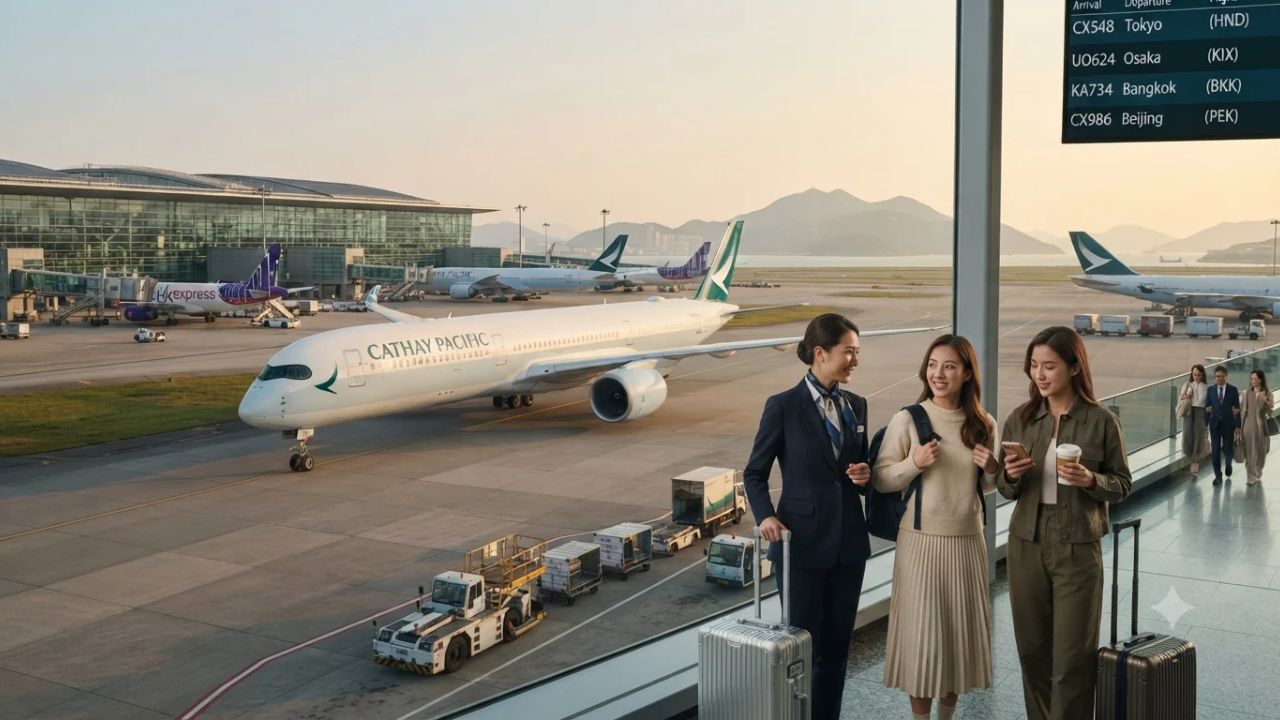
The Cathay Group carried 3,424,766 passengers across Cathay Pacific and HK Express during October 2026, marking a solid expansion in regional and intercontinental connectivity driven by robust mainland China Golden Week holiday demand, high-volume autumn business travel surrounding the 140th Canton Fair, and strong leisure performance across key East and Southeast Asian corridors. The dual-brand operating performance, detailed in the group's official October traffic release, pushed cumulative passenger traffic for the first ten months of the year past 33.6 million journeys. Concurrently, Cathay Cargo transported 162,747 tonnes of air freight to support surging Asian high-tech export volumes, while the carrier committed to a landmark fleet acquisition of 14 additional Airbus widebody and narrowbody aircraft as part of an overarching HK$150 billion ten-year investment strategy designed to cement Hong Kong International Airport’s role as the premier aviation gateway of the Greater Bay Area.
The operational figures demonstrate how Hong Kong’s aviation recovery has transitioned into sustained capacity expansion, supported by the full operational integration of the airport’s Three-Runway System (3RS). With Cathay Pacific catering to premium long-haul and regional business corridors and low-cost subsidiary HK Express absorbing high-density vacation traffic to destinations such as South Korea, Thailand, and forward-booked routes into Malaysia, the group has developed a segmented commercial network that capitalizes on multi-tier travel demand. Simultaneously, recent Hong Kong government transit statistics reveal that 20% to 30% of total airport passenger traffic consists of connecting travelers—with 40% spending more than four hours between flights—highlighting how synchronized flight scheduling and layover infrastructure directly influence Hong Kong's competitive standing against rival aviation hubs across East Asia and the Middle East.
========================================================================================
CATHAY GROUP OCTOBER 2026 OPERATIONAL PERFORMANCE SUMMARY
========================================================================================
Key Operating Metric             Cathay Pacific (FSC)  HK Express (LCC)    Combined Group Total
----------------------------------------------------------------------------------------
October 2026 Passengers Carried  2,720,195             704,571             3,424,766
Year-on-Year Passenger Change    +4.5%                 +3.1%               +4.2% (Blended)
Passenger Flight Sectors Flown   10,906                4,187               15,093
Available Seat Kilometres (ASK)  12,914 Million        1,710 Million       14,624 Million
Passenger Load Factor            85.7% (-0.8 pts YoY)  76.5% (Unchanged)   84.6% (Weighted)
Jan – Oct 2026 Cumulative Volume 26,721,379            6,946,160           33,667,539
October 2026 Cargo Tonnage       162,747 Tonnes        N/A                 162,747 Tonnes
Cargo YoY Tonnage Growth         +7.5%                 N/A                 +7.5%
Cargo Load Factor                61.8%                 N/A                 61.8%
Jan – Oct 2026 Cumulative Cargo  1,486,260 Tonnes      N/A                 1,486,260 Tonnes
========================================================================================
Source: Cathay Group Official Monthly Traffic Disclosures & Hong Kong Civil Aviation Department.
========================================================================================
Dual-Carrier Architecture: Cathay Pacific and HK Express Segmenting Asia-Pacific Demand
The Cathay Group's post-pandemic fleet deployment and commercial strategy rely on a bifurcated operating structure that divides premium international transit from price-sensitive leisure travel. In October 2026, this two-brand model proved instrumental in managing disparate passenger flows during one of the most volatile months on the regional travel calendar.
Cathay Pacific, operating as the group's full-service flagship carrier, transported 2,720,195 passengers across 10,906 sectors. The airline maintained a resilient passenger load factor of 85.7% across 12,914 million Available Seat Kilometres (ASK). While Cathay Pacific's passenger load factor registered a marginal contraction of 0.8 percentage points compared to October 2025, the shift was driven primarily by an accelerated capacity injection on long-haul routes rather than a softening of underlying demand. As the carrier introduced additional intercontinental flights to North America, Europe, and Australasia, capacity growth temporarily outpaced distance-weighted passenger growth, an expected operational dynamic during route rebuild phases.
========================================================================================
DUAL-BRAND STRATEGIC FLEET AND MARKET SEGMENTATION
========================================================================================
Strategic Variable       Cathay Pacific (Full-Service)        HK Express (Low-Cost Carrier)
----------------------------------------------------------------------------------------
Core Target Audience     Corporate executives, long-haul      Budget-conscious vacationers,
                         transit travelers, premium leisure   students, regional short-haul tourists
Fleet Composition        Airbus A350-900/1000, A330-300,      Airbus A320neo, A321neo, A320-200,
                         Boeing 777-300ER, ordered A330-900   A321-200 (Single-class layouts)
Cabin Classes Offered    First Class, Business Class,         Standard Economy with unbundled
                         Premium Economy, Economy             ancillary seat/baggage options
Network Role             Intercontinental trunk routes and    Point-to-point regional leisure runs;
                         major Asian business metropolises    secondary Asian resort destinations
Group Volume Share       79.4% of October Passenger Total     20.6% of October Passenger Total
Ticketing Structure      Interline, code-share, and oneworld  Point-to-point ticketing with selected
                         alliance through-checked baggage     interline connecting itineraries
========================================================================================
Conversely, low-cost subsidiary HK Express carried 704,571 passengers across 4,187 flights, accounting for approximately 20.6% of the group's total monthly passenger volume. Operating exclusively with single-class Airbus A320 and A321 narrowbody aircraft, HK Express generated 1,710 million Available Seat Kilometres while maintaining a stable load factor of 76.5%. Unlike the flagship carrier, HK Express expanded its capacity and revenue passenger kilometers at precisely equal rates, demonstrating disciplined capacity matching across its high-density short-haul network to Japan, South Korea, Taiwan, and Southeast Asia.
By maintaining two distinct brands, the Cathay Group prevents revenue cannibalization. Business travelers connecting from European or American business centers to Guangzhou or Shanghai remain within Cathay Pacific's premium multi-cabin ecosystem, while local Hong Kong residents seeking budget weekend trips to Bangkok, Fukuoka, or Seoul fly on HK Express. This dual coverage allows the parent group to defend slot dominance at Hong Kong International Airport across both ends of the fare yield spectrum.
China Golden Week & The 140th Canton Fair: Driving Dual-Class Cabin Demand
Mainland China served as the central demand engine for both passenger carriers throughout October 2026. The convergence of the National Day Golden Week holiday during the first week of October with the opening phases of the 140th China Import and Export Fair (Canton Fair) in neighboring Guangzhou generated heavy passenger movements that filled both forward and aft cabins.
========================================================================================
MAINLAND CHINA DEMAND DRIVERS & HONG KONG TOURISM FLOWS (OCTOBER 2026)
========================================================================================
Event / Traffic Channel       Official Scale & Metric             Airline Operating Impact
----------------------------------------------------------------------------------------
National Day Golden Week      1.6 Million total inbound visitors  High-density outbound feeder traffic
(October 1 – 7, 2026)         to Hong Kong; 1.41 Million from     connecting from mainland cities onto
                              mainland China (Peak: 277,000 on    Cathay long-haul intercontinental
                              October 1); 90% hotel occupancy     flights to Europe, Australia, and US.
140th Canton Fair             Phase 1: Oct 15–19 (Advanced Mfg.)  Surge in premium cabin bookings;
(Guangzhou Exhibition Phases) Phase 2: Oct 23–27 (Consumer Goods) high-yield international corporate
                              Phase 3: Oct 31–Nov 4 (Health/Care) buyers using HKIA as international
                              12,000 enterprises; 25,000+ booths  aviation entry point into Guangdong.
Cross-Border Rail & Road      Lok Ma Chau Spur Line and West      Complementary multimodal corridors;
Integration (GBA Transit)     Kowloon High-Speed Rail recorded    allows international arrivals to
                              record cross-boundary volume        transfer smoothly to high-speed rail.
========================================================================================
Source: Hong Kong Tourism Commission, Ministry of Commerce of PRC, and Cathay Pacific Disclosures.
========================================================================================
The Golden Week Leisure Rush
During the week-long Golden Week holiday running from October 1 to October 7, Hong Kong recorded approximately 1.6 million inbound passenger arrivals, with more than 1.41 million arriving directly from mainland China. Inbound arrivals peaked on October 1 at roughly 277,000 visitors, pushing citywide hotel occupancy above 90%.
While land border crossings—most notably the Lok Ma Chau Spur Line control point and the Express Rail Link West Kowloon terminus—handled the majority of direct cross-border visits, the Golden Week holiday exerted an immense positive effect on Cathay Pacific’s flight bookings. Mainland travelers utilized Cathay’s expansive domestic network connecting Beijing, Shanghai, Chengdu, and Hangzhou with Hong Kong as an international transit springboard. Wealthy leisure travelers used Hong Kong International Airport to connect onto long-haul flights heading to Sydney, Melbourne, London, and Tokyo, maximizing their holiday leave.
Canton Fair and Premium Corporate Yields
Following the Golden Week holiday, the first two phases of the 140th Canton Fair in Guangzhou sustained passenger demand through late October. Phase 1, staged between October 15 and October 19, focused on advanced manufacturing, electronics, and industrial automation, drawing over 12,000 participating enterprises across 25,000 exhibition booths. Subsequent phases spanning October 23 to October 27 and October 31 to November 4 attracted hundreds of thousands of international commercial buyers.
This industrial gathering produced an immediate spike in high-yield corporate bookings. Foreign delegations from Europe, North America, the Middle East, and Southeast Asia flew into Hong Kong International Airport on Cathay Pacific’s long-haul services before transferring into Guangdong province via ferry connections at the SkyPier Terminal or high-speed rail links from West Kowloon. The fair provided vital yield support for Cathay’s Business and Premium Economy cabins, cushioning overall unit revenues as leisure traffic normalized after the holiday rush.
Regional Asian Network Dynamics: South Korea, Thailand, and Forward Malaysian Pipelines
Beyond the mainland China corridor, the Cathay Group’s October passenger growth was propelled by diverse travel patterns across East and Southeast Asia. The geographical distribution of demand highlighted stark differences between historical October performance and forward winter bookings.
========================================================================================
REGIONAL MARKET PERFORMANCE & BOOKING VELOCITY MATRIX
========================================================================================
Asian Market Country     Observed Operating Performance       Forward Booking Pipeline (Q4 2026)
----------------------------------------------------------------------------------------
South Korea              Extremely high October load factors  Sustained ski-season bookings and
(Seoul, Busan, Jeju)     on HK Express; robust leisure        cultural weekend city breaks; high
                         demand for autumn foliage trips      frequency across morning departures
Thailand                 Solid dual-carrier performance;      Strong winter sun reservation intake;
(Bangkok, Phuket,        HK Express reported high yields;     heavy forward bookings through
Chiang Mai)              Cathay Pacific business traffic solid December 2026 and New Year period
Malaysia                 Moderate October passenger volume;   Identified as primary driver for
(Kuala Lumpur, Penang)   stable baseline scheduled demand     November and December travel surge;
                                                              strong group tour and VFR bookings
Japan                    Consistent volume across secondary   High demand for winter Hokkaido
(Tokyo, Osaka, Sapporo)  Japanese gateways on HK Express;     ski routes; elevated yield retention
                         primary corporate trunk on Cathay    across Cathay premium cabins
========================================================================================
South Korea and Thailand as October Anchor Routes
For HK Express, South Korea and Thailand emerged as the top-performing regional markets during October. In South Korea, daily flights connecting Hong Kong with Seoul Incheon and Busan experienced high load factors driven by autumn foliage tourism and youth leisure travel. The carrier's point-to-point pricing model appealed directly to independent travelers taking short three-to-four-day vacations.
In Thailand, both Cathay Pacific and HK Express recorded resilient demand. While Cathay Pacific maintained dense widebody operations into Bangkok Suvarnabhumi catering to both corporate travelers and transit traffic connecting from North America, HK Express provided high-frequency service to Phuket and Chiang Mai. The Thai market demonstrated unusual stability, bridging the transition between the late-monsoon shoulder season and the onset of peak winter sun vacations.
Dissecting the Malaysian Forward Pipeline
A critical distinction in the group’s disclosures involves Malaysia. Unlike China, South Korea, and Thailand—which registered verified October passenger surges—Malaysia’s prominence in Cathay’s operational reporting was characterized by forward reservation velocity for November and December 2026.
Travel planners and airline analysts must separate confirmed historical traffic from forward bookings. The strong booking volume recorded for flights to Kuala Lumpur and Penang reflects advance reservations for the year-end school holidays, family reunions (Visiting Friends and Relatives - VFR), and winter sun retreats. While this forward visibility provides positive revenue certainty for the fourth quarter, it did not alter October’s verified passenger counts.
Hong Kong International Airport as an Intercontinental Transit Engine
A defining attribute of the Cathay Group's operating model is its reliance on Hong Kong International Airport (HKIA) as a premier intercontinental transfer hub. The airline's financial and operational performance cannot be understood in isolation from the broader transit dynamics of the airport.
According to a detailed Hong Kong government civil aviation assessment published on November 18, 2026, transit and transfer passengers accounted for between 20% and 30% of HKIA’s total passenger volume from 2023 through September 2026. Approximately 40% of these connecting travelers had scheduled layovers exceeding four hours.
========================================================================================
HONG KONG INTERNATIONAL AIRPORT TRANSIT DYNAMICS & TRANSFER CORRIDORS
========================================================================================
Transfer Flow Category   Origin & Destination Corridors      Operational Characteristics
----------------------------------------------------------------------------------------
Corridor 1: Greater Bay  Mainland China ↔ Southeast Asia     High-frequency narrowbody connections;
to Southeast Asia        (Vietnam, Thailand, Singapore, Indo)short connection windows (60–90 mins);
                                                             high volume of budget and business trips
Corridor 2: Transpacific Mainland China ↔ North America      Long-haul widebody flights (Boeing 777,
Gateway Trunk            (New York, Los Angeles, Vancouver)  Airbus A350); substantial baggage loads;
                                                             average layovers of 3 to 6 hours at HKIA
Corridor 3: South-North  Southeast Asia ↔ North America      Key competitive arena against Tokyo,
Aviation Bridge          (Manila, Jakarta, KL ↔ US/Canada)   Seoul, and Taipei; driven by VFR traffic,
                                                             student travel, and corporate mobility
Corridor 4: Australasia  Europe ↔ Australia / New Zealand    Traditional "Kangaroo Route" alternative;
Kangaroo Route Pivot     (London, Frankfurt ↔ Sydney, Melb)  balanced transit flows with long layovers
========================================================================================
Source: Hong Kong Civil Aviation Department Official Report (November 18, 2026).
========================================================================================
The Four-Hour Layover Economy
The finding that four out of every ten transit passengers spend more than four hours within the airport terminal has significant commercial ramifications. Rather than treating extended connection times as an inconvenience, Airport Authority Hong Kong (AAHK) and Cathay have worked to monetize this dwell time.
Between September 2025 and October 2026, AAHK’s Free Layover Tour Programme attracted approximately 15,000 transit travelers. Passengers with layovers of six hours or longer who meet local visa exemption requirements are offered guided excursions into Lantau Island, the Big Buddha, and West Kowloon Cultural District before returning through security for their onward flights. For travelers remaining airside, HKIA’s luxury retail concessions, dining concourses, and Cathay’s signature airport lounges (including The Pier, The Wing, and The Deck) capture valuable consumer spend.
Three-Runway System: Unlocking Structural Airspace Capacity
The operational capacity of Hong Kong International Airport reached a historic milestone in late 2026 following the full commissioning of the Three-Runway System (3RS). The completed infrastructure expansion provides the physical capability to handle up to 120 million passengers and 10 million tonnes of air cargo annually.
========================================================================================
HONG KONG INTERNATIONAL AIRPORT: THREE-RUNWAY SYSTEM (3RS) SCALE
========================================================================================
Infrastructure Metric    Pre-Expansion Baseline (Two Runways) Completed 3RS Target Capacity
----------------------------------------------------------------------------------------
Annual Passenger Limit   Approximately 75 Million Passengers  120 Million Passengers
Annual Air Freight Limit Approximately 5.0 Million Tonnes     10.0 Million Tonnes Cargo
Hourly Aircraft Slots    68 Aircraft Movements Per Hour       102 Aircraft Movements Per Hour
Terminal Infrastructure  Terminal 1 & Midfield Concourse      Expanded Terminal 2 & Concourses
Global Route Destinations180 Operating Destinations           240 Target Global Gateways
========================================================================================
A government aviation update released on October 28, 2026, confirmed that the airport’s targeted route development incentives had successfully attracted 40 foreign and regional airlines to establish 95 new routes across five continents by the end of September 2026. Additionally, 15 existing international routes saw frequency enhancements, backed by 87 bilateral air service arrangements signed by the Hong Kong government.
While the Hong Kong Special Administrative Region’s First Five-Year Plan targets an ultimate airport-wide network of 240 international destinations, the Cathay Group has set its own corporate objective of serving 150 destinations worldwide over the coming decade. These expansion metrics reflect long-term ceiling capacities rather than immediately available schedules, but they establish the physical infrastructure necessary for Cathay to absorb further traffic growth without encountering the severe runway bottlenecks of the pre-pandemic era.
The HK$150 Billion Capital Deployment: Fleet Modernization and Airbus Inductions
To capitalize on the 3RS expansion, the Cathay Group is executing an extensive fleet modernization program backed by a committed investment exceeding HK$150 billion (US$19.2 billion) spanning the decade from 2026 to 2035.
A central element of this investment cycle was finalized in October 2026 with a firm order for 14 additional Airbus aircraft, comprising:
- 11 Airbus A330-900 (A330neo) widebody passenger aircraft.
- 3 Airbus A321neo single-aisle aircraft.
This purchase agreement elevated the group’s firm aircraft orderbook to 120 new aircraft scheduled for delivery from 2026 onward, with contractual options that could expand total fleet deliveries to 150 aircraft over the next ten years.
========================================================================================
CATHAY GROUP FLEET MODERNIZATION & AIRCRAFT INDUCTION PROFILE
========================================================================================
Aircraft Model           Role in Fleet Architecture           Operating Advantages & Strategy
----------------------------------------------------------------------------------------
Airbus A330-900          Regional & Mid-Haul Trunk Routes     Replaces aging A330-300s; powered by
(11 Aircraft on Order)   (Mainland China, India, Australia,   Rolls-Royce Trent 7000 engines;
                         Southeast Asian capitals)            delivers 14% fuel burn reduction per seat;
                                                              high underfloor cargo capacity for freight
Airbus A321neo           High-Density Short-Haul Routes       Single-aisle workhorse for HK Express
(3 Aircraft on Order)    (Japan, Korea, Taiwan, Tier-2 China) and Cathay regional; CFM LEAP-1A engines;
                                                              maximum seat economics; long regional range
Airbus A350-900 / 1000   Intercontinental Flagship Fleet      Operates ultra-long-haul sectors to US,
(Active Fleet Backbone)  (North America, Europe, Oceania)     Canada, and Europe; premium 3/4-class layout
Boeing 777-9             Future Ultra-Long-Haul Flagship      Next-generation long-haul capacity;
(On Order for 2027+)     (New York, London, Los Angeles)      debut of new First Class suites
========================================================================================
The Role of the Airbus A330-900 in Regional Growth
The selection of the Airbus A330-900 represents a strategic maneuver to reinforce Cathay Pacific’s dominance on regional trunk routes across Asia. The carrier has operated one of the world's largest Airbus A330-300 fleets for decades, utilizing them on high-frequency runs connecting Hong Kong with Tokyo, Singapore, Bangkok, Sydney, and major Chinese gateways.
The A330-900 delivers an immediate 14% reduction in fuel consumption and carbon emissions per seat compared to previous-generation aircraft, while retaining identical flight-crew type ratings with the existing A330 family. Importantly, the widebody fuselage accommodates significant bellyhold freight capacity, allowing Cathay to transport palletized air cargo on scheduled passenger flights—an essential profit driver across Asian industrial manufacturing belts.
Fleet Modernization Realities for Consumers
While airline marketing frequently associates aircraft orders with immediate network expansion, travel agents and corporate travel managers must view these acquisitions through an operational lens. New aircraft orders do not translate into immediate seat capacity. Delivery schedules from Airbus are staged across multiple years due to global aerospace supply chain constraints. Consequently, the newly announced orders will not result in new flight schedules, expanded seat availability, or lower ticket fares during the 2026–2027 winter travel season.
Air Cargo Renaissance: Cathay Cargo, High-Tech Consignments, and Dongguan Logistics
While passenger traffic captured public attention, cargo performance served as a financial anchor for the group. In October 2026, Cathay Cargo carried 162,747 tonnes of air freight, representing a year-on-year increase of 7.5%. Cargo capacity (measured in Available Cargo Tonne Kilometres) grew only marginally, driving the cargo load factor upward to 61.8%.
Over the first ten months of 2026, Cathay Cargo transported a cumulative 1,486,260 tonnes of freight, maintaining its position as one of the world's premier scheduled cargo airlines.
========================================================================================
CATHAY CARGO OCTOBER 2026 PERFORMANCE & SUPPLY CHAIN MATRIX
========================================================================================
Cargo Operating Factor   Reported Metric / Growth Rate       Supply Chain Driver & Market Role
----------------------------------------------------------------------------------------
October Monthly Tonnage  162,747 Tonnes (+7.5% YoY)          Strong consumer electronics releases;
                                                             autumn e-commerce inventory build-up
Cumulative 10-Month Load 1,486,260 Tonnes                    Sustained industrial component trade
Cargo Load Factor        61.8% (Improved YoY)                Tighter capacity utilization across fleet
High-Yield Cargo Types   Cathay Priority & Cathay Expert     Semiconductors, AI server equipment,
                         specialized handling products       lithium batteries, temperature pharma
Dedicated Freighter FleetBoeing 747-8F and 747-400ERF, plus  Transpacific and European maindeck cargo;
                         Airbus A330F via Air Hong Kong      supplemented by passenger bellyhold space
Hong Kong Export Context Sep Export Volume rose 36.1% YoY    Macro industrial surge across Pearl River
(Govt Census & Stats)    (Merchandise volume indicator)      Delta manufacturing plants
========================================================================================
Semiconductor Logistics and Specialized Consignments
Cathay identified strong export demand originating in Northeast and Southeast Asia as the primary catalyst behind October’s cargo growth. Shipments were heavily weighted toward networking hardware, semiconductor equipment, and high-value consumer electronics timed for global Black Friday and Christmas retail cycles.
The carrier captured premium yields through its specialized logistics products, notably Cathay Priority (time-definite guaranteed freight) and Cathay Expert (oversized and delicate industrial components). To accommodate heavy regional feeder volume, an additional Airbus A330 freighter operated by subsidiary Air Hong Kong was integrated into scheduled operations, connecting manufacturing hubs in Taiwan, the Philippines, and mainland China directly with Hong Kong's intercontinental freighter departures.
Structural Breakthrough: The HKIA Dongguan Logistics Park
A transformative development in Cathay’s cargo ecosystem is the HKIA Dongguan Logistics Park, an innovative cross-border upstream logistics facility located in the industrial heart of Guangdong province.
========================================================================================
HKIA DONGGUAN LOGISTICS PARK: UPSTREAM CARGO PROCESSING MODEL
========================================================================================
Step in Supply Chain     Operational Process at Dongguan and HKIA
----------------------------------------------------------------------------------------
1. Upstream Cargo ReceiptAir freight from Pearl River Delta factories arrives directly at Dongguan.
2. Security & Customs    Export cargo undergoes aviation security screening, palletization,
                         and Chinese customs clearance directly within the Dongguan park.
3. Bonded Sea Transport  Pre-cleared, security-screened cargo pallets are loaded onto dedicated
                         bonded container vessels and shipped down the Pearl River to HKIA.
4. Direct Ramp Transfer  Barges berth at the HKIA airside cargo pier; pallets transfer directly
                         to awaiting Cathay Pacific widebody jets without land border processing.
5. Global Flight Launch  Air cargo departs on intercontinental flights to the US, Europe, or Asia.
========================================================================================
By the end of October 2026, the Dongguan Logistics Park pilot program had handled pre-screened air freight valued at more than RMB 57 billion. With full-scale commercial operations scheduled for launch in June 2027, this multimodal sea-air corridor reduces cargo processing times by approximately 30% and trims logistics costs by 50%, guaranteeing that Cathay Pacific retains a decisive logistical advantage over competing airports in Guangzhou and Shenzhen.
Strategic Advisory for Travel Intermediaries, Corporate Mobility Planners, and Aviation Analysts
The October 2026 operating results offer vital strategic lessons for travel management companies (TMCs), tour operators, and corporate travel directors organizing global itineraries.
========================================================================================
COMMERCIAL DECISION MATRIX FOR TRAVEL INTERMEDIARIES
========================================================================================
Operational Area         Key Risk / Variable                 Recommended Professional Action
----------------------------------------------------------------------------------------
Demand Segmentation      Conflating historical results with  Do not base winter pricing on October
                         forward booking patterns            holiday traffic; evaluate each country
                                                             pipeline independently.
Transit Connection Time  Underestimating connection risks on Allow minimum 90–120 minutes at HKIA
                         separate tickets or interline runs  for terminal transfers; verify baggage
                                                             through-check rules before ticketing.
Stopover Itineraries     Missing free layover opportunities  Proactively advise clients with >6-hour
                         for clients with long connections   layovers about AAHK Free Layover Tours;
                                                             check entry visa eligibility beforehand.
Corporate Fare Budgets   Assuming fleet orders will trigger  Advise corporate finance teams that new
                         immediate fare deflation            Airbus aircraft deliveries will not
                                                             reduce peak-season business class fares.
Trade Fair Planning      Severe cabin compression during     Secure Canton Fair flight inventories
                         Guangzhou and HK exhibition windows at least 90 days in advance to avoid
                                                             peak yield surcharges.
========================================================================================
Essential Guidelines for Booking Hong Kong Transit Itineraries
- Verify Interline Baggage Agreements: When combining Cathay Pacific long-haul flights with HK Express regional segments, confirm whether baggage can be checked through to the final destination. While the group has introduced integrated ticketing on selected routes, standard point-to-point HK Express tickets booked separately require passengers to clear Hong Kong immigration, collect bags, and re-check them at Terminal 1.
- Observe Minimum Connection Times (MCT): Although HKIA is renowned for its operational efficiency, corporate travelers transferring between different concourses or clearing security during evening peak banks should maintain an MCT of at least 75 to 90 minutes. Passengers connecting to SkyPier cross-boundary ferries to Shenzhen or Macau require dedicated connection windows of 90 to 120 minutes.
- Monitor Canton Fair Peak Surcharges: Corporate travel planners must track the annual spring and autumn Canton Fair dates. Flights into Hong Kong and Guangzhou during late April and mid-to-late October consistently experience zero inventory in discounted economy fare buckets, with business class cabins filling weeks before departure.
Comprehensive Frequently Asked Questions
How many passengers did the Cathay Group carry in October 2026?
The Cathay Group carried a total of 3,424,766 passengers in October 2026. This comprised 2,720,195 passengers on full-service flagship Cathay Pacific and 704,571 passengers on low-cost carrier HK Express.
How did October 2026 traffic compare to the previous year?
Passenger volume grew by 4.2% on a blended group level. Cathay Pacific recorded a 4.5% year-on-year passenger increase, while HK Express expanded passenger numbers by 3.1%. Over the first ten months of 2026, the group carried 33,667,539 passengers.
What caused the high passenger demand from mainland China?
Passenger growth was driven by two major events: the National Day Golden Week holiday (October 1–7), which saw over 1.41 million mainland visitors enter Hong Kong, and the 140th Canton Fair in Guangzhou, which generated high-yield corporate and business travel across Cathay's regional and long-haul network.
Which regional Asian routes performed best during October?
HK Express reported exceptional route performance across South Korea and Thailand, driven by autumn vacation travel. Meanwhile, Malaysia emerged as a leading market in forward booking demand for November and December travel, rather than an October historical traffic surge.
Why did Cathay Pacific’s passenger load factor decline slightly in October 2026?
Cathay Pacific’s load factor eased slightly by 0.8 percentage points to 85.7% because the airline added long-haul capacity (Available Seat Kilometres) at a pace that temporarily outstripped distance-weighted passenger growth as new intercontinental frequencies were reinstated.
What is the Cathay Group’s new aircraft order announced in late 2026?
The group ordered 14 additional Airbus aircraft, consisting of 11 Airbus A330-900 (A330neo) regional widebody jets and 3 Airbus A321neo narrowbody aircraft. This expanded the group's firm delivery orderbook to 120 new aircraft starting from 2026, with long-term ambitions to reach 150 deliveries over a decade.
What is the HK$150 billion investment plan announced by Cathay?
The group has committed more than HK$150 billion across the 2026–2035 period to upgrade its fleet, introduce new cabin products, enhance digital passenger services, and expand its global route network to 150 destinations in tandem with Hong Kong's Three-Runway System.
How much cargo did Cathay transport in October 2026?
Cathay Cargo carried 162,747 tonnes of air cargo in October, a 7.5% year-on-year increase. Cumulative cargo volume for the first ten months of 2026 reached 1,486,260 tonnes, driven by high-tech electronics, semiconductors, and e-commerce exports across Asia.
How do Hong Kong International Airport's transit numbers impact airlines?
Official government data indicates that connecting and transit passengers account for 20% to 30% of HKIA’s total passenger volume, with 40% of them having layovers exceeding four hours. This high transit volume enables Cathay Pacific to fill long-haul flights by aggregating passengers from secondary Asian markets.
Does the completion of Hong Kong's Three-Runway System mean lower airfares?
No. The Three-Runway System increases theoretical airport capacity to 120 million passengers and 10 million tonnes of freight annually, creating room for airline network growth. However, actual airfares remain determined by carrier pricing strategies, operational costs, fuel expenses, and market supply and demand.
Strategic Outlook: Scaling Route Depth and Hong Kong's Global Aviation Leadership
The October 2026 operational performance highlights the strategic revitalization of the Cathay Group and underscores Hong Kong International Airport's enduring centrality in global air transportation. By operating Cathay Pacific and HK Express as complementary commercial instruments, the group has successfully captured both premium corporate travel and high-volume regional tourism.
Looking forward into 2027 and beyond, the critical challenge facing the carrier will be translating physical infrastructure expansion—namely the Three-Runway System and 120 new Airbus aircraft deliveries—into profitable, reliable scheduled flight frequencies. As competition intensifies from alternative aviation hubs in Singapore, Doha, Dubai, and Seoul, Cathay’s ability to optimize connecting corridors between mainland China, Southeast Asia, and North America will decide its long-term market share. Backed by a HK$150 billion capital commitment and an innovative cross-border freight architecture in Dongguan, the Cathay Group has established a solid operational runway to secure Hong Kong’s position as Asia's premier international aviation crossroads.
Related Travel Guides
- easyJet Passenger Removed from London Luton to Glasgow Flight After Smoking in Aircraft Lavatory Triggers Emergency Delay
- Avelo Airlines Expands Florida Network with Six Nonstop Routes to North Dallas, Charlotte, and Puerto Rico
- Haiti Strengthens US Air Corridor as Sunrise Airways Launches Nonstop Cap-Haïtien to New York JFK Flights
- Brazil Exceeds International Tourism Target Two Months Early Driven by Unprecedented Surge in Chinese Visitors
This article is for informational purposes. Flight routes, passenger regulations, visa rules, and transit advisories are subject to change by airlines and aviation authorities. Readers are advised to verify schedules and travel documentation with relevant carriers and border agencies before departure.
Related Stories
Singapore Airlines and Scoot Expand Asia-Pacific Holiday Capacity with Supplementary Japan Flights and Regional Network Surge

Delta Air Lines to Cancel Historic New York JFK to Washington Dulles Route Ending 35-Year Air Link in Early 2027