Delta Flight DL2498 In-Flight Lavatory Vaping Triggers Smoke Alarm Before Newark Landing, Sparking Safety Alert on Airbus A321neo

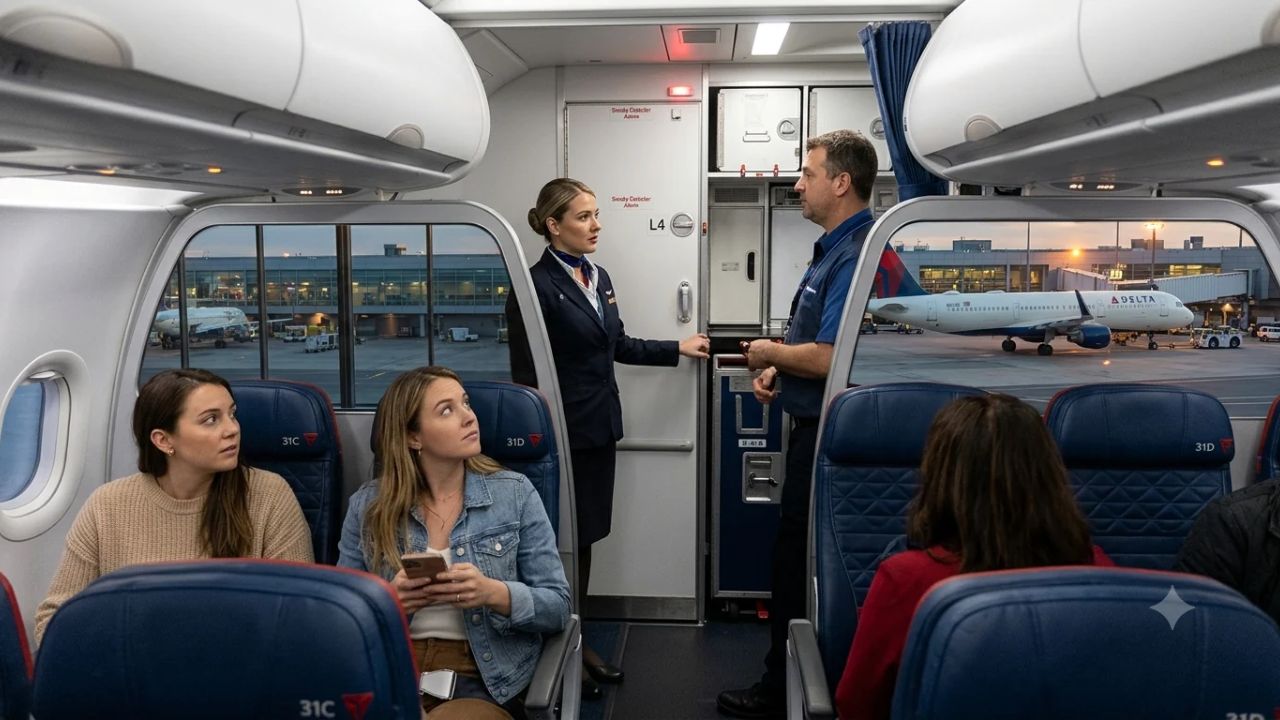
An in-flight safety alert was triggered aboard Delta Air Lines Flight DL2498 approaching Newark Liberty International Airport when an electronic cigarette used inside an aircraft lavatory activated the onboard smoke detection system, prompting an immediate emergency investigation by cabin crew.
The incident took place on the evening of 4 November 2026 aboard an Airbus A321neo passenger jet operating a scheduled domestic service from Hartsfield-Jackson Atlanta International Airport (ATL) to Newark Liberty International Airport (EWR). While descending toward the New York metropolitan area, the aircraft’s rear lavatory smoke sensor sounded an alert in both the passenger cabin and the flight deck. Cabin attendants responded immediately to inspect the lavatory for active flames or smoldering materials, where an adult passenger seated in 36C reportedly acknowledged using a personal vaping device.
Although the flight continued safely to its destination without requiring an emergency diversion, off-course landing, or passenger evacuation, the incident required coordination between flight crew and Delta ground operations, with airport customer service supervisors requested to meet the aircraft at the arrival gate. The event underscores the operational disruptions and safety risks caused by passengers disregarding strict federal aviation bans on electronic smoking devices.
Incident Overview: Delta Air Lines Flight DL2498
Flight DL2498 is a regular domestic trunk route connecting Delta’s primary global hub in Atlanta with Newark. On 4 November 2026, the flight was operated by an Airbus A321-271NX, registered as N533DT, an advanced narrowbody aircraft delivered with modern digital environmental control and safety monitoring systems.
As the aircraft entered the final stages of its approach into northern New Jersey airspace, the automated lavatory smoke alarm sounded. Cabin crew followed standard operating procedures for suspected in-cabin smoke events: notifying the flight deck, securing fire extinguishing equipment, and inspecting the enclosed lavatory compartment. Upon opening the door, flight attendants confirmed there was no active fire, and the passenger assigned to seat 36C admitted to having discharged an e-cigarette inside the compartment.
| Incident Parameter | Recorded Operational Information | Significance to Flight Operations |
|---|---|---|
| Operating Airline | Delta Air Lines | Strict zero-tolerance policy on onboard smoking and vaping |
| Flight Number | DL2498 | Scheduled domestic evening commercial service |
| Date of Occurrence | 4 November 2026 | Standard autumn flight operating under normal weather conditions |
| Departure Airport | Hartsfield-Jackson Atlanta International Airport (ATL) | World’s busiest airport hub; origin of flight |
| Arrival Airport | Newark Liberty International Airport (EWR) | Destination gateway serving New York metropolitan area |
| Aircraft Type | Airbus A321-271NX (A321neo) | Advanced narrowbody aircraft equipped with digital cabin sensors |
| Aircraft Registration | N533DT | Modern mainline commercial fleet aircraft |
| Passenger Involved | Assigned Seat 36C | Passenger admitted e-cigarette usage in rear lavatory |
| Safety Sensor Triggered | Rear Lavatory Smoke Detector | Optical smoke sensor linked directly to cabin interphone and cockpit |
| Arrival Time & Gate | Approximately 8:40 pm EST; Terminal A, Gate A04 | Safe touchdown and normal taxi to gate without emergency rollout |
| Operational Outcome | Flight completed safely; no diversion | Service supervisor dispatched to meet inbound aircraft |
Flight DL2498 completed its approach without requiring emergency priority handling from air traffic control. The aircraft touched down at Newark Liberty International Airport and taxied to Terminal A, arriving at Gate A04 at approximately 8:40 pm Eastern Standard Time. No injuries were reported among passengers or operating crew, and the aircraft sustained no physical damage.
Why Lavatory Smoke Detectors Prompt Immediate Cockpit and Cabin Alerts
Aircraft lavatories represent uniquely vulnerable environments on commercial passenger airliners. Enclosed within compact spaces with limited air circulation, lavatories house critical electrical wiring, vacuum flush motors, potable water heaters, and paper waste receptacles. Consequently, international aviation safety regulators mandate the installation of highly sensitive optical and ionization smoke detection devices inside every lavatory compartment.
When an aerosol or smoke particulate passes through an optical detector's sampling chamber, it scatters the infrared light beam onto a photo-sensor, instantly triggering audible warning chimes throughout the cabin and illuminating visual warning lights on the master attendant call panel and the cockpit flight deck console.
For pilots and flight attendants, an unverified smoke warning is treated as an active fire until proven otherwise. In-flight fires represent one of the most perilous emergencies in commercial aviation, capable of filling the cabin with toxic fumes or compromising flight controls within minutes. When an alarm activates, flight attendants must drop routine service tasks, don protective smoke hoods, retrieve Halon fire extinguishers, and perform emergency tactile checks of lavatory walls and waste receptacles to detect hidden thermal hotspots.
Electronic cigarettes generate an aerosol mist of propylene glycol, vegetable glycerin, and particulate matter that readily scatters infrared light inside optical smoke sensors. The smoke detector cannot distinguish between harmless water vapor, e-cigarette aerosol, or smoldering wiring insulation behind the lavatory wall panel. As a result, illicit vaping in an aircraft lavatory forces the flight crew through high-stress emergency response procedures, creating unnecessary cockpit workload during critical phases of flight such as descent and landing.
Beyond false alarms, electronic smoking devices present genuine fire risks due to their lithium-ion batteries. Thermal runaway caused by defective battery cells, internal short circuits, or substandard heating elements can result in intense localized fires that burn at temperatures exceeding 500°C. Attempting to use or conceal malfunctioning lithium-powered devices in confined aircraft lavatories filled with combustible paper towels creates severe fire hazards.
Federal Regulatory Framework: Comprehensive Vaping Bans in US Airspace
Federal laws governing smoking aboard commercial passenger aircraft are unambiguous and comprehensively enforced. Over several decades, the United States has enacted strict statutory rules to protect cabin air quality and operational flight safety.
| Regulatory Landmark | Year Enacted | Primary Statutory Provision | Practical Significance for Airline Passengers |
|---|---|---|---|
| US Scheduled Flight Smoking Prohibition | 2000 | Federal statutory ban across all domestic scheduled passenger services | Completely eliminated tobacco smoking on domestic flights |
| DOT Checked Baggage Safety Restrictions | 2015 | Prohibited transport of e-cigarettes in checked baggage | Mandated devices remain in carry-on cabin luggage only |
| DOT Final E-Cigarette Aircraft Rule | 2016 | Formally extended airline smoking ban to all vaping devices | Defined e-cigarette aerosol as prohibited smoking on all flights |
| FAA PackSafe Battery Guidelines | Current Standard | Requires strict terminal protection and cabin-only carriage | Mitigates lithium-ion battery fire and thermal runaway hazards |
| Delta Air Lines Passenger Safety Rules | Current Policy | Complete ban on using or charging electronic cigarettes | Applies across all aircraft areas, including lavatories and cabins |
In 2000, federal legislation established a permanent ban on conventional tobacco smoking across all scheduled domestic airline flights in the United States. As electronic smoking devices gained consumer popularity in the early 2010s, regulatory ambiguity emerged regarding whether battery-powered vaporizers fell under traditional tobacco smoking laws.
To eliminate legal loopholes, the United States Department of Transportation (DOT) issued a comprehensive Final Rule on 4 April 2016 that formally broadened the definition of prohibited smoking. Under federal regulations (14 CFR Part 252), the DOT clarified that the ban applies to any electronic device that delivers nicotine or other substances to the user through the production of smoke, mist, vapor, or aerosol.
The federal ban applies without exception to:
- All scheduled domestic passenger flights operated by US airlines.
- All scheduled international flights arriving into or departing from the United States, regardless of whether operated by US or foreign carriers.
- Public charter flights operating within US airspace.
Delta Air Lines enforces a strict company-wide policy that mirrors and expands upon federal standards. Published customer carriage contracts specify that passengers may not use, activate, or recharge electronic cigarettes, e-pipes, or personal vaporizers anywhere on board Delta aircraft, including passenger seats, galleys, and lavatories.
Legal Distinctions: Vaping Violations Versus Smoke Detector Tampering
In assessing the legal ramifications of the Newark flight incident, aviation legal experts highlight a fundamental distinction between the illicit use of an electronic cigarette and tampering with aircraft safety equipment.
Federal law establishes distinct penalties depending on the specific misconduct committed aboard the aircraft:
1. Unlawful In-Flight Vaping
Using an electronic cigarette on a commercial aircraft violates DOT smoking regulations under 14 CFR Part 252 and constitutes non-compliance with crewmember safety instructions under Federal Aviation Regulations (FAR) Section 91.11. The Federal Aviation Administration (FAA) possesses civil enforcement authority to levy fines against passengers who violate in-flight smoking and vaping restrictions, with civil penalties routinely reaching thousands of dollars per violation. In addition, individual airlines maintain internal corporate discretion to place offending passengers on company no-fly lists or revoke frequent flyer privileges.
2. Disabling or Tampering with Lavatory Smoke Detectors
Under Title 49 of the United States Code, Section 46301(b), federal law explicitly prohibits any individual from tampering with, disabling, or destroying a smoke alarm device installed in an aircraft lavatory. The statute establishes a specific civil penalty of up to US$2,000 for each tampering violation:
- Tampering involves physical interference, such as covering the detector head with plastic wrap, unscrewing sensory components, taping over air intake vents, or removing internal batteries.
- In the case of Delta Flight DL2498, the available incident reports indicate that the passenger discharged an e-cigarette inside the lavatory, triggering an immediate alarm. There is no evidence suggesting the passenger physically altered, obstructed, or damaged the smoke detector mechanism. Consequently, while the passenger faces regulatory scrutiny for unauthorized vaping and ignoring crew safety rules, the specific statutory charge of smoke detector tampering under 49 USC Section 46301(b) does not automatically apply.
FAA PackSafe Rules: Carry-On Versus Checked Lithium-Ion Restrictions
The Delta incident also emphasizes the operational paradox of electronic cigarettes in commercial aviation: passengers are legally required to carry vaping hardware into the passenger cabin, yet they are strictly forbidden from operating or charging the equipment while on board.
The Federal Aviation Administration’s hazardous materials division, known as FAA PackSafe, classifies all electronic smoking devices as high-risk, battery-powered equipment. Because electronic cigarettes rely on rechargeable lithium-ion or lithium-polymer cells, storing them in the cargo hold presents severe fire risks. If a device undergoes thermal runaway inside checked luggage in an unmonitored cargo compartment, automated cargo fire suppression systems (such as Halon 1301) may suppress open flames but struggle to cool the internal thermal reaction of a malfunctioning lithium battery.
| Passenger Travel Action | Legally Permitted? | Mandatory Aviation Safety Requirement |
|---|---|---|
| Carrying Vape in Hand Luggage | Yes | Must be protected against accidental activation in carry-on bag |
| Packing Vape in Checked Baggage | No | Strictly prohibited by federal hazardous material regulations |
| Using Vape While In Flight | No | Violates federal aviation smoking ban across all aircraft areas |
| Recharging Vape Aboard Aircraft | No | Prohibited; connecting to seat power or power banks is banned |
| Transporting Spare Lithium Batteries | Yes | Carry-on only; individual terminals must be taped or insulated |
| Carrying Damaged or Recalled Devices | No | Hazardous batteries are strictly prohibited from all aircraft |
To comply with federal safety regulations, passengers travelling with electronic cigarettes must adhere to strict guidelines:
- Cabin-Only Storage: All devices, e-liquids, and spare batteries must travel in carry-on baggage or on the passenger's person.
- Accidental Activation Prevention: Devices must feature a safety lock, have the battery removed, or be stored inside a protective rigid case to prevent the heating element from engaging inside luggage bins.
- No In-Flight Charging: Connecting e-cigarettes to in-seat USB outlets, laptop ports, or portable power banks is strictly illegal aboard US airliners due to the elevated risk of battery overheating during the charging cycle.
Operational Repercussions for Airlines, Crews, and Travelling Public
Although Flight DL2498 avoided severe disruption, illicit in-flight vaping creates widespread operational ripple effects across the aviation system. Even minor cabin safety breaches impose real costs, divert critical resources, and generate unnecessary passenger anxiety.
| Aviation Stakeholder | Direct Incident Impact | Operational and Safety Ramifications |
|---|---|---|
| Flight Crew & Attendants | Immediate emergency diversion from service duties | Forced to investigate potential fire threat wearing safety equipment |
| Cockpit Flight Deck | Increased pilot workload during critical approach phase | Communication with cabin, air traffic control, and dispatch |
| Traveling Passengers | Elevated stress and alarm over potential fire hazards | Anxiety caused by emergency bells and flight attendant investigations |
| Ground Operations & Police | Resource redeployment at arrival gate | Airport police or airline supervisors dispatched to intercept passenger |
| Airline Brand & Schedule | Potential turnaround delays for subsequent flights | Post-incident safety logging, crew debriefing, and equipment inspection |
When an in-flight smoke detector sounds, passengers in nearby rows frequently experience immediate alarm, suspecting an active aircraft fire. For flight attendants, investigating an alarm in the descent phase creates physical hazards if sudden turbulence occurs while crew members are out of their jumpseats inspecting lavatories.
On the ground, requesting a service supervisor or law enforcement presence at Gate A04 requires coordination between flight dispatchers, station operations, and Port Authority police. If local authorities initiate formal questioning, the disembarkation of other passengers can be delayed, potentially causing missed connections for travelers on tight international itineraries.
International Travel Realities: Navigating Foreign Vaping Laws
The regulatory enforcement seen in the United States represents only one facet of a fragmented global landscape regarding electronic cigarettes. International travelers must recognize that possessing or carrying a vape permitted by FAA domestic rules can result in severe legal penalties once crossing international borders.
Unlike the United States—which allows personal possession and carry-on transport while banning in-flight usage—dozens of international tourism destinations enforce total prohibitions on the importation, sale, and possession of electronic cigarettes:
- Southeast Asia: Countries including Thailand, Singapore, and Cambodia enforce stringent anti-vaping legislation. In Thailand, possessing an electronic cigarette can lead to heavy administrative fines or imprisonment of up to five years. In Singapore, carrying a vape through Singapore Changi Airport incurs immediate confiscation and fines up to SGD 2,000.
- The Middle East & South Asia: India instituted a comprehensive ban on the sale, manufacture, import, and transport of e-cigarettes in 2019, making transit with vaping equipment subject to customs seizure. Several Gulf nations enforce rigorous import controls at airport checkpoints.
- Latin America: Nations such as Mexico, Brazil, and Argentina prohibit the importation and commercial distribution of vaping products, subjecting arriving tourists to customs inspections and penalties.
Airline baggage allowances do not supersede the sovereign laws of destination countries. International passengers must research the national customs and public health regulations of their destination and transit hubs before packing electronic smoking devices into their carry-on bags.
Frequently Asked Questions
What occurred aboard Delta Air Lines Flight DL2498?
On 4 November 2026, a passenger aboard Delta Flight DL2498 from Atlanta to Newark vaped inside the rear lavatory of an Airbus A321neo. The vapor triggered an automated smoke detector, prompting an immediate safety investigation by cabin crew before a safe landing at Newark.
Is vaping permitted on any commercial flight in the United States?
No. Federal regulations enforced by the Department of Transportation (DOT) and the FAA strictly prohibit smoking and vaping aboard all commercial scheduled and charter flights operating within, arriving in, or departing from the United States.
Can travelers carry electronic cigarettes in checked luggage?
No. Under FAA PackSafe hazardous materials rules, electronic cigarettes and spare lithium-ion batteries are strictly forbidden in checked baggage due to fire risks. They must be transported in carry-on baggage with safeguards against accidental activation.
What is the penalty for tampering with an aircraft smoke detector?
Under 49 USC Section 46301(b), tampering with, disabling, or destroying an aircraft lavatory smoke detector carries a federal civil penalty of up to US$2,000. Vaping alone violates separate federal smoking rules and airline safety directives.
Related Travel Guides
This article is for informational purposes. Flight routes, passenger regulations, visa rules, and transit advisories are subject to change by airlines and aviation authorities. Readers are advised to verify schedules and travel documentation with relevant carriers and border agencies before departure.
Related Stories
Toronto Pearson Airport Issues Urgent Health Advisory Following Measles Exposure in Terminal 1 from Inbound Ethiopian Airlines Flight ET552

Middle East Flight Disruptions: Over 880 Delays and 70 Cancellations Hit Dubai, Doha, and Saudi Airports