
Australia and Italy Lead Global Tourism Shift as Climate Change Threatens Great Barrier Reef and Venice in 2026
Climate change is redefining global travel in 2026, forcing a shift toward 'coolcations' and shoulder-season visits as rising seas and extreme heat threaten the Great Barrier Reef, Venice, and the Maldives.

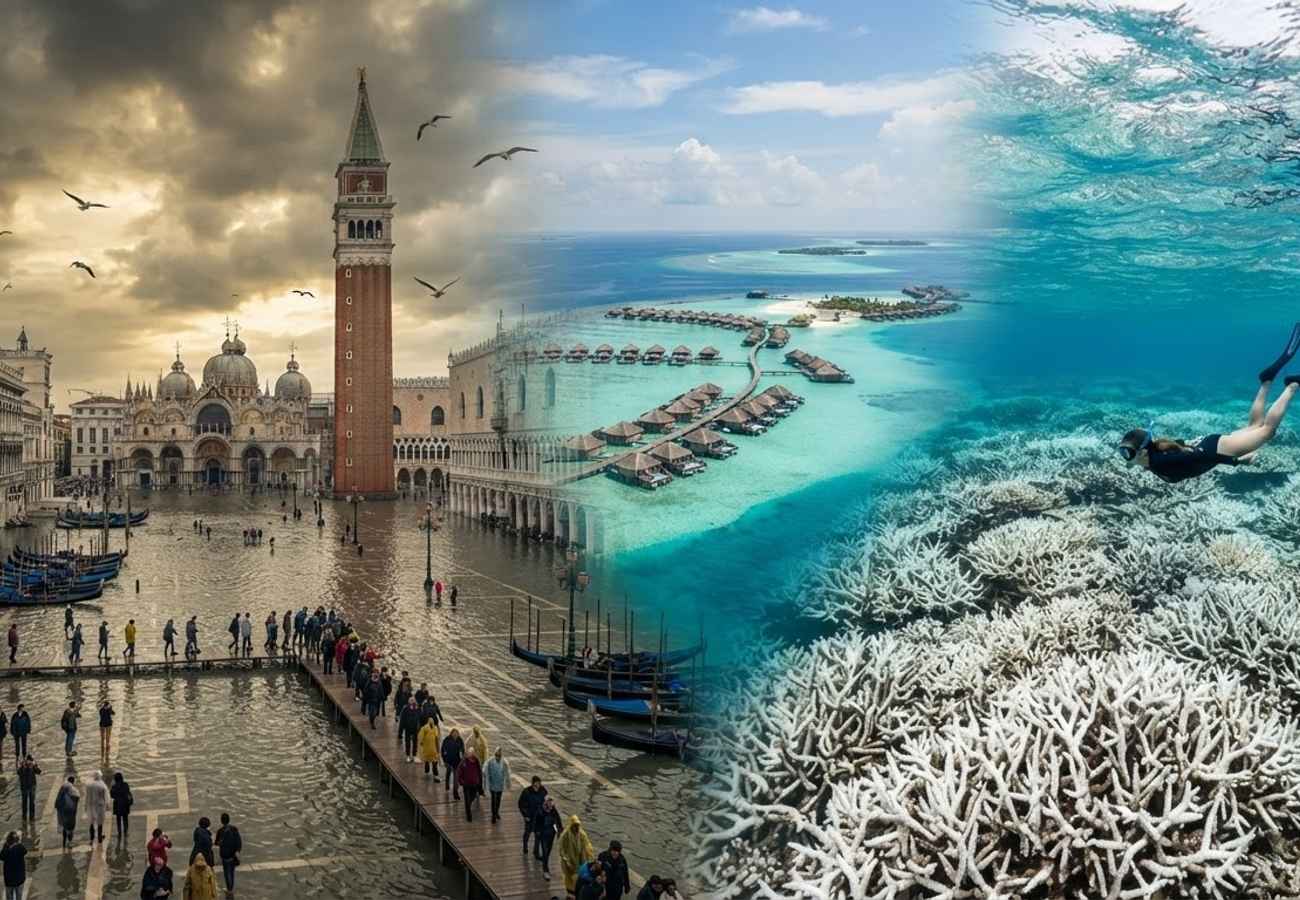
Image generated by AI
Extreme weather events, including heatwaves, floods, and wildfires, are now primary drivers of destination selection, forcing a global migration from peak summer crowds toward "shoulder season" travel.
The Rise of the Climate-Driven Travel Shift
By 2026, the traditional tourism calendar has been fundamentally disrupted. The era of predictable seasonal planning—where Mediterranean summers and Alpine winters were guaranteed—has ended. In its place is a new operational reality where climate resilience is the primary metric for future growth.
Travelers are abandoning historical expectations in favor of real-time climate monitoring. This has birthed the "coolcation" trend, where visitors bypass traditional heat-soaked hubs for northern latitudes or cooler months. Southern Europe is seeing a marked increase in autumn and spring arrivals, while Northern Europe is becoming the primary summer draw.
For the modern traveler, the impact is a shift in logistics. Booking flexibility is no longer a luxury but a requirement, leading hotels and airlines to overhaul cancellation policies. Furthermore, travel insurance has transitioned from an optional add-on to a critical safeguard against weather-related disruptions.
Evolving Travel Behaviors in 2026
| Changing Travel Pattern | Impact on Tourism |
|---|---|
| Shift to shoulder seasons | Increased spring and autumn visits to avoid extreme heat |
| Demand for flexibility | Revised hotel and airline rebooking policies |
| Insurance reliance | Higher adoption to protect against weather cancellations |
| Buffer scheduling | Longer connection times to mitigate flight delays |
| Real-time monitoring | Weather data now dictates destination selection |
Heritage and Ecosystems Under Pressure
The crisis is most acute in destinations where the economy is inextricably linked to natural beauty or historic architecture. From the low-lying atolls of the Indian Ocean to the canals of Italy, the physical infrastructure of tourism is under siege.
The Maldives: An Existential Struggle
The Maldives faces a precarious future, with more than 80% of its islands sitting less than one metre above sea level. The very assets that drive its economy—white sands and overwater villas—are vulnerable to saltwater intrusion and coastal erosion. To combat this, luxury resorts are pivoting toward aggressive adaptation, including the development of artificial islands like Hulhumalé and advanced coral conservation programs.
Venice: Protecting the Floating City
In Italy, the phenomenon of acqua alta (high tides) has evolved from a seasonal nuisance to a systemic threat. While the MOSE flood barrier system provides a critical shield during extreme events, the long-term risk of land subsidence and saltwater exposure continues to threaten the structural integrity of St Mark’s Square and other UNESCO World Heritage sites.
The Great Barrier Reef: Marine Heatwaves
Australia's premier marine attraction is battling ocean warming and acidification. Repeated coral bleaching events, triggered by marine heatwaves, are reducing the reef's resilience and directly impacting the diving and snorkeling sectors.
Regional Climate Threat Summary
| Destination | Primary Climate Threat | Tourism Impact |
|---|---|---|
| Maldives | Sea-level rise / Erosion | Threats to resorts and freshwater |
| Venice, Italy | Rising tides / Subsidence | Flooding of heritage infrastructure |
| Great Barrier Reef | Ocean warming | Coral bleaching and loss of biodiversity |
| European Alps | Reduced snowfall | Decline in traditional ski tourism |
| Greek Islands | Heatwaves / Wildfires | Summer disruptions and seasonal shifts |
Cultural & Environmental Value: The Shift to Resilience
For the visitor, the real impact of these changes is a transition from "passive sightseeing" to "conscious engagement." Travel is no longer just about the location; it is about supporting the systems that keep these places alive.
The shift toward eco-tourism is now a matter of survival. In the Maldives and Australia, tourism revenue is increasingly diverted into reef restoration and coastal protection. When travelers choose "coolcations" or shoulder-season visits, they reduce the peak-load pressure on fragile infrastructures, allowing local ecosystems a window to recover. This movement supports regional heritage by decoupling economic gain from environmental exhaustion.
Visitor Insider Tips
To navigate this new travel landscape, visitors should adopt these local and strategic practices:
- The "Coolcation" Window: If visiting the Mediterranean, target the window between late September and early November. Temperatures are mild, and the "overtourism" crowds of July and August have vanished.
- Venice Etiquette: When visiting during high-tide warnings, avoid the lowest-lying areas of St Mark's Square to reduce congestion for emergency drainage crews. Support local artisans in the quieter Sestieri (districts) to spread economic benefits beyond the flood-prone center.
- Reef Responsibility: When visiting the Great Barrier Reef, prioritize operators certified by the Great Barrier Reef Marine Park Authority (GBRMPA). Use reef-safe sunscreens to prevent further chemical stress on bleaching corals.
- Maldives Sustainability: Opt for resorts that utilize solar energy and have active "coral gardening" programs where guests can participate in reef restoration.
Tourism Outlook
The long-term trajectory for global tourism is a move toward "Climate-Adaptive Travel." We are seeing the end of the monoculture of the "summer holiday." Future investments will likely flow toward destinations that can prove year-round stability or those that have successfully integrated climate-resilient infrastructure. The success of projects like Hulhumalé in the Maldives will serve as a blueprint for other island nations. Ultimately, the destinations that survive will be those that prioritize ecological health over short-term passenger counts.
The map of global travel is being redrawn, not by borders, but by the thermometer.
Related Travel Guides
Disclaimer
This article is for informational and educational purposes only. It does not constitute legal, financial, or professional advice. While we strive to provide accurate and up-to-date information, travel policies, regulations, and conditions change rapidly. Always verify information with official sources before making travel decisions. Nomad Lawyer makes no representations about the accuracy, reliability, completeness, or suitability of the information provided. Readers should consult qualified professionals for advice specific to their circumstances. The views expressed in this article are those of the author and do not necessarily reflect the views of Nomad Lawyer.
Preeti Gunjan
Contributor & Community Manager
A passionate traveller and community builder. Preeti helps grow the Nomad Lawyer community, fostering engagement and bringing the reader experience to life.
Learn more about our team →