Japan's Shingashi Waku Waku Festival in Kawagoe Revives Edo-Era River Boat Rides, Historic Storehouses, and Evening Lantern Launches

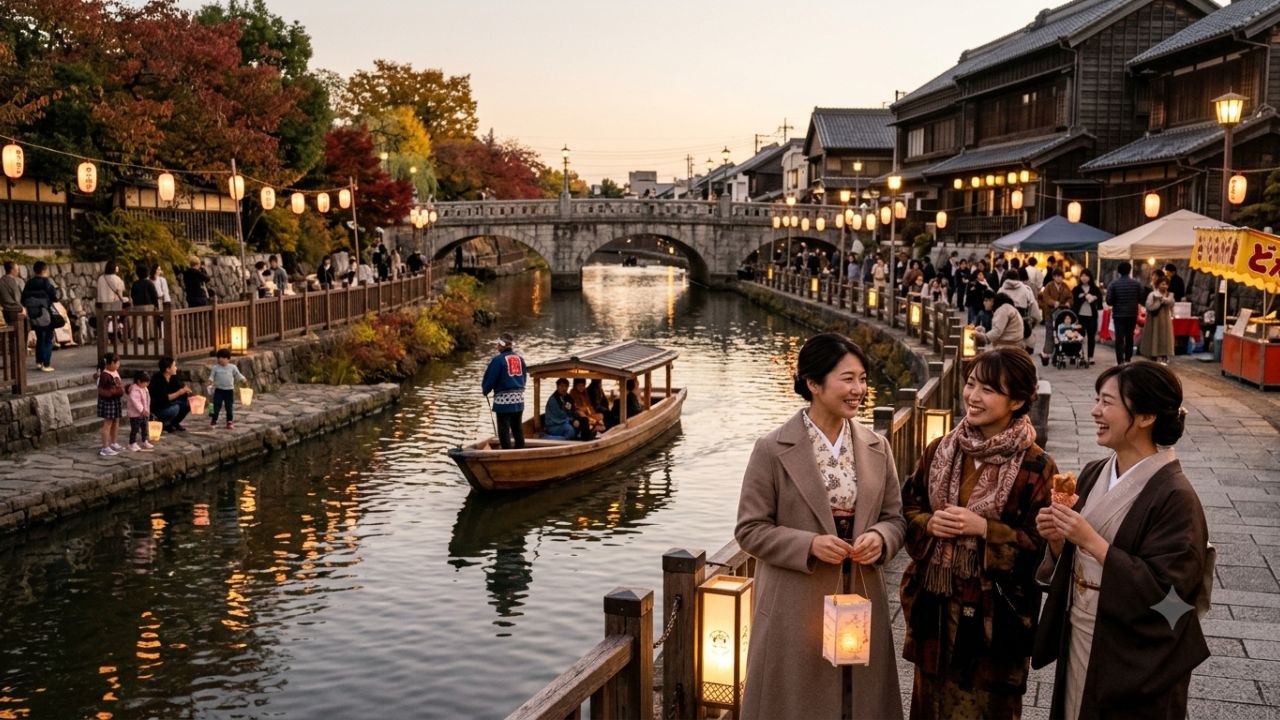
KAWAGOE / TOKYO — The historic merchant city of Kawagoe in Saitama Prefecture has confirmed that the annual Shingashi Waku Waku Festival will take place on Sunday, 8 November 2026, offering visitors an authentic window into Edo-period maritime heritage through riverboat rides, guided storehouse walks, and an evening lantern launch.
Known colloquially as "Koedo" or "Little Edo," Kawagoe is renowned for its clay-walled kurazukuri merchant architecture and iconic bell tower. However, while millions of tourists crowd into the city’s northern historic core each year, the southern district of Shingashi preserves the authentic river trade that originally created Kawagoe's commercial wealth during the Tokugawa shogunate.
According to the official November civic bulletin released by the Kawagoe City Government, the 2026 festival program spans three coordinated community hubs centered around Shingashi Station on the Tobu Tojo Line.
At Asahi Bridge, traditional flat-bottomed wooden boats (Fune-nori) will carry passengers along the willow-lined Shingashi River between 09:45 and 15:00. In the surrounding historic quarter, travelers can explore three surviving Edo-era storehouses named for the valuable commodities they once housed—rice, fine wheat noodles, and fermented miso paste.
The celebrations culminate at Takashina Primary School, where food stalls, traditional festival music, and community sports conclude with an evening sky lantern launch between 18:00 and 18:30.
The festival provides an inspiring case study in sustainable regional tourism dispersal. As central Kawagoe contends with heavy sidewalk crowding and transit bottlenecks, the Shingashi festival redirects cultural interest into southern heritage neighborhoods, demonstrating how community-led preservation can celebrate living history while protecting local quality of life.
SHINGASHI WAKU WAKU FESTIVAL 2026: PROGRAMME OVERVIEW
| Entity / Route | Metrics | Operational Status |
|---|---|---|
| Feature | Operational Details | Visitor Significance |
| Event Date | Sunday, 8 Nov 2026 | Annual Autumn Edition |
| Primary River Location | Asahi Bridge Landing | Historic River Port |
| Boat Rides Operating Window | 09:45 to 15:00 JST | Arrival-order queues |
| Adult / Student Boat Fare | ¥200 (Preschool Free) | Family-friendly price |
| Guided Heritage Walk | 13:30 to 15:00 JST | 90-min historical tour |
| West-Exit Pedestrian Street | 10:30 to 17:00 JST | Food trucks & floats |
| Takashina School Evening | 17:00 to 18:30 JST | Lantern distribution |
| Regional Dining Rally | 5 to 23 Nov 2026 | 47 participating spots |
The Historic Lifeline: How the Shingashi River Built Edo and Kawagoe
To understand the cultural importance of the Shingashi Waku Waku Festival, travelers must step back four centuries to the founding of the Tokugawa shogunate in 1603. When Shogun Tokugawa Ieyasu transformed the small fishing settlement of Edo (modern Tokyo) into the administrative capital of Japan, the city grew into one of the largest metropolises on Earth, with a population exceeding one million residents by the early 18th century.
Feeding, clothing, and housing this massive urban populace required an enormous logistics network. Located thirty kilometers northwest of Edo in fertile Musashi Province, Kawagoe emerged as a primary agricultural and commercial production base.
However, overland transport on horseback or ox-cart across muddy post roads was slow and expensive. The solution was the Shingashi River (Shingashigawa), a calm tributary connecting Kawagoe directly to the Sumida River and Tokyo Bay.
                  THE HISTORIC EDO–KAWAGOE RIVERWAY AXIS

   [ Kawagoe / Shingashi Port ]
                 |
                 | (Downriver Cargo: Sweet potatoes, rice, timber, wheat noodles, miso)
                 v
   [ Shingashi River Corridor ] (Propelled by oars, poles, and river current)
                 |
                 v
   [ Sumida River & Nihonbashi Wholesale Markets (Edo / Tokyo) ]
                 |
                 | (Upriver Cargo: European textiles, refined sugar, tea, fertilizer)
                 ^
                 | (Towpath Tracking: Boats hauled upriver by teams of trackers)
   [ Shingashi Port Wharves & Kura Storehouses ]
Starting in 1648 under the direction of Lord Matsudaira Nobutsuna, the Shingashi River was systematically deepened, channeled, and equipped with river wharves known as kashi (river landings).
Specialized wooden freight barges carried sweet potatoes, polished rice, timber, charcoal, hand-woven fabrics, and barrel-aged miso downriver to the wholesale markets of Nihonbashi in Edo.
On their return journeys, the vessels were loaded with luxury items from the capital—including imported Dutch and Chinese textiles, refined sugar, marine fertilizers, and ceramic pottery. Because the river flowed south toward Edo, downriver journeys took less than a day, while return voyages required teams of boatmen to haul the vessels upriver using towpaths along the riverbanks.
A stone monument standing beside Asahi Bridge marks the exact site of the historic landing where river barges unloaded. According to municipal archives, Shimo-Shingashi was home to powerful shipping wholesalers (funadonya) who operated private wharves, administrative offices, and secure fireproof storehouses.
Three of these historic structures survive today, known as the Rice Kura, the Somen (Wheat Noodle) Kura, and the Miso Kura. Within these preserved compound walls, visitors can view maritime artifacts recorded on Kawagoe’s municipal heritage register, including a ten-meter wooden mast, hand-carved tracking oars, and iron-bound river cargo poles kept under the eaves.
The Modern Rebirth: From Divided Railroad to Community Celebration
The golden era of river shipping continued until the early twentieth century, when the expansion of modern rail infrastructure transformed Japanese logistics.
In 1914, the opening of the Tojo Railway (now the Tobu Tojo Line) provided faster overland freight transit directly between Kawagoe and Tokyo’s Ikebukuro terminal. Commercial shipping along the Shingashi River declined and was formally discontinued by the mid-1930s.
As modern housing developments expanded around Shingashi Station during the post-war economic boom, the railway tracks created a physical and psychological division within the community.
For decades, Shingashi Station possessed only a single western ticket gate. Residents living in the historic river merchant quarters east of the tracks had to navigate circuitous grade crossings to board trains.
                    URBAN EVOLUTION OF SHINGASHI STATION

   [ Pre-2017 Divided Station ]
        * East Side: Historic Edo-era river port, merchant kura, agricultural hamlets
        * West Side: Modern post-war residential suburbs, primary shopping streets
        * Problem: Severe physical severance caused by railway tracks

   [ 2017 Station Elevation Project ]
        * Modern elevated concourse constructed above the Tobu Tojo railway tracks
        * Dual station exits (East and West) with barrier-free lifts and escalators
        * Community workshops held to design public spaces around the station

   [ The Shingashi Waku Waku Festival Committee ]
        * Formed by civic leaders, local merchants, and school educators
        * Primary school pupils design festival mascots and miniature train rides
        * High school students manage boat ticketing and guided heritage walks
In 2017, a comprehensive infrastructure project led by the Ministry of Land, Infrastructure, Transport and Tourism (MLIT) and Tobu Railway transformed the area. A modern elevated station building was constructed above the tracks, featuring an enclosed pedestrian concourse, barrier-free elevators, and spacious forecourts on both the east and west sides.
Rather than letting the new station concourse remain a simple transit corridor, neighborhood associations, local shopkeepers, and educators organized civic design workshops.
Residents recognized that younger generations were losing touch with Shingashi's heritage as an Edo-era port. From these discussions emerged the Shingashi Waku Waku Festival Committee.
The festival was deliberately designed as an intergenerational community celebration:
- Elementary school students from Takashina Primary School participate in logo design contests and help operate miniature railway attractions.
- Junior high and senior high school students volunteer as river marshals, assist elderly visitors with boat boarding, and distribute event programs.
- Neighborhood elders and historical societies lead guided walking tours through preserved merchant streets, passing down oral histories of the river trade.
The Festival Program: Coordinating River Rides, Street Stages, and Evening Lanterns
Attending the Shingashi Waku Waku Festival on Sunday, 8 November 2026, requires careful schedule coordination. With activities spread across three distinct venues and specific operational windows, planning an arrival strategy ensures travelers can experience both daytime maritime traditions and the evening lantern ceremony.
SHINGASHI WAKU WAKU FESTIVAL 2026 SCHEDULE
| Entity / Route | Metrics | Operational Status |
|---|---|---|
| Time Window (JST) | Venue / Location | Activity & Visitor Access |
| 09:45 - 15:00 | Asahi Bridge River Landing | Traditional flat-bottom boat rides |
| (Shingashi Riverbank) | Arrival-order ticketing (¥100-¥200) | |
| 10:30 - 17:00 | West-Exit Pedestrian Promenade | Local street food trucks, craft |
| (200m traffic-free zone) | booths, community merchandise | |
| 12:00 - 12:45 | West-Exit Main Street Stage | Traditional festival float display |
| (In front of commercial shops) | and live Hayashi festival music | |
| 13:15 - 13:30 | East-Exit Station Forecourt | Registration for guided heritage |
| (Beside Koban Police Box) | walking tour (First 50 participants | |
| 13:30 - 15:00 | Historic Shimo-Shingashi District | 90-minute guided walking tour of |
| (Preserved storehouses & landing) | Rice, Somen, and Miso Kura (Free) | |
| 15:00 - 15:45 | West-Exit Main Street Stage | Afternoon float music performance |
| (Street plaza area) | Community dance presentations | |
| 15:00 - 17:00 | Takashina Primary School Grounds | Children’s sports, brass band, |
| (School gymnasium and yard) | amateur wrestling & jazz stage | |
| 17:00 - 18:00 | Takashina Primary School Grounds | Sky lantern distribution and prep |
| (Central collection desk) | Ticket verification & lamp assembly | |
| 18:00 - 18:30 | Takashina Primary School Field | Grand evening sky lantern launch |
| (Illuminated open grounds) | Collective lighting ceremony |
1. Morning Boat Rides at Asahi Bridge (09:45 – 15:00)
For visitors arriving at Shingashi Station, the recommended first stop is the river landing at Asahi Bridge, located approximately five hundred meters east of the station (an easy six-minute walk through residential lanes).
Boarding for the traditional flat-bottomed wooden boats operates strictly in arrival order from 09:45 until 15:00. Because queue capacity can fill quickly during midday hours, arriving between 09:30 and 10:30 is strongly advised.
The boat ride offers a serene journey along a scenic stretch of the Shingashi River. Propelled by volunteer boatmen wielding long bamboo poles, the vessels glide past weeping willows and stone embankments where cargo barges once moored.
Fares are intentionally kept accessible: ¥200 for adults and senior high school students, ¥100 for primary and junior high school pupils, while preschool children ride free of charge. A family of four (two adults and two primary students) can enjoy the river journey for just ¥600.
Life jackets are provided and mandatory for all passengers. Volunteer guides aboard the boats explain how water levels were managed during the Edo period and point out surviving stone mooring rings along the banks.
The traditional wooden craft used for the festival are built according to historic Japanese boatbuilding techniques (wasen), using native cedar and cypress planks secured with traditional iron nails and waterproofed with natural tree resin. As the boats navigate the winding waterway, passengers can admire autumn foliage reflecting off the river surface, accompanied by the calls of wintering waterfowl such as spot-billed ducks and grey herons that inhabit the reed beds along the Shingashi riverbanks. This peaceful aquatic journey provides a striking sensory contrast to the urban energy of central Tokyo just thirty minutes away.
2. The West-Exit Pedestrian Promenade and Float Music (10:30 – 17:00)
Exiting Shingashi Station on the western side, travelers find a 200-meter stretch of the commercial street completely closed to vehicular traffic. While the immediate station forecourt remains open for taxis and municipal buses, the pedestrian avenue creates an open-air festival space.
Over twenty local food trucks and market stalls line the street, serving regional culinary favorites:
- Kawagoe Sweet Potato Delicacies: Steamed sweet potato cakes (imo-manju), purple sweet potato ice cream, and crisp sweet potato chips (satsuma-imo chips).
- Saitama Street Fare: Charcoal-grilled yakitori skewers, yakisoba noodles seasoned with Kawagoe craft soy sauce, and hot croquettes.
- Traditional Float Music (Hayashi): At noon and again at 15:00, a traditional festival float (dashi) is showcased in the center of the pedestrian zone. Local musicians dressed in traditional happi coats perform energetic Kawagoe Hayashi—an intangible folk cultural asset featuring traditional flutes (shinobue), taiko drums, and hand cymbals accompanying masked performers depicting foxes and comedic characters (hyottoko).
3. Guided Heritage Walk of Shimo-Shingashi (13:30 – 15:00)
Travelers interested in exploring the architectural history of the river port should make their way to the East-Exit Station Forecourt by 13:15, when registration opens for the official Guided Heritage Walking Tour.
Participation is free of charge and open to visitors aged fifteen and above, with group sizes capped at fifty participants to ensure easy pedestrian movement through narrow historic alleys.
Departing at 13:30, the 90-minute walking tour is led by historians from the Kawagoe City Cultural Properties Protection Division. The itinerary explores:
- The surviving Edo-era merchant storehouses of Shimo-Shingashi, explaining their heavy plaster construction designed to withstand urban fires.
- The Rice Kura, Somen Kura, and Miso Kura, showcasing how goods were inventoried, inspected, and packaged for river transport.
- The ancient shipping monument near Asahi Bridge and the historic towpaths where boatmen walked.
- Preserved residential estates belonging to the descendants of Edo-period shipping masters, featuring traditional tiled roofs and cedar lattice walls.
4. Takashina Primary School and the Evening Lantern Launch (17:00 – 18:30)
As late afternoon approaches, festival activities transition southward to the grounds of Takashina Primary School, located roughly eight minutes on foot from the station. The schoolyard hosts an eclectic community carnival featuring student brass band recitals, live jazz performances, local amateur wrestling exhibitions, and handicraft stalls operated by parent-teacher associations.
The emotional climax of the day begins at 17:00, when attendees who have pre-registered or purchased commemorative lantern vouchers collect their lanterns at the schoolyard distribution desk.
Between 18:00 and 18:30, as twilight falls over Saitama, hundreds of illuminated lanterns are gently released into the night sky, their warm golden glow reflecting the hopes and community solidarity of Shingashi. The sight of hundreds of lanterns rising above the schoolyard against the autumn night provides an unforgettable photographic and emotional conclusion to the festival day.
Sustainable Dispersal: Countering Overcrowding in Central Kawagoe
The Shingashi Waku Waku Festival plays a vital role within Kawagoe's wider municipal tourism strategy, providing a practical blueprint for mitigating the pressures of overtourism.
According to official tourism statistics published by the Kawagoe City Government, the city recorded 7.16 million total visitor arrivals across 2025—a slight 2.7 percent decline compared to 7.358 million in 2024.
However, beneath the headline number lies a profound structural shift in visitor composition: domestic Japanese day-trippers slipped from 6,659,000 to 6,354,000, while international foreign tourist visits surged from 699,000 to 806,000. As a result, international travelers accounted for 11.3 percent of Kawagoe’s total tourism in 2025, up from 9.5 percent the previous year.
KAWAGOE ANNUAL TOURISM VOLUME TRENDS (2024 VS 2025)
| Entity / Facility | Delays | Cancellations | Details |
|---|---|---|---|
| Visitor Category | 2024 Arrivals | 2025 Arrivals | YoY Change (%) |
| Domestic Day Visitors | 6,659,000 | 6,354,000 | -4.6% |
| Inbound Foreign Tourists | 699,000 | 806,000 | +15.3% |
| Total Citywide Visits | 7,358,000 | 7,160,000 | -2.7% |
| Inbound Share of Total | 9.5% | 11.3% | +1.8% Points |
Historically, the vast majority of these visitors concentrate in a narrow four-hundred-meter corridor along the Ichiban-gai historic warehouse district, surrounding the famous Toki no Kane (Bell of Time) and Kashiya Yokocho (Penny Candy Alley).
On autumn weekends, pedestrian crowds regularly spill off narrow sidewalks into active vehicular lanes, public buses face severe schedule delays, and popular sweet potato pastry shops experience queues exceeding forty minutes.
By promoting the Shingashi Waku Waku Festival, municipal authorities are actively encouraging visitors to explore southern Kawagoe. Situated just one railway stop from Kawagoe Station, Shingashi offers travelers an unhurried, authentic experience of Edo-era heritage without the dense commercial crowds of the northern warehouse district.
Visitors interact directly with local residents, sample regional dishes prepared by community cooks, and discover historical narratives that are often overlooked in standard Tokyo day-trip itineraries.
This geographic rebalancing also reduces physical wear and tear on Kawagoe’s delicate nineteenth-century clay storehouses, which are vulnerable to heavy pedestrian vibrations and street exhaust. By channeling tourism revenue into secondary neighborhoods, family-owned confectioneries, independent tea merchants, and neighborhood carpenters in Shingashi gain economic support, ensuring that cultural preservation remains a sustainable, community-wide endeavor rather than an isolated commercial showcase.
Beyond Festival Sunday: The Kawagoe Dining Rally and Fujimino Museum
Travelers whose itineraries extend beyond 8 November can continue exploring the cultural and culinary heritage of the Shingashi River corridor throughout the month.
NOVEMBER 2026 REGIONAL HERITAGE & DINING EXPERIENCES
| Entity / Route | Metrics | Operational Status |
|---|---|---|
| Experience | Dates & Locations | Highlights & Practical Details |
| Kawagoe Regional Dining | 5 to 23 November 2026 | Stamp rally across 47 venues; |
| Stamp Rally | Shingashi (16), Central (18), | Special curated menus priced at |
| Minami-Otsuka (13) | ¥1,000 and ¥2,000 set tariffs | |
| Kamifukuoka History & | Saturday, 14 November 2026 | Free public opening of preserved |
| Folklore Museum | Fujimino City (2 km downriver) | upper guest rooms of 19th-century |
| Special Opening | Saitama Citizens' Day celebration | river shipping master merchant |
1. The Regional Dining Stamp Rally (5 to 23 November 2026)
Running throughout the first three weeks of November, the Kawagoe Dining Stamp Rally unites forty-seven independent restaurants, cafes, and traditional izakayas across three distinct neighborhoods:
- Shingashi District: 16 participating local venues specializing in home-style ramen, soba noodles, grilled yakitori, and traditional Japanese confectionery.
- Central Kawagoe: 18 participating establishments near the warehouse district and Hon-Kawagoe Station.
- Minami-Otsuka: 13 neighborhood dining spots west of the central core.
Participating restaurants offer curated promotional set meals priced uniformly at either ¥1,000 or ¥2,000, allowing diners to sample regional specialties without language barriers.
Travelers can collect official stamp rally cards at tourist information centers, local train stations, and participating restaurants. Collecting stamps from multiple districts unlocks entries into municipal prize drawings featuring locally brewed Coedo craft beer, artisanal sweet potato sweets, and handmade ceramic goods.
2. Fujimino Riverbank Museum Special Opening (14 November 2026)
On Saturday, 14 November 2026, the neighboring city of Fujimino celebrates Saitama Citizens’ Day (Saitama Kenmin no Hi) with a special public opening of the Kamifukuoka History and Folklore Museum (Kamifukuoka Rekishi Minzoku Shiryokan).
Located approximately two kilometers downriver from Asahi Bridge—an easy 25-minute walk along the scenic riverbank footpath—the museum preserves the historic compound of the Hoshino family, one of the most prominent river shipping merchants on the Shingashi River.
On this single day, the museum grants complimentary admission and unlocks the normally restricted upper-floor guest rooms of the 19th-century merchant residence. Visitors can view hand-carved cedar screens, historic shipping ledgers, and elevated balconies designed to give merchants an unobstructed view of incoming river barges.
Practical Travel Playbook: Planning a Day Trip from Tokyo
Planning an excursion to the Shingashi Waku Waku Festival from central Tokyo is straightforward, supported by Tokyo’s dense suburban rail network.
PRACTICAL KAWAGOE & SHINGASHI TRANSIT PLAYBOOK
| Entity / Route | Metrics | Operational Status |
|---|---|---|
| Rail Route | Travel Time & Frequency | Fare & Ticketing Options |
| Tobu Tojo Line | 30 minutes from Ikebukuro Station | ¥480 one-way (IC Card); |
| (Direct to Shingashi) | Rapid/Express trains every 10 mins | Kawagoe Discount Pass available |
| Seibu Shinjuku Line | 45 minutes from Seibu-Shinjuku to | ¥530 one-way; transfer to Tobu |
| (To Hon-Kawagoe) | Hon-Kawagoe (Red Arrow Express opt) | at Kawagoe Station for Shingashi |
| JR Kawagoe Line | 55 minutes from Shinjuku / Tokyo via | Covered by JR Pass / Tokyo Wide; |
| (To Kawagoe Station) | Saikyo Line through-service | Transfer to Tobu for 1 stop south |
1. Optimal Train Routing and Ticket Selection
- The Fastest Route: Board the Tobu Tojo Line from Ikebukuro Station in northwestern Tokyo. Take an Express (Kyuko) or Rapid (Kaisoku) train heading toward Ogawamachi or Shinrinkoen. Transfer to a local stopping train at Asakadai or Shiki to alight directly at Shingashi Station (Station Code: TJ-20). The total journey takes approximately thirty minutes and costs ¥480.
- Ticketing Options: The standard Suica, Pasmo, and IC mobile phone wallets are accepted at all automated ticket turnstiles. Foreign tourists can also purchase the Tobu Kawagoe Discount Pass (¥710 from Ikebukuro), which covers round-trip rail travel to Kawagoe and grants discounts at affiliated shops.
- Accessibility: Shingashi Station is fully barrier-free, featuring passenger elevators, escalators, braille signage, and multi-purpose wheelchair-accessible restrooms.
2. Weather Protocols and Dress Advice
Early November in Saitama brings crisp, sunny autumn weather with daytime temperatures averaging 16°C to 19°C (61°F to 66°F). However, temperatures drop rapidly after sunset to around 9°C to 11°C during the 18:00 evening lantern launch.
- Pack a warm fleece or light down jacket for the evening program at Takashina Primary School.
- Wear comfortable walking shoes, as navigating between the river landing, the west-exit street, and the school involves walking two to three kilometers throughout the day.
- Weather Policy: In the event of light rain, the festival proceeds as scheduled. In the event of severe stormy weather or heavy downpours, outdoor boat rides and the lantern launch will be canceled. Travelers should check the official festival status notice online (
shingashiwakufes.com) before departing Tokyo on Sunday morning.
3. Japanese Visa and International Entry Requirements
International visitors traveling to Japan to attend autumn cultural festivals must ensure compliance with Japanese immigration standards:
- Visa-Exempt Passports: Citizens of seventy-one nations and territories—including the United States, Canada, the United Kingdom, Australia, Singapore, and European Union member states—enjoy visa-free entry for tourism stays up to ninety days.
- Electronic Visa (eVisa): Eligible nationals from selected countries (including India, China, and Brazil) residing in qualifying jurisdictions can apply for an online single-entry tourist eVisa through the official JAPAN eVISA system.
- Customs & Immigration Digital Registration: All arriving foreign travelers are encouraged to pre-register their immigration arrival card and customs declaration via the Visit Japan Web digital service (
vjw-lp.digital.go.jp), generating QR codes that streamline airport turnstile passage at Tokyo Narita (NRT) and Haneda (HND).
Consumer Protections and Passenger Rights for Japan Rail Travel
Travelers exploring the Tokyo metropolitan and Saitama rail networks are protected under Japan’s rigorous public transport consumer charters and Ministry of Land, Infrastructure, Transport and Tourism (MLIT) guidelines.
                     JAPAN RAIL DISRUPTION & REFUND PROTOCOLS

   [ Train Delay Exceeding 2 Hours (Operating Railroad Fault) ]
                 |
                 +---> Shinkansen / Limited Express: 100% full refund of express surcharge
                 |
                 +---> Local / Commuter Services (Tobu/JR): Alternative transport certificate
                                                           (Furikae Yuso) via parallel lines

   [ Voluntary Ticket Cancellation Prior to Departure ]
                 |
                 +---> Unused Regular Paper Ticket: Refundable at ticket window subject to
                                                    minimal administrative fee (¥220)
                 |
                 +---> IC Card Balance (Suica/Pasmo): Refundable at station offices minus
                                                      deposit fee; cards valid for 10 years
Train Delays and "Furikae Yuso" Alternative Routing
If an operational disruption, mechanical fault, or signaling issue delays trains along the Tobu Tojo Line, the railway company issues official Delay Certificates (Chien Shomeisho) digitally and at ticket barriers.
Under the statutory Furikae Yuso (Alternative Transport Guarantee) framework, passengers holding valid tickets or IC cards are permitted to transfer free of charge to parallel competing rail lines—such as the Seibu Shinjuku Line or JR Saikyo Line—to reach their destination without purchasing new tickets.
Ticket Refunds and IC Card Balances
Travelers holding unused single-trip paper tickets can request an immediate cash refund at any staffed ticket window prior to the train's scheduled departure, subject to a minimal statutory cancellation fee of ¥220.
For visitors using Suica or Pasmo cards, stored monetary balances remain valid for ten years from the date of last use, and remaining balances can be refunded at Tokyo station service centers upon departure from Japan.
Cultural Etiquette: Engaging Respectfully with Local Japanese Festivals
Participating in a community-organized festival like Shingashi Waku Waku provides an intimate cultural experience that requires travelers to observe local community norms:
- Waste Management and Trash Disposal: Japanese public festivals rarely provide large public trash cans. Visitors are expected to follow the cultural norm of carrying their waste home or returning disposable food wrappers directly to the specific food truck where the item was purchased.
- Pedestrian Decorum: Avoid walking while eating (aruki-gui) through crowded residential alleys. Instead, consume street food within designated seating areas along the west-exit street or schoolyard picnic grounds.
- Photography Etiquette: When photographing the traditional float musicians or schoolchildren during performances, maintain respectful distances and avoid obstructing performers or volunteer marshals.
- Supporting the Neighborhood: The Shingashi festival relies entirely on volunteer efforts and local community sponsorships. Purchasing small items—such as a ¥200 boat ride ticket, sweet potato snacks, or a commemorative festival towel—directly funds the preservation of the historic storehouses and supports local youth heritage education.
Strategic Horizons: The Enduring Charm of Little Edo’s Waterways
The Shingashi Waku Waku Festival demonstrates that Japan’s most memorable cultural encounters often lie just beyond the familiar tourist circuit.
By stepping away from the crowded souvenir arcades of central Kawagoe and boarding a wooden boat at Asahi Bridge, travelers connect with the living history that shaped the Tokyo capital region over four centuries.
As twilight settles over the Saitama countryside and hundreds of glowing lanterns rise into the autumn sky above Takashina School, Shingashi proves that when a community honors its ancestral heritage, it creates an experience that is both deeply local and universally welcoming.
Related Travel Guides
- Vietnam Launches First Nationwide Culture Day on 24 November 2026
- Greece Showcases Agios Nikolaos at WTM London 2026 with Luxury Cruise Plans
- Thailand, Japan, and Cambodia Brace for Winter Tourism Setback as Chinese Group Travel Plunges
- Switzerland and Global Destinations Suffer Sharp Tourism Contraction as Indonesian Rupiah Plunges
This article is for informational purposes. Flight routes, passenger regulations, visa rules, and transit advisories are subject to change by airlines and aviation authorities. Readers are advised to verify schedules and travel documentation with relevant carriers and border agencies before departure.