
ANA Advances Sustainable Aviation Fuel Innovation As Green Travel Demand Accelerates Worldwide Aviation Transformation
ANA accelerates its net-zero 2050 decarbonization roadmap with a 10% SAF target by FY2030 and launches the Green Pokémon Jet from Tokyo Haneda to Honolulu.

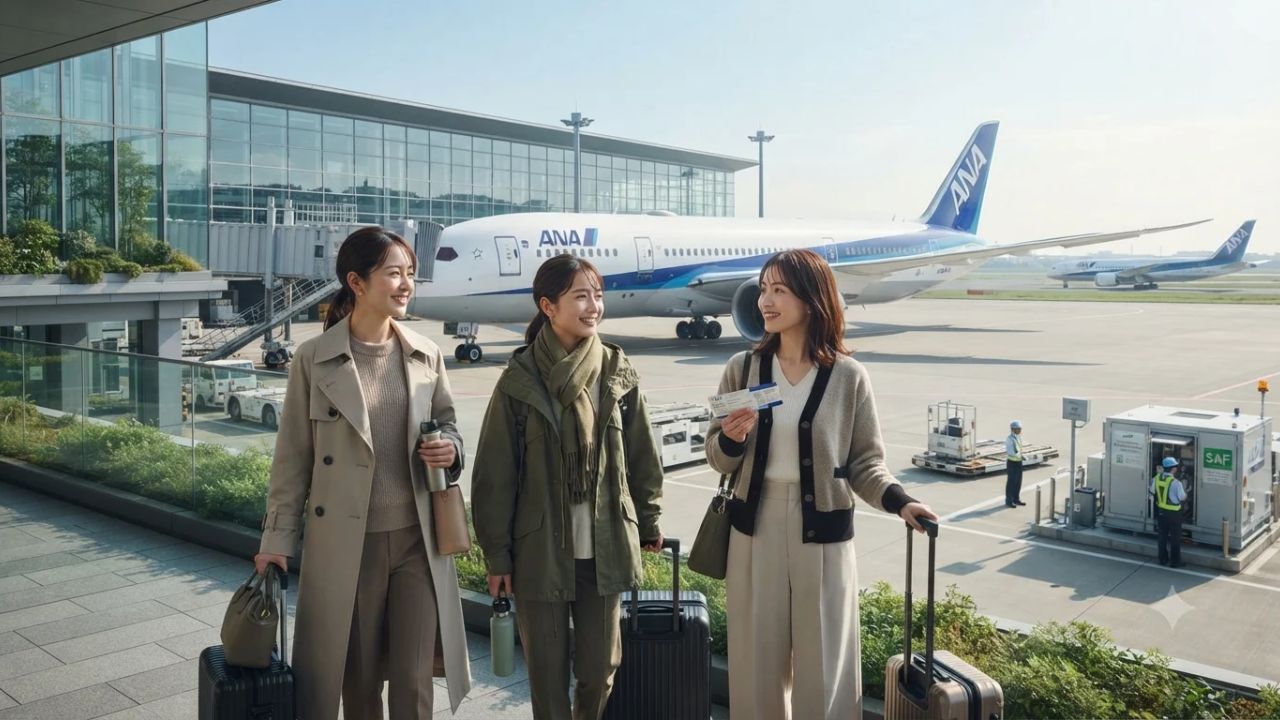
Image generated by AI
A binding operational commitment to replace at least 10% of its total jet fuel consumption with Sustainable Aviation Fuel (SAF) by fiscal year 2030 positions All Nippon Airways (ANA) at the vanguard of Asia's commercial decarbonization, even as global airlines confront severe renewable feedstock shortages. Under the overarching architecture of its ANA Future Promise program, Japan's largest airline group is integrating alternative fuel procurement, flight operations optimization, and cultural branding into a unified roadmap aimed at achieving net-zero carbon emissions by 2050. The carrier celebrated this technical transition with the high-profile commercial debut of its Green Pokémon Jet, which departed Tokyo Haneda Airport (HND) for Honolulu (HNL) at 9:55 p.m., illustrating how legacy flag carriers are using global pop-culture entertainment to bridge complex environmental mandates with everyday consumer consciousness.
The Decarbonization Mandate: SAF Chemistry and Japan's 2030 Benchmark
Aviation accounts for roughly 2.5% of worldwide energy-related carbon dioxide emissions, creating intense regulatory and societal pressure on international operators to decouple network growth from fossil fuel consumption. For All Nippon Airways, achieving environmental compliance cannot rely on experimental hydrogen or battery-electric propulsion, which remain decades away from powering long-haul intercontinental aircraft. Instead, Sustainable Aviation Fuel represents the only technically viable, immediate pathway for deep emissions reduction.
Derived from renewable feedstocks—including used cooking oil, agricultural residues, municipal waste, and industrial off-gases—SAF functions as a drop-in liquid hydrocarbon. According to technical certifications verified by the International Air Transport Association (IATA), SAF blends seamlessly up to 50% with conventional fossil kerosene (Jet A-1) without requiring modifications to aircraft engines, fuel manifolds, or airport storage infrastructure. Over its lifecycle, neat SAF achieves up to an 80% reduction in net carbon emissions compared to petroleum fuel.
ANA’s 10% SAF target by fiscal year 2030 directly aligns with regulatory frameworks established by Japan’s Ministry of Land, Infrastructure, Transport and Tourism (MLIT). The Japanese government has mandated that 10% of all jet fuel loaded onto international flights departing Japanese airports must consist of SAF by 2030. However, domestic refining capacity in East Asia remains nascent, forcing ANA into aggressive procurement partnerships with global petrochemical producers while co-investing in domestic bio-refining initiatives across Japan to secure stable supply chains.
Programmatic Structure: ANA Future Promise and The Green Pokémon Jet
To translate broad environmental pledges into measurable operational improvements, ANA consolidates its initiatives under the ANA Future Promise program. This operational umbrella spans flight deck procedures, maintenance planning, catering logistics, and passenger-facing cabin design.
| Decarbonization Pillar | Core Strategic Initiative | Target Metric / Timeline | Operational Focus |
|---|---|---|---|
| Fuel Procurement | Sustainable Aviation Fuel (SAF) Integration | 10% replacement by FY2030; Net-Zero by 2050 | High-volume blending at Haneda & Narita gateways |
| Operational Flight Efficiency | Continuous Descent Approaches (CDA) & Single-Engine Taxiing | Ongoing across domestic & international flights | 2% to 4% direct flight-level fuel conservation |
| Cabin Waste Elimination | Single-use plastic phase-out & organic meal catering | 100% eco-friendly service items by 2030 | Closed-loop meal waste composting & recycling |
| Consumer Engagement | Green Pokémon Jet Livery & Specialized Transpacific Service | Inaugural flight from HND to HNL at 9:55 p.m. | Cultural entertainment paired with eco-awareness |
| Resource Efficiency | Digital weight management & paperless flight decks | Fleet-wide deployment across Boeing 787 & 777 | Weight reduction lowering per-kilometer fuel burn |
The commercial deployment of the Green Pokémon Jet reflects an innovative approach to passenger communication. Unveiled during an official ceremony before its maiden 9:55 p.m. departure from Tokyo Haneda to Honolulu's Daniel K. Inouye International Airport, the specially liveried aircraft transforms a standard transpacific crossing into an immersive cultural journey.
Inside the cabin, travelers encounter dedicated Pokémon headrest covers, customized paper cups, bespoke napkins, and commemorative plush toys presented by flight attendants. The inflight entertainment system features curated programming, including "Pokémon: The First Movie" alongside "Pokémon TV Anime Theme Songs BEST OF BEST OF BEST 1997–2023 Disc 1," paired with ambient boarding music. By merging beloved entertainment intellectual property with fuel-efficiency messaging, ANA captures consumer attention in a competitive leisure corridor.
Operational Innovations Across Flight Deck and Ground Infrastructure
Beyond alternative fuel procurement and special liveries, ANA is engineering subtle operational changes that produce cumulative emissions savings. Modern commercial aviation efficiency relies on micro-optimizations across thousands of scheduled flights.
Flight operations teams utilize advanced flight-planning software that recalculates optimal high-altitude wind trajectories in real time, avoiding turbulent air currents and minimizing fuel burn across transpacific tracks. On descent into hub airports, flight crews employ Continuous Descent Approaches (CDA), allowing aircraft to glide smoothly from cruising altitude toward the runway on idle engine power rather than executing conventional stepped step-down descents that consume excessive fuel.
On the ground, ANA mandates single-engine taxi procedures for twin-engine widebody aircraft following landing, shutting down one power plant during the taxi from runway to gate. Inside the cabin, flight service teams have replaced traditional single-use plastic cutlery and cups with paper and bio-based alternatives, while catering software utilizes historical booking patterns to eliminate unconsumed meal overproduction.
Expert Analysis: The Green Premium Dilemma and Pop-Culture Decarbonization
The transition toward sustainable aviation reveals a harsh economic paradox that the global travel industry must navigate over the next decade. Sustainable Aviation Fuel currently trades at a price premium three to five times higher than conventional fossil jet fuel. Because aviation fuel constitutes between 25% and 35% of an international airline's total operating expenses, absorbing a 10% SAF blend by 2030 introduces immense financial pressure on corporate balance sheets.
For travelers booking this route, the direct consequence is the inevitable emergence of green passenger surcharges and elevated baseline ticket prices across transpacific routes. Airlines cannot absorb multi-million-dollar SAF procurement premiums without passing a portion of the cost onto end consumers. On competitive long-haul leisure routes like Tokyo to Honolulu, passengers should expect visible environmental surcharges bundled into fare breakdowns, alongside tighter reward seat availability in economy class as carriers attempt to protect operational margins.
The pricing pressure this creates means that airlines must find creative mechanisms to build brand loyalty and justify elevated fares. This reality explains the strategic rationale behind the Green Pokémon Jet. By offering an exclusive, premium entertainment experience that appeals powerfully to families, leisure vacationers, and cultural enthusiasts, ANA insulates itself from raw price competition. Parents and travelers are far more willing to pay a premium for a flight that doubles as a memorable pop-culture experience than for an anonymous, standard commercial connection.
In addition, the alliance between pop-culture icons and environmental policy serves as a behavioral nudge. Environmental initiatives that rely solely on technical jargon or guilt-based appeals often alienate mainstream passengers. By packaging sustainability within an engaging, visual narrative featuring Pokémon, ANA demystifies decarbonization and builds public acceptance for the green transition. However, as international aviation regulators tighten carbon offset verification and mandate hard SAF blending quotas, marketing flair must match industrial delivery: securing enough refined bio-kerosene to power hundreds of daily departures remains the true operational battleground.
Key Takeaways
- Ambitious 2030 Target: All Nippon Airways has formally committed to replacing at least 10% of its total jet fuel consumption with Sustainable Aviation Fuel (SAF) by fiscal year 2030.
- Net-Zero 2050 Roadmap: SAF procurement serves as the technical foundation for ANA's overarching goal of achieving net-zero carbon emissions across all aircraft operations by 2050.
- Green Pokémon Jet Deployment: The themed aircraft debuted on the prestigious transpacific corridor between Tokyo Haneda (HND) and Honolulu (HNL), departing at 9:55 p.m.
- Bespoke Inflight Entertainment: Passengers on the Green Pokémon Jet enjoy themed headrest covers, specialized cups, plush toys, and curated media including "Pokémon: The First Movie" and anime soundtracks.
- The Green Premium Reality: With SAF trading at 3 to 5 times the price of conventional jet fuel, the airline's green transition will drive structural changes in transpacific fare models and passenger environmental surcharges.
FAQ: ANA Sustainable Aviation Fuel & Green Pokémon Jet 2026
What is ANA's Sustainable Aviation Fuel target for 2030?
All Nippon Airways has committed to replacing at least 10% of its total aviation fuel consumption with Sustainable Aviation Fuel (SAF) by fiscal year 2030.
When does ANA plan to achieve net-zero carbon emissions?
ANA has committed to achieving net-zero carbon emissions across all commercial aircraft operations by 2050 through SAF adoption, fleet renewal, and operational flight efficiency.
What route does the Green Pokémon Jet operate?
The Green Pokémon Jet operates primarily on the transpacific route connecting Tokyo Haneda Airport (HND) to Honolulu, Hawaii (HNL), with its inaugural flight departing at 9:55 p.m.
What unique features are found onboard the Green Pokémon Jet?
Passengers receive Pokémon-themed paper cups, napkins, and headrest covers, alongside special plush toys and curated inflight entertainment featuring classic Pokémon anime movies and music.
As the Green Pokémon Jet climbs into the night sky above Tokyo, All Nippon Airways proves that while the industrial path to zero-carbon flight requires formidable engineering, the journey can still begin with a spark of imagination.
Related Travel Guides
The 10 Best Transpacific Flights From Tokyo, According To Reddit
Disclaimer
This article is for informational and educational purposes only. It does not constitute legal, financial, or professional advice. While we strive to provide accurate and up-to-date information, travel policies, regulations, and conditions change rapidly. Always verify information with official sources before making travel decisions. Nomad Lawyer makes no representations about the accuracy, reliability, completeness, or suitability of the information provided. Readers should consult qualified professionals for advice specific to their circumstances. The views expressed in this article are those of the author and do not necessarily reflect the views of Nomad Lawyer.
Raushan Kumar
Founder & Lead Developer
Full-stack developer with 11+ years of experience and a passionate traveller. Raushan built Nomad Lawyer from the ground up with a vision to create the best travel and law experience on the web.
Learn more about our team →