
American Airlines Introduces Advanced Delay Technology At Charlotte Hub To Target Rolling Flight Delays
American Airlines Introduces Advanced Delay Technology At Charlotte Hub To Target Rolling Flight Delays

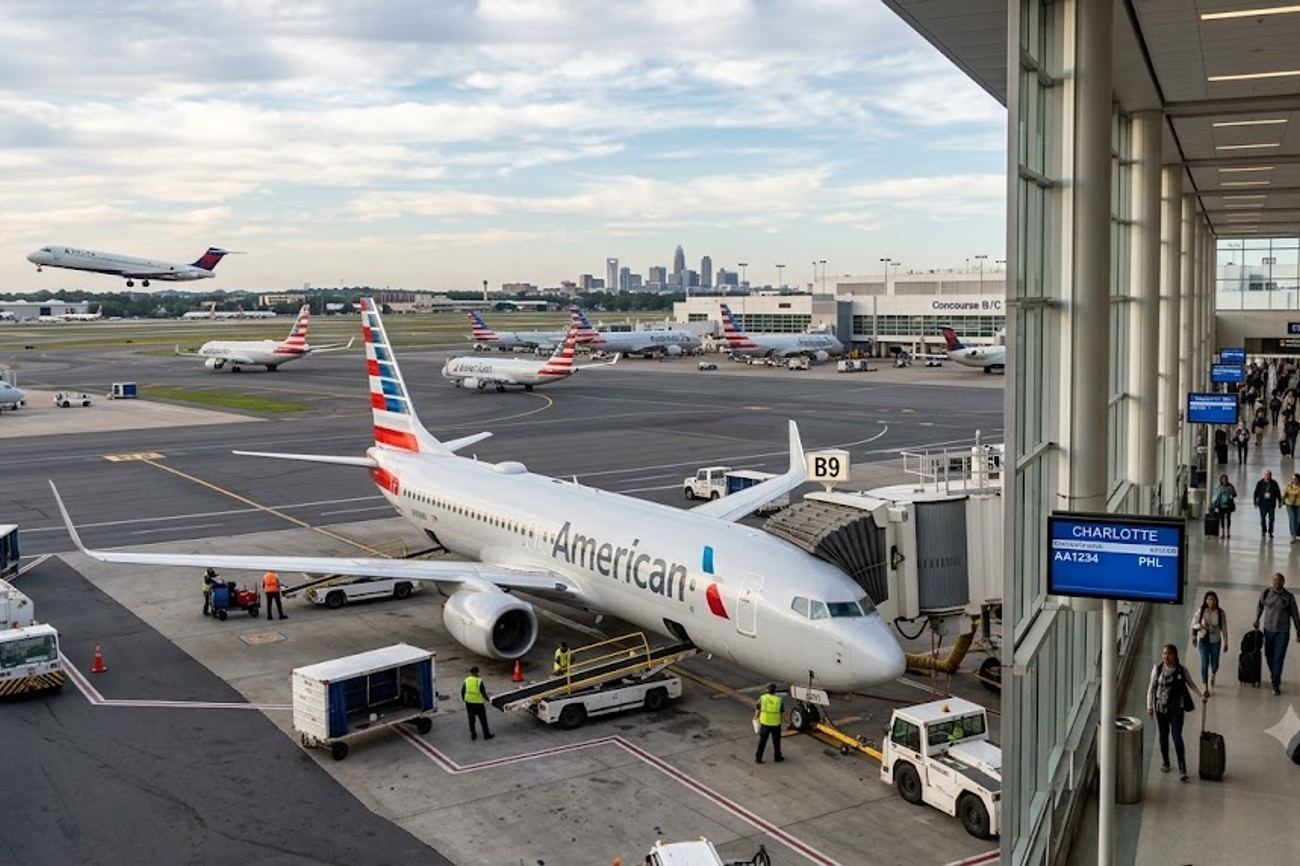
Image generated by AI
Imagine standing at a boarding gate in Charlotte, watching your departure time slide back by 15 minutes every half hour, while your own flight-tracking app shows the aircraft is still three states away. This "rolling delay" cycle is the primary source of friction for millions of travelers, and it is the specific pain point American Airlines is attempting to solve with a new operational trial at one of its busiest hubs.
American Airlines Real-Time Delay Integration Trial
American Airlines has launched a pilot program at Charlotte Douglas International Airport designed to eliminate the gap between actual aircraft positioning and the information displayed on airport monitors. The core of this initiative is the integration of real-time air traffic data directly into the boarding and departure communication stream.
Historically, passengers have suffered through "rolling delays," where a flight is pushed back in small increments. This often happens because the airline's communication system is not perfectly synced with the actual arrival of the incoming aircraft. Under this new system, the airline will estimate boarding times based on the precise, expected arrival of the aircraft operating the previous leg of the journey. By tying boarding announcements to the physical location of the plane, the carrier aims to provide a realistic timeline rather than a hopeful one, reducing the confusion that occurs when passengers see a discrepancy between the gate screen and third-party tracking tools.
The selection of Charlotte Douglas International Airport as the testing ground is strategic. As one of the largest hubs in the American Airlines network, it provides a high-volume, high-stress environment that serves as a litmus test for whether this technology can scale. If the trial successfully reduces passenger frustration and operational chaos in Charlotte, the airline intends to roll the system out across its other major hubs.
Affected Routes and Flights
While this is a systemic technology trial rather than a specific flight cancellation event, the impact is felt by all passengers transitioning through the Charlotte hub. The primary focus is on:
- All American Airlines flights departing from Charlotte Douglas International Airport (CLT).
- Connecting passengers who rely on accurate arrival/departure windows to navigate the terminal.
- Inbound aircraft rotations where delays on the first leg of a flight's day create a domino effect for subsequent departures.
Passengers can monitor their specific flight status via the American Airlines flight status page or use independent tools like FlightRadar24 to verify the physical location of their incoming aircraft.
Your Rights as a Passenger
Regardless of whether an airline uses predictive technology to communicate a delay, your legal rights regarding that delay remain unchanged. In the United States, passenger protections are primarily governed by the Department of Transportation (DOT) and the airline's own Contract of Carriage.
US DOT Refund Rules Under current US DOT regulations, passengers are entitled to a full refund if the airline cancels a flight or makes a "significant change" to the scheduled departure or arrival time. While the DOT has recently moved toward stricter definitions of "significant," a delay that results in a passenger choosing not to travel typically triggers a refund right. You can verify your specific protections through the US Department of Transportation's air consumer portal.
Compensation and Duty of Care Unlike the EU261/2004 framework, US law does not mandate fixed cash compensation for delays. However, if a delay is within the airline's control (such as a crew scheduling error or a mechanical failure) and results in an overnight stay, the airline typically provides hotel vouchers and meal coupons. If the delay is caused by "acts of God" (weather, air traffic control restrictions), the airline is generally not legally required to provide these amenities, though many do so as a matter of customer service.
The "Rolling Delay" Legal Gap The frustration of rolling delays—where a flight is delayed by 30 minutes, then 60, then 120—often falls into a legal gray area. Because the flight is eventually operated, it does not qualify as a cancellation. However, if these cumulative delays result in a missed connection on a single itinerary, the airline is responsible for rebooking you on the next available flight to your destination at no additional cost.
Rebooking Strategy and Alternatives
When you find yourself caught in a rolling delay at a hub like Charlotte, the "wait and see" approach is often the least efficient strategy. Use the following tactical approach to regain control of your itinerary:
1. The Parallel Tracking Method Do not rely solely on the gate agent. Use a flight tracker to find your incoming aircraft's tail number. If the aircraft is delayed by four hours but the gate screen says "delayed 30 minutes," you know the gate information is lagging. This is the exact gap American Airlines is trying to close, but until the system is universal, manual verification is your best tool.
2. Proactive Rebooking If you have a tight connection, do not wait for the delay to be "official." If you see the incoming plane is significantly behind, use the American Airlines mobile app to check for alternative flights to your final destination. It is often easier to secure a seat on a later flight before the entire plane of delayed passengers realizes they will all miss their connections.
3. Competitor Pivot Charlotte is a fortress hub for American, but other carriers operate there. If a delay becomes a cancellation or a multi-hour disruption, check for flights on Delta or United. While the airline will not pay for a ticket on a competitor, the cost of a new ticket may be less than the cost of a lost day of work or a missed event.
4. Refund vs. Credit If the delay becomes "significant" per DOT guidelines, you have the right to a refund to your original form of payment. Be cautious: airlines will often offer "Flight Credits" or "Vouchers." These are generally less valuable than cash because they have expiration dates and restrictions. Always insist on a cash refund if the disruption meets the legal threshold for a significant change.
FAQ: American Airlines Delay Management 2025
Am I entitled to cash compensation for a rolling delay? In the US, there is no federal law requiring cash compensation for delays, regardless of how they are communicated. You are entitled to a refund if the flight is cancelled or significantly changed and you choose not to travel.
How does the new Charlotte trial help me? It aims to stop the "rolling delay" cycle. Instead of guessing, the airline will use the aircraft's actual GPS location to tell you exactly when boarding will start, allowing you to leave the lounge or restaurant with confidence.
What should I do if my flight is delayed and I miss a connection? The airline is obligated to rebook you on the next available flight to your destination. If the delay is the airline's fault and requires an overnight stay, request a hotel and meal voucher immediately at the customer service desk.
Can I use the new system to find my plane? The system is internal to American Airlines' communication tools. While you won't see the "backend" data, you will see more accurate times on the airport screens and in the AA mobile app.
Better data doesn't mean fewer delays, but it means you stop spending your vacation staring at a flickering departure screen.
Tags: American Airlines, CLT, Charlotte Douglas International Airport, US DOT Regulations, Flight Disruption Technology, On-Time Performance 2025
Related Travel Guides
- Syrian Airlines Accelerates International Growth With New Copenhagen And Vienna Routes To Europe
- Wuhan Municipal Culture and Tourism Bureau Introduces Heartbeat Weekend Passes and Digital Passports
- China, India And More Countries Drive Travel AI Revolution As Millions Turn To Artificial Intelligence For Holiday Ideas
Disclaimer
This article is for informational and educational purposes only. It does not constitute legal, financial, or professional advice. While we strive to provide accurate and up-to-date information, travel policies, regulations, and conditions change rapidly. Always verify information with official sources before making travel decisions. Nomad Lawyer makes no representations about the accuracy, reliability, completeness, or suitability of the information provided. Readers should consult qualified professionals for advice specific to their circumstances. The views expressed in this article are those of the author and do not necessarily reflect the views of Nomad Lawyer.
Naina Thakur
Contributor & Travel Specialist
Travel enthusiast and legal writer covering visa regulations, responsible tourism, and cultural journeys across global destinations.
Learn more about our team →