Middle East Travel Alert: Deconstructing US Security Warnings, Gulf Flight Corridors, and Airspace Risks Across 14 Nations


RIYADH, Saudi Arabia — A renewed regional security alert issued by the United States Mission in Saudi Arabia on November 7, 2026, has placed Middle Eastern travel risks under intense scrutiny, advising international travelers to prepare for potential airspace restrictions, flight diversions, and regional transit volatility.
Circulated by the US Embassy in Riyadh, the security message urges American citizens across the Gulf and wider Middle East to maintain heightened vigilance regarding potential armed attacks by Iran-backed Houthi forces and specific security threats targeting US personnel.
While the advisory cautions travelers to anticipate sudden flight cancellations and explore overland alternatives, it does not signify a blanket closure of Gulf aviation hubs. Major international gateway airports—including Dubai International (DXB), Hamad International in Doha (DOH), and King Abdulaziz International in Jeddah (JED)—continue operating scheduled international passenger flights.
A systematic review of official US Department of State travel advisories across 14 Middle Eastern countries reveals a sharply tiered risk environment: five nations sit at Level 4 ("Do Not Travel"), eight countries remain at Level 3 ("Reconsider Travel"), and Egypt holds Level 2 ("Exercise Increased Caution"). Concurrently, active Conflict Zone Information Bulletins (CZIBs) published by the European Union Aviation Safety Agency (EASA) identify specific airspace corridors requiring technical avoidance, illustrating that open airport terminals can coexist with rerouted flight paths and lengthened journey times.
+----------------------------------------------------------------------------------------------------+ | MIDDLE EAST REGIONAL TRAVEL SECURITY & AIRSPACE SCORECARD: NOV 2026 | +----------------------------------------------------------------------------------------------------+ | Core Issuing Authority | US Mission in Saudi Arabia (US Embassy Riyadh Alert, Nov 7, 2026) | | Primary Threat Vector | Regional Houthi Missile/Drone Activity & Escalation Risks | | US Advisory Distribution | 5 Nations at Level 4; 8 Nations at Level 3; 1 Nation at Level 2 | | Level 4 ("Do Not Travel") | Iran, Iraq, Yemen, Lebanon, Syria | | Level 3 ("Reconsider Travel")| Saudi Arabia, UAE, Qatar, Bahrain, Kuwait, Oman, Jordan, Israel | | Level 2 ("Increased Caution")| Egypt (Standard Regional Baseline) | | Aviation Safety Regulator | European Union Aviation Safety Agency (EASA CZIB Bulletins) | | Key Airspace Restrictions | Avoid Over-Water Persian Gulf & Gulf of Oman West of 58°E; Tehran FIR| | Connecting Hub Scale (2025) | Dubai (95.2M Int'l Pax), Doha (54.3M Pax), Jeddah (36.8M Pax) | | Maritime Risk Reference | US MARAD Advisory 2026-013 (Red Sea, Bab el-Mandeb, Gulf of Aden) | +----------------------------------------------------------------------------------------------------+
Deconstructing the November 7 Alert: What Actually Changed?
Understanding the practical consequences of the November 7 alert requires separating new operational guidance from longstanding baseline security policies.
The security alert released by the US Embassy in Riyadh represents a continuation and reinforcement of warnings established in late October. On October 23, 2026, the US Department of State ordered the departure of non-emergency US government personnel and eligible family members from Saudi Arabia due to heightened security concerns. The November 7 notice reminds private citizens that US government personnel remain subject to special travel authorizations to use commercial airports within the Kingdom and face strict geographical restrictions prohibiting travel within 50 miles of the Saudi-Yemeni border.
THE THREE TIERS OF MIDDLE EAST TRAVEL RISK INTERPRETATION
=============================================================================================
DIPLOMATIC / CONSULAR RISK            AIRSPACE / REGULATORY RISK        COMMERCIAL AIRLINE REALITY
[US State Dept Travel Advisories]     [EASA / FAA Airspace Bulletins]   [Live Flight Schedules]
* Focuses on sovereign legal risk,    * Focuses on physical altitude    * Focuses on aircraft rotations,
  civil unrest, and consular access.    hazards, missiles, and radar.     crew duty times, and routing.
* Level 3 / Level 4 country labels.   * Avoids specific FIR corridors.  * Flights continue via doglegs.
                      \                               |                               /
                       \                              |                              /
                        v                             v                             v
             +-----------------------------------------------------------------+
             |              ACTIONABLE TRAVEL DECISION FRAMEWORK               |
             | A Level 3 advisory does NOT mean an airport is closed.           |
             | An EASA CZIB avoidance does NOT halt all commercial departures. |
             | Journeys remain viable but demand strict through-ticketing,     |
             | extended connection buffers, and active insurance auditing.     |
             +-----------------------------------------------------------------+
The alert advises travelers to monitor commercial carrier websites and consider contingency land transport, but it does not declare that civilian flights have been grounded. International airlines, including Emirates, Qatar Airways, Saudia, flydubai, and Gulf Air, maintained their scheduled flight rotations on November 7, albeit utilizing adjusted air corridors that circumvent sensitive over-water zones.
The 14-Nation State Department Risk Matrix: Levels 2, 3, and 4
The US Department of State categorizes travel risk across the Middle East into distinct tiers. Lumping all regional destinations together under a single monolithic danger warning misrepresents the operational realities on the ground:
US STATE DEPARTMENT TRAVEL ADVISORY ARCHITECTURE (14 MIDDLE EAST NATIONS)
=============================================================================================
TIER 1: LEVEL 4 ("DO NOT TRAVEL") - SEVERE ARMED CONFLICT & MINIMAL CONSULAR ACCESS
---------------------------------------------------------------------------------------------
* YEMEN: Active civil conflict, maritime piracy, and pervasive Houthi missile launches.
* IRAN: High risk of arbitrary detention; total avoidance of Tehran Flight Information Region.
* IRAQ: Armed conflict, active militia activity, and high terrorism threat vectors.
* LEBANON: Regional cross-border missile exchanges; restricted commercial flight access.
* SYRIA: Enduring civil conflict, military operations, and complete lack of US consular presence.

TIER 2: LEVEL 3 ("RECONSIDER TRAVEL") - ELEVATED REGIONAL RISK & AIRSPACE CAUTION
---------------------------------------------------------------------------------------------
* SAUDI ARABIA: Houthi ballistic missile/drone threats; infrastructure caution; Yemen border ban.
* UNITED ARAB EMIRATES: Regional conflict caution; transit hubs (DXB/AUH) fully operational.
* QATAR: Regional security exposure; Doha Hamad International flight corridors closely managed.
* BAHRAIN: Gulf airspace exposure; King Fahd Causeway road transit linking Saudi Arabia active.
* KUWAIT: Conflict monitoring; northern Gulf flight-path adjustments; steady airport operations.
* OMAN: Gulf of Oman maritime airspace restrictions; high security within interior tourist zones.
* JORDAN: Border area security restrictions; contingency flight path planning around Amman.
* ISRAEL: Terrorism and conflict sensitivity; strict location-based border exclusions.

TIER 3: LEVEL 2 ("EXERCISE INCREASED CAUTION") - STANDARD REGIONAL BASELINE
---------------------------------------------------------------------------------------------
* EGYPT: Longstanding baseline advisory; tourist zones (Cairo, Luxor, Red Sea) open and normal.
=============================================================================================
Navigating Level 3 Transit Hubs
Eight nations occupy Level 3 status. For global travelers, the presence of the United Arab Emirates, Qatar, and Saudi Arabia in Level 3 requires contextual nuance.
In these Gulf Cooperation Council (GCC) nations, the advisory stems from regional conflict proximity and the potential for ballistic missile or uncrewed aerial vehicle (UAV) interceptions, rather than domestic street violence, violent crime, or civil breakdown. Domestic infrastructure, public transit, hotels, business districts, and tourist attractions across Dubai, Abu Dhabi, Doha, and Riyadh function normally under rigorous municipal security oversight.
Conversely, the five Level 4 nations represent active combat zones or environments characterized by severe detention risks and absent diplomatic protections, where civilian leisure and standard corporate travel are strictly unviable.
EASA Conflict Zone Information Bulletins: Airspace Routing vs. Airport Operations
To understand why commercial flights continue operating despite elevated security alerts, one must examine the regulatory mechanisms governing international aviation. The European Union Aviation Safety Agency (EASA) maintains an active system of Conflict Zone Information Bulletins (CZIBs).
EASA CZIBs are safety recommendations issued to European commercial airlines, advising cockpit crews and dispatchers to avoid specific geographical Flight Information Regions (FIRs) or restrict flight altitudes to reduce exposure to surface-to-air missiles, anti-aircraft artillery, or military GPS jamming.
EASA CONFLICT ZONE INFORMATION BULLETINS (CZIBS) IN EFFECT NOVEMBER 2026
=============================================================================================
BULLETIN CODE         AFFECTED AIRSPACE JURISDICTION   SPECIFIC OPERATIONAL DIRECTIVE
---------------------------------------------------------------------------------------------
CZIB-2026-09-R1       Saudi Arabia (Jeddah FIR)        Avoid designated portions of western and
                                                       southern Jeddah FIR; exercise caution elsewhere.
CZIB-2026-07R3        Bahrain, Kuwait, Qatar, UAE      Avoid specified Persian Gulf over-water
                                                       airspace; exceptions for airport approaches.
CZIB-2026-07R3        Oman (Muscat FIR)                Avoid Gulf of Oman over-water airspace
                                                       west of longitude 58° East.
CZIB-2026-08-R3       Jordan (Amman FIR)               Heightened risk assessment and contingency
                                                       planning; no blanket airspace prohibition.
CZIB-2026-04-R2       Iran (Tehran FIR)                Total operational avoidance recommended for
                                                       all flight levels and transit corridors.
CZIB-2026-05-R2       Iraq (Baghdad FIR)               Total operational avoidance recommended
                                                       except for defined high-altitude corridors.
CZIB-2026-06-R2       Lebanon (Beirut FIR)             Avoid overland airspace; sea approaches and
                                                       departures to Beirut Rafic Hariri permitted.
CZIB-2017-07R20       Yemen (Sanaa FIR)                Complete longstanding airspace avoidance.
CZIB-2017-03R20       Syria (Damascus FIR)             Complete longstanding airspace avoidance.
=============================================================================================
The Geometry of Flight Rerouting
The critical insight for travelers is that airspace avoidance does not equal airport closure:
- The Persian Gulf Corridor Adjustments: EASA bulletin CZIB-2026-07R3 recommends that airlines avoid flying over certain open-water sections of the Persian Gulf. However, the bulletin explicitly provides exceptions for flights taking off from or landing at major coastal hubs, including Dubai (DXB), Abu Dhabi (AUH), Doha (DOH), and Kuwait City (KWI). Commercial aircraft climb steeply out of these airports and immediately route into designated, radar-protected inland air corridors over Saudi Arabia or eastward over the Arabian Sea.
- The "Dogleg" Routing Reality: Because the Tehran and Baghdad FIRs are entirely avoided by European and North American carriers, flights connecting Europe with Southeast Asia or the Indian subcontinent cannot fly direct great-circle routes. Instead, they execute southern "doglegs," routing south across Egypt, the Red Sea, and central Saudi Arabia before turning east across Oman.
- Flight Time and Fuel Penalties: These avoidance detours add between 45 and 90 minutes of flight time to standard Europe–Gulf and Europe–Asia itineraries. While flights arrive safely, the extended airborne time increases fuel burn, strains aircraft turnaround schedules, and narrows passenger connection windows at major transfer hubs.
The Gulf Transit Mega-Hub Network: Dubai, Doha, and Jeddah
The global sensitivity to Middle Eastern airspace alerts arises from the unprecedented scale of the region's commercial transit hubs. The Persian Gulf is not merely an endpoint for tourism; it functions as the central nervous system of intercontinental travel.
According to verified annual traffic statistics compiled by Airports Council International (ACI) World, Gulf hubs process tens of millions of international connecting passengers annually:
GLOBAL TRAFFIC SCALE OF LEADING GULF AVIATION HUBS
=============================================================================================
AIRPORT METROPOLIS             ANNUAL INTERNATIONAL PASSENGERS   GLOBAL INTERNATIONAL RANK
---------------------------------------------------------------------------------------------
Dubai International (DXB)      95,192,160                        #1 in the World
Hamad International (DOH)      54,338,667                        #10 in the World
King Abdulaziz, Jeddah (JED)   36,762,823                        #19 in the World
=============================================================================================
Total Combined Traffic: More than 186 Million Annual International Passenger Movements
When an airspace warning is issued, its primary victim is not the traveler terminating in Dubai or Doha, but the connecting passenger traveling between London and Sydney, Frankfurt and Bangkok, or New York and Mumbai.
THE CONNECTING ITINERARY RISK PROGRESSION
=============================================================================================
ORIGIN AIRPORT (EUROPE / USA)
[Long-Haul Flight Departs on Modified Dogleg Route]
                   |
                   v
[Flight Encounters 60-Minute Airspace Delay Due to Air Corridor Congestion]
                   |
                   v
TRANSIT HUB (DUBAI / DOHA / JEDDAH)
[Arrives with Only 25 Minutes Remaining in Scheduled 90-Minute Transfer Window]
                   |
                   +-----------------------------------+
                   |                                   |
                   v                                   v
    [SCENARIO A: THROUGH-TICKET]         [SCENARIO B: SEPARATE TICKETS]
    * Airline holds onward flight        * Onward carrier cancels seat as "No-Show"
      or rebooks automatically.          * Passenger forfeits downstream ticket value
    * Free transit hotel & food provided.* Passenger must purchase walk-up rebooking
    * Luggage automatically transferred. * Luggage stranded in transit baggage hall
The "Separate Tickets" Vulnerability
This structural reality exposes travelers to the single greatest commercial danger during regional disruptions: the unlinked separate ticket booking.
When a traveler books their entire journey under a single booking reference (PNR) with an airline or alliance—such as British Airways connecting to Qatar Airways, or Emirates connecting to Qantas—the operating carrier is legally obligated to protect the passenger if an airspace detour causes a missed connection. The airline will provide hotel accommodation, meal vouchers, and automatic rebooking onto the next available departure at zero additional cost.
In contrast, travelers who book separate, unlinked tickets across independent low-cost or non-partner carriers—for example, flying an ultra-low-cost airline into Dubai and a separate carrier out of Sharjah—bear 100 percent of the financial risk. If the inbound flight arrives 45 minutes late due to a Persian Gulf air traffic detour, the outbound airline classifies the passenger as a "no-show," canceling the forward ticket without refund.
The Red Sea Maritime and Cruise Dimension: US MARAD Advisory 2026-013
The security environment across the Middle East exerts an equally profound impact on global maritime navigation and the international cruise industry.
The US Maritime Administration (MARAD) maintains active advisory 2026-013, which documents more than 100 separate Houthi attacks utilizing anti-ship ballistic missiles, uncrewed surface vessels (USVs), and aerial drones against commercial merchant shipping in the southern Red Sea, the Bab el-Mandeb Strait, the Gulf of Aden, and the Arabian Sea. The advisory highlights that missile and drone activity has extended northward, including incidents targeting commercial vessels in the vicinity of the Saudi industrial port of Yanbu along the northern Red Sea.
THE GLOBAL CRUISE REALIGNMENT: CIRCUMNAVIGATING AFRICA
=============================================================================================
HISTORIC ROUTE (PRE-CONFLICT)                   MODERN CONTINGENCY (2024–2026)
[Mediterranean Sea via Suez Canal]              [Western Mediterranean / Atlantic]
                   |                                           |
                   v                                           v
[Red Sea Transit & Gulf of Aden]                [Circumnavigation of Africa via Cape of Good Hope]
                   |                                           |
                   v                                           v
[Direct Arrival in Dubai / Mumbai]              [10 to 14 Extra Days at Sea via South Africa]
=============================================================================================
Cruise Industry Abandonment of the Red Sea
Major global cruise conglomerates—including Carnival Corporation, Royal Caribbean Group, MSC Cruises, and Norwegian Cruise Line Holdings—have completely suspended passenger transits through the Red Sea and the Suez Canal.
Grand world voyages and seasonal repositioning sailings between Europe and Asia that historically traversed the Red Sea have been permanently rerouted around the Cape of Good Hope at the southern tip of Africa. This massive detour adds between 10 and 14 days of open-ocean sailing, bypassing historic ports of call in Egypt (Safaga, Sharm El Sheikh), Jordan (Aqaba), and Saudi Arabia (Jeddah, Yanbu).
While regional Gulf coastal cruises operating exclusively within the sheltered waters of the United Arab Emirates and Oman (e.g., Dubai–Abu Dhabi–Sir Bani Yas–Muscat) continue operating, lines must continuously evaluate insurance war-risk premiums and adjust shore excursion protocols.
Saudi Arabia Domestic Transit Alternatives: Rail and Road Crossings
In its November 7 bulletin, the US Embassy in Riyadh advised travelers to evaluate alternative modes of transport within the Kingdom, specifically highlighting railway services, intercity coach networks, and land border crossings.
Saudi Arabia has invested tens of billions of dollars into high-capacity ground transportation infrastructure that provides viable, highly reliable alternatives to domestic short-haul flights:
SAUDI ARABIA GROUND TRANSPORTATION ALTERNATIVES
| Column 1 |
|---|
| 1. THE HARAMAIN HIGH-SPEED RAILWAY (HHR) |
| - 450 km electrified double-track high-speed rail operating at speeds up to 300 km/h. |
| - Connects Makkah, Jeddah (Al-Sulaymaniyah & King Abdulaziz Airport), King Abdullah |
| Economic City (KAEC), and Madinah in complete comfort and safety. |
| - Operates independently of airspace restrictions; trains depart on 30-minute headways. |
| 2. SAUDI ARABIA RAILWAYS (SAR) NORTH-SOUTH & EAST-WEST NETWORKS |
| - Modern passenger rail linking Riyadh with eastern industrial centers (Dammam, Hofuf) |
| and northern highland provinces (Hail, Al-Qassim, Al-Jouf). |
| 3. THE KING FAHD CAUSEWAY (BAHRAIN LAND LINK) |
| - 25 km multi-span causeway bridge connecting Al Khobar (Saudi Arabia) with Bahrain. |
| - Operating normally on November 7; provides an immediate road evacuation/transit route |
| between eastern Saudi oil corridors and Bahrain International Airport. |
| 4. INTERCITY BUS NETWORKS (SAPTCO & SAT TRANSPORTATION) |
| - Extensive, air-conditioned VIP coach services linking major urban centers with |
| western Red Sea ports and southern regional administrative centers. |
Travelers utilizing land border crossings must verify their entry visa permissions and vehicle insurance documents prior to departure. While the King Fahd Causeway to Bahrain was fully operational on November 7, border processing times can vary, and foreign nationals must hold appropriate multi-entry visas for both Saudi Arabia and Bahrain.
14 Middle East Destinations, US Advisory Levels, EASA Airspace Status, and Hub Exposure
The following comprehensive reference table details the operational landscape across the 14 Middle Eastern nations evaluated in the November 2026 security review:
| Sovereign Nation | US State Dept Advisory Level | EASA Airspace Status (CZIB) | Primary Transit Airport | Commercial Operational Status on Nov 7 | Key Traveler Advice & Precautions |
|---|---|---|---|---|---|
| Saudi Arabia | Level 3 (Reconsider Travel) | CZIB-2026-09-R1 (Avoid parts of Jeddah FIR) | King Abdulaziz Int'l, Jeddah (JED) | Fully Operational; Flight paths adjusted | US Gov personnel restricted near Yemen; utilize Haramain high-speed rail |
| United Arab Emirates | Level 3 (Reconsider Travel) | CZIB-2026-07R3 (Avoid over-water Gulf) | Dubai International (DXB) | Fully Operational; World's #1 hub active | Ensure all connections are booked on a single through-ticket; plan 3h buffers |
| Qatar | Level 3 (Reconsider Travel) | CZIB-2026-07R3 (Avoid over-water Gulf) | Hamad International, Doha (DOH) | Fully Operational; Southern tracks active | Monitor flight schedules via Qatar Airways; transit passengers stay airside |
| Bahrain | Level 3 (Reconsider Travel) | CZIB-2026-07R3 (Avoid over-water Gulf) | Bahrain International (BAH) | Fully Operational; Normal flights | King Fahd Causeway road bridge to Saudi Arabia open; verify border visas |
| Kuwait | Level 3 (Reconsider Travel) | CZIB-2026-07R3 (Avoid over-water Gulf) | Kuwait International (KWI) | Fully Operational; Caution in north | Flights reroute south across Saudi interior; corporate travel normal |
| Oman | Level 3 (Reconsider Travel) | CZIB-2026-07R3 (Avoid Gulf west of 58°E) | Muscat International (MCT) | Fully Operational; South tracks clear | Interior tourist corridors (Nizwa, Salalah) safe; check maritime dive tours |
| Jordan | Level 3 (Reconsider Travel) | CZIB-2026-08-R3 (Heightened risk assess) | Queen Alia Int'l, Amman (AMM) | Fully Operational; Caution near borders | Avoid Syria and Iraq border zones; Petra and Wadi Rum tourist travel open |
| Israel | Level 3 (Reconsider Travel) | National Authority Flight Restrictions | Ben Gurion, Tel Aviv (TLV) | Limited International Carrier Access | Extreme caution; multiple international airlines operate suspended schedules |
| Iran | Level 4 (Do Not Travel) | CZIB-2026-04-R2 (Total Tehran avoidance) | Imam Khomeini Int'l (IKA) | Severely Restricted; Avoided by West | Severe arbitrary detention risk; western carriers maintain total overflight ban |
| Iraq | Level 4 (Do Not Travel) | CZIB-2026-05-R2 (Total Baghdad avoidance) | Baghdad International (BGW) | High-Risk Operational Environment | Armed conflict and kidnapping risks; overflight prohibited below FL320 |
| Yemen | Level 4 (Do Not Travel) | CZIB-2017-07R20 (Complete avoidance) | Aden / Sanaa | Extreme Combat Zone; Closed to Transit | Active warfare, missile launches, uncrewed surface vessels; zero consular help |
| Lebanon | Level 4 (Do Not Travel) | CZIB-2026-06-R2 (Sea approaches only) | Beirut–Rafic Hariri (BEY) | Constrained Operations; Daily audits | Conflict zone; commercial carriers operate variable, highly restricted schedules |
| Syria | Level 4 (Do Not Travel) | CZIB-2017-03R20 (Complete avoidance) | Damascus International (DAM) | Combat Zone; Total Civilian Ban | Enduring warfare, airstrikes; total international aviation avoidance |
| Egypt | Level 2 (Increased Caution) | Standard European Operations Permitted | Cairo International (CAI) | Fully Operational; Standard Schedules | Stable tourist baseline; avoid northern Sinai; monitor Red Sea shipping updates |
Consumer Protection, Airline Refunds, and Travel Insurance Realities
When international travel advisories are updated, consumers frequently misunderstand their legal rights regarding flight cancelations and refunds:
AIRLINE REFUND & INSURANCE COMPLIANCE DIRECTIVE
| Column 1 |
|---|
| 1. US DEPARTMENT OF TRANSPORTATION (DOT) MANDATORY REFUND RULES |
| - A passenger is entitled to a full cash refund (not a travel voucher) if an airline |
| cancels a flight or significantly modifies the scheduled departure time (defined as |
| over 3 hours for domestic and over 6 hours for international flights), provided the |
| passenger rejects the alternative rebooking offered by the carrier. |
| - A US State Department travel advisory DOES NOT automatically mandate a refund if the |
| airline continues to operate the scheduled flight on time. |
| 2. TRAVEL INSURANCE "WAR AND CONFLICT" EXCLUSIONS |
| - Standard comprehensive travel insurance policies contain strict exclusion clauses |
| barring claims resulting from acts of war, military hostilities, or civil insurrection. |
| - "Cancel For Any Reason" (CFAR) coverage is required to voluntarily cancel a vacation |
| based on an advisory update, and must be purchased within 14–21 days of initial deposit. |
| 3. THE SMART TRAVELER ENROLLMENT PROGRAM (STEP) |
| - All American citizens traveling through or residing in the Middle East should enroll |
| their itineraries via step.state.gov. |
| - STEP enables US embassies in Riyadh, Abu Dhabi, Doha, and Muscat to transmit instant |
| emergency push alerts and locate citizens during crisis evacuations. |
Actionable Strategic Roadmap: Corporate Travel Managers and Independent Passengers
For corporate travel executives managing executive personnel and independent leisure travelers navigating the Middle East, the following strategic roadmap provides a practical framework for risk mitigation:
STRATEGIC ROADMAP FOR GULF TRAVEL RISK MITIGATION
| Column 1 |
|---|
| PHASE 1: ITINERARY ARCHITECTURE & TICKET AUDITING |
| - Eliminate separate, unlinked ticket bookings across non-partner airlines. |
| - Book exclusively on single-ticket through-fares with integrated alliances (oneworld, |
| Star Alliance, SkyTeam, or Emirates/Qantas partnership agreements). |
| - Require a minimum scheduled transfer window of 3.0 hours at Dubai, Doha, or Jeddah. |
| PHASE 2: REAL-TIME AIRSPACE & NOTAM SURVEILLANCE |
| - Cross-reference flight numbers against live radar tracking tools (Flightradar24). |
| - Monitor EASA Conflict Zone Information Bulletins (easa.europa.eu) for expiry updates. |
| - Check live Notices to Air Missions (NOTAMs) for temporary FIR waypoint closures. |
| PHASE 3: DOMESTIC GROUND CONTINGENCY ACTIVATION |
| - In Saudi Arabia, register accounts with Saudi Arabia Railways (sar.com.sa) for the |
| Haramain High-Speed Train between Jeddah, KAEC, and Madinah. |
| - Pre-screen King Fahd Causeway road transit requirements for Bahrain connections. |
| PHASE 4: CRISIS COMMUNICATION & EMBASSY INTEGRATION |
| - Enroll all traveling staff and family members in the US State Department STEP program. |
| - Maintain redundant physical copies of emergency embassy telephone numbers in Riyadh, |
| Abu Dhabi, and Doha, alongside local private security contact protocols. |
By moving past sensationalized headlines and embracing rigorous, layered verification—combining official consular alerts, aviation regulator safety bulletins, and verified airline schedule data—travelers and corporate organizations can navigate Middle Eastern transit corridors with clarity, safety, and operational resilience.
Related Travel Guides
- Navigating Middle East Aviation Mega-Hubs: Transit Strategies for Dubai, Doha, and Abu Dhabi
- Airline Passenger Rights for Flight Cancellations, Missed Connections, and Reroutings
- Saudi Arabia High-Speed Rail and Overland Transit: Exploring the Kingdom by Train
- Travel Insurance Masterclass: Navigating War Risk Exclusions and CFAR Protection
This article is for informational purposes. Flight routes, passenger regulations, visa rules, and transit advisories are subject to change by airlines and aviation authorities. Readers are advised to verify schedules and travel documentation with relevant carriers and border agencies before departure.
Related Stories

Asia Travel Weather Advisory: Deconstructing Tropical Storm Cempaka, Monsoon Rains, and Separate Sea Alerts Across Six Nations
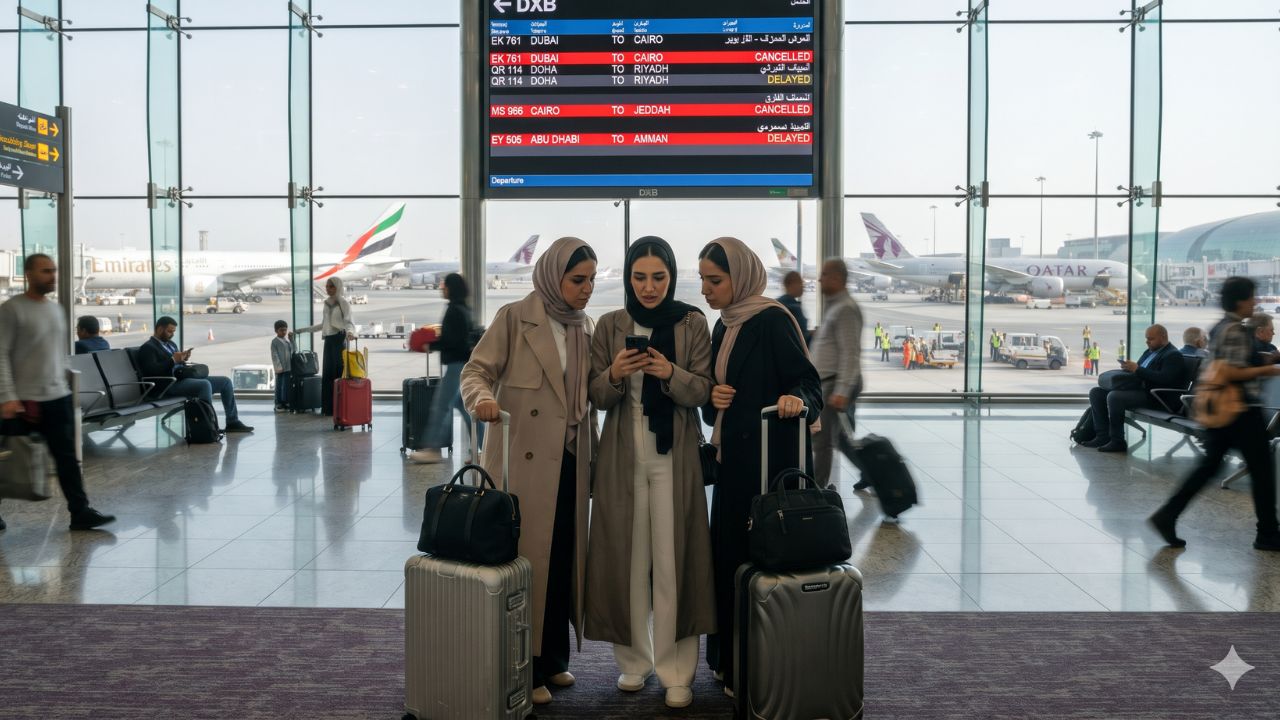
Middle East Flight Disruptions: Over 1,180 Delays and 106 Cancellations Across Gulf Hubs