
Agoda Unites with Google and More Companies at WiT Singapore 2026 Unites 30+ Countries as Travel Tech Leaders Head to Marina Bay Sands
Agoda Unites with Google and More Companies at WiT Singapore 2026 Unites 30+ Countries as Travel Tech Leaders Head to Marina Bay Sands

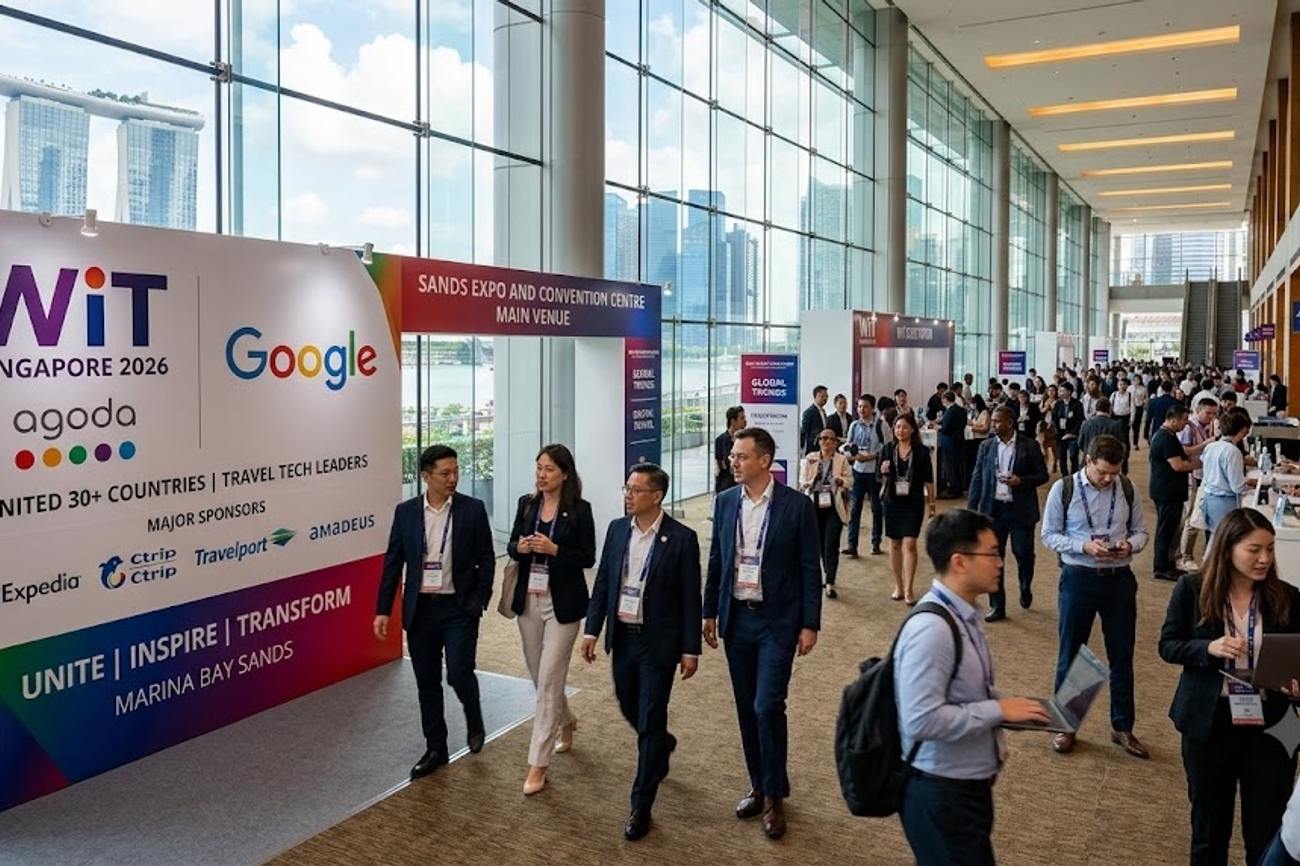
Image generated by AI
The concentration of travel technology leadership in Southeast Asia has shifted from fragmented regional meetings to centralized global summits, with WiT Singapore 2026 now aggregating decision-makers from more than 30 countries in a single three-day window. This represents a significant scaling of industry convergence compared to previous years, signaling that Singapore has transitioned from a regional hub to the primary node for Asia-Pacific travel tech orchestration.
The Digital Convergence in Numbers: WiT Singapore 2026
The upcoming WiT (Web in Travel) Singapore 2026 event serves as a data point for the industry's current trajectory toward hyper-integration. Scheduled from 30 September to 2 October 2026, the event is structured across two primary venues: Pan Pacific Singapore for the Innovation Day on 30 September, and the Marina Bay Sands Expo & Convention Centre for the main program on 1 and 2 October.
The scale of the event is defined by its diversity of participants rather than traditional exhibitor counts. By bringing together leaders from over 30 countries, the event reflects a broader market movement where the "travel value chain" is no longer siloed by sector. The participant list includes a comprehensive cross-section of the travel economy:
- Online Travel Agencies (OTAs): Agoda, Booking.com, Trip.com Group, MakeMyTrip, ixigo, and Wego.
- Technology and Infrastructure: Google, Amadeus, and Mews.
- Payment Systems: Visa.
- Aviation and Mobility: AirAsia MOVE.
- Experience Platforms: Klook.
- Distribution and Logistics: Etraveli Group.
This concentration of power suggests that the industry is moving toward a "platformization" model, where the boundaries between a search engine (Google), a payment processor (Visa), and a booking engine (Agoda) are becoming increasingly porous. According to data trends tracked by IATA, the integration of digital payments and AI-driven distribution is the primary driver of efficiency in modern aviation and hospitality.
Comparative Market Context: Regional Hub Analysis
The shift toward Singapore as the epicenter for these discussions is not accidental. Historically, travel tech gatherings were split between Western-centric events and smaller, localized Asian forums. The 2026 event demonstrates a consolidation of these interests.
While WiT Singapore does not release traditional numerical visitor targets, the geographical spread of its participants—including the US, UK, Germany, Saudi Arabia, UAE, Japan, South Korea, China, Australia, New Zealand, and various Southeast Asian nations—indicates a shift in the center of gravity for travel innovation. The "21: A New Beginning" theme suggests a departure from the "recovery phase" of the early 2020s and a move toward a new baseline of digital-first commerce.
The following table illustrates the shift in the travel tech ecosystem's focus leading into 2026:
| Metric | Previous Industry Cycle (2020-2023) | Emerging Cycle (2024-2026) | Trend Direction |
|---|---|---|---|
| Primary Objective | Pandemic Recovery & Survival | AI Integration & Hyper-Personalization | Value-Added Growth |
| Geographic Focus | Fragmented Regional Hubs | Centralized Global Nodes (e.g., Singapore) | Consolidation |
| Tech Priority | Basic Digitization/Contactless | Generative AI & Automated Distribution | Intelligence-Driven |
| Participant Mix | Sector-Specific (Hotels OR Airlines) | Cross-Sector (Payments + OTA + Tech) | Ecosystem Integration |
| Market Reach | Localized Market Penetration | 30+ Country Global Convergence | Internationalization |
This transition is mirrored in broader industry data. As reported by Statista, the adoption of AI in the travel sector is no longer an optional upgrade but a core requirement for maintaining market share against agile startups. The inclusion of the "WiT Phocuswright Global Startup Pitch" and "Next Generation Leaders powered by Booking.com" underscores the industry's reliance on external innovation to disrupt legacy systems.
What This Means for Travelers
While WiT Singapore 2026 is a corporate and technical summit, the outcomes of these meetings directly dictate the consumer experience in 2027 and beyond. When companies like Google, Visa, and Agoda align their technological roadmaps, the result is a reduction in "friction" for the end user.
1. The End of the "Multi-Tab" Booking Process The collaboration between search giants (Google) and distribution platforms (Amadeus, Agoda) indicates a move toward "single-pane" travel. Travelers will likely see a decrease in the need to jump between five different sites to compare flights, hotels, and insurance. Booking will happen within the search or payment interface.
2. AI-Driven Dynamic Pricing With the focus on "digital commerce" and "AI" at the 2026 summit, travelers should expect more aggressive dynamic pricing. AI will not only predict when prices will drop but will tailor offers based on individual behavioral data in real-time. To counter this, booking windows are shifting; the historical 30-day rule is being replaced by AI-optimized windows that vary by route and season.
3. Seamless Cross-Border Payments The presence of Visa alongside major Asian OTAs suggests a push for frictionless currency conversion and integrated payment methods. For the nomad lawyer or international business traveler, this means fewer hidden FX fees and more integrated "one-click" payment systems across different Asian jurisdictions.
Forward Projection: The Post-2026 Travel Ecosystem
Based on the current trajectory of WiT Singapore's programming, the travel industry is heading toward a "Predictive Travel" era. We are moving away from "Reactive Search" (where a traveler searches for a destination) to "Anticipatory Suggestion" (where the ecosystem suggests a trip based on calendar data, budget, and preference).
The "Innovation Showcase" and "Global Travel Tech Thinktank" mentioned in the 2026 program are early indicators that the industry is solving for the "last mile" of the traveler journey. This includes the integration of ground transport, local experiences, and digital identity (biometrics) into a single digital token.
If the current pattern of 30+ countries converging in Singapore continues, we can expect Singapore to become the " Davos of Travel Tech," where the standards for global distribution (NDC - New Distribution Capability) and AI ethics in travel are codified. The involvement of the "Next Generation Leaders" suggests a generational shift in leadership, moving away from traditional hospitality management toward software-engineering-led corporate governance.
FAQ: Travel Tech Trends 2026
Will AI-driven booking increase travel prices? Not necessarily. While AI enables dynamic pricing, it also optimizes carrier and hotel occupancy. This often creates "micro-deals" for travelers who use AI-powered tools to find unsold inventory in real-time, potentially lowering costs for flexible travelers.
Is now a good time to invest in travel tech startups? The presence of the WiT Phocuswright Global Startup Pitch suggests a high appetite for innovation. The trend is moving toward "niche" AI solutions—such as sustainable travel tracking or hyper-local experience curation—rather than general booking engines.
Which regions are dominating the travel tech expansion? Southeast Asia is currently the primary growth engine. The convergence of 30+ countries in Singapore highlights the region's role as the bridge between Western capital (US/UK) and the massive demand markets of India, China, and Indonesia.
How will the "single-pane" booking experience change my planning? You will spend less time researching and more time validating. Instead of searching for "best hotels in Tokyo," your ecosystem will present three options that fit your budget, previous preferences, and flight arrival time, requiring only a final confirmation.
The transition from fragmented booking to integrated ecosystems is no longer a projection—it is the current operational standard.
Tags: Singapore-Travel-Tech-2026, AI-Distribution-Trends, APAC-Tourism-Growth, OTA-Market-Integration, WiT-Singapore-Data
Related Travel Guides
- Illinois Joins New Jersey and More US States Where EV Road Trips Are Getting Harder for Drivers
- Oman Goes Hand In Hand With More Middle East Countries To Redefine Tourism Through Culture, Sustainable Growth And Regional Unity
- UAE and Saudi Arabia Turbocharges with New Robotic and AI Integration to Boom Travel Technology to These Surprising Levels
Disclaimer
This article is for informational and educational purposes only. It does not constitute legal, financial, or professional advice. While we strive to provide accurate and up-to-date information, travel policies, regulations, and conditions change rapidly. Always verify information with official sources before making travel decisions. Nomad Lawyer makes no representations about the accuracy, reliability, completeness, or suitability of the information provided. Readers should consult qualified professionals for advice specific to their circumstances. The views expressed in this article are those of the author and do not necessarily reflect the views of Nomad Lawyer.
Naina Thakur
Contributor & Travel Specialist
Travel enthusiast and legal writer covering visa regulations, responsible tourism, and cultural journeys across global destinations.
Learn more about our team →