
UK Airports Accelerate Border Processing as Contactless Facial Recognition E-Gates Expand to 13 Major Gateways
The UK Home Office expands contactless facial recognition e-gates across 13 major airports, cutting immigration processing times by up to 25% for eligible travellers ahead of a nationwide 2027 rollout.

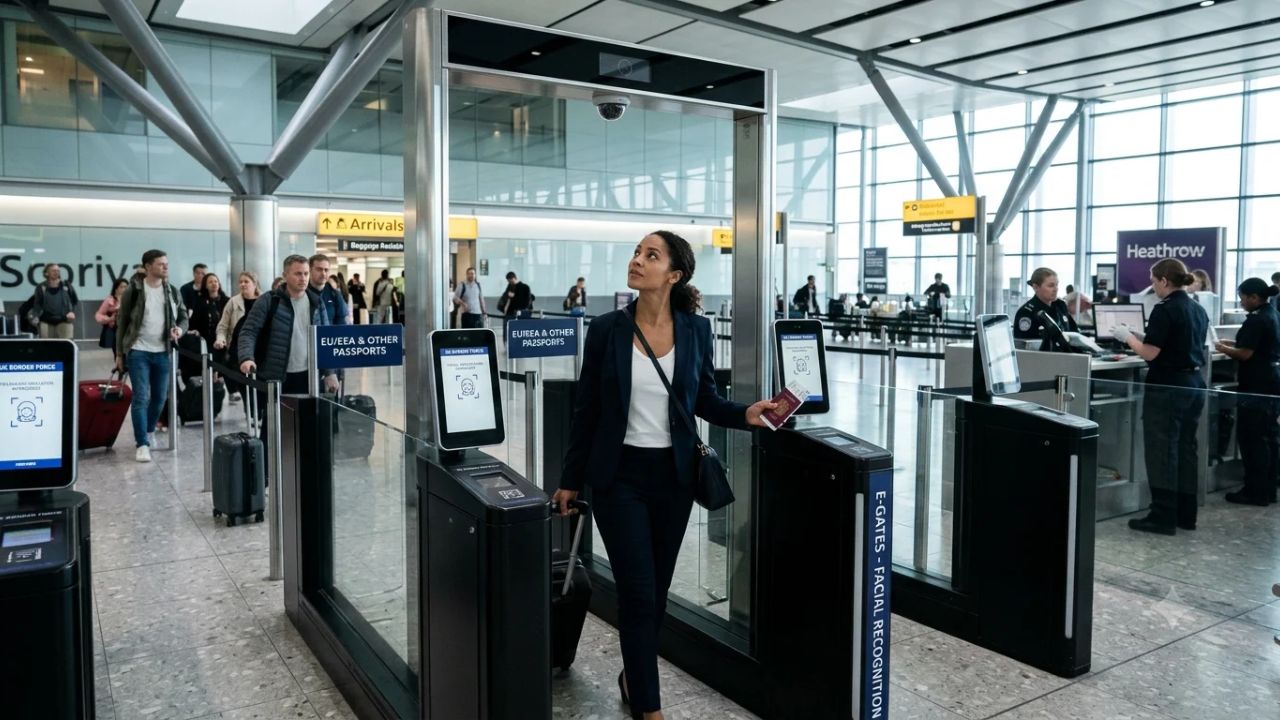
LONDON, United Kingdom — Britain is undertaking a major modernization of its international airport borders as the Home Office expands contactless facial recognition e-gates across 13 major commercial hubs, eliminating the physical passport-scanning requirement for eligible travellers and reducing individual border transaction times by up to 25%.
Following a successful three-week operational trial at Manchester Airport, early deployment commenced on 6 October 2026 at Birmingham Airport and East Midlands Airport. The biometric border program targets a comprehensive nationwide rollout by early 2027 across high-capacity international gateways, including London Heathrow, London Gatwick, London Stansted, Edinburgh, and Glasgow.
By matching real-time facial photography against advance digital immigration profiles and verified travel authority databases, the contactless system removes mechanical chip-reading delays at the border barrier while maintaining rigorous national security protocols.
         UK CONTACTLESS BIOMETRIC BORDER CONTROL ARCHITECTURE (2026–2027)
         =================================================================

             [ ARRIVING PASSENGER APPROACHES CONTACTLESS E-GATE ]
                                      │
               High-Resolution Live Camera Captures Facial Image
                                      │
                                      ▼
         ┌────────────────────────────────────────────────────────┐
         │             BORDER FORCE BIOMETRIC MATCHING ENGINE     │
         │  • Cross-references live scan with advance passenger   │
         │    data, digital eVisa, and passport chip records      │
         │  • Automated identity & national security verification │
         └────────────────────────────┬───────────────────────────┘
                                      │
                   ┌──────────────────┴──────────────────┐
                   ▼                                     ▼
        [ MATCH CONFIRMED ]                   [ ANOMALY DETECTED ]
        • Transaction: 15–19 Seconds          • Gate Prompts Physical Scan
        • Barrier Opens Automatically         • Unresolved: Referral to
        • Direct Terminal Exit                • Border Force Officer Desk
Thirteen Major UK Airports Slated for National Contactless Border Upgrades
The deployment of contactless automated border gates represents the most significant shift in British immigration processing since the nationwide introduction of electronic passport gates in 2008. While an initial draft program outlined 12 regional airports, updated Home Office documentation released on 20 October 2026 expanded the roster to 13 key aviation gateways.
These 13 designated facilities manage the vast majority of Britain's business, regional, and leisure aviation traffic:
- London Hubs: London Heathrow (LHR), London Gatwick (LGW), London Stansted (STN), London Luton (LTN), and London City (LCY).
- English Regional Centres: Manchester Airport (MAN), Birmingham Airport (BHX), Bristol Airport (BRS), Newcastle International Airport (NCL), and East Midlands Airport (EMA).
- Scottish Gateways: Edinburgh Airport (EDI) and Glasgow Airport (GLA).
- Welsh Gateway: Cardiff Airport (CWL).
Targeting completion by early 2027, the rollout is being conducted on a phased, lane-by-lane basis. Rather than instantly decommissioning legacy hardware, airport arrivals halls are operating hybrid zones where newly upgraded contactless e-gates run alongside traditional document-scanning terminals.
Manchester Airport Pilot Validates Next-Generation Biometric Verification
The foundation for the national rollout was established during a rigorous three-week pilot conducted at Manchester Airport's international arrivals terminal. The trial evaluated whether high-throughput border corridors could function reliably without requiring passengers to physically open, align, and press their passport photo pages against optical scanner beds.
In standard e-gate operations, the passenger experience involves three distinct mechanical phases:
- Inserting the passport booklet into the reader slot and applying physical pressure to register the chip.
- Waiting for optical and RFID scanning to verify the document's digital security signature.
- Looking into an overhead camera to match live facial features against the digital photograph stored in the microchip.
The contactless system fundamentally restructures this sequence. By eliminating physical document handling, the upgraded terminal detects approaching passengers, captures facial topography instantly via high-definition optical sensors, and verifies identity against advance passenger information (API) submitted by airlines prior to takeoff.
Manchester Airport trial data demonstrated that eliminating the physical insertion step substantially curtailed passenger hesitation, reduced gate rejections caused by scratched or misaligned passport covers, and smoothed queue flow during peak bank holiday and school break arrivals.
Border Processing Speeds Accelerate: Cutting Clearance Times by Up to 25 Percent
Under conventional automated border procedures, a single passenger clearance requires approximately 20 to 25 seconds. However, real-world transaction times frequently stretch to 40 seconds or more when passengers struggle to position worn documents correctly or when RFID antennas fail on initial contact.
Field metrics indicate that contactless biometric e-gates reduce transaction duration by up to 25 percent, bringing average clearance times down to an estimated 15 to 19 seconds per traveller.
| Metric / Scenario | Conventional Optical E-Gate | Contactless Biometric E-Gate | Operational Performance Variance |
|---|---|---|---|
| Document Handling | Physical insertion & RFID scan required | Contactless; no physical booklet scan | Eliminates alignment errors & physical wear |
| Average Processing Time | 20 to 25 seconds per passenger | 15 to 19 seconds per passenger | Up to 25% faster individual throughput |
| Primary Identification | Passport chip data matched to live face | Live face matched to verified advance profile | Instantaneous digital record retrieval |
| Mechanical Bottlenecks | Jammed booklets, dirty scanner glass | Fully optical; touch-free camera sensors | Reduced maintenance downtime |
| Fallback Mechanism | Referral to Border Force manned booth | Secondary physical scan, then officer check | Multi-tier validation protects security |
| Initial Eligibility | UK, EU, US, CA, AU, NZ, JP, SG, KR | British citizens only (Phase 1) | Gradual rollout across wider e-gate cohorts |
While a six-second reduction per individual may appear modest, its compounding effect across high-volume transit corridors is transformative. For a wide-body Boeing 777-300ER or Airbus A380 arriving at Heathrow Terminal 5 with 400 passengers, a 25 percent speed improvement compresses immigration clearance queues by tens of minutes, accelerating baggage claim access and easing arrivals hall congestion.
Birmingham and East Midlands Lead Live Operational Deployment
While national attention remains focused on London Heathrow and Manchester, operational deployment is already live at two Midland transport centers. Following preliminary calibrations, the Home Office initiated phased live passenger processing at Birmingham Airport and East Midlands Airport on 6 October 2026.
At Birmingham and East Midlands, designated banks of e-gates have been retrofitted with next-generation optical pods and updated Border Force firmware. Ground staff actively direct eligible British passport holders into dedicated contactless transit lanes, allowing engineers to benchmark real-world facial recognition precision against changing ambient terminal lighting, passenger transit speeds, and diverse facial attire.
The selection of Birmingham and East Midlands provides valuable performance data across contrasting airline operating models. Birmingham handles substantial long-haul Middle Eastern connections and dense European scheduled traffic, while East Midlands serves heavy volumes of seasonal charter flights and budget carrier operations.
Passenger Eligibility and Multi-Tiered Verification Safeguards
To maintain border integrity during the technology transition, the Home Office has applied strict access criteria for the initial implementation phase:
- Initial Cohort Restriction: The contactless e-gate lanes are currently open exclusively to British citizens holding valid biometric passports (distinguished by the gold rectangular chip symbol on the cover).
- Phased Expansion Strategy: Border Force plans to extend contactless access to international travellers who already qualify for standard UK e-gates—including citizens of the United States, Canada, Australia, New Zealand, Japan, Singapore, South Korea, and European Union member states.
- Mandatory Passport Carriage: Travellers are legally required to carry their physical passports when entering the country. Airlines require physical documents for check-in and boarding gate manifest checks, and Border Force retains full authority to request physical passports at any stage.
- Two-Tier Technical Fallback: If the optical system cannot confirm a traveller's identity—due to heavy glare, hats, eyewear, or digital record discrepancies—the e-gate interface prompts the passenger to place their passport on the integrated physical scanner. If automated matching remains unresolved, the gate redirects the traveller to an adjacent manned Border Force control desk for manual examination.
Family Travel Modernization: Minimum Age Lowered to Eight Years
The expansion of contactless biometric lanes complements another major operational reform introduced across the UK border network. On 8 July 2026, the Home Office officially reduced the minimum age for children using automated airport e-gates from ten to eight years old.
Under updated border guidelines:
- Children aged 8 to 17 years can use automated e-gates provided they are accompanied by a responsible adult.
- Young travellers must satisfy a minimum height threshold of 120 centimetres to ensure camera alignment.
- Children must travel on their own valid biometric passports.
Lowering the eligibility threshold has eliminated a major point of friction for travelling families, who previously faced lengthy manual processing queues because young children were barred from automated lanes. During summer and autumn half-term holiday peaks, family access to automated corridors has significantly reduced peak wait times at regional leisure gateways like Bristol, Newcastle, and London Stansted.
Digital Border Transformation: Integrating eVisas and Electronic Travel Authorisations
Contactless e-gates form the front-line physical component of a complete digital transformation across the UK immigration system. Over the past three years, the UK government has progressively replaced physical visa vignette stickers and Biometric Residence Permits (BRPs) with digital eVisas accessed through online immigration accounts.
Simultaneously, the rollout of the UK Electronic Travel Authorisation (ETA) scheme requires non-visa national visitors to secure digital pre-clearance prior to departure.
When fully integrated by 2027, the British border infrastructure will operate as an interconnected digital corridor:
            THE UK DIGITAL BORDER ECOSYSTEM (2026–2027)
            ==========================================

   [ Pre-Travel Clearance ]
   • Non-visa nationals submit Electronic Travel Authorisation (ETA)
   • Visa-required travellers hold centralized digital eVisas
   • Airlines submit Advance Passenger Information (API) manifests
                                 │
                                 ▼
   [ Flight Departure & Transit ]
   • Automated pre-screening against international security watchlists
   • Passenger biometric profile established in secure transit cloud
                                 │
                                 ▼
   [ Arrival at UK Airport ]
   • Contactless e-gate camera captures live facial geometry
   • Instantaneous record validation (15–19 second clearance)
   • Seamless baggage hall entry without manual document handling
By verifying passenger admissibility before planes leave foreign tarmac, Border Force officers can focus their investigative attention on complex immigration cases, security anomalies, and customs enforcement rather than performing routine clerical identity validation.
Passenger Guidelines for Clearing Contactless E-Gates
Holidaymakers and business travellers transiting through participating UK airports should observe several practical guidelines to ensure smooth clearance through automated biometric corridors:
- Remove Obstructing Headwear and Eyewear: Before stepping onto the verification footprint, passengers must remove sunglasses, wide-brimmed hats, and large scarves. Prescription glasses with heavy frames or anti-reflective coatings should be removed if the camera fails to verify the iris and eye profile immediately.
- Step Firmly onto Position Markers: Approach the gate individually and stand directly upon the illuminated floor footprints. Look straight ahead into the camera screen until the interface displays a green confirmation circle.
- Avoid Stepping Together: Even when traveling as a family, passengers must enter the e-gate vestibule one at a time. Accompanying parents should clear their gate first before guiding eligible children aged eight and above into adjacent lanes.
- Keep Documents Readily Accessible: While the physical booklet remains in pockets or hand luggage during successful contactless scans, passengers must keep passports easily accessible in case secondary optical reading or officer verification is required.
Frequently Asked Questions
Which UK airports are getting contactless facial recognition e-gates?
Thirteen airports are included in the national program: London Heathrow, Gatwick, Manchester, Birmingham, Bristol, Cardiff, Edinburgh, Glasgow, London City, Luton, Newcastle, London Stansted, and East Midlands.
How much faster are the new contactless e-gates compared to traditional ones?
The contactless biometric system reduces transaction times by up to 25 percent, cutting average individual processing from 20–25 seconds down to approximately 15–19 seconds per passenger.
Do British travellers still need to carry physical passports?
Yes. Travellers must carry physical passports for airline boarding, transit verification, and secondary border checks if facial recognition requires document validation.
Can children use the new UK airport e-gates?
Children aged eight and above can use automated e-gates if they are at least 120 centimetres tall, hold a biometric passport, and are accompanied by an adult.
Related Travel Guides
- Port of Santos Schedules 164 Cruise Calls and 785,000 Travellers Across 10 Ships for Brazil’s 2026–2027 Summer Sailing Season
- Europe’s Underrated Autumn Foliage Destinations: Ambroz Valley, Gauja National Park, and Hidden Fall Escapes
- WTTC Economic Impact Report: US Leads $2.63T Global Tourism Economy as Spain, India, and Malta Surge
Disclaimer
This article is for informational and educational purposes only. It does not constitute legal, financial, or professional advice. While we strive to provide accurate and up-to-date information, travel policies, regulations, and conditions change rapidly. Always verify information with official sources before making travel decisions. Nomad Lawyer makes no representations about the accuracy, reliability, completeness, or suitability of the information provided. Readers should consult qualified professionals for advice specific to their circumstances. The views expressed in this article are those of the author and do not necessarily reflect the views of Nomad Lawyer.
Naina Thakur
Contributor & Travel Specialist
Travel enthusiast and legal writer covering visa regulations, responsible tourism, and cultural journeys across global destinations.
Learn more about our team →