Durham North Carolina Tourism Guide: Food Culture, Black Wall Street Heritage, and Slower Travel

Visitors to Durham spend far more money savoring wood-smoked barbecue, heirloom Southern cuisine, and independent coffee roasts than they do on hotel beds—funneling $324.59 million into local restaurants and cafes compared to $242.28 million on accommodations—even as the Bull City achieved an all-time record of $1.17 billion in countywide visitor expenditures. Released on August 19, 2026, by economic development body Durham Next and Discover Durham, the official findings compiled by Longwoods International and Tourism Economics for Visit North Carolina reveal that while Durham County welcomed an estimated 13.4 million visits in 2025, annual spending growth slowed to a modest 0.9 percent, prompting city planners to pivot toward cultural preservation, sports tourism, and neighborhood-focused exploration.
Unpacking the $1.17 Billion Record: Food and Mobility Lead the Way
While Durham reached an all-time nominal spending high, climbing from $1.16 billion in 2024 to $1.17 billion in 2025, its 0.9 percent growth rate trailed behind North Carolina’s statewide pace. Data published in May 2026 by the North Carolina Department of Commerce confirmed that statewide travel expenditures reached a record $37.2 billion (up 1.3 percent year-on-year), powered by $36.1 billion from domestic travelers, over $1.1 billion from international visitors, and directly supporting 230,997 jobs across the state.
A granular inspection of North Carolina's 100 counties reveals an uneven economic picture. Only 59 counties achieved visitor spending gains in 2025. Western mountain counties recovering from hurricane disruption showed sharp rebounds, with Cherokee County surging 13.9 percent and Macon County growing 11.1 percent. Amid this regional divergence, Durham County retained its stature as the eighth-largest visitor economy in North Carolina, capturing roughly 3.1 percent of the entire state's travel revenue behind larger urban centers like Mecklenburg and Wake.
The internal breakdown of Durham's $1.17 billion expenditure reshapes common assumptions about urban tourism:
- Transport Leads All Categories: Visitors spent $384.60 million on transport across Durham County, accounting for nearly one-third of all expenditures.
- Dining Outpaces Lodging: Culinary purchases generated $324.59 million (27.7 percent of the total), outstripping hotel and home rentals, which captured $242.28 million (roughly one-fifth of spending).
- Recreation and Retail Footprint: Cultural entertainment and recreation contributed $144.78 million, while retail shopping brought in $73.91 million, combining for nearly $219 million in localized economic activity.
- Community Employment and Civic Taxes: Visitor activity directly supported 7,779 jobs and generated $319.31 million in personal income for local workers, alongside $41.14 million in state tax receipts and $41.25 million in local taxes—providing an estimated civic contribution of approximately $239 per Durham County resident.
| Spending & Economic Category | Official 2025 Result | Share of Total Expenditure | Practical Community & Traveler Impact |
|---|---|---|---|
| Total Durham Visitor Spending | $1.17 billion | 100% ($1.16B in 2024) | Modest 0.9% growth rate; reflects steady rather than rapid spending expansion. |
| Total Annual Visitors | 13.4 million visits | Longwoods International | High-volume regional and interstate travelers visiting for sports, health, and dining. |
| Transport Expenditures | $384.60 million | 32.9% of county spend | Encompasses commercial flights, highway transit, regional rail, and local transport. |
| Food & Beverage Purchases | $324.59 million | 27.7% of county spend | Durham’s James Beard-recognized dining scene drives substantial direct sales. |
| Lodging & Accommodation | $242.28 million | 20.7% of county spend | Supported by downtown boutique properties, university lodgings, and extended rentals. |
| Recreation & Cultural Events | $144.78 million | 12.4% of county spend | Ticket sales and admissions across performing arts, museums, and athletic events. |
| Retail & Independent Shopping | $73.91 million | 6.3% of county spend | Purchases at local boutiques, farmers' markets, and artisan craft shops. |
| Direct Tourism Employment | 7,779 jobs supported | Major local employer | Sustains kitchen staff, hotel crews, stagehands, and transportation workers. |
| Personal Labor Income | $319.31 million | Direct wages and payroll | Distributes visitor money into household paychecks across Durham neighborhoods. |
| State & Local Tax Contribution | $82.39 million total | $41.14M State / $41.25M Local | Offsets local residential tax obligations by roughly $239 per county household. |
What Makes the Bull City Different: Tobacco Heritage, Black Wall Street, and Living Arts
Durham's cultural identity is rooted in historic reinvention. Unlike conventional college towns centered solely on university quads, Durham was forged in the industrial fire of the late nineteenth century as the global capital of brightleaf tobacco manufacturing and textile milling. Today, that industrial architecture provides the stage for modern community life.
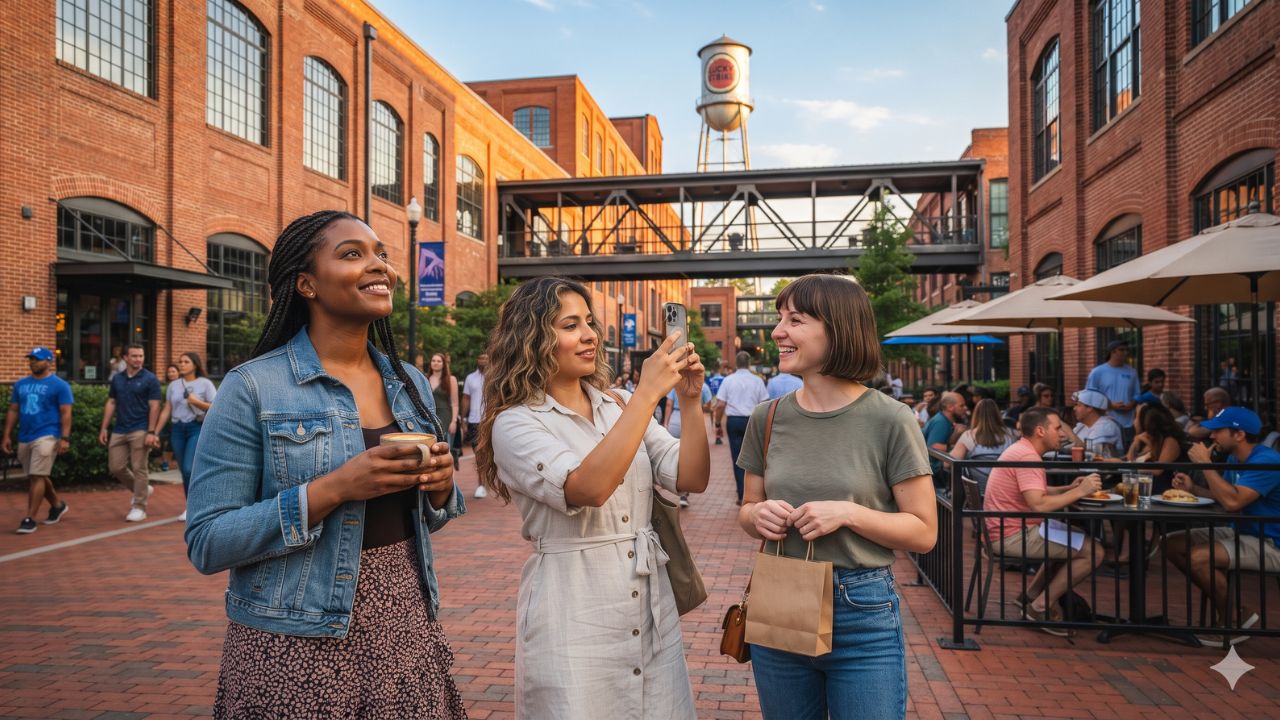
The epicenter of this transformation is the American Tobacco Campus. Former brick cigarette manufacturing warehouses, complete with a towering brick smokestack and the historic Lucky Strike water tower, now house tech startups, open-air grassy gathering lawns, craft breweries, and an artificial whitewater river channel. A pedestrian footbridge connects the campus to the Durham Performing Arts Center (DPAC), which welcomed more than 600,000 patrons across 258 performances during its 2025–2026 season, ranking among the most attended theater venues in the nation for Broadway touring shows.
Equally central is the enduring legacy of Parrish Street, known historically as "Black Wall Street." During the Jim Crow era, African American entrepreneurs founded North Carolina Mutual Life Insurance and Mechanics and Farmers Bank along this four-block downtown corridor, establishing an economic capital of Black wealth and independence. In 2026, Durham Next advanced community support for "Breathe Parrish," an augmented-reality and sensory installation that brings the stories of historic Black business pioneers to life for visiting pedestrians.
West of downtown, Sarah P. Duke Gardens completed a $30 million "Garden Gateway" expansion in April 2026. The project unveiled a state-of-the-art welcome center, modernized pathway access, and expanded public horticulture zones across its 55 acres of landscaped grounds, inviting travelers into quiet woodlands, terraced flower amphitheaters, and traditional Japanese koi ponds.
Emerging Tourism Drivers: Sports Expansion and Festival Investments
Recognizing that spending growth has flattened, municipal leaders are actively developing new reasons for travelers to visit during shoulder seasons. In May 2026, the Durham Sports Commission hosted the inaugural Garmin Marathon Series, drawing more than 6,000 registered runners from 48 states and 17 countries, producing an estimated economic impact exceeding $4 million ahead of its scheduled return in May 2027.
Similarly, professional women’s athletics delivered an unexpected economic lift in 2026. The Carolina Blaze professional softball franchise completed its inaugural 13-game home season in Durham, generating nearly $5.95 million in direct economic activity, selling 23,077 tickets, and booking 8,976 hotel room nights from traveling fans spanning 20 states. Concurrently, Durham Next directed $535,000 in hotel-occupancy tax grants to 11 cultural festivals—including documentary film showcases, dance festivals, and Black heritage programs—to ensure arts funding directly benefits independent neighborhood venues.
Regional access is also expanding. Raleigh-Durham International Airport (RDU) added transatlantic service to Dublin via Aer Lingus in April 2026, followed by Volaris flights to Guadalajara in October 2026, expanding the airport's route map to 91 nonstop destinations operated by 19 airlines.
Visitor Insider Tips: Neighborhood Bases, Barbecue Etiquette, and Campus Transit
To experience Durham with the depth of a longtime resident, adopt these practical travel habits:
- Base Yourself in Downtown Pedestrian Quarters: Skip generic highway hotels along Interstate 40. Reserve a boutique room in Downtown Durham near CCB Plaza or the American Tobacco District. From here, you can walk to DPAC, dozens of craft taprooms, and the Durham Bulls Athletic Park without renting a car.
- The True Carolina Barbecue Circuit: Understand the local barbecue landscape. North Carolina is famous for Eastern-style whole-hog barbecue, chopped finely and seasoned with a sharp vinegar-and-pepper sauce. Order a chopped pork platter with crispy cracklings, vinegar coleslaw, and fried hushpuppies at local smokehouses around downtown and North Durham.
- Visit Duke Gardens at Dawn: Sarah P. Duke Gardens opens daily at 8:00 AM with free public admission. Arrive right at opening to stroll the Terrace Gardens and Historic Pavilion before midday student crowds and photo shoots arrive. Park at the newly renovated Garden Gateway entrance along Anderson Street.
- Walk Parrish Street with an Audio Guide: Spend an hour walking Parrish Street between North Corcoran and North Mangum streets. Look for bronze sidewalk markers detailing the architects, bankers, and civil rights leaders who built Black Wall Street, pairing your stroll with an espresso from a nearby independent coffee counter.
- Transit Between RDU and the Bull City: If traveling light from Raleigh-Durham International Airport, take the regional GoTriangle Route 100 bus directly from the terminal to the Durham Station Transportation Center for standard public transit fare, avoiding expensive rideshare surcharges during evening peak arrival banks.
Cultural and Environmental Context: Sustainable Urban Balancing in the Triangle
Durham’s current evolution reflects the challenges of rapid metropolitan expansion across North Carolina’s Research Triangle. As thousands of corporate and technology workers relocate to the region each year, municipal planners face the delicate task of encouraging tourism while safeguarding community heritage against gentrification.
The Durham Next Destination Master Plan establishes 61 specific community recommendations, shaped by direct contributions from more than 2,300 local residents and civic stakeholders. Rather than prioritizing generic hotel towers, the plan emphasizes sustainable green infrastructure, historical preservation on Parrish Street, and upgrading community recreation facilities like Durham County Memorial Stadium. By reinvesting visitor-paid lodging taxes into local cultural festivals, public arts programming, and park expansions, Durham demonstrates how a modern visitor economy can enrich neighborhood vitality while preserving the working-class soul of the Bull City.
FAQ: Exploring Durham North Carolina 2026
What is the best neighborhood to stay in when visiting Durham?
Downtown Durham and the American Tobacco District offer the best walking access to restaurants, breweries, DPAC performances, and Durham Bulls baseball games.
Is Sarah P. Duke Gardens free to visit?
Yes. Admission to Sarah P. Duke Gardens is free year-round from 8:00 AM until dusk, though on-site parking at the new Garden Gateway entrance requires an hourly municipal parking fee.
How far is Durham from Raleigh-Durham International Airport (RDU)?
Durham is located approximately 14 miles northwest of RDU airport, a quick 18- to 22-minute drive via Interstate 40 under standard traffic conditions.
What food specialty is Durham most famous for?
Durham is celebrated for Eastern North Carolina whole-hog vinegar-based barbecue, alongside a nationally recognized farm-to-table Southern restaurant scene that drives over $324 million in annual dining spending.
In the shadow of historic tobacco brick and sunlit sweetgum trees, Durham proves that a city's greatest wealth lies not in polished slogans, but in the enduring flavor of its kitchens and the proud spirit of its streets.
Related Travel Guides
California Central Coast Tourism 2028: SLO CAL Capitalizes on Rail Links and Olympic Momentum
Kersey Colorado Travel Guide: Organic Farms, South Platte River, and 150th Anniversary Heritage
The Best Craft Breweries, Secret Food Trucks, and Historic Alleys in Durham, According To Reddit (Coming Soon)
This article is for informational purposes. Flight routes, passenger regulations, visa rules, and transit advisories are subject to change by airlines and aviation authorities. Readers are advised to verify schedules and travel documentation with relevant carriers and border agencies before departure.
Related Stories

American Cruise Travel 2027: Record 22.4M Passengers Reshape Caribbean, Alaska, and European Sailings
California Central Coast Tourism 2028: SLO CAL Capitalizes on Rail Links and Olympic Momentum