
Vietnam’s Khuan Bang Shows How Small Villages Can Create Big Tourism Opportunities Through Heritage and Community
Vietnam’s Khuan Bang Shows How Small Villages Can Create Big Tourism Opportunities Through Heritage and Community

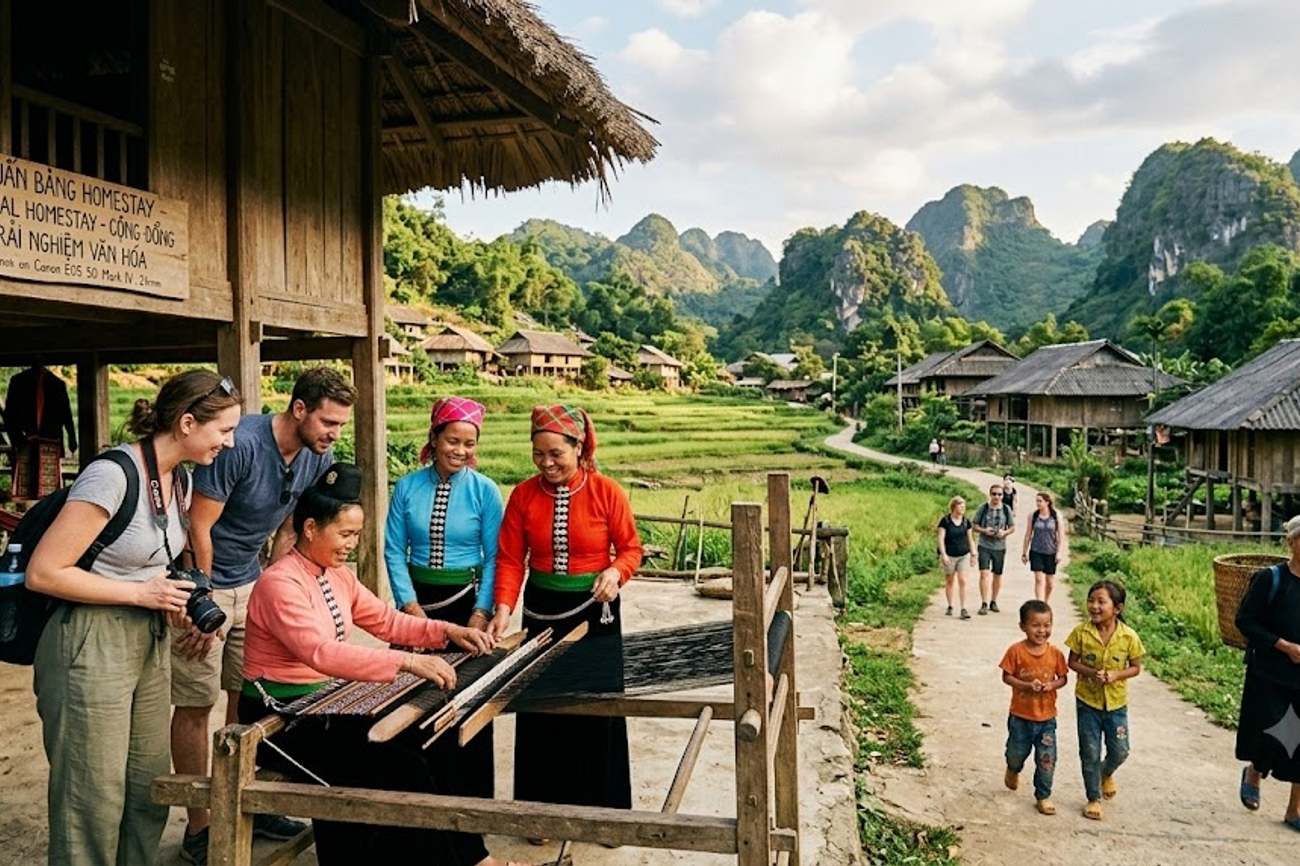
Image generated by AI
Vietnam's rural tourism pivot is evidenced by the transition of Khan Bang from a purely agrarian economy to a diversified service model, mirroring a broader national shift where community-based tourism (CBT) is now outperforming traditional mass-tourism growth in several highland provinces. While the village previously relied exclusively on farming, forest exploitation, and livestock, the formal recognition of Khan Bang as a community tourism destination in 2023 has converted static cultural assets—specifically 40 traditional stilt houses—into active revenue-generating hospitality units.
The Rural Pivot in Numbers: Khan Bang’s Asset Conversion
The economic restructuring of Khan Bang Hamlet, located in the Cho Moi Commune of Thai Nguyen Province, provides a precise case study in asset monetization. The village consists of approximately 60 households, the majority of whom belong to the Tay ethnic group. The shift from a primary sector economy (agriculture) to a tertiary sector economy (tourism) is quantified by the repurposing of existing residential infrastructure.
The core of this transition is the utilization of 40 traditional stilt houses. These structures, which historically served only as private family dwellings, have been upgraded into homestay facilities. This conversion involves a specific investment pattern: the maintenance of original architectural character coupled with targeted upgrades to sanitation and sleeping quarters. By utilizing the areas beneath these houses for communal cultural exchanges, the community has created a dual-use space that serves both as a residence and a commercial venue.
Beyond residential assets, the community has integrated four primary natural landmarks into its tourism circuit:
- Tam Kha Lake
- Khe Cup Waterfall
- Nam Tac Hill
- Thames Hon Cave
This integration transforms the natural environment from a resource for exploitation (forest activities) into a service-based attraction. The economic model here is not replacement but supplementation; agriculture, tea cultivation, and rice production continue to operate, but they now function as "experiential products" for visitors rather than solely as commodities for market sale.
Comparative Context: Community-Based Tourism (CBT) vs. Mass Tourism
The development of Khan Bang reflects a strategic shift in the Vietnamese tourism sector. According to data trends monitored by the World Tourism Organization (UNWTO), there is a global movement toward "regenerative travel," where the goal is to leave a destination better than it was found. Vietnam is applying this at a micro-level through pilot sites like Khan Bang.
Historically, rural tourism in Vietnam often followed a "top-down" model where external investors built resorts near ethnic villages, leading to leakage—where the majority of profits left the local community. The Khan Bang model is "bottom-up," utilizing government funding for infrastructure (directional signs, public sanitation, and visitor welcome points) while keeping ownership of the hospitality assets in the hands of the 60 local households.
The following table compares the traditional agrarian model of Khan Bang against the new Community-Based Tourism (CBT) model implemented since 2023.
| Metric | Pre-2023 Agrarian Model | Post-2023 CBT Model | Shift Analysis |
|---|---|---|---|
| Primary Income Source | Farming, Forest Exploitation | Diversified: Agri + Tourism | Reduced economic volatility |
| Infrastructure Use | Private Residential (Stilt Houses) | Hybrid: Residential + Homestay | Asset monetization |
| Labor Focus | Physically Demanding Manual Labor | Service-Oriented / Cultural Guide | Shift toward skilled services |
| Asset Value | Land/Livestock Commodity | Cultural Heritage/Experience | Transition to intangible asset value |
| Environmental Role | Resource Extraction | Conservation & Sightseeing | Sustainable resource management |
This shift aligns with broader trends reported by the World Travel & Tourism Council (WTTC), which indicate that travelers are increasingly seeking "authentic" and "off-the-beaten-path" experiences over standardized luxury. By preserving Then singing, Tinharé lute performances, and traditional fabric-making, Khan Bang is positioning itself within a high-growth niche of the travel market.
What This Means for Travelers
The transition of Khan Bang into a formal tourism destination alters the booking and experience profile for the individual traveler. Because the village relies on a limited number of renovated stilt houses (a subset of the 40 available), capacity is strictly capped.
Booking Strategy: Travelers seeking authentic Tay cultural experiences should avoid "walk-in" expectations. Since these are family-run homestays rather than commercial hotels, availability is volatile. Booking 4-6 weeks in advance is recommended, particularly during peak cultural festivals or harvest seasons when tea landscapes are most scenic.
Experience Expectations: Visitors should prepare for "semi-structured" travel. The infrastructure—funded by government pilot programs—now includes directional signs and welcome points, but the core experience remains rural. The value proposition here is the "living community" aspect; visitors are not entering a museum, but a working village where rice and tea production continue.
Economic Impact: Spending in Khan Bang has a direct, high-impact correlation with local welfare. Unlike staying at a corporate hotel in a major city, payments for homestays and handicrafts (basket weaving and fabric-making) go directly to the households of the Cho Moi Commune, supporting a sustainable local economy.
Forward Projection: The Scalability of the Tay Model
Based on the current trajectory, Khan Bang is likely to move from a "pilot site" to a "blueprint site." The success of integrating government-funded public works (sanitation and signage) with private household investment creates a scalable framework for other ethnic minority communities across Vietnam.
We can project a shift in the regional tourism flow. As primary hubs like Hanoi and Sapa reach saturation points, "satellite destinations" like Khan Bang will see a Year-over-Year (YoY) increase in arrivals. This will likely lead to a secondary wave of investment in local transport links and digital visibility.
However, the critical risk factor is "over-tourism." To maintain the authenticity that attracts visitors, the community must resist the urge to build large-scale commercial hotels. The data suggests that the current model—maintaining the 40-house limit and integrating tourism with existing farming—is the only way to prevent the "museumification" of the Tay culture. If the village maintains this balance, it will likely see a steady increase in high-value, low-impact travelers who prioritize cultural integrity over luxury.
FAQ: Khan Bang Community Tourism 2024
Will prices for homestays in Khan Bang increase? Yes, as infrastructure improves and demand for authentic experiences grows, pricing will likely stabilize at a higher point than traditional rural lodging. However, costs remain significantly lower than commercial resorts.
Is this a good time to visit Khan Bang? Yes. The village has recently completed government-funded infrastructure upgrades (signs and sanitation), meaning the visitor experience is now more accessible while the destination remains undiscovered by mass tourism.
Which activities provide the most authentic Tay experience? Engaging with Then singing, Tinharé lute performances, and participating in traditional fabric-making offers the deepest connection to the community's heritage, as these are living traditions rather than staged performances.
How does this tourism model benefit the local environment? By shifting the economy from forest exploitation to sightseeing (e.g., Tam Kha Lake and Khe Cup Waterfall), the community has a financial incentive to preserve the natural landscape rather than extract resources from it.
The conversion of ancestral stilt houses into economic assets proves that cultural preservation is not a cost, but a competitive advantage in the modern travel economy.
#TayCultureVietnam #CommunityBasedTourism #ThaiNguyenTourism #SustainableRuralDevelopment #VietnamCBT2024 #EthnicTourismGrowth
Related Travel Guides
- Bermuda Aligns Cayman Islands and More Dismantle Digital Nomad Tourism as Short-Term Rentals and Visa Schemes Face Major Regulatory Crackdown
- Costa Rica’s Digital Detox Tourism Boom Shows Why Travellers Are Searching for Silence and Slow Living
- Indonesia Launches Wonderful Indonesia Gastronomy 2026 Festival Across Solo, Yogyakarta, and 14 Major Cities to Showcase Culinary Heritage
Disclaimer
This article is for informational and educational purposes only. It does not constitute legal, financial, or professional advice. While we strive to provide accurate and up-to-date information, travel policies, regulations, and conditions change rapidly. Always verify information with official sources before making travel decisions. Nomad Lawyer makes no representations about the accuracy, reliability, completeness, or suitability of the information provided. Readers should consult qualified professionals for advice specific to their circumstances. The views expressed in this article are those of the author and do not necessarily reflect the views of Nomad Lawyer.
Preeti Gunjan
Contributor & Community Manager
A passionate traveller and community builder. Preeti helps grow the Nomad Lawyer community, fostering engagement and bringing the reader experience to life.
Learn more about our team →