Nepal and Indonesia Forge Landmark Mountaineering Partnership to Elevate Guide Safety and Adventure Tourism

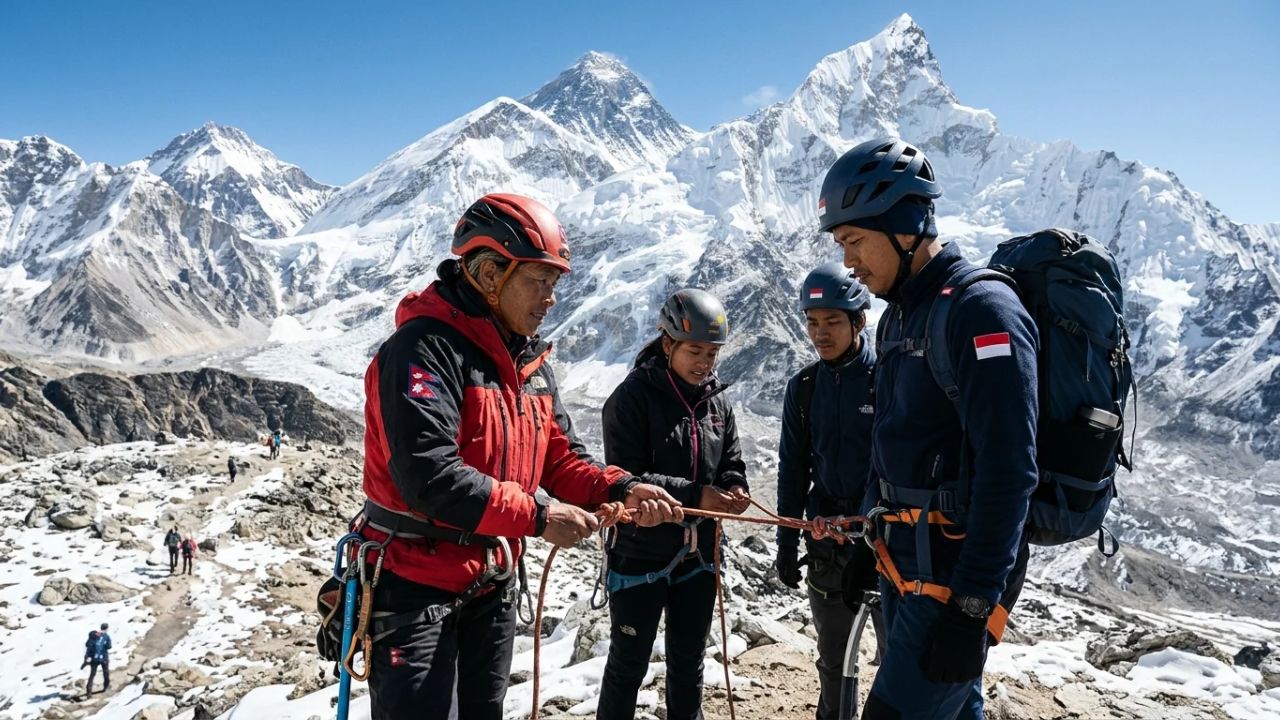
The Nepal National Mountain Guide Association and the Indonesian Mountaineering Federation partner in Kathmandu to advance guide training and alpine rescue.
KATHMANDU, Oct 31 (Nomad Lawyer) — In a landmark trans-Asian mountain diplomacy development, the Nepal National Mountain Guide Association (NNMGA) and the Indonesian Mountaineering Federation (Federasi Mountaineering Indonesia or FMI) have established a formal bilateral partnership to elevate climbing safety standards, advance technical guide education, and foster sustainable adventure tourism. Formalized through a Memorandum of Understanding (MoU) signed in Kathmandu on October 30, 2026, alongside the International Climbing and Mountaineering Federation (UIAA) General Assembly, the accord bridges the high-altitude Himalayan expertise of Nepal with the complex tropical and volcanic mountaineering landscapes of the Indonesian archipelago.
[!NOTE] Accord Overview: Executed on October 30, 2026, in Kathmandu with diplomatic representation from both nations, the partnership focuses on joint instructor exchanges, professional guide certification, and climbing safety management. The Indonesian Mountaineering Federation has formally designated high-altitude search and rescue (SAR) operations as the primary operational priority for bilateral training across the 2027–2028 calendar.
NEPAL-INDONESIA MOUNTAINEERING PARTNERSHIP ARCHITECTURE
| Column 1 |
|---|
| [Institutional Drivers] ----------> NNMGA (Nepal) & FMI (Indonesia) |
| MoU Executed: Kathmandu, October 30, 2026 |
| [Diplomatic Context] -------------> UIAA General Assembly 2026 in Kathmandu |
| Indonesian Diplomatic Mission Participation |
| +------------------------------------------------+------------------------+ |
| v v |
| [Himalayan High-Altitude Domain] [Tropical Volcanic Island Domain] |
| - 8,000-Meter Extreme Altitude Physiology - Active Volcanic Gas Hazard Mgmt |
| - Glacial Navigation & Crevasse Rescue - Unstable Scree & Lahar Traversal |
| - High-Angle Snow & Ice Anchoring Systems - Tropical Rain & Jungle Navigation |
| - IFMGA International Credential Pipeline - Multi-Island Dispersed Logistics |
| \ / |
| \ / |
| v v |
| [2027–2028 JOINT OPERATIONAL ROADMAP] |
| Priority Focus: High-Altitude Mountain Search & Rescue (SAR) |
| Instructor Exchanges, Field Safety Drills, & Curriculum Harmonize |
| v |
| [Long-Term Adventure Tourism Impact] |
| Mitigate Commercial Client Risks on Extreme Trekking Routes |
| Establish Professionalized, Certified Guiding Standards Across Asia |
The Kathmandu Accord: Strategic Synergy Between Himalayan and Volcanic Powers
The formal signing of the Memorandum of Understanding in Kathmandu marks an innovative chapter in Asian alpine cooperation. While international mountain guiding education has historically been dominated by Western European institutions centered around the Alps, the bilateral pact between the Nepal National Mountain Guide Association and the Indonesian Mountaineering Federation represents an emerging model of South-South technical collaboration.
The timing of the accord was strategically coordinated with the 2026 General Assembly of the International Climbing and Mountaineering Federation (UIAA), hosted in the Nepali capital. The assembly gathered international delegates, expedition leaders, and mountain safety researchers from around the world. Taking advantage of this global gathering, executive leadership from NNMGA and FMI convened alongside senior representatives from the Indonesian diplomatic mission in Kathmandu to formalize their cooperative framework.
The agreement establishes an institutional mechanism designed to share specialized mountain knowledge without altering the sovereign regulatory jurisdictions or permitting authorities of either nation. Instead of imposing rigid, homogenized bureaucratic mandates, the MoU creates a structured pipeline for practical training, instructor exchanges, safety protocol development, and capacity building tailored specifically to the unique topography and climbing environments of each country.
| Institutional Metric | Nepal National Mountain Guide Association (NNMGA) | Indonesian Mountaineering Federation (FMI) |
|---|---|---|
| Year of Establishment | 2005 | Established national governing body for climbing |
| International Affiliation | Full Member of IFMGA / UIAGM (since 2012) | Member of UIAA (International Climbing Federation) |
| Primary Geographic Focus | High-altitude Himalaya, 8,000m peaks, glacial valleys | Tropical volcanic peaks, Ring of Fire ridges, dense rain forests |
| Key Operational Strength | Extreme altitude endurance, ice climbing, crevasse rescue | Volcanic terrain navigation, tropical expedition logistics |
| Guiding Workforce Scope | Certified IFMGA guides, national aspirants, expedition sirdars | National trekking guides, volcanic park rangers, rescue teams |
By formalizing this partnership, both organizations recognize that the international adventure travel market has evolved. Modern adventure tourists who book trekking and mountaineering holidays in the Himalayas or across Southeast Asia expect professionalized guiding services, rigorous risk management protocols, and clear emergency response capabilities. Through coordinated educational initiatives, NNMGA and FMI aim to elevate the professional standing of their respective mountain workforces, ensuring that adventure tourism continues to expand responsibly and safely.
Contrasting Mountain Environments: Himalayan Extremes Versus Tropical Volcanic Rifts
The technical core of the Nepal-Indonesia partnership lies in the profound contrast between their respective mountain environments. Rather than viewing these geographic differences as an obstacle to cooperation, both federations recognize that exposure to contrasting terrains will produce more adaptable, highly skilled mountain professionals.
Nepal's mountain geography is defined by the colossal uplift of the Greater Himalaya, hosting eight of the world's fourteen peaks exceeding 8,000 meters, including Mount Everest (Sagarmatha), Kanchenjunga, Lhotse, Makalu, and the Annapurna massif. Operating in the Himalayas demands mastery of extreme altitude physiology, where atmospheric pressure drops precipitously, exposing climbers to acute mountain sickness (AMS), high-altitude pulmonary edema (HAPE), and high-altitude cerebral edema (HACE). Additionally, Himalayan routes require advanced technical competencies in traversing active seracs, crossing heavily crevassed glaciers, anchoring safety lines on vertical blue ice, and enduring sub-zero temperatures that induce severe hypothermia and frostbite within minutes.
CONTRASTING GEOGRAPHICAL AND OPERATIONAL PROFILES
| Column 1 |
|---|
| [Nepal: Himalayan Alpine Realm] [Indonesia: Tropical Volcanic Realm] |
| - Permanent Snow, Glacial Ice, Moraines - Active Volcanic Vents, Crater Rims |
| - Severe Freezing Weather, Blizzards - Tropical Torrential Rain, Humidity |
| - Hypoxia, Extreme Oxygen Depletion - Toxic Gas Emissions (SO2, H2S, CO2) |
| - Helicopter Evacuations in High Winds - Jungle Density, Remote Island SAR |
Indonesia, situated along the seismically volatile Pacific Ring of Fire, presents an entirely different set of operational challenges. The Indonesian archipelago encompasses hundreds of volcanic peaks rising steeply from tropical sea level to elevations between 3,000 and nearly 4,000 meters. Iconic trekking destinations include Mount Rinjani on Lombok (3,726 meters), Mount Semeru in East Java (3,676 meters), and Mount Kerinci in Sumatra (3,805 meters).
While Indonesian peaks do not reach the extreme elevations of the Himalayas, guiding in volcanic environments involves distinct hazards. Mountain guides must continuously evaluate volcanic activity, including unexpected eruptions, pyroclastic ash clouds, and venting of toxic volcanic gases such as sulfur dioxide (SO2), hydrogen sulfide (H2S), and carbon monoxide (CO). The terrain is characterized by steep, unstable volcanic scree, loose pumice, and steep caldera rims prone to catastrophic landslides during sudden tropical cloudbursts. In addition, the lower approaches require navigating dense equatorial rain forests where heat exhaustion, dehydration, and navigation through thick jungle canopies test a guide's logistical resourcefulness.
By synthesizing these two distinct operational domains, the partnership enables Nepali guides to gain deep insight into volcanic hazard management, tropical search and rescue, and dispersed archipelago logistics. In return, Indonesian climbing instructors gain direct access to world-leading Himalayan methodologies in high-altitude acclimatization, fixed-rope rigging, and technical ice rescue.
Technical Guiding Standards: The Role of IFMGA Recognition and Professional Pedigree
A major objective of the collaboration is strengthening professional mountain guiding standards and aligning national training frameworks with established international benchmarks.
In international mountaineering, the gold standard of professional qualification is governed by the International Federation of Mountain Guides Associations (IFMGA / UIAGM / IVBV), founded in 1965. Achieving full member status within the IFMGA requires rigorous multi-year evaluations covering four demanding disciplines: rock climbing, alpine mountaineering, ice climbing, and ski mountaineering.
The Nepal National Mountain Guide Association (NNMGA), established in 2005, achieved a historic milestone in 2012 by becoming a full member of the IFMGA. This distinction placed Nepal in an elite global cadre, standing alongside Japan and Kyrgyzstan as the only nations in Asia to achieve full IFMGA accreditation. Over the past decade and a half, certified Nepali mountain guides have instructed across international expeditions, serving as lead climbers and safety directors on high-profile ascents in the Himalayas, the Karakoram, the European Alps, and the Americas.
| Federation Milestone | Key Achievement & Professional Relevance | Strategic Value for Asia-Pacific Tourism |
|---|---|---|
| NNMGA Establishment (2005) | Unified Nepali climbing sherpas and high-altitude instructors under a single professional association | Shifted mountain guiding in Nepal from informal portering to an internationally recognized profession |
| IFMGA Accreditation (2012) | Nepal became the third Asian nation to achieve full voting membership in the global mountain guide federation | Certified Nepali guides holding the IFMGA carnet can legally guide commercial expeditions worldwide |
| International Instruction Role | Nepali instructors deployed to conduct alpine training clinics across Asia, North America, and Europe | Establishes Nepal as an educational exporter of extreme-altitude technical knowledge |
| FMI Strategic Alliance (2026) | Formal bilateral partnership linking Indonesian instructors with NNMGA training academies | Provides Indonesia with a direct developmental bridge toward international guide standardization |
For the Indonesian Mountaineering Federation (FMI), collaborating with the NNMGA provides direct access to an established curriculum that has already successfully adapted European alpine standards to Asian high-altitude realities. Rather than attempting to invent a national guide certification system in isolation, Indonesian climbing authorities can examine the structural progression, examination standards, and ethical codes developed by the NNMGA over the past twenty years.
This institutional exchange is intended to support the gradual professionalization of Indonesia's mountain tourism workforce. As trekking popularity accelerates across Mount Rinjani, Mount Semeru, and the high-altitude peaks of Papua (including Carstensz Pyramid / Puncak Jaya), establishing standardized qualifications for Indonesian mountain guides ensures that commercial clients receive consistent, highly competent safety oversight.
Priority Initiative for 2027–2028: High-Altitude Search and Rescue (SAR) Systems
Following the signing of the Kathmandu accord, executive leadership from the Indonesian Mountaineering Federation confirmed that high-altitude mountain search and rescue (SAR) has been formally designated as the primary operational priority for joint collaboration during the 2027–2028 biennial period.
Mountain search and rescue represents one of the most hazardous undertakings in the adventure sports sector. When an accident occurs on an isolated peak, the window for successful intervention is extraordinarily narrow. Rescuers must contend with severe terrain, deteriorating weather, limited communications, and the physiological vulnerability of the injured climber.
2027–2028 JOINT SAR TECHNICAL TRAINING ROADMAP
| Column 1 |
|---|
| [Phase 1: Curriculum Harmonization] ----> Joint Working Group (Early 2027) |
| Review emergency protocols, medical triage, |
| and technical rigging standards |
| [Phase 2: Himalayan High-Altitude Camp] -> Langtang / Annapurna Ranges (Autumn 2027) |
| - Extreme altitude emergency medicine |
| - Glacial crevasse extrication systems |
| - Long-line helicopter hoist operations |
| [Phase 3: Volcanic & Jungle SAR Camp] ---> Mount Rinjani / Mount Semeru (Spring 2028) |
| - Crater rim technical rope evacuation |
| - Toxic gas detection & plume management |
| - Jungle litter carry & rainforest tracking |
| [Phase 4: Bilateral Simulation Drill] ---> Integrated Emergency Response Exercise |
| Deploying mixed teams under simulated crisis |
The 2027–2028 training schedule envisions a multi-stage operational progression. In the initial phase, instructors from both organizations will convene to harmonize technical terminology, rope-rigging methodologies, and emergency medical protocols. Following this foundational alignment, joint field training camps will be staged in the high valleys of Nepal, focusing on extreme-altitude emergency medical care, hypothermia management, specialized stretcher transport across boulder moraines, and high-angle rope hauling systems designed for crevasse rescue.
In the subsequent phase, training will shift to the volcanic terrain of Indonesia, staging exercises across the rugged slopes of Mount Rinjani on Lombok and Mount Semeru in East Java. These field sessions will address rescue scenarios unique to volcanic island geography: extricating injured trekkers from steep volcanic crater walls, managing toxic gas detection during search operations, navigating unstable pumice scree slopes, and executing litter carries through dense, rain-soaked tropical forests where helicopter access is impossible due to low cloud cover.
By combining Nepal's extensive experience in high-altitude helicopter rescue and technical rope systems with Indonesia's proficiency in ground tracking and jungle evacuation, both organizations aim to produce a cadre of highly versatile search and rescue instructors capable of managing complex emergencies across diverse environments.
Adventure Tourism Economics: Enhancing Safety in High-Volume Trekking Corridors
The commercial significance of the Nepal-Indonesia mountaineering partnership extends directly into the broader adventure tourism economy. Across both nations, mountain-based travel serves as a vital economic engine, generating foreign exchange receipts, sustaining regional hospitality businesses, and providing employment for thousands of guides, porters, and transport operators.
In Nepal, mountain tourism is the cornerstone of the national travel sector. High-volume trekking corridors—such as the Everest Base Camp trek in the Khumbu region, the Annapurna Circuit, the Langtang Valley, and the remote Manaslu Circuit—attract tens of thousands of international visitors every spring and autumn. The economic viability of these mountain communities depends on maintaining international confidence in route safety, trail infrastructure, and guiding professionalism.
Similarly, Indonesia has experienced explosive growth in domestic and international mountain trekking. The volcanic landscapes of Java, Bali, Lombok, and Sumatra have transformed from backcountry hiking routes into major adventure tourism assets. Annually, thousands of international visitors climb Mount Bromo, Mount Ijen, Mount Rinjani, and Mount Semeru, injecting substantial revenue into rural island economies through homestays, transport hires, national park fees, and local food services.
| Country & Regional Focus | Flagship Mountain Tourism Corridors | Primary Economic Beneficiaries | Adventure Tourism Safety Priorities |
|---|---|---|---|
| Nepal (Himalayan Arc) | Everest Base Camp (Khumbu), Annapurna Circuit, Manaslu, Langtang | Teahouse lodges, high-altitude porters, regional flight operators, equipment rentals | Altitude sickness prevention, avalanche zone management, glacial crevasse safety |
| Indonesia (Lombok & Java) | Mount Rinjani (Lombok), Mount Semeru (East Java), Mount Bromo, Kerinci | Local village homestays, licensed porters, park rangers, regional transport vans | Volcanic gas monitoring, loose scree stability, flash flood & landslide preparedness |
| Bilateral Economic Synergy | Shared adventure tourism markets across Asia-Pacific and Western Europe | International tour operators, specialized adventure travel agencies, equipment brands | Consistent guide certification, transparent safety standards, client risk mitigation |
However, rapid growth in adventure tourism can expose destinations to heightened operational vulnerabilities if guiding standards fail to keep pace with visitor volumes. Commercial clients who undertake mountain expeditions often possess limited mountaineering experience, relying entirely on their guides to make critical decisions regarding weather, pacing, acclimatization, and safety.
By investing in formalized guide training, certification frameworks, and search and rescue readiness, Nepal and Indonesia are protecting the long-term sustainability of their adventure tourism sectors. International tour wholesalers and specialized adventure travel agencies in Europe, North America, and East Asia prioritize destinations where local operators operate under verifiable safety standards. Ensuring that mountain guides possess standardized technical training reduces the incidence of preventable accidents, mitigates commercial liability for travel companies, and reinforces the international reputation of both countries as world-class adventure destinations.
Educational Curriculum and Instructor Exchanges: Building Adaptable Mountain Leaders
Central to the long-term vision of the partnership is the development of an adaptable, multi-tiered educational curriculum that can serve as the foundation for mountain guide instruction in both countries.
Rather than adopting a rigid European alpine training model that presumes consistent access to glaciers and ski infrastructure, NNMGA and FMI are collaborating to design educational modules that reflect Asian environmental realities. The curriculum balances hard technical skills with critical leadership and environmental stewardship competencies.
Technical modules will encompass rope management, anchor construction on diverse rock and ice mediums, ascending and descending techniques, mechanical advantage hauling systems, and high-altitude navigation utilizing modern GPS mapping alongside traditional compass and topographical map interpretation. In addition, the curriculum places heavy emphasis on wilderness first aid, recognizing that mountain guides are frequently the sole healthcare providers during multi-day expeditions in remote terrain.
CORE CURRICULUM ARCHITECTURE FOR MOUNTAIN GUIDES
| Column 1 |
|---|
| [Technical Rigging & Climbing] ---> Multi-pitch rock anchoring, fixed-line systems, |
| ice axe and crampon techniques, crevasse extricate |
| [Wilderness Medicine & SAR] ------> Advanced high-altitude triage, hypothermia care, |
| HAPE/HACE identification, litter immobilization |
| [Environmental Hazard Analysis] --> Volcanic gas detection, seismic alert reading, |
| snowpack stability evaluation, flash flood routes |
| [Expedition Leadership] ----------> Client psychological management, ethical pacing, |
| conflict resolution, cultural heritage etiquette |
| [Ecological Stewardship] ---------> Leave No Trace principles, high-altitude waste |
| management, fragile volcanic flora preservation |
Equally significant are the non-technical leadership components. Mountain guides must master client management, learning to assess the physical condition and psychological state of commercial climbers under stress. Instructors will train guides to practice proactive communication, recognize subtle early symptoms of altitude sickness or exhaustion, and exercise sound judgment when determining whether to abort an ascent due to worsening weather or volcanic instability.
Environmental preservation forms another foundational pillar of the educational program. High-volume trekking routes in both the Himalayas and Indonesia's volcanic national parks face severe ecological strains, including trail erosion, deforestation for firewood, and accumulation of solid waste. The joint training program incorporates strict "Leave No Trace" principles, training guides to enforce responsible waste disposal, educate clients on fragile alpine and volcanic ecosystems, and advocate for sustainable mountain tourism practices within their local communities.
Multilateral Context: The UIAA General Assembly and Asia's Emerging Alpine Diplomacy
The signing of the Nepal-Indonesia accord in Kathmandu highlights the growing influence of Asian nations within international mountaineering governance.
The International Climbing and Mountaineering Federation (UIAA), founded in 1932, serves as the recognized global authority on climbing safety, equipment standards, and mountain preservation. Hosting the UIAA General Assembly in Kathmandu in late October 2026 provided Nepal with a prestigious platform to showcase its technical leadership and assert its position as a central hub for international mountain policy.
For decades, Asian climbing associations participated in global mountaineering bodies primarily as junior observers, with policy agendas and technical standards established almost entirely by Western alpine nations. Today, the demographic center of gravity in global adventure tourism has shifted dramatically toward Asia. Millions of domestic travelers across China, India, Indonesia, South Korea, and Southeast Asia are actively exploring mountain sports, while Asian climbing destinations attract an increasing share of international expedition capital.
In this context, the partnership between Nepal and Indonesia represents an assertive step toward building regional self-reliance in mountain education and safety governance. By collaborating directly, NNMGA and FMI demonstrate that Asian mountaineering organizations can establish bilateral training frameworks, share technical resources, and professionalize their workforces through horizontal partnerships. This cooperative model paves the way for broader Trans-Asian alliances, potentially involving other regional mountaineering bodies across Central Asia, East Asia, and the South Asian subcontinent in future safety initiatives.
Strategic Traveler Guidelines: Selecting Mountain Expeditions in Nepal and Indonesia
For adventure travelers, alpine trekkers, and climbing enthusiasts planning journeys to the mountain regions of Nepal or Indonesia, understanding how to evaluate expedition operators ensures a rewarding, safe experience.
While the bilateral partnership between NNMGA and FMI establishes a framework for long-term professional development, travelers retain primary responsibility for assessing the credentials of their chosen guiding services.
Guide Credential Verification
When booking a climbing expedition or high-altitude trek, travelers should explicitly inquire about the professional certifications held by their lead guides. In Nepal, look for guides registered with the Nepal National Mountain Guide Association, particularly those holding full IFMGA international credentials or national mountain guide certifications. In Indonesia, verify that your guide is affiliated with the Indonesian Mountaineering Federation (FMI) or accredited through official national park guiding associations on Mount Rinjani or Mount Semeru.
Permit Regulations and Official Clearances
Both nations enforce strict regulatory systems governing mountain access. In Nepal, trekkers must secure Trekkers' Information Management System (TIMS) cards and national park entry permits (such as the Sagarmatha National Park or Annapurna Conservation Area permits), while climbers tackling designated trekking peaks or expedition mountains must obtain formal climbing permits issued by the Nepal Mountaineering Association (NMA) or the Department of Tourism. In Indonesia, trekking in national parks requires advance registration through official portals (such as the e-Rinjani system) to comply with daily carrying-capacity limits. In addition, climbers must monitor alerts issued by the Center for Volcanology and Geological Hazard Mitigation (PVMBG) regarding volcanic activity levels and trail closures.
Physical Preparation and Environmental Specificity
Travelers should tailor their physical training to the specific environmental demands of their chosen destination. Preparing for a Himalayan expedition in Nepal requires rigorous cardiovascular conditioning, endurance training carrying weighted backpacks, and building acclimatization days into the itinerary to prevent altitude-related illnesses. For trekking in Indonesia's volcanic rifts, conditioning must focus on steep stair climbs, leg endurance on loose shifting scree, heat and humidity tolerance, and proper foot care for humid tropical conditions.
Comprehensive Evacuation and Travel Insurance
Standard travel insurance policies almost universally exclude high-altitude mountaineering, technical climbing, and search and rescue operations. Travelers embarking on mountain adventures in either country must secure specialized adventure travel insurance that explicitly covers emergency helicopter evacuation up to the maximum altitude of the planned itinerary, technical mountain search and rescue, and medical treatment for altitude sickness and traumatic injuries.
By taking an informed, prepared approach to mountain travel, international adventurers can experience the awe-inspiring majesty of Nepal's Himalayan peaks and the dramatic grandeur of Indonesia's volcanic rifts with confidence, supporting a safer and more sustainable future for mountain communities across Asia.
Related Travel Guides
- Barcelona Leads European Clampdown with Heavy Tourist Tax Hikes
- Azerbaijan Partners with PATA to Accelerate Asia-Pacific Tourism Growth
- Canada Transforms October Travel into High-Yield Halloween Tourism
- US Bipartisan Coalition Advances Film Tourism and Federal Tax Credits
- Nepal Suspends Restricted-Area Trekking Permits Amid Himalayan Snowstorms
This article is for informational purposes. Flight routes, passenger regulations, visa rules, and transit advisories are subject to change by airlines and aviation authorities. Readers are advised to verify schedules and travel documentation with relevant carriers and border agencies before departure.
Related Stories

Barcelona Leads European Overtourism Clampdown with Heavy Tourist Tax Hikes Across Short-Stay Lodging

Azerbaijan Partners with PATA to Accelerate Asia-Pacific Tourism and Travel Trade Growth