
Travel Chaos Devastates Vancouver Airport as Air Canada, Jazz, and Philippine Airlines Ground 8 Flights to Global Destinations: Latest Airline News
A highly disruptive operational bottleneck at Vancouver International Airport violently strands passengers as major transpacific and domestic carriers suffer sudden groundings and cascading delays.

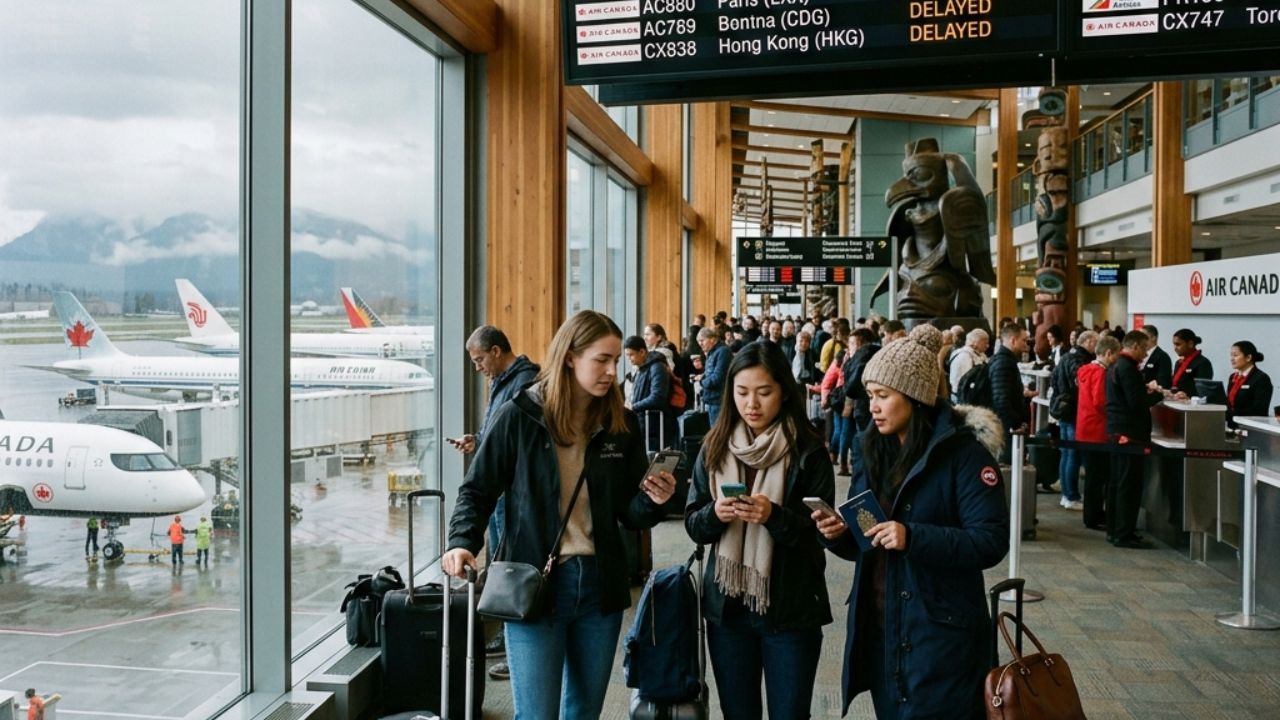
Image generated by AI
A Sudden Logistical Bottleneck on the Canadian West Coast
While the broader global passenger network frequently battles unpredictable localized weather events and massive transcontinental congestion, a highly disruptive wave of operational friction is currently severely straining operations across Canada's premier West Coast gateway. Delivering highly urgent, breaking airline news, verified flight data confirms that Vancouver International Airport (YVR) succumbed to an unexpected and highly frustrating scheduling bottleneck on May 31, 2026. While desperate travelers attempt to navigate sudden, terrifying airport disruptions, these exclusive aviation updates reveal that major mainline and transpacific carriers—including Air Canada, its regional subsidiary Jazz, and Philippine Airlines—were violently forced into aggressive ground holds. This resulted in severe rolling delays and exactly 8 outright flight cancellations. By aggressively stalling critical domestic and international departures across this massive hub, this localized failure has triggered uncontrollable, rolling travel chaos, leaving hundreds of passengers entirely stranded and completely severing vital routes connecting major cities across Canada, the US, Germany, the Netherlands, Switzerland, and Asia.
Expanded Overview: The Scale of the Vancouver Gridlock
The sudden execution of these mass cancellations and severe delays serves as an undeniable example of how rapidly carrier-specific technical and operational hurdles can completely dismantle a major aviation hub's highly optimized schedule. Historically, Vancouver International Airport operates as the premier, highly efficient mega-hub connecting North America directly to massive transpacific and European connection points.
However, the sheer impact of today's disruption has completely dismantled that reliability. Because Vancouver serves as a highly vital aviation hub for the Pacific Rim, these cascading service interruptions quickly began generating gridlock that is expanding rapidly across the globe. The sudden decision by airline operations teams to pull these 8 specific aircraft has left hundreds of passengers stranded inside the terminals. Alongside the cancellations, terminal screens are heavily lighting up with several rolling delays, which are heavily complicating scheduling operations nationwide. Airport officials heavily advised everyone to aggressively verify their flight status online before heading out to the terminal, especially with so many widespread global connections completely compromised. Air travel demand remains incredibly high, but this localized network instability is making scheduling highly unpredictable for transpacific commuters.
Section-Wise Breakdown of the Hub Disruptions
Air Canada and Jazz Suffer Localized Groundings
The operational friction was violently absorbed by Canada's most critical domestic operators. On May 31, 2026, flight cancellation data shows that regional and international air travel experienced isolated yet deep operational disruptions. At Vancouver International Airport, the mainline flag carrier Air Canada felt the absolute largest impact in terms of sheer volume, violently dropping 5 flights from its schedule alongside 9 rolling delays. Fortunately, because of the carrier's massive size, this only represented a relatively low 4% cancellation rate.
Simultaneously, its regional subsidiary, Jazz (ACA), closely followed the mainline struggles. Jazz executed 2 absolute cancellations while battling 8 rolling delays, ultimately maintaining a minor but highly disruptive 1% disruption rate for its localized regional routes.
Philippine Airlines Suffers a Severe Transpacific Breakdown
While the Canadian carriers managed to absorb the sheer volume of their disruptions, foreign flags were absolutely devastated. In stark contrast to Air Canada, Philippine Airlines suffered a brutally severe blow to its daily operational schedule out of YVR. Though the transpacific carrier logged only a single outright cancellation and zero delays, this single dropped flight accounted for a massive 50% breakdown of its total operational capacity for the entire day. This sudden grounding left travelers on that highly critical transpacific route facing absolute disruptions, effectively severing the connection to Manila.
North American and European Corridors Severed
The massive bottleneck in Vancouver instantly pushed devastating ripple effects across highly interconnected international corridors. Across North America, disruptions severely impacted Canadian cities including Calgary, Ottawa, Castlegar, Prince Rupert, Comox, Williams Lake, Saskatoon, Terrace, Victoria, Toronto, Port Hardy, Kelowna, and Sandspit.
Travel within the United States was also violently affected, specifically touching major hubs like Atlanta, Denver, Dallas-Fort Worth, Los Angeles, Chicago, Seattle, San Francisco, Newark, Portland, and Phoenix. Furthermore, Houston operations were also disrupted by the Canadian bottleneck. On the international front, European travel saw highly frustrating delays or cancellations directly linked to major continental gateways in Frankfurt, Munich, Amsterdam, and Zurich. Transpacific networks experienced massive disruptions connecting to Manila and Taipei.
Verified Vancouver Flight Disruption Metrics Table
To fully comprehend the highly severe operational parameters and massive logistical breakdown dictating this localized network collapse, the following table explicitly details the exact cancellation and delay metrics across the heavily impacted carriers operating at Vancouver:
| Airline | Cancelled Flights | Delayed Flights |
|---|---|---|
| Air Canada | 5 | 9 |
| Jazz (ACA) | 2 | 8 |
| Philippine Airlines | 1 | 0 |
Passenger Impact: Stranded Commuters and Emergency Rebooking
For the modern domestic commuter and transpacific tourist, the passenger impact of these massive, sudden disruptions is physically exhausting. Flight cancellations can be incredibly frustrating, but airport officials urge passengers to take immediate, proactive steps. Because Vancouver handles immense daily traffic, the regional backlog is expanding quickly. Disgruntled travelers face incredibly lengthy queues inside YVR while gate agents scramble to desperately rebook stranded passengers.
Stranded travelers must immediately reach out to the airline’s customer service either in person at the airport or over the phone. If caught in the massive lines at Vancouver, utilizing the airline’s digital app can heavily bypass the physical wait. Passengers are strongly urged to aggressively familiarize themselves with airline policies regarding cancellations. Many airlines offer robust rebooking options or direct compensation if the cancellation is actively within their operational control. Furthermore, passengers flying into Europe on affected carriers should immediately review EU regulations, as passengers are entitled to compensation under certain conditions regarding airline-controlled delays.
Industry Analysis: The Devastating Ripple of Hub Congestion
From a macroeconomic and industry operations perspective, the localized flight disruptions at Vancouver highlight how sudden technical hurdles can instantly ripple through a highly interconnected global aviation network. While major domestic carriers like Air Canada and Jazz miraculously managed to absorb their cancellations with relatively low overall percentage rates, smaller-scale operations like Philippine Airlines bore a much more devastating impact, seeing half of its scheduled capacity completely wiped out. For travel analysts, these grounded flights and consecutive delays prove that even a handful of cancellations at a major hub like Vancouver can trigger a massive logistical headache for international travel.
Conclusion: A Highly Volatile Recovery Phase for Vancouver
The sudden, highly publicized reporting of 8 outright cancellations across Air Canada, Jazz, and Philippine Airlines at Vancouver International Airport is a textbook example of how rapidly localized operational constraints can devolve into terminal gridlock. By completely severing critical domestic connections and violently delaying international transpacific routes to Manila and Europe, the disruption has proven that global scheduling architectures remain highly vulnerable to sudden friction. For now, the focus entirely shifts toward operational recovery as carriers work aggressively to clear the massive backlog and stabilize their transatlantic and transpacific networks.
Key Takeaways
- Localized Network Gridlock: Vancouver International Airport (YVR) suffered a highly concentrated wave of 8 absolute flight cancellations.
- Air Canada and Jazz Devastated: Mainline operator Air Canada suffered 5 cancellations and 9 delays, while Jazz executed 2 cancellations and 8 delays.
- Philippine Airlines Paralyzed: The transpacific carrier executed 1 cancellation, representing a massive 50% wipeout of its daily schedule at the hub.
- Global Corridors Severed: Highly critical routes bound for the US (Atlanta, Chicago), Europe (Frankfurt, Amsterdam), and Asia (Manila, Taipei) suffered targeted disruptions.
- Passenger Chaos: Stranded travelers are heavily urged to utilize airline mobile apps for instant rebooking and to avoid the massive customer service queues forming inside the terminal.
Disclaimer: The specific flight cancellation counts, delay percentages, and destination impacts presented in this report are based on verified flight tracking data regarding operations at Vancouver International Airport on May 31, 2026. Official causes for this operational breakdown, subsequent network recovery timelines, and passenger compensation procedures are highly volatile and subject to continuous, real-time update. Affected passengers are urgently advised to monitor their specific booking status directly via their airline's official portal.
Disclaimer
This article is for informational and educational purposes only. It does not constitute legal, financial, or professional advice. While we strive to provide accurate and up-to-date information, travel policies, regulations, and conditions change rapidly. Always verify information with official sources before making travel decisions. Nomad Lawyer makes no representations about the accuracy, reliability, completeness, or suitability of the information provided. Readers should consult qualified professionals for advice specific to their circumstances. The views expressed in this article are those of the author and do not necessarily reflect the views of Nomad Lawyer.
Kunal K Choudhary
Co-Founder & Contributor
A passionate traveller and tech enthusiast. Kunal contributes to the vision and growth of Nomad Lawyer, bringing fresh perspectives and driving the community forward.
Learn more about our team →