Air France Middle East Flight Suspensions: Dubai and Riyadh Schedules, Passenger Rights, and Travel Alternatives

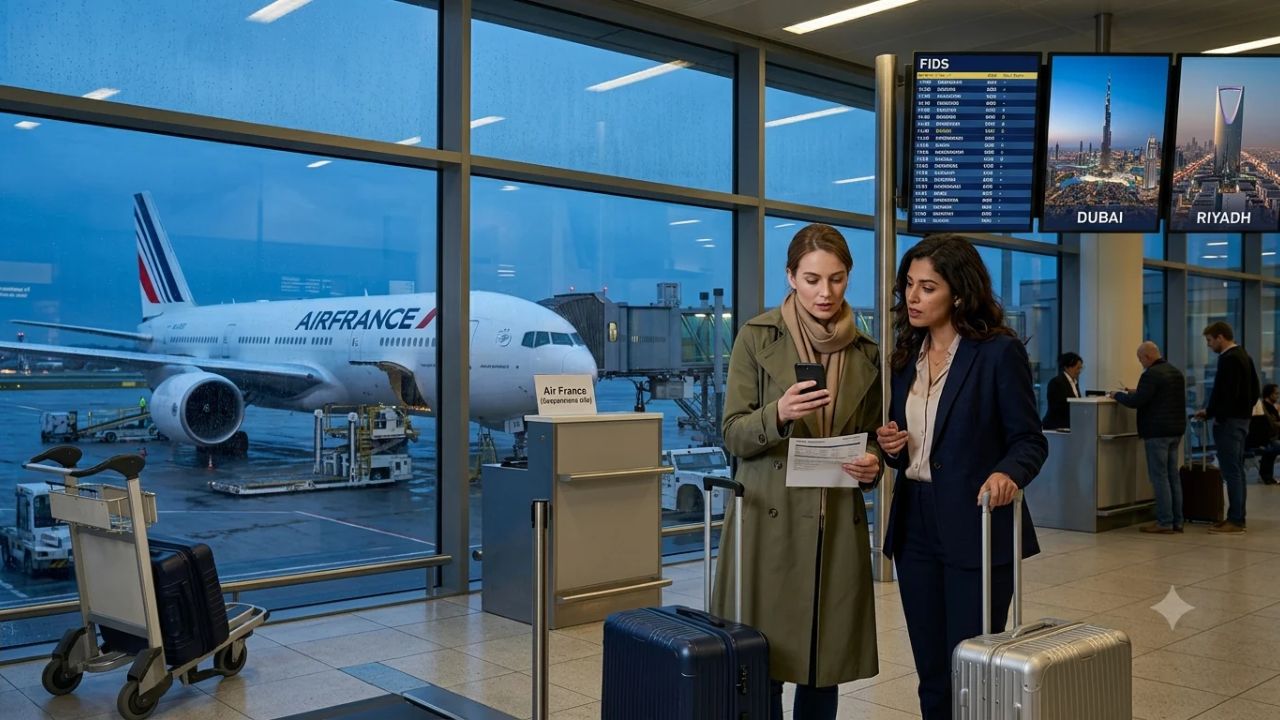
Air France has maintained rolling flight suspensions and schedule adjustments across key Middle Eastern routes including Dubai and Riyadh amid evolving regional airspace restrictions
[PARIS, Oct 30, 2026] — Air France has extended operational flight suspensions and schedule adjustments on key commercial corridors connecting Paris Charles de Gaulle with Dubai International Airport and Riyadh’s King Khalid International Airport, confronting thousands of business travelers and winter holidaymakers with mounting itinerary uncertainty as the 2026–2027 winter aviation season gets underway.
[!NOTE] Key Operational and Regulatory Framework: In its official winter 2026–2027 schedule update released on October 27, 2026, Air France confirmed that while it plans to serve nearly 170 destinations across the Americas, Asia, and Iberia, operational schedules for Middle Eastern destinations remain decoupled from the primary timetable and subject to daily security reviews and airspace closures. The ongoing suspensions place European travelers in a tight planning squeeze, as non-refundable hotel cancellation deadlines, connecting regional flights, and pre-paid desert excursions expire before airlines issue definitive flight confirmations. Under European Union Regulation (EC) No 261/2004 (EU261) and European Commission guidance issued during the regional crisis, passengers on canceled flights maintain an absolute right to choose between a full financial reimbursement within seven days or rerouting under comparable transport conditions. While geopolitical airspace closures qualify as "extraordinary circumstances" exempting airlines from paying fixed statutory compensation (up to €600), carriers remain legally bound to provide duty of care—including hotel lodging, meals, and ground transfers—throughout any operational delay.
AIR FRANCE MIDDLE EAST OPERATIONAL SUSPENSION MATRIX
| Column 1 |
|---|
| [ PRIMARY CORRIDORS IMPACTED: PARIS CHARLES DE GAULLE (CDG) ] |
| - Paris (CDG) <-> Dubai International (DXB): High-density leisure, MICE, and transit link |
| - Paris (CDG) <-> Riyadh King Khalid (RUH): Major commercial, diplomatic, and trade corridor |
| +----------------------------+-----------------------------+ |
| v v |
| [ AIR FRANCE WINTER 2026–2027 PROGRAM ] [ THE PASSENGER TIMING GAP ] |
| - Global Reach: Nearly 170 destinations active - Air France daily rolling updates |
| - Middle East Policy: Segregated from main schedule - Hotel Free Cancellation Deadline: |
| - Decoupled Status: Suspensions evaluated daily based on often 48-72 hours prior to arrival |
| civil aviation security alerts and airspace NOTAMs - Risk: Hotel charges non-refundable |
| +----------------------------+-----------------------------+ |
| v |
| [ STATUTORY PASSENGER PROTECTIONS (EU261 / EC GUIDANCE) ] |
| - Article 8: Inviolable right to full refund (7 days) OR re-routing at earliest opportunity |
| - Article 9: Mandatory Duty of Care (Hotel accommodation, meals, airport transfers) |
| - Article 5(3): Extraordinary circumstances exemption applies to lump-sum cash compensation, |
| but NEVER waives the airline's duty of care or ticket refund obligations |
The Anatomy of the Planning Gap: Timetables vs. Operational Reality
For international holidaymakers and corporate travelers planning trips between Western Europe and the Arabian Gulf, the central difficulty of the current disruption lies in the fundamental distinction between an announced suspension window and a confirmed flight restart.
When an airline announces that flights to a specific destination are suspended through a given calendar date, that announcement merely establishes a minimum cancellation period. It does not guarantee that scheduled departures will resume automatically the following morning. As regional security conditions, geopolitical risks, and civil aviation notices to air missions (NOTAMs) shift, carriers frequently issue rolling 48-hour or 72-hour extensions to their suspension windows.
This rolling schedule creates an acute planning gap for travelers. Air France’s winter 2026–2027 network announcement, published on October 27, 2026, highlighted broad network expansion across North America, Latin America, and southern Europe, but directed passengers seeking Middle Eastern flight information to a dedicated operational update portal. By decoupling Middle East operations from its standard commercial timetable, the airline signaled that flights to Dubai and Riyadh remain subject to tactical, real-time security reassessments.
For a family traveling to Dubai for a mid-winter beach vacation, or a business executive heading to Riyadh for an industrial trade conference, this uncertainty creates immediate logistical friction. Hotel reservations across major luxury resorts in Dubai or corporate hotels in Riyadh often enforce non-refundable cancellation penalties starting 48 to 72 hours before the scheduled check-in time. If a traveler waits for Air France to officially cancel a flight twelve hours before departure, the deadline to cancel or modify their hotel booking without forfeiting thousands of dollars may have already passed.
Regional Security Considerations and Airspace Management
The operational disruptions affecting Air France’s Gulf routes are rooted in complex geopolitical developments and airspace closures that have affected civil aviation corridors across the Levant and the Middle East throughout 2026.
MIDDLE EAST TRANSIT AIRSPACE CONSTRAINTS (2026)
| [ CONVENTIONAL FLIGHT ROUTING: PRE-CRISIS ] |
|---|
| Paris (CDG) -> Central Europe -> Balkans -> Turkey -> Iraq / Iran Corridor -> Arabian Gulf |
| - Efficient flight time: ~6 hours 30 minutes to Dubai; ~6 hours to Riyadh |
| v |
| [ RESTRICTED AIRSPACE: CONFLICT ESCALATION ] |
| - Active NOTAMs and conflict zones over sections of Iraq, Iran, Syria, and the Red Sea corridor |
| - Civil aviation authorities (DGAC France, EASA) advise against overflying specific flight levels |
| v |
| [ TACTICAL DIVERSION CORRIDORS: OPERATIONAL CHALLENGES ] |
| - Route A (Southern Circuit): Egypt -> Red Sea -> Saudi Airspace (Extended track, +60-90 mins) |
| - Route B (Northern Circuit): Caucasus -> Central Asia -> Persian Gulf Entry (Severe congestion) |
| - Consequences: Increased fuel burn, payload limitations, crew duty timeouts, slot delays |
Commercial flight operations between Western Europe and the Gulf traditionally traversed direct corridors crossing southeastern Europe, Turkey, and portions of Iraqi or Iranian airspace before descending toward the Arabian Peninsula. However, escalating military tensions, cross-border missile launches, and unmanned aerial vehicle (UAV) activity prompted civil aviation safety regulators—including the European Union Aviation Safety Agency (EASA) and France's Direction Générale de l’Aviation Civile (DGAC)—to issue conflict zone information bulletins (CZIBs) advising airlines to avoid or severely restrict operations within designated flight information regions (FIRs).
While some international airlines continue to operate into Dubai and Riyadh by flying extended diversion routes around restricted zones, Air France’s corporate safety committee maintains conservative risk-assessment protocols. In its public schedule updates, the airline previously documented that flights were suspended not only due to airspace transit restrictions, but also following tactical evaluations of destination security conditions and ground infrastructure resilience.
Rerouting aircraft around volatile airspace requires significant operational adjustments:
- Flying wide diversions over Egypt and the Red Sea, or navigating northward via the Caucasus and Central Asia, adds between 60 and 90 minutes of flight time to each sector.
- These longer flight paths increase aircraft fuel burn, forcing carriers to impose payload restrictions that limit passenger capacity or cargo weight.
- Extended flight times can cause flight crews to exceed legal Flight Duty Periods (FDP), creating scheduling complications that affect subsequent departures across an airline's long-haul network.
When these operational complications become too severe, airlines frequently choose to temporarily suspend secondary long-haul routes and reallocate widebody aircraft—such as Boeing 777-300ERs and Airbus A350-900s—to high-yield, open corridors across the North Atlantic, Asia-Pacific, or Latin America.
Dubai’s Tourism Economy: Why European Air Connectivity Matters
The suspension of direct flights by a major European flag carrier highlights the economic importance of international connectivity for the destination economies of the Arabian Gulf.
DUBAI TOURISM & VISITOR ECONOMY BENCHMARKS
| Column 1 |
|---|
| [ RECORD-SETTING INTERNATIONAL OVERNIGHT ARRIVALS ] |
| - 2025 Total International Visitors: 19.59 Million (+5% Year-on-Year Growth over 2024) |
| - Western European Market Contribution: 4.1 Million Visitors (21% of Global Total) |
| - Core Source Markets: United Kingdom, Germany, France, Italy, and the Netherlands |
| +----------------------------+-----------------------------+ |
| v v |
| [ HOTEL CAPACITY & INFRASTRUCTURE ] [ STRATEGIC ECONOMIC AGENDAS ] |
| - Total Available Rooms: 154,264 Keys - Dubai Economic Agenda (D33): |
| - Active Establishments: 827 Properties Double economy size by 2033 |
| - Luxury & Resort Concentration: Over 65% - Hotel Incentive Programme: |
| of total room inventory in 4- and 5-star segments Targeted growth in new zones |
According to official statistics published by the Dubai Government’s Department of Economy and Tourism (DET), the emirate welcomed a record 19.59 million international overnight visitors in 2025, representing a 5% increase compared to 2024 and cementing Dubai's standing among the world's most visited cities.
Western Europe represents a vital pillar of Dubai’s visitor economy, supplying 4.1 million travelers—more than one in every five international guests (21% of the total). European holidaymakers flock to Dubai during the autumn, winter, and spring months, drawn by warm coastal weather, world-class resort hospitality, and extensive shopping festivals.
At the end of 2025, Dubai’s hospitality sector encompassed 154,264 rooms across 827 establishments, with luxury four- and five-star properties making up more than two-thirds of total inventory. Under the Dubai Economic Agenda (D33), which aims to double the size of the emirate's economy by 2033, sustainable tourism growth is supported by targeted government policies, such as the Hotel Incentive Programme introduced to encourage hotel development in designated master-planned districts.
While Dubai’s aviation connectivity is anchored by its home-base carrier, Emirates, alongside flydubai, European network carriers like Air France provide essential point-to-point corporate links and high-yield premium traffic connecting corporate headquarters in Paris, Lyon, and Geneva with regional commercial headquarters in the Dubai International Financial Centre (DIFC). Disruptions to direct flights do not close the destination—Dubai International Airport (DXB) remains fully open and connected via hundreds of daily international flights—but they complicate corporate travel logistics and place European leisure travelers in difficult booking situations.
Saudi Arabia’s Tourism Expansion: Riyadh’s Global Business Corridor
A similar dynamic is unfolding in Saudi Arabia, where Riyadh serves as the political, financial, and commercial engine of the Kingdom’s economic transformation.
SAUDI ARABIA TOURISM GROWTH & RIYADH TRANSFORMATION
| Column 1 |
|---|
| [ NATIONAL TOURISM PERFORMANCE: 2024 BENCHMARKS ] |
| - Total Domestic & Inbound Tourists: ~116 Million Travelers (+6% Year-on-Year) |
| - Combined Tourism Expenditure: ~SAR 284 Billion (+11% Year-on-Year Growth) |
| - Milestones: Surpassing 100 million annual tourists for two consecutive years |
| +----------------------------+-----------------------------+ |
| v v |
| [ SAUDI VISION 2030 OBJECTIVES ] [ RIYADH COMMERCIAL CORRIDOR ] |
| - National Target: 150 Million annual tourists by 2030 - Multinational Regional HQs: Over |
| - Economic Goal: Tourism to contribute 10% of national GDP 500 international firms established |
| - Infrastructure Investments: King Salman International - Business Travel Profile: Corporate |
| Airport, Diriyah Gate, New Murabba development projects delegations, MICE, trade summits |
According to official performance data released by the Saudi Ministry of Tourism, the Kingdom registered approximately 116 million combined domestic and inbound tourists in 2024, generating a total expenditure of about SAR 284 billion (approximately $75.7 billion). Total visitor numbers grew by 6%, while visitor spending expanded by 11%, reflecting higher average spend per traveler across luxury hotels, culinary dining, and cultural heritage sites.
Under the ambitious Saudi Vision 2030 development blueprint, Saudi Arabia has raised its national tourism target to 150 million annual visitors by 2030, seeking to position travel and hospitality as a primary pillar of its non-oil economy contributing 10% of national gross domestic product (GDP).
In Riyadh, air connectivity is directly tied to international corporate investment. Under Saudi Arabia’s Regional Headquarters (RHQ) mandate, more than 500 multinational corporations have established their regional headquarters in Riyadh. The Paris–Riyadh flight corridor serves as an essential business link for French and European executives in defense, luxury retail, engineering, renewable energy, and technology.
When direct services on a major European flag carrier are suspended, corporate travelers must adjust itineraries to route through secondary hubs, adding layover hours and complicating business meetings during high-density autumn conference seasons.
The Multi-Commitment Travel Dilemma: Managing Competing Deadlines
When an airline suspends flights on a route, the traveler’s immediate challenge is managing multiple, competing cancellation deadlines across different travel service providers.
A vacation or corporate journey is rarely an isolated airline ticket. It represents an interconnected package of financial commitments: non-refundable hotel rooms, prepaid airport transfers, connecting domestic flights, guided desert excursions, and travel insurance coverage. Each component operates under its own terms and conditions, creating a complex web of deadlines.
THE MULTI-COMMITMENT TRAVEL AUDIT FRAMEWORK
| Column 1 |
|---|
| Booking Element Key Question to Establish Actionable Verification Step |
| -------------------------------------------------------------------------------------------- |
| Airline Ticket Is the flight formally canceled, or Request written confirmation of |
| is it under a rolling suspension? rebooking / refund options. |
| Hotel Lodging What is the strict cutoff date for Check penalty-free cancel window |
| cancellation or date amendments? (e.g., 48 to 72 hours prior). |
| Connecting Travel Does an alternative flight arrival Verify transit windows for |
| time protect downstream transfers? domestic flights or rail links. |
| Tours & Activities Will tour operators accept credit Request written voucher or date |
| vouchers or rescheduled dates? flexibility from local guides. |
| Travel Insurance Does your policy cover geopolitical Review policy wording for |
| flight cancellations & airspace delays? airspace closure exclusions. |
1. The Airline Ticket: Cancellation vs. Schedule Change
Travelers must verify whether their flight has been officially canceled by Air France, or if the airline is simply offering voluntary rebooking flexibility. Under European regulations, the full suite of statutory passenger protections—including mandatory refunds—is triggered when the carrier formally cancels the flight. If a passenger proactively cancels their ticket before the airline issues an official cancellation notice, standard non-refundable fare restrictions may apply.
2. Hotel Lodging: Identifying the Penalty Cutoff
Luxury hotels and resort properties in Dubai and Riyadh generally enforce strict cancellation deadlines. A room booked under a "flexible" rate may permit free cancellation up to 48 hours before the 15:00 check-in time on the arrival date, while promotional or discounted rates may be entirely non-refundable from the moment of booking.
If your flight is in jeopardy and the airline has not confirmed operations 72 hours before departure, contact the hotel general manager or reservation department directly. Explain that your flight is subject to airline schedule suspension, provide your booking reference, and request a written extension of the cancellation cutoff or a credit voucher valid for future dates. Many hospitality operators will accommodate requests when notified in advance, but will enforce full penalties if a guest simply fails to appear (no-show).
3. Connecting Travel and Ground Logistics
Travelers should carefully review downstream itineraries. If an alternative flight arrives in Dubai at 03:00 instead of the originally scheduled 20:00, will private airport transfers still be operational? Will you need to pay for an extra hotel night to secure immediate room access upon arrival in the early morning? If your itinerary includes connecting domestic flights within Saudi Arabia (e.g., from Riyadh onward to AlUla or Jeddah on flynas or Saudia), missing the initial long-haul flight can trigger an automated cancellation of all downstream flight coupons on separate tickets.
4. Travel Insurance: Airspace Closure Exclusions
Travelers should carefully inspect the terms of their comprehensive travel insurance policies. Many standard travel insurance policies include specific exclusions for flight disruptions caused by "war, warlike operations, civil commotion, or sovereign airspace closures ordered by government authorities." Understanding whether your policy provides travel delay compensation, trip abandonment benefits, or emergency accommodation coverage helps you make informed financial decisions when rebooking.
Passenger Rights Under EU261: Refunds, Rerouting, and Extraordinary Circumstances
European passenger rights legislation provides some of the world's most robust statutory protections for airline consumers. However, during geopolitical crises and security-related flight disruptions, travelers must understand the precise boundaries of these legal protections.
REGULATION (EC) NO 261/2004: PASSENGER RIGHTS SUMMARY
| Column 1 |
|---|
| [ ARTICLE 8: THE RIGHT TO CHOOSE ] |
| - Option A: Full reimbursement of the ticket price within 7 days for the parts of the journey |
| not made, alongside a free return flight to the initial point of departure if applicable. |
| - Option B: Re-routing under comparable transport conditions to the final destination at the |
| earliest opportunity (including on partner or competing airlines). |
| - Option C: Re-routing at a later date at the passenger's convenience, subject to availability. |
| v |
| [ ARTICLE 9: THE INVIOLABLE DUTY OF CARE ] |
| - Complimentary meals and refreshments proportionate to the waiting time. |
| - Free hotel accommodation where an overnight stay or additional stay becomes necessary. |
| - Free ground transportation between the airport and the place of accommodation. |
| - Two complimentary telephone calls, faxes, or electronic messages. |
| v |
| [ ARTICLE 7 VS. ARTICLE 5(3): THE EXTRAORDINARY CIRCUMSTANCES RULE ] |
| - Fixed Financial Compensation (€600 for flights >3,500 km) is NOT payable if the airline can |
| prove that the cancellation was caused by extraordinary circumstances beyond its control |
| (e.g., airspace closures, security risks, air traffic control restrictions). |
| - CRITICAL RULE: Extraordinary circumstances NEVER exempt the airline from Article 8 (Refunds) |
| or Article 9 (Duty of Care)! |
The Inviolable Choice: Reimbursement or Rerouting (Article 8)
Under Article 8 of Regulation (EC) No 261/2004, whenever an airline cancels a flight departing from an airport within the European Union (such as Paris CDG), the carrier is legally required to offer the passenger a choice between:
- Full Reimbursement: A complete refund of the ticket cost within seven days, paid via the original method of payment, for the part or parts of the journey not made.
- Rerouting at the Earliest Opportunity: Alternative transportation to the final destination under comparable transport conditions at the earliest opportunity. Crucially, under established European case law, this obligation requires the airline to book passengers on partner airlines or even competing carriers if the operating airline cannot provide alternative transport in a timely manner.
- Rerouting at a Later Date: Rescheduling the journey to a later calendar date chosen by the passenger, subject to seat availability.
The Non-Negotiable Duty of Care (Article 9)
When a flight is canceled or delayed, Article 9 of EU261 mandates that the operating airline must provide passengers with immediate, free-of-charge assistance:
- Meals and refreshments reasonable in relation to the waiting time.
- Hotel accommodation in cases where a stay of one or more nights becomes necessary, or where a stay additional to that intended by the passenger becomes necessary.
- Transport between the airport and the place of accommodation.
- Access to communication facilities (two free telephone calls or emails).
Following the escalation of regional security conditions, the European Commission issued official guidance on May 8, 2026, clarifying passenger rights during the Middle East crisis. The Commission affirmed that while regional security developments and sovereign airspace closures qualify as "extraordinary circumstances" under Article 5(3)—exempting airlines from paying fixed lump-sum cash compensation (€600 per passenger on long-haul routes exceeding 3,500 kilometers)—extraordinary circumstances never exempt airlines from their duty of care or refund obligations.
Even if an airline cancels a flight due to sudden airspace closures, it cannot abandon passengers at the airport. The airline remains legally obligated to provide meals, secure hotel lodging, and arrange alternative transport. If an airline fails to provide these amenities directly and instructs passengers to make their own arrangements, travelers should keep all itemized receipts for reasonable food, hotel, and transit expenses and submit them for full reimbursement.
Alternative Travel Routing Options: Navigating Between Europe and the Gulf
For travelers who cannot postpone their journeys to Dubai or Riyadh, multiple alternative travel routes remain operational. While Air France evaluates rolling suspensions, other major international airlines continue to operate regular passenger services connecting Western Europe with the Arabian Peninsula.
ALTERNATIVE CARRIERS & ROUTING CORRIDORS
| [ NON-STOP GULF NETWORK CARRIERS ] |
|---|
| - Emirates: Daily Airbus A380 & Boeing 777 services from Paris (CDG), Nice, and Lyon to Dubai |
| - flydubai: Direct regional services connecting European secondary cities to Dubai (DXB) |
| - Saudia: Direct widebody services connecting Paris (CDG) to Riyadh (RUH) and Jeddah (JED) |
| - Operational Advantage: Continuous flights utilizing certified southern Arabian corridors |
| v |
| [ CONNECTING VIA COMPATIBLE REGIONAL HUBS ] |
| - Qatar Airways: Multi-daily flights from European gateways via Doha Hamad (DOH) to DXB / RUH |
| - Etihad Airways: Direct services connecting Europe via Abu Dhabi (AUH) with easy ground links |
| - Turkish Airlines: Extensive connections from Europe via Istanbul Airport (IST) to the Gulf |
| - British Airways / Lufthansa: Operating selective services subject to daily security reviews |
| v |
| [ TRAVELER SELECTION CRITERIA ] |
| - Verify that connecting layover times are at least 2.5 to 3 hours to absorb airspace delays |
| - Book entire itinerary on a single ticket to ensure baggage through-check and rebooking rights |
1. Direct Non-Stop Services via Gulf Flag Carriers
Carriers based in the Arabian Gulf maintain extensive schedules connecting European metropolises with their home hubs:
- Emirates: Continues to operate multiple daily Airbus A380 and Boeing 777-300ER flights connecting Paris Charles de Gaulle (CDG), Nice (NCE), and Lyon (LYS) directly with Dubai International Airport (DXB). Emirates utilizes tactical southern flight tracks over Egypt and Saudi Arabia, maintaining scheduled connectivity.
- Saudia (Saudi Arabian Airlines): Operates direct scheduled widebody services connecting Paris CDG with Riyadh’s King Khalid International Airport (RUH) and Jeddah’s King Abdulaziz International Airport (JED), providing dependable access for business and diplomatic travelers.
- flydubai: Operates direct flights linking several secondary European regional cities directly with Dubai International Terminal 2 and Terminal 3.
2. Connecting Routes via Major Hubs
Travelers can also explore one-stop itineraries via neighboring regional hubs:
- Qatar Airways via Doha (DOH): Provides multi-daily connections from major European gateways to both Dubai and Riyadh, with brief transit layovers at Hamad International Airport.
- Etihad Airways via Abu Dhabi (AUH): Serves European gateways directly to Abu Dhabi Zayed International Airport, located just a 60- to 75-minute drive from central Dubai via luxury airport express motorcoaches or private transfers.
- Turkish Airlines via Istanbul (IST): Operates one of the world's most extensive flight networks, connecting European cities through its mega-hub at Istanbul Airport to Dubai, Riyadh, Jeddah, Dammam, and Medina.
When booking alternative routing during periods of airspace congestion, travelers should ensure their entire journey is ticketed on a single Passenger Name Record (PNR). A single through-ticket guarantees that if the initial feeder flight is delayed by air traffic rerouting, the connecting airline is legally obligated to rebook you on the next available onward flight at no additional charge.
In addition, passengers flying on Air France tickets can leverage SkyTeam alliance partnerships. Saudia, a fellow SkyTeam alliance member, maintains daily widebody departures between Paris Charles de Gaulle and Saudi hubs, providing a natural interline alternative for Riyadh-bound passengers. When requesting rerouting under EU261 Article 8, travelers can specifically ask Air France customer support agents to endorse their e-tickets onto Saudia services, preserving their original travel dates and baggage allowances without incurring additional fare differences.
Practical Decision Matrix for Affected Travelers
Travelers holding Air France tickets to Dubai or Riyadh across the upcoming winter travel period should adopt a structured, step-by-step decision framework to navigate their travel arrangements.
PASSENGER ACTIONABLE DECISION WORKFLOW
| [ STEP 1: VERIFY SPECIFIC FLIGHT STATUS ] |
|---|
| - Log into Air France "Manage My Booking" portal or the Air France mobile app |
| - Check the operational status of your specific flight number (e.g., AF658 to DXB) |
| - Do not rely solely on general news reports; verify your specific departure date |
| [ STEP 2: AUDIT ACCOMMODATION & GROUND SERVICE DEADLINES ] |
| - Review hotel cancellation cutoffs; identify the exact hour penalties apply |
| - Contact hotel reservations to request a provisional 48-hour penalty waiver or date freeze |
| - Review car rental, desert safari, and conference registration refund policies |
| [ STEP 3: EVALUATE AIRLINE REBOOKING OFFERS ] |
| - If flight is canceled: Request re-routing on SkyTeam partners or direct Gulf carriers |
| - If airline cannot provide suitable re-routing: Submit formal claim for 100% cash refund |
| - Rebook alternative transport directly on an operating airline (Emirates, Saudia, Qatar) |
| [ STEP 4: DOCUMENT ALL EXPENSES ] |
| - If stranded during transit: Retain receipts for hotel rooms, meals, and ground taxis |
| - Submit expense reimbursement claims to Air France Customer Care under EU261 Article 9 |
Proactive Steps Before Arriving at the Airport
- Never Travel to the Airport Without Flight Confirmation: If your flight is subject to suspension notices, do not travel to the airport hoping to resolve issues at check-in desks. Terminal ticket counters during active disruption face severe crowding and limited rebooking inventory. Manage changes via airline mobile applications, dedicated customer service hotlines, or through your issuing travel agent.
- Obtain Written Documentation: If an airline customer service representative informs you that a flight is canceled or that you are authorized to book your own hotel, request written confirmation via email or SMS text message. Having written authorization simplifies the reimbursement process after your trip.
- Know Your Rights Regarding Alternative Airlines: If Air France cancels your flight and offers an alternative departure three days later, you are not obligated to accept an unreasonable delay. Under EU law, you have the right to request rerouting at the earliest opportunity on another carrier serving the route under comparable conditions.
By approaching flight uncertainty with a clear understanding of European passenger rights, proactive hotel communication, and flexible routing options, travelers can protect their holiday investments and navigate shifting Middle Eastern schedules with confidence.
Frequently Asked Questions (PAA)
Are flights between Paris, Dubai, and Riyadh completely stopped?
No. While Air France has instituted rolling operational suspensions on its specific direct flights between Paris Charles de Gaulle and Dubai (DXB) and Riyadh (RUH) due to regional airspace and security assessments, both airports remain open and fully operational. Direct flights continue to be operated by other carriers, including Emirates and Saudia, while connecting options remain available via Doha, Abu Dhabi, and Istanbul.
If Air France cancels my flight to Dubai or Riyadh, am I entitled to a cash refund?
Yes. Under European Union Regulation (EC) No 261/2004 (EU261), passengers whose flights are canceled by the airline are legally entitled to choose a 100% reimbursement of the ticket price within seven days for any unused segments of the journey, regardless of the reason for the cancellation.
Can I claim €600 compensation under EU261 for security-related cancellations?
Generally, no. Under Article 5(3) of EU261, airlines are exempt from paying fixed statutory financial compensation (up to €600 on long-haul routes) if they can prove that the cancellation was caused by "extraordinary circumstances" that could not have been avoided even if all reasonable measures had been taken. Geopolitical instability, active conflict zones, and sovereign airspace closures are recognized by European courts as extraordinary circumstances. However, this exemption applies only to lump-sum compensation; the airline must still provide full refunds or rerouting, alongside mandatory duty of care (meals and hotel accommodation).
What duty of care must Air France provide during flight delays or cancellations?
Under Article 9 of EU261, Air France must provide stranded passengers with complimentary meals and refreshments reasonable in relation to the waiting time, free hotel accommodation if an overnight stay is required, free ground transportation between the airport and the hotel, and access to communications. These rights cannot be waived by the airline under any circumstances.
What should I do if my hotel cancellation deadline arrives before my flight is confirmed?
Review your hotel booking terms immediately. If your reservation allows free cancellation up to 48 or 72 hours before arrival, contact the hotel management directly before that deadline passes. Explain the flight disruption, provide your flight details, and request a written extension of the cancellation cutoff or a credit voucher for future travel. If the hotel refuses and your flight is subsequently canceled, check whether your travel insurance policy covers cancellation penalties resulting from airline schedule suspensions.
Related Travel Guides
This article is for informational purposes. Flight routes, passenger regulations, visa rules, and transit advisories are subject to change by airlines and aviation authorities. Readers are advised to verify schedules and travel documentation with relevant carriers and border agencies before departure.
Related Stories

Jin Air Data Privacy Concerns: What Happens to Passenger Information After Your Holiday Ends?
Brazil Nears 100 Million Air Passengers in 2026 Amid Divergent Global Aviation Growth